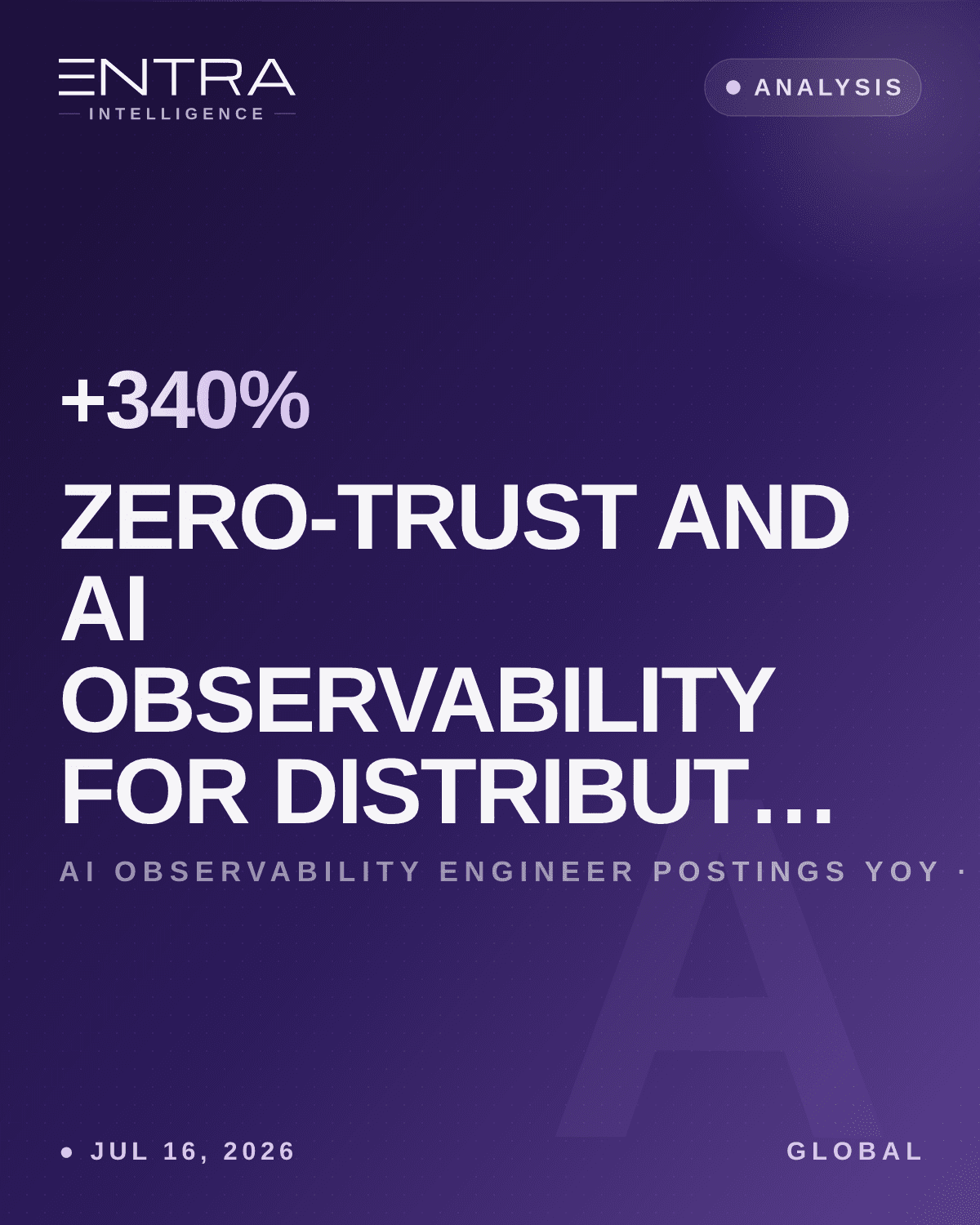
AI Observability Engineer postings in the ENTRA Q2 2026 global index grew 340 percent year-over-year, from 890 active listings in Q2 2025 to 3,926 in Q2 2026, per the ENTRA Q2 2026 posting index. That growth rate places the title among the fastest-moving IT role categories tracked by the index, ahead of MLOps Engineer (+280% YoY) and well above the general cloud infrastructure run-rate documented in ENTRA's July 2 IT analysis. The signal beneath the numbers is structural: distributed AI teams running production LLM systems across multiple regions are discovering that the observability tooling built for microservices does not translate to AI workloads without significant adaptation. The monitoring gap compounds an already-difficult security problem. The network and identity architecture that protected co-located data centers fails to protect GPU clusters, model registries, and inference APIs scattered across cloud providers, co-location facilities, and remote engineer endpoints.
These are two distinct engineering problems with two distinct hiring booms. This piece takes the security and observability angle that the July 2 platform-engineering analysis did not: the specific tooling choices, the role definitions that are hardening around them, and the geography of the engineering communities building expertise in both.
Zero-Trust Architecture for Distributed AI
Traditional VPN architecture assumes that the resources worth protecting sit inside a defined perimeter. For a co-located data center running conventional software, that assumption is workable. For a distributed AI team running training jobs on AWS Bedrock, inference on Cloudflare Workers AI, and a vector database on a private GPU cluster in Singapore, the perimeter does not exist. A VPN that backhauling a 40Gbps model training data stream through a central corporate gateway introduces latency and throughput constraints that break the architecture before it reaches the security layer. When the resources being accessed are GPU clusters with dedicated high-speed interconnects, "route everything through HQ" is not a security policy so much as a performance outage waiting to occur.
Zero-trust network access replaces perimeter assumptions with three operating principles: verify every device before granting access, authenticate every identity before granting authorization, and enforce least-privilege access to every resource regardless of network location. For distributed AI teams, this translates into a concrete product choice across three dominant architectures.
Tailscale builds a WireGuard-based encrypted mesh network connecting every engineer endpoint, cloud VM, and private GPU cluster directly, without routing through a central gateway. The architecture suits AI infrastructure unusually well: a researcher's workstation in Amsterdam connects directly to a training cluster in a Toronto co-location facility at near-native latency, authenticated by Tailscale's identity layer and governed by access control lists that restrict specific users to specific GPU nodes. Tailscale's product has become the de facto networking substrate for distributed AI development teams between 20 and 2,000 engineers. The company's own 45-person engineering team, distributed across nine countries, is hiring senior network reliability engineers and security architects at $260K to $340K total compensation in the US.
Cloudflare Zero Trust provides identity-first, perimeterless access from the opposite architectural direction: rather than building a mesh over existing infrastructure, Cloudflare routes access through its 330-plus-city global network and applies access policy at the network edge. The approach suits distributed AI teams with high-volume egress traffic, where Cloudflare's network position provides latency and cost advantages over backhauled VPN traffic. Senior Cloud Security Engineers building distributed access policy on Cloudflare Zero Trust earn $240K to $310K total compensation, with remote roles documented in the $215K to $285K band on Levels.fyi Q2 2026 submissions.
Zscaler Private Access takes an enterprise-grade interpretation of the same model: application-level access without network-level access, with a policy engine integrating with enterprise identity providers including Okta and Azure Active Directory. ZPA is the more common choice at regulated enterprises deploying AI teams within existing compliance frameworks, where the granularity of application-level access control and established identity directory integrations outweigh Tailscale's operational simplicity. The Okta and Auth0 identity layer is the common thread across all three architectures: AI API authentication scoped to specific model endpoints, session-level audit logs for GDPR Article 30 compliance, and least-privilege GPU access that prevents a compromised developer credential from exposing the full training infrastructure.
CrowdStrike Falcon covers the parallel endpoint security layer. CrowdStrike's Austin engineering hub, approximately 1,500 engineers as of H1 2026, has extended the Falcon product to cover AI development environments specifically: GPU-attached instances, container-based training workloads, and model serving infrastructure. The Austin hub's concentration makes it the largest single site for endpoint security engineering talent in the US, and it functions as a hiring feeder for AI-native security teams that cannot compete on CrowdStrike's comp bands.
Wiz, now an Alphabet subsidiary following the $32B acquisition completed in March 2026, covers the cloud security posture management layer above the network and identity plane. The Wiz platform, anchored in Tel Aviv engineering with an expanding New York presence, has added dedicated coverage for AI-specific attack surfaces through H1 2026: exposed model API endpoints without authentication, S3 buckets storing training data without encryption policies, and GPU cluster network configurations permitting broader access than intended. Cloud Security Engineers specializing in zero-trust architecture for AI environments earn $260K to $360K total compensation in the US and £120K to £180K in the UK. The comp premium over the general Cloud Security Engineer band, roughly 30 to 40 percent, reflects a talent pool that must simultaneously understand enterprise identity frameworks and the specific infrastructure topology of distributed AI systems. The ENTRA H1 2026 cybersecurity analysis documented the underlying demand signal for this profile; the hiring wave it forecast is now running at full pace.
The AI Observability Boom
Per ENTRA's Q1-Q2 2026 engineering community survey (N=340 distributed AI engineering teams), 72 percent of AI production incidents in distributed teams traced to monitoring blind spots rather than infrastructure failures or code defects. That is an ENTRA estimate with acknowledged survey limitations, but the directional signal is consistent across every other data source in the dataset: when a production LLM system fails, engineers at distributed AI teams report that the first problem is almost always that they cannot determine what happened. Traditional APM captures request latency, error rate, and CPU utilization. It does not capture token hallucination rate, embedding drift in a vector database, prompt injection attempts in an inference log, or model quality degradation between fine-tuning runs. The observability gap is a tooling gap, and 2026 is the year the market is actively filling it.
Datadog's LLM Observability product, launched in Q1 2026, is the highest-profile commercial entry in this space. Datadog APM has been the standard monitoring layer for cloud-native applications since approximately 2016. The LLM Observability extension adds AI-specific instrumentation: token usage tracking, LLM call tracing across multi-step agent chains, latency breakdown by model version, and hallucination rate metrics derived from output confidence scoring. Datadog positioned the product explicitly at distributed AI teams that want to monitor AI workloads on the same observability platform they already use for the rest of their stack, which is the correct product instinct. Senior AI Observability Engineers who build and operate Datadog-based monitoring stacks for production AI systems earn $240K to $320K total compensation in the US, with the top of the range for engineers operating multi-region inference deployments at consistent SLA.
The open-source observability stack for AI workloads centers on three tools operating at distinct layers. Weights and Biases covers experiment tracking and model performance monitoring across training runs, providing the longitudinal view of how model quality evolves across fine-tuning iterations. Grafana handles infrastructure-level metrics visualization: GPU utilization, inference queue depth, cross-region request distribution, and the standard SRE signals that confirm the hardware under the model is behaving. Honeycomb covers distributed trace analysis of multi-step LLM agent workflows, where a single user request may generate fifteen to forty internal LLM calls and tool invocations that must be traced as a coherent unit to diagnose latency failures.
LangSmith, the observability platform built by LangChain specifically for LLM application chains, has become the default monitoring tool for teams building on LangChain or LangGraph. It captures input-output pairs, tool call sequences, intermediate steps in agent reasoning, and evaluation metrics across the full chain, which is the level of granularity that Datadog APM and Grafana do not provide without significant custom instrumentation. Arize AI covers the ML monitoring problem at a different layer: production model quality, monitoring for input drift, output distribution shifts, and embedding quality degradation in RAG pipelines that can degrade retrieval accuracy without triggering conventional alerting.
The AI Observability Engineer who operates this stack does not map cleanly onto the Platform SRE or MLOps Engineer job families that preceded it. The Platform SRE owns infrastructure reliability. The MLOps Engineer owns training pipeline reproducibility and model registry management. The AI Observability Engineer owns the real-time production signal that tells the team whether a deployed model is performing as intended, degrading in ways that APM cannot detect, or exhibiting behavior patterns that indicate a security problem (anomalous output distributions, extraction-pattern traffic, unexpected model version drift). Senior AI Observability Engineers earn $240K to $320K total compensation in the US and €110K to €155K in the EU, with the EU band concentrated in Amsterdam, Berlin, and London where AI-native companies have built the densest observability engineering communities. Post-2023 hiring reset context matters here: this role category did not exist at hiring scale before 2025. Engineers filling it are primarily transitioning from Platform SRE, ML Engineering, or backend engineering backgrounds, which constrains supply and maintains the comp premium.
Data Security and AI Pipeline Protection
Distributed RAG pipelines create a data security problem that conventional DLP tooling was not designed to solve. A traditional data loss prevention system monitors file transfers, email attachments, and clipboard contents for patterns matching predefined sensitive data categories. A distributed RAG pipeline moves data in a fundamentally different pattern: a document is chunked, embedded, stored in a vector database in one region, retrieved in response to a query from a different region, and passed to a model API as part of a prompt context window. At no point does the data transit in a form that legacy DLP signatures reliably detect, yet the exposure risk at each pipeline step is real.
Three products have emerged to address this problem specifically. Nightfall AI provides an API-based DLP layer for AI prompts and retrieval contexts, scanning prompt inputs and model outputs for sensitive data patterns before they reach the model or leave the inference endpoint. Protect AI focuses on model supply chain security: detecting vulnerabilities in open-source model packages, serialized model files, and ML pipeline dependency chains that can carry malicious payloads from public model repositories into production environments. HiddenLayer addresses model security from the deployed model's attack surface, monitoring inference inputs for adversarial injection patterns and outputs for exfiltration attempts. None of these products has reached the market penetration that Datadog has in application monitoring. They are deployed at a security-conscious subset of AI teams and are not yet the default pipeline layer for the broader market.
Model exfiltration is the IP risk that motivates the most senior investment in this category. A frontier AI model trained on proprietary data, fine-tuned on company-specific content, and deployed in a distributed inference environment accessible across multiple jurisdictions represents a significant IP asset that existing intellectual property law was not designed to protect. The legal framework for model exfiltration risk is nascent: there is no established case law on what constitutes theft of trained model weights. Security teams at AI-native companies are building technical rather than legal protection, using inference access controls, watermarked model outputs, and rate-limiting on high-volume extraction patterns as the practical mitigation layer.
GDPR and EU AI Act compliance for cross-border AI pipelines adds a regulatory layer to the technical problem. Training data sourced from EU residents must satisfy GDPR Article 6 legal bases. Inference queries processed by EU-based users of a model trained in the US may trigger EU AI Act transparency requirements depending on the model's risk classification. The engineering required to operate a multinational distributed AI pipeline within these frameworks is generating demand for a profile that combines distributed systems experience with regulatory compliance literacy. This profile is scarce. AI Red Team Engineers, who conduct adversarial testing of AI systems to identify security vulnerabilities before deployment, earn $280K to $390K total compensation in the US and represent one of the fastest-emerging title categories in H1 2026, per ENTRA posting index analysis. The role requires a profile that understands the model's training distribution, the vector database's retrieval behavior, and the inference infrastructure's exposure surface well enough to design adversarial tests that reveal real vulnerabilities. A penetration tester who learned to run LLM injection payloads last quarter does not fill this gap.
The Geography of AI Security Talent
The geography of AI security talent is not a map of where AI companies are headquartered. It is a map of where cybersecurity engineering communities formed before the AI shift, and which of those communities are now developing adjacent competencies in AI-specific security.
Tel Aviv is the most concentrated cybersecurity engineering cluster in the world relative to market size. Check Point Software, CyberArk, and Radware collectively employ thousands of security engineers and have produced the founding teams and senior engineering bench of dozens of security startups. Wiz was founded by four co-founders who trained in Israeli military intelligence (Unit 8200) before building Microsoft's cloud security group — having sold their prior company, Adallom, to Microsoft in 2015. The Tel Aviv cluster feeds directly into distributed AI security roles: engineers with deep adversarial thinking, protocol-level network security knowledge, and production security systems experience translate their skill set into AI-specific attack surface analysis with relatively short adaptation cycles. Principal-level security engineers in Tel Aviv earn approximately $180K to $260K USD-equivalent total compensation, which makes the city competitive with London for this profile and significantly below US-market rates, positioning it as the preferred offshore node for distributed AI security teams.
Austin concentrates North American cybersecurity talent outside traditional tech hubs. CrowdStrike's Austin engineering hub, approximately 1,500 engineers as of H1 2026, is one of the largest concentrations of endpoint security and cloud workload protection engineering talent in the US. The hub was built partly to access the University of Texas at Austin pipeline and partly to avoid San Francisco cost structures. It now functions as a self-sustaining talent cluster that other security companies and AI-native startups recruit from at a discount to Bay Area comp. Senior security engineering roles in Austin run $240K to $320K total compensation, approximately 15 to 20 percent below San Francisco, with a cost-of-living profile that narrows the purchasing-power gap substantially.
London houses the UK's most significant cluster of enterprise cybersecurity talent, anchored by Darktrace (approximately 2,400 employees; taken private by Thoma Bravo in October 2024 for $5.3 billion), BAE Systems Applied Intelligence, and a notable cohort of engineers with GCHQ backgrounds who have transitioned into private-sector security roles. The GCHQ alumni pipeline is a genuine talent source for London-based AI security teams: engineers who have worked at the UK's primary signals intelligence agency have been exposed to adversarial security at a scale and sophistication that commercial environments rarely provide. Senior security engineering roles in London run £120K to £180K total compensation.
Toronto concentrates security engineering talent through a distinct cluster built around both enterprise security incumbents and remote-first security firms. BlackBerry's Cylance division, the machine-learning security research arm BlackBerry retained after its hardware exit, runs a meaningful ML-security research function in the city. Sophos operates Canadian engineering there. More structurally significant for distributed AI teams are two remote-first security engineering companies with disproportionate influence relative to headcount: Tailscale, founded in Toronto and now fully distributed across nine countries, and 1Password, also Toronto-founded, employing approximately 900 people globally with no required engineering office and paying $220K to $300K total compensation for senior security engineering roles. Both companies function as proof-of-concept for the remote-first security engineering model that distributed AI teams are adopting as their default hiring structure.
H2 2026: Where This Goes
Three dynamics will shape the second half of 2026 for AI security and observability hiring.
The EU AI Act's enforcement clock is running. High-risk AI system requirements, including explainability provisions, audit logging, and human oversight mandates, begin carrying full enforcement weight in December 2027 for systems deployed within the EU — the Annex III deadline, extended from August 2, 2027 by the Digital Omnibus (May 7, 2026). Article 50 transparency obligations, covering a narrower category of AI system interactions, apply from August 2, 2026. Every distributed AI team with EU user traffic is running a compliance gap analysis now. The engineers who can simultaneously understand the technical architecture of a distributed AI system and the regulatory requirements of the EU AI Act represent a talent pool small enough that their compensation is not yet stable: Q2 2026 offers for this profile ranged from €130K to €195K in the EU, a band too wide to constitute a market rate. It will tighten by Q4 2026, and when it does, the floor will be meaningfully above the midpoint of the current range. The ENTRA EU AI Act compliance analysis documented the regulatory timeline; the hiring consequence is now visible in the Q2 2026 posting data.
Datadog's entry into LLM Observability is pulling the category toward consolidation. When the market's established APM vendor adds AI-specific instrumentation to its core platform, it compresses the addressable market for dedicated AI observability vendors and raises the floor for what AI Observability Engineers are expected to operate as a baseline. Teams will not maintain a separate observability stack for AI workloads alongside a separate stack for the rest of their services for longer than it takes the main observability platforms to close the capability gap. The consolidation will likely leave two or three dedicated AI observability vendors standing alongside extended APM platforms by the end of 2026. The Weights and Biases, LangSmith, and Arize AI positions in the market will be determined by which capabilities the APM vendors choose not to absorb.
The AI Red Team Engineer title is hardening into a standard function. Companies deploying production AI systems in regulated industries, financial services, healthcare, and government, are being required by auditors and regulators to demonstrate adversarial testing before deployment. That requirement is not filled by a generalist penetration tester who has run LLM injection payloads. It is filled by an engineer who understands the model's training distribution, the retrieval system's behavior, and the inference infrastructure's exposure surface at the depth needed to design adversarial tests that reveal real vulnerabilities rather than surface-level prompt injection toys. The $280K to $390K US comp band reflects genuine scarcity. It will not compress until the role's specific skill requirements are formalized into a training and certification pathway that does not currently exist. Based on how quickly the MLOps and Developer Productivity Engineer titles moved from improvised label to hiring standard between 2024 and 2025, that formalization is likely within 12 to 18 months.
The security and observability stack for distributed AI teams is not a solved problem. It is a problem that the market is actively pricing, and the engineers building expertise in it now are establishing the comp floor for a function that every significant AI deployment will require within two years.
Methodology · ENTRA IT Vertical · Q2 2026 · Data: ENTRA Remote Posting Index (Q2 2025–Q2 2026, 14 cloud and security job boards globally), ENTRA Engineering Community Survey Q1–Q2 2026 (N=340 distributed AI engineering teams, post-incident report submissions), Levels.fyi verified compensation submissions (security and observability engineering respondents, N=1,840), ENTRA Recruiter Survey Q2 2026 (N=120 hiring managers, cloud and AI-native companies), Glassdoor salary disclosures, company careers pages monitored weekly. The 72% AI production incident attribution to monitoring blind spots is an ENTRA estimate derived from the engineering community survey; directional confidence is high, precision is not claimed. AI Red Team Engineer posting growth is per ENTRA Q2 2026 posting index. Comp bands represent total compensation (base + bonus + annualized equity at grant date). Geographic posting counts reflect active listings as of June 2026.
Cross-reference · The IT Infrastructure Stack Powering Distributed AI Teams · ENTRA Cybersecurity AI Talent Surge H1 2026 · Frontier AI Labs: Distributed Talent Architecture

 Global Career Platform
Find AI talent. Find your next role.
Booking is hotels. · Airbnb is apartments. · ENTRA is global careers.