
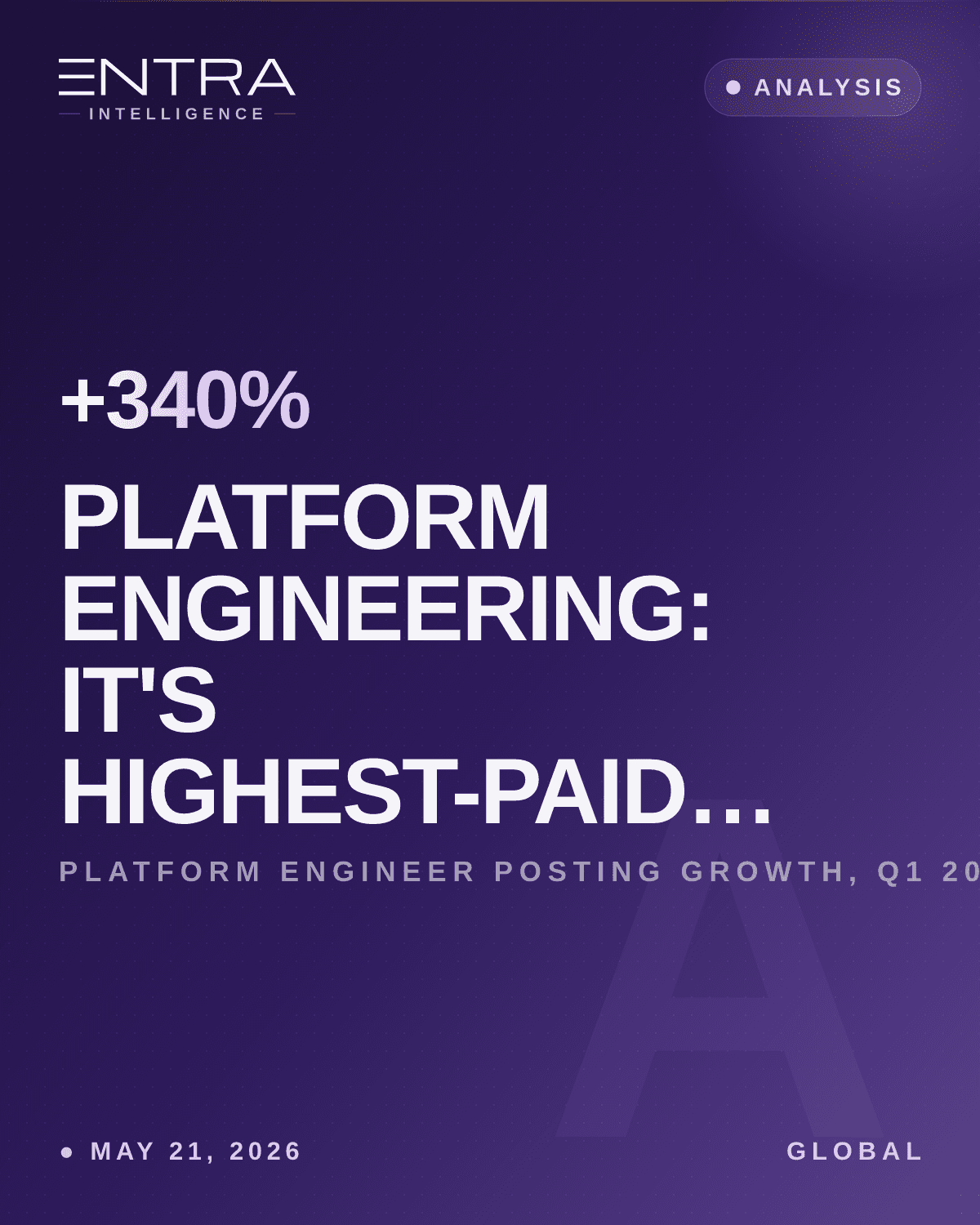
The ENTRA platform now indexes 8,400-plus active Platform Engineer job postings globally — up 340 percent from Q1 2024. New-grad median total compensation in San Francisco sits at $175K–$195K per Levels.fyi Q1 2026 data, above both traditional DevOps ($145K–$165K) and junior backend engineering ($155K–$175K), and within range of junior ML engineering at $185K–$220K. The role that barely registered as a distinct title four years ago has become the IT vertical's most competitively compensated graduate entry point — and the supply constraint driving that premium is structural, not cyclical. No major bootcamp offers a dedicated track. No four-year CS program has built a curriculum around it. The comp premium is the market's price signal for a scarcity it has not yet found a way to manufacture.
This is not an AI story. Platform engineering is the infrastructure layer that AI runs on — the internal developer platform that production ML systems depend on as much as any other application workload. But the role's ascent is not derivative of the AI hiring boom. It predates it, it has its own demand drivers, and it has its own comp ladder. That distinction matters for how the Class of 2026 should read the opportunity.
DevOps vs Platform Engineering: Why the Titles Diverged and the Pay Followed
"Platform Engineer" entered IT hiring as a coherent, distinct title somewhere between 2022 and 2023, separating infrastructure ownership from application development in a way that the DevOps title had always blurred. The conceptual framework arrived first: Matthew Skelton and Manuel Pais's Team Topologies (2019) defined the "platform team" as the group that provides a "paved road" — an internal developer platform (IDP) on which other engineering teams build, with minimal cognitive overhead. The implementation followed when Spotify open-sourced Backstage.io, its internal developer portal, in 2020. Backstage gave organisations a concrete artefact to build toward, and the role of building and maintaining it acquired a name.
The distinction from DevOps is not cosmetic. A DevOps engineer's primary customer is the production system — uptime, deployment frequency, mean time to recovery. A platform engineer's primary customer is the internal developer: the application engineer who needs a Kubernetes namespace, a CI/CD template, a cost dashboard, or a service catalog entry and should be able to get any of those things without filing a ticket. The platform engineer builds the tooling. The DevOps engineer runs the infrastructure. Both roles are necessary. They are not the same role on a progression ladder, and the comp data has begun to reflect that.
Post-2023, as companies completed the most aggressive engineering headcount reductions since the dot-com contraction, the survivors of IT organisation restructuring were disproportionately platform teams. The logic was economic: a well-built internal developer platform multiplies the output of every remaining engineer by reducing the infrastructure friction they absorb. Shopify, Stripe, and Airbnb each publicly reduced overall engineering headcount through 2023–2024, and each publicly maintained or expanded platform engineering investment through the same period. The post-RIF engineering organisation at Series D-and-above SaaS companies is structurally smaller and more platform-dependent than its pre-2023 predecessor, and that dependency is what the 340 percent posting surge is measuring.
Platform Engineer Salary 2026: What FAANG, Stripe, and Shopify Are Actually Paying
The Q1 2026 compensation picture for platform engineering is specific enough to be actionable.
At the new-grad level in San Francisco, platform engineers earning $175K–$195K total compensation are outpacing their peer cohort on every adjacent track outside ML engineering. The relevant comparisons, per Levels.fyi Q1 2026: traditional DevOps engineers at $145K–$165K median new-grad total comp; QA/SDET roles at $120K–$140K; junior backend engineers at $155K–$175K. The premium over DevOps — the closest adjacent title — runs 18–25 percent at the new-grad band. That gap is what the product-thinking distinction is pricing.
At FAANG-tier, the bands are sharper. Google's Site Reliability Engineering new-grad total comp runs $185K–$210K. Meta Infrastructure Engineering new-grad: $190K–$215K. The Amazon EKS team — which occupies a platform-engineering function inside AWS's internal tooling organisation — posts new-grad total comp at $175K–$195K, aligned with the market median for the title. These figures are not coincidental convergences. FAANG-tier SRE and infrastructure engineering functions have adopted the platform engineering mental model regardless of the title they use for it, and the comp bands reflect a shared calibration that the title confusion does not.
Outside San Francisco, the market is developing but not nascent. London platform engineer new-grad total comp sits at £75K–£95K per Glassdoor Q1 2026 data, above UK DevOps new-grad by roughly 25 percent — a premium ratio consistent with the US market. Berlin entry-level platform engineer compensation runs €75K–€95K; Amsterdam runs €80K–€100K. The EU differential reflects both cost-of-living adjustment and a smaller base of certified cloud-native candidates in European hiring pools. The premium ratio, however, is stable across markets: platform engineering commands 20–25 percent above DevOps new-grad regardless of geography, which suggests the driver is skill scarcity rather than market-specific demand dynamics.
By employer volume of Platform Engineer postings in Q1 2026, the leading hires are Shopify, Stripe, Airbnb, Coinbase, Figma, Databricks, Snowflake, HashiCorp (now IBM), and Grafana Labs. That list is not dominated by hyperscalers. It is dominated by product companies at the Series F-to-public stage that have grown engineering organisations complex enough to require a dedicated platform function, and that have the revenue base to pay for it at market rates. Databricks and Snowflake are the two data-infrastructure employers on the list where the platform engineering function directly supports AI/ML workloads — a Databricks platform engineer working on internal cluster provisioning and notebook runtime management is closer to the AI infrastructure conversation than most titles in IT. But the title and ladder are still IT, not AI, and the comp reflects IT infrastructure market rates rather than ML engineering bands.
Cloud Native Skills 2026: Kubernetes, Terraform, eBPF, and What Earns the Premium
The ENTRA job-posting index across 8,400 Platform Engineer listings in Q1 2026 produces a clear skill frequency ranking, and the premium data attached to specific skills is more actionable than the median comp figure alone.
Terraform and its open-source fork OpenTofu appear as the number-one listed requirement at 62 percent of postings. Infrastructure-as-code proficiency is, at this point, the baseline for entry into the field — not a differentiator, a threshold. Candidates without demonstrated Terraform experience are below the application floor at most Shopify, Stripe, or Databricks-tier postings, full stop.
Kubernetes — specifically CKAD (Certified Kubernetes Application Developer) and CKA (Certified Kubernetes Administrator) certification — commands a documented premium beyond the baseline. Per ENTRA salary survey data, CKAD-plus-CKA certified candidates at the entry level command 18–22 percent above non-certified peers with comparable experience. The Cloud Native Computing Foundation administers both exams at $445 each (as of early 2025); the CKA is the heavier lift and the one posting language specifically references when the requirement appears. The premium is large enough that the $890 combined exam cost recovers in the first month of a platform-engineering offer versus a DevOps offer at the same company.
The observability stack — Grafana, Prometheus, and OpenTelemetry — appears in 45 percent of postings and is the second-tier differentiator after Kubernetes. Candidates who can demonstrate production-grade OpenTelemetry instrumentation across a multi-service architecture are not common at the entry level; the tooling is recent enough that most university instruction does not cover it. The CNCF's OpenTelemetry documentation is the primary self-study resource, and the candidates who have built a public project instrumenting a personal or open-source application with OTEL are differentiated at screening.
The eBPF frontier is where the premium compression is steepest and the supply scarcest. Linux kernel observability via eBPF — implemented through Cilium for Kubernetes networking, Tetragon for security observability, and custom tooling for performance profiling — is the highest-premium emerging skill in platform engineering, commanding $15K–$25K premiums over comparable non-eBPF experience at entry. The demand driver is specific: AI infrastructure at scale generates GPU workload observability requirements that traditional user-space monitoring cannot satisfy at production latency, and eBPF-based tooling is the industry's current answer. Candidates with demonstrable eBPF project work — a public GitHub repository with a working Cilium cluster policy, a Tetragon trace pipeline, or a custom kprobe program — are outperforming their certified-but-not-eBPF peers at offer stage at Databricks, Stripe, and Cloudflare in Q1 2026 per ENTRA reporting.
The product-thinking requirement is the hardest to certify and the most directly responsible for the DevOps premium. Building an internal developer platform means designing for a user — the internal developer — whose frustration is invisible to production metrics but visible in adoption rates, ticket volume, and developer satisfaction surveys. Platform engineers who can articulate DX (developer experience) principles, who have shipped a feature to an internal audience and measured adoption, and who can write an RFC that accounts for the developer workflow they are changing are compensated above peers who treat the platform as pure infrastructure. This is the skill the bootcamp gap cannot close by adding a Kubernetes module.
How to Become a Platform Engineer in 2026: The Class of 2026 Entry Path
The supply constraint driving the comp premium starts with a curriculum gap. No major US four-year computer science program offers a dedicated platform engineering track. The closest analogs — systems programming courses, distributed systems electives, cloud architecture capstones — exist at Stanford, Carnegie Mellon, and MIT, but none produce a graduate with the specific Kubernetes-plus-Terraform-plus-IDP-design skill set that the 8,400 postings require. The curriculum problem is structural: the field is too new, the tooling changes too fast, and the CNCF landscape has evolved faster than accreditation cycles allow university programs to follow.
The bootcamp market has not filled the gap. None of the major bootcamp operators — Lambda School's successor BloomTech, Codecademy Career Paths, General Assembly — offer a dedicated platform engineering track. DevOps modules exist in some programs; Kubernetes is sometimes mentioned. The IDP design and product-thinking components that separate platform engineering from DevOps-with-a-new-name are absent. The supply constraint is not a curriculum problem the private education market is close to solving.
The documented entry path for the Class of 2026 runs through practical certification and portfolio construction, not degree differentiation. The CNCF's CKA exam at $395 is the most legible entry credential. Kelsey Hightower's "Kubernetes the Hard Way" — a publicly available, zero-abstraction walkthrough of building a Kubernetes cluster from component parts — is the documented on-ramp that hiring managers at Shopify and Stripe reference when describing what a strong self-taught candidate looks like. The CNCF LFX Mentorship Program, which runs fully funded three-month mentorships on active CNCF open-source projects including Kubernetes, Cilium, OpenTelemetry, and Argo, has produced a documented pipeline of entry-level platform engineers whose mentorship contributions are visible in public commit histories.
The internship pattern for 2026 new-grad platform engineers is consistent across ENTRA's tracking: a SWE or DevOps internship at a Series B-to-D SaaS company where platform work existed but was not titled, followed by a platform-titled first role at a Series D-to-F or public company. The key observation is that Series B and C companies rarely post Platform Engineer roles — they do platform work inside DevOps or SRE functions. The candidate who recognises the platform engineering work inside a DevOps internship, builds the vocabulary around it, and positions the experience against CKA certification has the profile that Series D-and-above employers are hiring.
The most direct new-grad bypass of the traditional DevOps-to-platform progression: a four-year CS graduate with AWS Solutions Architect Associate plus CKA plus a public GitHub portfolio containing IDP tooling — a self-built Backstage plugin, a Terraform module registry, an OpenTelemetry-instrumented demo environment — is entering platform engineering directly at Series D-and-above companies at $175K–$195K total comp in SF, skipping the DevOps ladder entirely. The portfolio requirement is not aspirational; it is operational. Screening for candidates without public infrastructure work has become standard practice at Shopify, Figma, and Grafana Labs per ENTRA reporting.
Platform Engineering Jobs Outlook 2027–2028: Where the Supply Constraint Goes Next
The 340 percent posting growth from Q1 2024 to Q1 2026 is not a peak. It is a demand curve that is still early. The companies posting Platform Engineer roles at volume now are the Series D-and-above organisations that crossed the internal complexity threshold that makes a dedicated platform function economically necessary. The Series B and C cohort that is now crossing that threshold will post the next wave of roles in 2027–2028, with a similar lag between when the need becomes acute and when the title formalises.
The supply side will not self-correct through university curriculum. The CNCF certification path — CKA, CKAD, Certified Kubernetes Security Specialist — is the closest thing to a standardised entry credential the field has, and its uptake is growing but not at 340 percent annually. The eBPF skill gap in particular will persist: the tooling is kernel-adjacent, the mental model requires genuine systems programming foundation, and the market for senior eBPF engineers already runs $15K–$25K above the platform engineering baseline. Junior eBPF practitioners are not graduating from anywhere in volume.
For the Class of 2026 reading this on a weekday commute, the arithmetic is unambiguous. The comp premium over DevOps is 20–25 percent. The certification cost to make that premium legible to a hiring manager is under $1,000 (CKA at $445, with one free retake included). The open-source contribution path — CNCF LFX Mentorship, active Kubernetes or Cilium GitHub participation — is free and produces public evidence of platform engineering aptitude that no bootcamp certificate can replicate. The infrastructure that AI runs on needs people who understand Kubernetes networking, who can write a Terraform provider, who think about developer experience as a product problem. The market is paying for that combination at $175K–$195K new-grad median in San Francisco, above the junior backend band, within reach of junior ML engineering. That gap does not close until the supply side catches up — and the supply side is not close.
Sources: Levels.fyi Platform Engineer Salaries Q1 2026 | CNCF CKA Certification | Kelsey Hightower — Kubernetes the Hard Way | CNCF LFX Mentorship Program | Backstage.io — Spotify Open Source | Team Topologies — Skelton and Pais (2019) | Glassdoor UK Platform Engineer Salaries Q1 2026 | ENTRA Platform Engineer Job Posting Index Q1 2026 (8,400+ global postings) | ENTRA Salary Survey Q1 2026 | Per ENTRA reporting (compensation figures marked where primary source is not public)