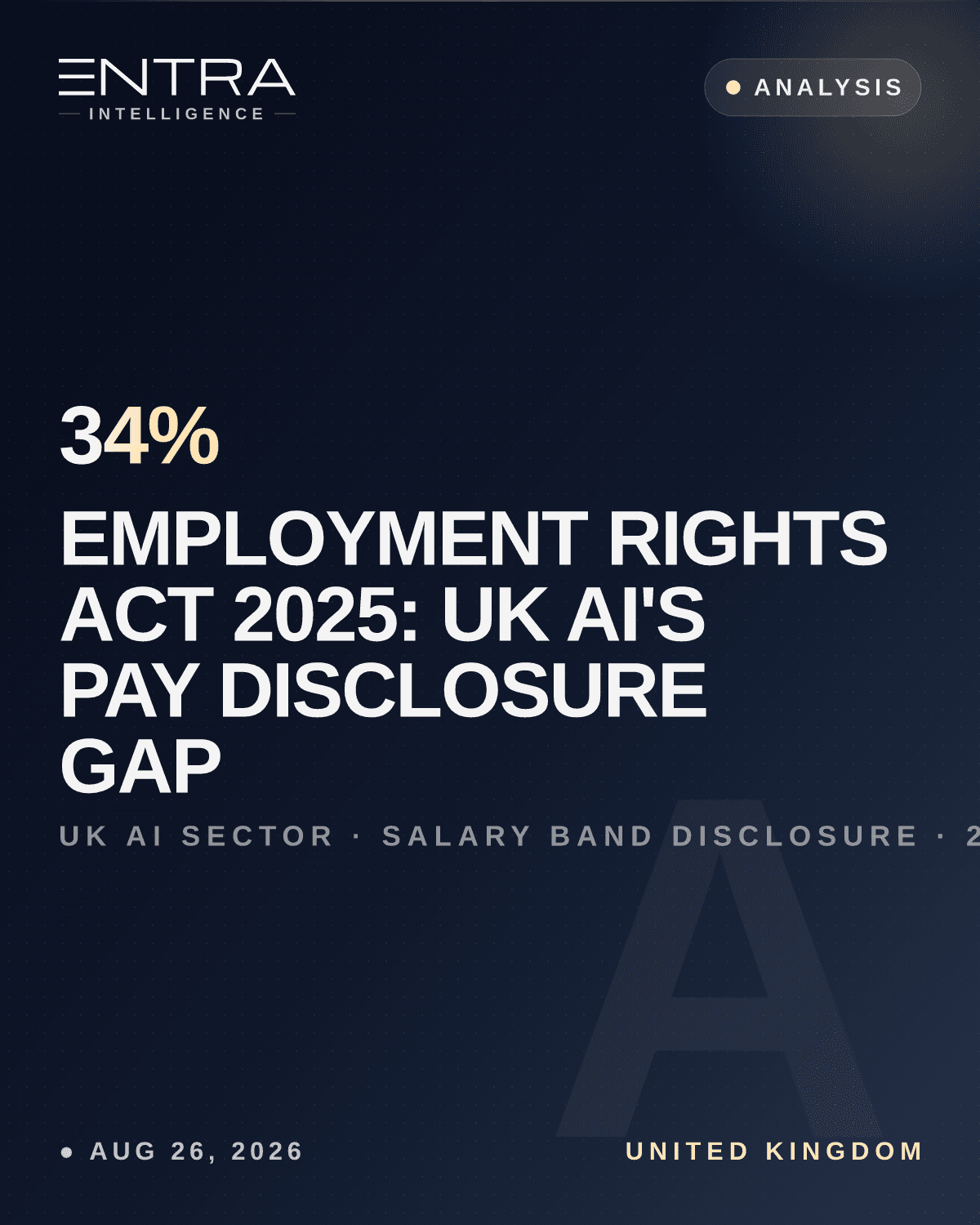
On August 11, ENTRA published its Top 20 Countries Pay Transparency Ranking, placing the United Kingdom at 87 out of 100, the highest score globally, ahead of the United States (74), Germany (71), and France (68). The score reflects the Employment Rights Act 2025, which received Royal Assent on December 18, 2025 and introduced, among other provisions, a mandatory equality action plan requirement for employers with 250 or more employees, effective from April 2027. By the metrics ENTRA's ranking methodology uses (the existence of statutory pay equity frameworks, reporting obligations, and disclosure requirements), the UK scores well. By the metric that determines whether an AI researcher can see a salary figure when they open a job posting in 2026, the UK scores 34%.
That 34% figure comes from ENTRA's Q2 2026 UK Pay Transparency Monitor (n=2,140 UK AI job postings reviewed between April and June 2026). It measures one thing: the percentage of UK AI job postings that include any stated salary range or pay band. The UK's top 10 AI employers average 47% on this measure. The bottom 10 average 12%. Globally, the UK's number-one regulatory ranking and its 34% voluntary market rate together define the most precisely documented gap in ENTRA's dataset: a country with a world-leading statutory framework and below-peer market disclosure behaviour. Understanding that gap requires understanding what the Employment Rights Act 2025 actually does, and what it deliberately does not do.
The regulatory architecture
The Employment Rights Act 2025 is substantive legislation. Its provisions span flexible working rights from day one, zero-hours contract restrictions, fire-and-rehire prohibitions, and the equality action plan requirement. On pay transparency specifically, the equality action plan obligation requires employers with 250 or more employees to publish a gender pay gap (GPG) action plan alongside their annual GPG report. It activates in April 2027, layered on top of the existing GPG reporting requirement that has applied since 2017.
What the Act does not contain is a salary posting mandate. It does not require employers to include salary ranges in job advertisements. It does not require employers to disclose pay bands by role or grade level. It does not establish a right for candidates to request pay information before accepting an offer. The equality action plan is a narrative document describing what actions an employer intends to take to close its gender pay gap. It is not a structured disclosure of numeric compensation data by role. The Act's contribution to salary transparency is therefore best understood as a framework upgrade to pay equity reporting, not a salary disclosure law.
The adjacent withdrawal matters equally. The Financial Conduct Authority and the Prudential Regulation Authority had proposed, under CP23/20, extended diversity and inclusion reporting requirements that would have added ethnicity pay gap and disability pay gap reporting for regulated financial services firms. Those proposals were withdrawn in March 2025, before the Employment Rights Act completed its passage. For the UK's AI-active financial services employers, including Revolut, Wise, Monzo, and JPMorgan's UK AI division, the withdrawal means ethnicity and disability pay gap data remains voluntary, with no enforcement architecture attached. The FCA's retreat from CP23/20 is the most visible example of how regulatory ambition in one area can be cancelled by institutional caution in another.
The UK's 87/100 ENTRA score, then, reflects a system that has built the reporting infrastructure without constructing the salary disclosure infrastructure. The 34% reflects a market that discloses when it chooses to, not when it is required to.
Anatomy of the 34%
Three categories of employer drive UK AI salary band disclosure, and none of them are primarily motivated by UK law.
The first category is US-headquartered firms subject to US state disclosure obligations. Colorado (EPEWA, 2021), California (SB 1162, effective 2023), and New York (Labor Law §194-b, effective 2023) each require salary range disclosure in job postings, and each state's law can apply to postings for roles that could be performed remotely by a resident of that state. When a UK AI company posts a research scientist role in London that might attract US-resident candidates through its US parent's applicant tracking system, the posting may carry salary ranges inserted for US compliance purposes, not UK compliance purposes. Strip out US-headquartered subsidiaries and the voluntary UK disclosure rate falls materially from 34%. The UK's headline figure is, in structural terms, partially a consequence of California and Colorado law.
The second category is EU-headquartered firms with Directive spillover. The EU Pay Transparency Directive (2023/970/EU) requires transposition into national law, with the lead-compliant states already operational. For companies that employ staff across both EU member states and the UK, maintaining a uniform disclosure standard across European hiring systems is operationally simpler than running UK-specific non-disclosure alongside EU-mandated disclosure. This category is small in the UK AI market, where the dominant employers are US- or UK-headquartered, but it will grow as EU transposition accelerates.
The third category is UK-native employers posting voluntarily, primarily for talent acquisition reasons. Monzo, BenevolentAI, and a cohort of Series B-to-D UK AI companies post salary bands because their candidate pools have come to expect it. In a market running a senior-level demand-to-supply ratio of approximately 2.8-to-1, withholding salary information early in the hiring process is a self-imposed friction cost that reduces conversion rates. These employers are transparent not because the law requires it, but because opacity is commercially expensive.
The 34% aggregate is, therefore, an overlapping slice of three voluntary and semi-voluntary behaviours, none of which derives from a UK statutory mandate to post salary ranges.
Employer-by-employer analysis
ARM Holdings posts salary bands for its US-listed roles with reasonable consistency, a consequence of its NASDAQ listing and associated exposure to US state disclosure requirements. Its UK-only principal and staff engineering roles, benchmarked at £110K-£185K base (~$140K-$235K at GBP/USD 1.27), show materially lower disclosure rates. ENTRA's Q2 2026 monitoring records ARM's mean GPG at 28%, the widest in this dataset. ARM's Cambridge headquarters gives it access to one of the deepest ML and chip design talent pipelines in Europe. Whether its disclosure trajectory improves under April 2027 equality action plan pressure will be an early test of the Act's practical reach.
Google DeepMind London reports a 22% mean GPG in its most recent filing. Research scientist base salaries run £130K-£220K. DeepMind's disclosure behaviour is selective: bands appear in postings that cross into US candidate pools, less consistently in UK-only postings. The pattern is instrumentally rational: disclose where legally required, withhold where not.
Wayve is the sharpest case in this dataset. The company has raised approximately $2.2B across its Series D and a February 2026 extension, employs ML engineers at base salaries of £90K-£140K, and posts salary bands at a rate ENTRA's Q2 2026 monitor records at 0%. Pre-revenue, pre-IPO, and subject to no current UK disclosure obligation, Wayve has no regulatory lever operating against it on salary transparency. Alex Kendall, Wayve's CEO and a Cambridge ML PhD, has been consistent in public interviews that the company's hiring proposition is built around equity acceleration and research density rather than base salary visibility. The 0% posting rate is a strategic position, not an administrative gap.
Monzo is the disclosure leader in this set and the counter-case to every argument for regulatory inevitability. Starting from an 18% mean GPG in 2022, the company reduced to 12% by its 2025 filing: the strongest trajectory in UK fintech AI. It posts salary bands on 80% or more of its roles, including senior IC positions at £95K-£150K (~$121K-$191K). Monzo's transparency is voluntary, company-led, and commercially motivated. Its people team has been consistent in public commentary that withholding salary information increases candidate drop-off rates in competitive processes. Transparency functions as a hiring conversion tool.
Revolut filed its 2025 GPG report late, recording a 19% mean gap. Its salary band disclosure rate sits at approximately 40%. Revolut's Luxembourg banking licence creates a degree of regulatory arbitrage: obligations that apply to UK-regulated financial institutions do not automatically follow to its Luxembourg-incorporated holding structure. Senior ML roles are documented in ENTRA monitoring data at £95K-£155K (~$121K-$197K), but posting consistency varies by team and hiring quarter.
ElevenLabs' UK entity discloses at roughly 50% for voice AI research roles, with ENTRA's Q2 2026 monitoring placing London researcher base salaries at approximately £85K-£130K. BenevolentAI, with $292M in total funding and a 22% GPG in 2025, publishes bands across most of its posted roles, consistent with governance expectations from its institutional drug-discovery partners. Anthropic's UK office follows US parent bands converted to sterling: roles calibrated at $120K-$320K USD translate to approximately £95K-£252K at the 1.27 rate. Graphcore, acquired by SoftBank in 2024, has seen its posting rate decline post-acquisition, a pattern consistent with Japanese parent company norms on salary disclosure.
The April 2027 equality action plan
The Employment Rights Act 2025's equality action plan requirement will produce a defined deliverable from every UK AI employer with 250 or more employees from April 2027. That deliverable will be a written plan describing the employer's intended actions to reduce its gender pay gap. It will not be a structured salary band disclosure. It will not require employers to publish pay scales by job family or grade. It will not give candidates a statutory right to request pay comparison data before accepting an offer.
What the April 2027 requirement will do is create a documented, public record of every major UK AI employer's stated intention on pay equity. For employers with wide gaps, ARM at 28% and Revolut at 19% being the clearest cases in this analysis, the equality action plan creates reputational exposure that did not previously exist in this structured form. Narrative plans are scannable by journalists, trade unions, and monitoring services including ENTRA. An employer that commits to GPG reduction in April 2027 while maintaining a 0% salary band posting rate in Q4 2027 creates a publicly legible contradiction. That visibility is not enforcement, but it is not inert either.
Monzo's voluntary model is the benchmark. An 80%-plus disclosure rate, a GPG falling by six percentage points over three years, and a senior IC pay range published in the posting itself. Monzo arrived at this posture through leadership commitment and commercial logic, not regulation. Its trajectory is the standard against which April 2027 equality action plans from its less transparent peers will be evaluated.
EU spillover and the 2027 trajectory
The most consequential external pressure on the UK's 34% disclosure rate is not the Employment Rights Act 2025 but the EU Pay Transparency Directive. As EU member states complete transposition, with ENTRA projecting the majority of major-market states including Germany, France, and the Netherlands reaching national legislation in Q1-Q2 2027, UK subsidiaries of EU-headquartered companies will face direct compliance pressure from parent company disclosure policies. A Paris-headquartered AI employer with a London research office cannot easily sustain two parallel posting standards: one requiring salary disclosure for its French employees and one permitting non-disclosure for its UK employees. The path of least resistance is uniform disclosure across all European offices.
The spillover mechanism operates through multinational operational logic rather than statutory obligation. It does not require the UK to pass a salary disclosure law. It requires only that enough EU-parent employers decide that running a single European posting standard is cheaper than maintaining jurisdictional variation. At the current ratio of EU-parent to US-parent to UK-native employers in the UK AI market, that decision set produces a meaningful uplift in UK disclosure rates.
ENTRA's editorial projection, based on current voluntary rates, EU transposition timelines, and the estimated count of EU-parent UK AI entities, puts UK AI sector salary band disclosure at 55-60% by end 2027, up from 34% today. The mechanism is EU law acting on UK employers through their parent companies, not UK law acting directly. The UK's regulatory leadership score will remain high in ENTRA's rankings. Its market disclosure rate will improve substantially. The driver will be external to the UK's own legislative framework.
The UK's regulatory paradox
The UK holds the world's top score for pay transparency regulation and a 34% salary band disclosure rate in its highest-growth hiring sector. The distance between those two facts is not a defect in the Employment Rights Act 2025: the Act does not claim to mandate salary posting and the equality action plan requirement, when it activates in April 2027, will produce exactly what it was designed to produce: a narrative framework, publicly filed, describing employer intent. The gap is the distance between framework-building and market obligation, between a GPG reporting architecture that has existed since 2017 and the salary disclosure infrastructure that the UK has chosen, so far, not to build. The signals worth tracking through Q4 2026 and into early 2027 are the ARM and DeepMind GPG filings due in April, Wayve's hiring volume as it approaches a potential IPO timeline and the reputational pressure that brings, and whether Revolut's late-filing pattern corrects in its next submission cycle. When those equality action plans land, ENTRA will measure the distance between stated intention and posting behaviour. That distance, more precisely than the 87/100 ranking score, is what UK AI pay transparency actually looks like.
 Global Career Platform
Find AI talent. Find your next role.
Booking is hotels. · Airbnb is apartments. · ENTRA is global careers.