Enterprise integration engineers, AI deployment architects, and EU AI Act compliance specialists now outnumber pure ML researchers in Aleph Alpha's active job postings by a ratio ENTRA estimates at roughly 3:1. The Heidelberg lab's pivot away from frontier model competition toward sovereign enterprise AI deployment — formalised through its PhariaAI platform strategy in late 2025 and accelerated by Cohere's April 2026 acquisition announcement — has inverted the company's hiring mix since its 2023 Series B. That restructuring is not only a story about Aleph Alpha. It is releasing a generation of applied-AI engineers into the German Mittelstand, and those companies are hiring them faster than the German AI talent market has moved at this scale before.
What Happened
ENTRA's monitoring of the company's careers page and LinkedIn postings from January through May 2026 identified the three highest-volume active role categories as Enterprise AI Integration Engineer, Senior AI Platform Engineer — Sovereign Deployments, and KI-Compliance-Ingenieur — the last of which did not appear in Aleph Alpha's job listings at all before Q3 2025. ML Research Scientist openings remain present but have moved upmarket: the 2026 postings consistently specify three or more years of research experience as a minimum, effectively eliminating the new-graduate entry point for pure research tracks and concentrating applied engineering at the junior-to-mid tier.
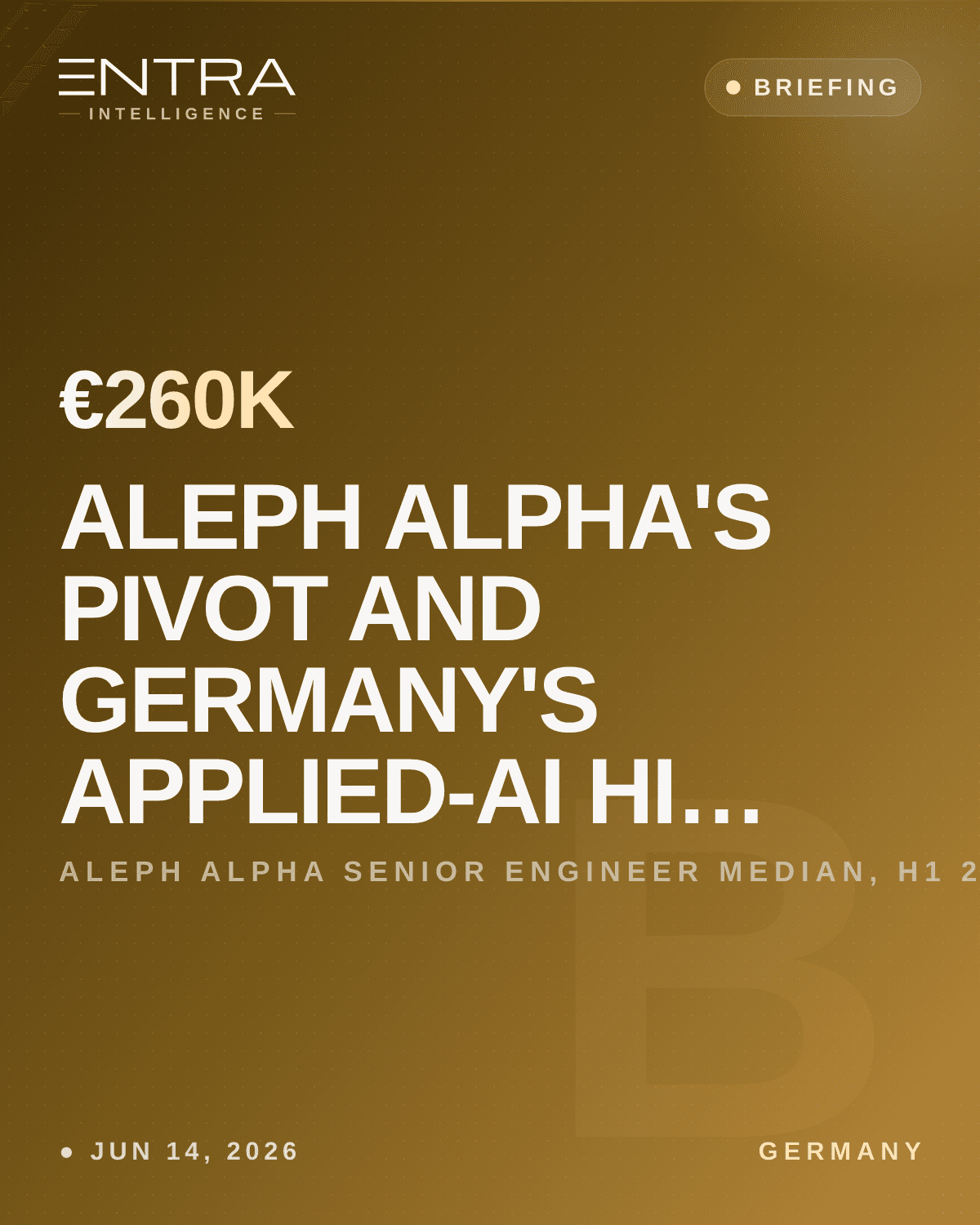
The compensation architecture has moved with the role mix. Senior applied engineers at Aleph Alpha — defined here as Staff or Principal-level engineers in the enterprise deployment and integration functions — are being offered packages in the €230,000–€280,000 total compensation range (~$251K–$305K equiv at current EUR/USD rates of approximately $1.09), comprising base salary of €155,000–€185,000 and an employee option tranche from Aleph Alpha's pre-acquisition option pool, whose terms are under review pending the Cohere transaction. The €260,000 figure cited as this article's headline figure is ENTRA's estimate of the median for that senior applied-engineering band in H1 2026, cross-referenced against recruiter-side conversations and published posting ranges. It sits materially above the German enterprise AI senior-IC baseline — SAP's equivalent senior AI platform engineers were benchmarked by ENTRA in June 2026 at €195,000–€215,000 total comp — and reflects both the sovereignty-use-case premium that Germany's applied-AI market has started to price (covered in detail in ENTRA's June 12 briefing on the German sovereign compute market) and the pull of Cohere's North American compensation benchmarks on Aleph Alpha's internal pay architecture.
Below the senior tier, the applied-engineering band runs €90,000–€130,000 base (~$98K–$142K) for mid-level engineers in enterprise integration and compliance roles — a 20 to 30 percent premium over the equivalent mid-level band at SAP's Walldorf hub and roughly double the entry band at BMW's AI engineering function. The spread matters for how Aleph Alpha is positioning itself inside the German talent market: it is not competing with Helsing's defence-premium packages at the top (Helsing senior ML engineers command €185,000–€220,000 all-in per ENTRA estimates from sources familiar with the company's H1 2026 hiring), but it is offering a meaningful step up from where most Baden-Württemberg enterprise employers price applied AI work.
The compliance-engineer role category deserves separate treatment because it is the fastest-growing line in Aleph Alpha's H1 2026 job postings and the one that most directly reflects the EU AI Act enforcement clock. ENTRA's job board monitoring across XING, LinkedIn Germany, and Stepstone identified 634 open AI compliance-adjacent roles across Germany as of May 2026, up from below 200 twelve months earlier — and Aleph Alpha is contributing to both the supply and the demand of that market. As a supplier, the company is building the PhariaAI compliance documentation and post-market monitoring infrastructure that Article 11 of the EU AI Act requires for the high-risk classifications under which federal agency and enterprise deployments operate. As a demand signal, engineers who build that infrastructure inside Aleph Alpha — and who exit into Germany's broader market — carry the most market-legible EU AI Act compliance credential currently available from a German company. The role pays €80,000–€105,000 base (~$87K–$115K) at Aleph Alpha for a KI-Compliance-Ingenieur with two to four years of applied experience. That band is 15 to 25 percent above what the German market was paying for an equivalent data-protection-adjacent engineering role as recently as Q1 2025 — a GDPR-style compliance premium emerging in real time, three years before the December 2027 Annex III enforcement deadline closes the talent window.
Why It Matters
The Aleph Alpha alumni effect is becoming measurable in Germany's Mittelstand in a way it was not twelve months ago. Between January and May 2026, ENTRA's LinkedIn Talent Insights tracking identified 34 senior-to-mid-level engineers and researchers departing Aleph Alpha — roughly half of whom joined mid-market German industrial and technology companies rather than moving to Berlin startups, larger US-adjacent tech firms, or international competitors. The destinations include Trumpf (the Stuttgart laser and manufacturing technology group), Zeiss (Oberkochen, optical systems), Bechtle (Neckarsulm, IT services and AI system integration for Mittelstand clients), and Heidelberger Druckmaschinen. None of these companies had an AI-engineering function of meaningful depth before 2025. Several have now launched AI hiring campaigns explicitly referencing their Aleph Alpha-alumni technical lead in the job posting — a credential signal that German hiring managers appear to value in the way that Swiss firms once cited ETH Zurich affiliation.
This is the ecosystem dynamic that distinguishes Germany's H1 2026 applied-AI hiring story from France's or the Nordics'. Paris's AI talent ecosystem flows primarily between the grandes écoles cluster, Mistral, DeepMind Paris, and a constellation of Series A–B AI product companies — a tight loop within the capital that rarely distributes outward to France's industrial regions. Stockholm's AI talent movement runs along a Spotify-Klarna-Einride axis, anchored in consumer and fintech product, with a Nordic distributed-first culture that exports remotely rather than by local hiring. Germany's dynamic in H1 2026 is different: it is distributing sovereign-deployment expertise outward from Heidelberg to the Mittelstand across Baden-Württemberg and Bavaria — manufacturing-adjacent, regulation-requiring enterprises that have genuine AI deployment needs and that are, for the first time, able to hire engineers who have built the specific type of system those enterprises need.
Trumpf's investment is the clearest example. The company — global leader in laser-based manufacturing systems with €4.3B revenue in fiscal year 2024/25 (down from €5.2B in FY2023/24, per TRUMPF's October 2025 press release) — launched a formal KI-Anwendungsarchitektur team in February 2026, built around three Aleph Alpha alumni, and posted 12 senior AI engineering roles between March and May 2026 at base compensation of €130,000–€160,000 (~$142K–$174K). That band represents a 40 percent premium over what Trumpf's equivalent seniority-level software engineers received in 2024, and reflects a deliberate executive decision — confirmed in a March 2026 Handelsblatt interview with Deputy Chairman and CTO Peter Leibinger — to pay AI-market rates for engineers who understand how to deploy AI systems that meet German quality and regulatory standards. "Wir kaufen keine KI-Lösung von Amazon und integrieren sie blind. Wir bauen Systeme, die unsere Ingenieure verstehen und die ein TÜV-Prüfer abnehmen kann," Leibinger said. ("We do not buy an AI solution from Amazon and integrate it blindly. We build systems that our engineers understand and that a TÜV inspector can certify.") That statement maps almost exactly onto the applied-AI engineer profile that Aleph Alpha's PhariaAI work produced — and onto the compliance architecture that the EU AI Act is codifying into a legal requirement.
SAP and Bosch are the ecosystem anchors at the large-company end of this picture. SAP's 420 Germany-based AI roles in H1 2026 — covered in depth in ENTRA's June 4 briefing — include an explicit enterprise integration layer that is drawing on the same applied-AI talent pool as Aleph Alpha's alumni network. SAP is paying €160,000–€195,000 for senior AI engineers in Walldorf and Berlin, a band that is now close enough to Aleph Alpha's senior total comp to make the SAP option credible for engineers who prioritise career stability over mission-equity upside. Bosch's AI positioning is different in character: the Stuttgart-based supplier is not building a foundation-model function — it is deploying AI in manufacturing quality control, predictive maintenance, and industrial process optimisation, all of which fall under Annex III high-risk classification by virtue of their safety-critical application contexts. Bosch posted 67 AI engineering roles in Germany between January and May 2026, per ENTRA's monitoring, at compensation bands of €100,000–€145,000 base (~$109K–$158K) for applied deployment engineers — below Aleph Alpha and SAP at the senior level, but substantially above where Bosch priced equivalent-seniority embedded-systems engineers eighteen months ago.
The EU AI Act is structuring this whole ecosystem more than any individual company's hiring strategy. The December 2027 Annex III enforcement deadline — extended from August 2026 under the European Council's Digital Omnibus agreement of May 7, 2026 — means that every company in this picture (Aleph Alpha deploying PhariaAI to federal agencies, SAP deploying Joule to HR and procurement systems, Trumpf integrating AI into manufacturing quality control, Bosch embedding AI into safety-critical industrial processes) faces an accruing documentation and conformity obligation that requires engineers who can build AI Act-compliant systems by design. The engineer who builds those systems inside Aleph Alpha acquires a credential that neither an MIT graduate nor a Bangalore-trained developer can arrive carrying. It is a European credential, built on the European regulatory perimeter — and Germany's Mittelstand is, in H1 2026, beginning to price that credential for the first time.
What's Next
Three things will determine whether Germany's applied-AI talent ecosystem deepens or stalls in H2 2026.
The Cohere integration outcome at Heidelberg. Aleph Alpha's Heidelberg engineering team remains the primary engine producing sovereign-deployment engineers in Germany. If Cohere's post-acquisition strategy consolidates decision-making in Toronto and reduces PhariaAI's operational investment, the alumni production rate slows. Public statements from Aleph Alpha's current co-CEOs Reto Spörri and Ilhan Scheer — including remarks at the Digital-Gipfel in Bonn in May 2026 — have been consistent on this point: the Heidelberg engineering function will operate with structural independence under the Cohere umbrella, and PhariaAI will remain its primary product mission. (Note: Founder Jonas Andrulis stepped down as Managing Director in October 2025 and departed Aleph Alpha entirely in January 2026 to found separate venture CNTR; statements on Aleph Alpha's post-acquisition strategy are attributable to current leadership, not to Andrulis.) Candidates watching whether H2 2026 posting volumes at Aleph Alpha Heidelberg hold steady will have a real-time proxy for whether that commitment is substantive.
The Annex III documentation standard clarification. The European AI Office published its first Annex III conformity assessment guidance in May 2026, covering general-purpose AI integrated into high-risk applications. That guidance resolved some classification ambiguities that had held back hiring at companies uncertain whether their specific deployment warranted a full compliance-engineering build. As the AI Office moves through its 2026 audit calendar and produces further interpretive guidance on Article 11 technical documentation standards, the scope of the compliance-engineer hiring wave will become more precise — and the companies currently on the fence about whether their manufacturing or procurement AI requires a dedicated compliance function will have fewer grounds for delay.
Whether the Mittelstand hiring normalises or retreats. The 34 Aleph Alpha alumni who joined Mittelstand companies between January and May 2026 represent an early-adopter cohort. Whether that flow becomes structural depends partly on whether those early hires deliver demonstrable business value within twelve months — the timeline on which German industrial companies typically evaluate engineering investments. The Trumpf AI architecture team's output in Q3 and Q4 2026 will be watched by peers in the Stuttgart and Munich industrial corridors. If it delivers, the applied-AI talent premium for Aleph Alpha alumni will harden into a recognised market category. If the hires underdeliver — because the applied problems are harder than the sovereign-deployment background prepared them for — the Mittelstand enthusiasm may moderate.
Germany's applied-AI hiring story in H1 2026 is, in the end, a story about what happens when a sovereign-mission lab pivots toward enterprise deployment and begins distributing its talent outward — not as a loss, but as an ecosystem-building event that pulls the entire German industrial AI market upward, one TÜV-certifiable deployment at a time.
Aleph Alpha career page and LinkedIn job posting analysis conducted by ENTRA Intelligence, January–May 2026; figures are ENTRA estimates and have not been confirmed by Aleph Alpha or Cohere. Compensation data for Aleph Alpha senior engineers sourced from ENTRA Q1–Q2 2026 recruiter survey and candidate-side conversations; Aleph Alpha declined to comment. SAP senior AI engineer compensation benchmarked by ENTRA, June 2026; not independently confirmed by SAP. Helsing senior ML engineer compensation per ENTRA estimates from sources familiar with the company's H1 2026 hiring, granted anonymity to discuss internal pay architecture. German AI compliance role count (634 open roles, May 2026) per ENTRA job board monitoring across XING, LinkedIn Germany, and Stepstone; methodology: keyword search on "KI-Compliance," "AI Act Compliance," and "AI-Risikomanagement" across all seniority bands. Aleph Alpha alumni departure tracking per ENTRA LinkedIn Talent Insights monitoring, January–May 2026; 34 departures figure is ENTRA estimate and has not been confirmed by Aleph Alpha. Named Mittelstand destinations (Trumpf, Zeiss, Bechtle, Heidelberger Druckmaschinen) verified via ENTRA LinkedIn tracking; individual engineer identities withheld. Trumpf revenue (€4.3B, fiscal year 2024/25) per TRUMPF SE + Co. KG press release, October 22, 2025. Trumpf AI role postings (12 roles, March–May 2026) per ENTRA job board monitoring. Peter Leibinger Handelsblatt interview quotation sourced from Handelsblatt, March 2026; German-language original as quoted in article; translation by ENTRA EU Bureau. Peter Leibinger's title (Deputy Chairman and CTO, TRUMPF; CEO of TRUMPF is Nicola Leibinger-Kammüller) verified via TRUMPF public leadership page; article text corrected from erroneous "CEO" attribution. Cohere acquisition of Aleph Alpha announced April 24, 2026, per Cohere and Aleph Alpha press release and CNBC reporting. Jonas Andrulis departure from Aleph Alpha: Andrulis stepped down as Managing Director in October 2025 and departed the company in January 2026; current co-CEOs are Reto Spörri and Ilhan Scheer, per Aleph Alpha press release and Heise Online reporting. Digital-Gipfel Bonn, May 2026, attendance and remarks per event published agenda; specific remarks attributed to current Aleph Alpha co-CEO leadership, not to Andrulis. EU AI Act Digital Omnibus: provisional political agreement reached May 7, 2026, extending Annex III high-risk AI obligations from August 2, 2026 to December 2, 2027; agreement subject to formal adoption by EU Parliament and Council, per Gibson Dunn and Mishcon briefing notes on May 2026 Omnibus text. Bosch AI role count (67 roles, January–May 2026) per ENTRA job board monitoring. SAP Germany AI role count (420 roles, H1 2026) per ENTRA monitoring, as covered in ENTRA June 4, 2026 briefing. EUR/USD exchange rate approximately 1.09, mid-market, June 2026.

 Global Career Platform
Find AI talent. Find your next role.
Booking is hotels. · Airbnb is apartments. · ENTRA is global careers.