
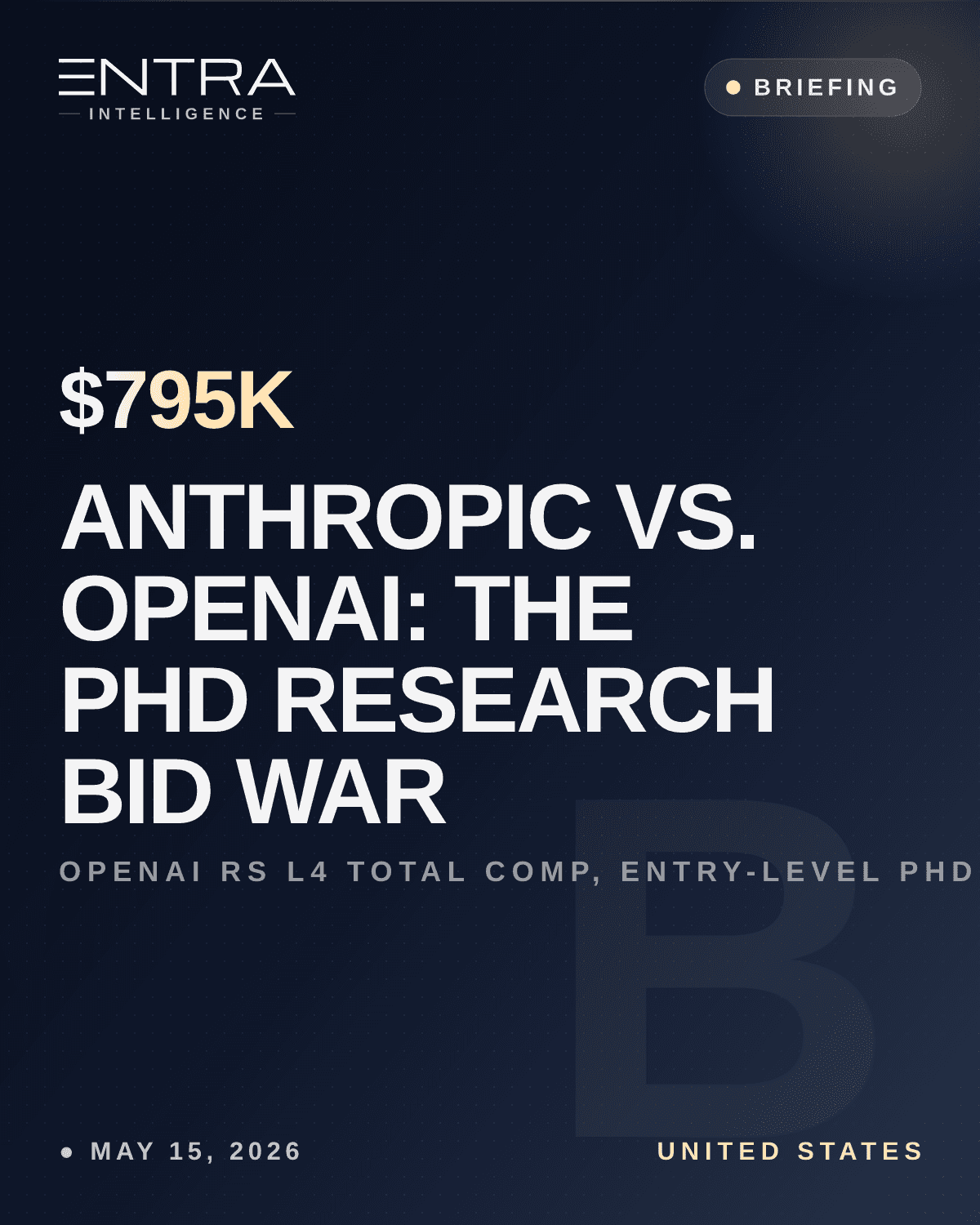
OpenAI's Early Career Research Cohort starts June 3, 2026, with a one-month bootcamp before team placement. Anthropic's Fellows Program — application deadline May 15, 2026 — runs four months, pays a $3,850 weekly stipend, and converts 25 to 50 percent of fellows to full-time research scientist offers. Both labs are targeting the same thin slice of the graduating class: the CS and ML PhD candidates who have a shot at moving the research frontier. The comp gap between the two paths is narrowing. The structural difference — how fast you get a permanent title and what your equity is worth — has never been more legible.
What Happened
The competition for PhD research talent at the frontier labs accelerated in lockstep with the model release cycle. Anthropic shipped Claude Opus 4.5 in November 2025, reclaimed the SWE-bench Verified coding leadership with an 80.9 percent score, and followed with Claude Sonnet 4.6 and, in April 2026, Mythos Preview — a model restricted to cybersecurity-focused Project Glasswing partners including AWS, Apple, Google, JPMorgan, and NVIDIA. OpenAI responded with GPT-5 in August 2025, which unified reasoning and general capabilities into a single model line and posted 94.6 percent on AIME 2025. The release tempo has put a measurable premium on the researchers who can sustain it. Both labs need more of them by September.
On compensation, the two paths diverge in architecture before they converge in total comp.
Anthropic's new-grad range across all roles runs $290,000 to $441,000 total compensation, per 6figr's aggregated 2026 data. For direct-hire research scientist positions — the path for candidates coming out of PhD programs with a publication record in interpretability, RLHF, or alignment — the band sits closer to the top of that range, with Levels.fyi's broader Anthropic research scientist dataset updated May 2026 showing packages from $320,000 to over $1,050,000 across seniority levels. Entry-level PhD hires land in the $380,000 to $500,000 range when RSU grants at Anthropic's current $380 billion valuation (per February 2026 Series G funding round) are included. Equity vests over four years with a one-year cliff. Anthropic has been transitioning from stock options to RSUs for newer hires — a structural signal, noted by compensation analyst Zuhayeer Musa in a public LinkedIn post (May 2026, accessed May 15, 2026), that the company is maturing its equity program ahead of a potential liquidity event. Anthropic has not confirmed the RSU transition publicly.
OpenAI's entry-level research scientist compensation is structured differently and reports higher. Levels.fyi's OpenAI research scientist dataset, updated May 13, 2026, shows L4 total compensation at $795,000, composed of a $295,000 base plus $500,000 in Profit Participation Units. The PPU structure is specific to OpenAI: units vest 25 percent per year over four years, are restricted from sale for the first two years after a liquidity event, and are capped at 10x the original grant value. PPUs are taxed as capital gains rather than ordinary income — a material advantage over RSUs at comparable total comp levels, per Liquid Stock's analysis of the OpenAI equity structure. The headline number is real; the liquidity timeline is longer than it looks.
The Early Career Cohort — OpenAI's dedicated new-grad research track — targets candidates with demonstrated performance in Olympiad mathematics, ICPC competition programming, or Putnam results. The official posting lists June 3 as the 2026 cohort start date. Participants join as full Research Scientists or Research Engineers from day one, not as residents, with permanent titles conditional on clearing the bootcamp and team-match process. OpenAI's new-grad total comp range on 6figr runs $240,000 to $1,500,000, a distribution that reflects the wide spread between the Residency cash track (annualizing to approximately $219,600) and the PPU-heavy research scientist direct path.
xAI and Google DeepMind are bidding for the same candidates from the side.
xAI's new-grad total comp runs $304,000 to $327,000 per 6figr's 2026 data, with no fellowship or residency layer — it writes direct offers. The ceiling for ML-specific candidates (inference engineering, pre-training systems) reaches approximately $340,000, per ENTRA reporting on xAI's May 2026 active roles. There is no bootcamp month and no conversion uncertainty. What xAI offers in speed and simplicity it trades against research depth: the Memphis Colossus infrastructure requires systems engineers more than it requires alignment researchers.
Google DeepMind's US new-grad PhD research scientist offer for an L4 hire lands between $250,000 and $550,000 in total comp, with base salary in the $133,000 to $240,000 range plus bonus and Google equity (per negotiation data cited by career advisors and Glassdoor's Mountain View dataset, updated May 2026). DeepMind recruits heavily from NeurIPS and ICML poster sessions — the lab's relationship with conference recruiting is tighter than any US-only lab's, given the London headquarters and established academic pipeline. Its Mountain View office on Charleston Road has run structured PhD hiring since 2017, and the lab's brand in mechanistic interpretability and model evaluation gives it a recruiting angle that neither OpenAI nor Anthropic can replicate exactly.
Why It Matters
The bid war is structurally asymmetric in ways that matter to the 2026 PhD cohort.
Anthropic's Fellows track — four months, $3,850 per week ($200,200 annualized in cash), $15,000 per month in compute funding — is designed as an audition. The conversion rate is 25 to 50 percent to a full-time offer, and over 40 percent of all past fellows have joined Anthropic full-time, per the company's public Fellows Program announcement for the May and July 2026 cohorts. The selection bar is research-publication-quality independent work, not Olympiad credentials. A candidate who wrote a meaningful paper on RLHF or published interpretability tooling on GitHub has a credible path into the cohort even without a top-five-school pedigree. The risk: four months pass, and 50 to 75 percent of fellows exit without an offer. Anthropic does not issue exploding offers, per candidate accounts reported at IGotAnOffer — candidates can run the OpenAI process in parallel without penalty.
OpenAI's Early Career Cohort is a narrower gate aimed at a different profile. The Olympiad-and-competition framing explicitly selects for mathematical performance under constraint — the skill set most correlated with novel architecture work and theoretical ML. The cohort is described as "small," implying single-digit or low-double-digit intake. The trade: you get a Research Scientist title from June 3 forward, not after a conversion gate, but you are entering a company with 7,000 employees (per public headcount data, early 2026) and a PPU structure that looks attractive at a $300 billion valuation but carries a 2-year lock on any liquidity event and a 10x growth cap.
The equity question is the one candidates are actively negotiating around. Anthropic RSUs at the February 2026 Series G valuation of $380 billion are priced at a premium to the $61.5 billion March 2025 Series E — a 6x step-up that materially changes the take-home math relative to OpenAI PPUs at current pricing. But RSUs vest into common stock with no liquidity cap, and Anthropic has run tender offers to give employees partial liquidity before an IPO. The PPU cap means an OpenAI researcher who stays six years sees zero marginal equity upside above the 10x ceiling, regardless of where the company's valuation goes. For a 24-year-old PhD who expects to be at the same lab for a decade, that cap is a real number.
The process speed matters too. Anthropic's interview timeline runs four to eight weeks for research roles, with a team-matching pool adding two to four weeks of silence after the technical rounds clear, per IGotAnOffer's Anthropic process guide. OpenAI's Early Career Cohort has a hard start date — June 3 — which means the decision timeline is compressed into April and May. Both companies require the same base materials: a research statement, a technical interview series covering ML fundamentals and system design, and a project deep-dive with a senior researcher. The difference is that Anthropic's process ends in a pool placement; OpenAI's ends in a team offer.
What's Next
Three things to watch through September 2026.
First, whether Anthropic's RSU transition changes the new-grad offer cadence. The shift from options to RSUs, flagged in Musa's May 2026 LinkedIn analysis, suggests Anthropic is pricing equity grants against a near-term liquidity event — either an IPO or a secondary tender. If a tender offer materializes before the end of 2026, the RSU packages being written today become significantly more attractive in hindsight. Research scientist candidates currently choosing OpenAI PPUs over Anthropic RSUs on liquidity grounds may be reading an arbitrage that disappears within 12 months.
Second, the DeepMind factor. Google DeepMind is running US research scientist hiring on a rolling basis through NeurIPS 2026 recruiting, and its Mountain View office has added interpretability and alignment research headcount following Gemini Ultra's competition with GPT-5 and Claude 4. The lab does not run a cohort or a fellowship — it makes direct research scientist offers to PhD candidates it has tracked across conference poster sessions and paper submissions. That process is slower than OpenAI's cohort but does not carry conversion risk. For PhD candidates whose research is in model evaluation, RLHF, or multimodal systems, DeepMind's Mountain View path is a credible third option that the Anthropic–OpenAI framing tends to obscure.
Third, offer inflation. The published bands for Anthropic and OpenAI new-grad research scientist roles have moved up sharply since the GPT-4 and Claude 3 release windows in 2023, when comparable offers cleared at $250,000 to $350,000. The current Levels.fyi and 6figr data puts the center of the PhD research scientist market at $400,000 to $800,000 in total comp depending on lab and equity structure. That number was unusual three years ago. At the current model-release pace — Anthropic's Mythos Preview shipped in April 2026, four months after Claude Opus 4.5 — neither lab's research scientist headcount is growing fast enough to keep pace with demand. The bid war has one rational outcome: the floor moves up again before the Class of 2027 recruiting cycle opens.
The Class of 2026 has two offers on the table. One is a cohort with a hard start date and PPUs capped at 10x. The other is a fellowship with conversion uncertainty and RSUs in a company that may be twelve months from a liquidity event. Both are worth more than anything the same résumé would have commanded in 2023. The candidates who understand the equity mechanics — not just the headline total comp — are the ones making the decision correctly.
Sources: Levels.fyi — OpenAI Research Scientist Salary — Levels.fyi — Anthropic Research Scientist Salary — 6figr — Anthropic New Grad Salaries 2026 — 6figr — OpenAI New Grad Salaries 2026 — 6figr — xAI New Grad Salaries 2026 — OpenAI Early Career Cohort — Careers Page — Anthropic Fellows Program 2026 — alignment.anthropic.com — OpenAI PPU Structure — Levels.fyi Blog — Anthropic RSU Transition — Zuhayeer Musa, LinkedIn, May 2026 — Liquid Stock: OpenAI PPU Analysis — IGotAnOffer — Anthropic Interview Process — Anthropic New Stack: Claude Opus 4.5, November 2025 — Claude model timeline — claudefa.st — OpenAI headcount targeting 8,000 — Silicon Republic — Google DeepMind Mountain View Salaries — Glassdoor — Anthropic Fellows Program — BusinessToday, May 14, 2026