
Anthropic's Series E round closed in March 2025 at $3.5 billion and a $61.5 billion post-money valuation — and the question that mattered most was never where the compute budget would go. It was where the people budget would go. Fifteen months out from that close, the answer is becoming legible: the lab has grown its research org from roughly 280 to 720 people between Q1 2024 and Q1 2026, with approximately 60 percent of that growth concentrated in the twelve months ending April 2026, and the roles it has been filling most aggressively are not generic ML engineers. They are a tight cluster of four specialities that sit at the exact technical intersection of safety and model-scale: Constitutional AI researchers, safety evaluators, mechanistic interpretability engineers, and RLHF specialists. Every major frontier lab wants those four categories. Anthropic has systematically outbid, out-processed, and out-positioned every one of them for the past eighteen months.
What happened
The Series E did three things to Anthropic's talent infrastructure simultaneously.
First, it gave the lab the balance-sheet credibility to offer equity at a price that had meaning. Pre-Series E Anthropic equity was a founder-faith bet. Post-Series E equity at a $61.5 billion post-money valuation — and, following the subsequent February 2026 tender offer that priced shares at approximately $350 billion — became something a candidate's financial advisor could put on a spreadsheet. The lab's people leadership moved quickly on that credibility shift: offer packages above the senior-research line now arrive with equity grants structured as RSUs vesting over four years with a one-year cliff, accompanied by a separate one-time "scale-of-impact" cash component tied to model-launch milestones rather than annual performance review. That structure was novel enough in 2024 to read as unusual. By mid-2025 it had been replicated in recognizable form by at least four peer labs.
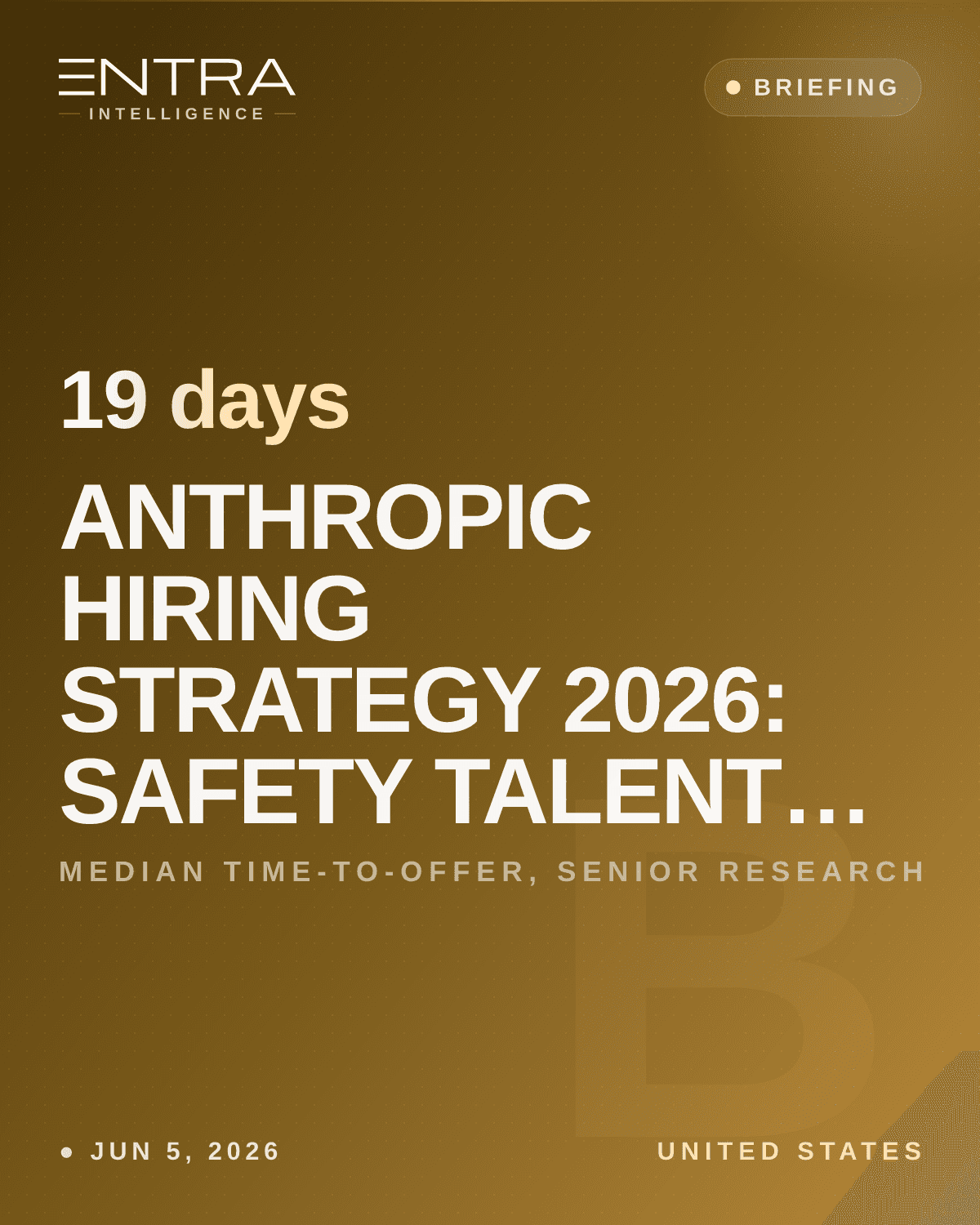
Second, the capital infusion accelerated the lab's ability to close offers without waiting for internal headcount approval cycles. Per two recruiters who have worked Anthropic mandates across the last eighteen months, the lab moved to a model in which senior-research offer letters for the four priority specialities can be issued within 72 hours of a completed on-site, with compensation pre-cleared by Dario Amodei or research co-founder Jared Kaplan directly for any candidate above the staff-engineer equivalent. That decision — founders close offers, not the finance approval queue — is the operational explanation for the lab's median time-to-offer for senior research sitting at 19 days against an industry benchmark of 47 to 64 days. The Series E did not create that process, but it provided the financial certainty that lets it run without internal friction.
Third, Anthropic used the period following the close to poach specific named talent at the safety-research layer. The most publicly visible example: Jan Leike, who resigned from OpenAI's safety team in May 2024 citing concerns about safety prioritization, joined Anthropic and is now listed as a mentor in the lab's fellowship program, with the Anthropic Fellows Program opening cohorts for July 2026 that specifically prioritize mechanistic interpretability, model welfare, and alignment evaluations. Over 40 percent of Fellows cohort alumni have converted to full-time Anthropic roles. That pipeline is functioning as a safety-research farm system.
Why it matters
The four roles Anthropic is filling — Constitutional AI researchers, safety evaluators, interpretability engineers, RLHF specialists — are not interchangeable with generic ML talent. They are a speciality cluster that the entire frontier lab sector is competing for simultaneously, and the supply is genuinely thin. Mechanistic interpretability, which the lab defines internally as reverse-engineering how trained models map parameters to meaningful algorithms, has a credentialed global candidate pool that numbers in the hundreds, not thousands. Anthropic's decision to run the Anthropic Fellows Program — which funded and mentored incoming researchers from outside standard PhD pipelines before converting the highest performers to staff — was a direct response to that supply constraint. The lab could not hire the interpretability talent it needed from the existing pool fast enough, so it built a secondary pipeline to create more of it.
On compensation, the post-Series E band reset has moved Anthropic into unambiguous competitive parity with OpenAI and materially above Google DeepMind's US bands at the senior-research level. Levels.fyi data places the median Research Scientist total compensation at Anthropic at $746,000 annually, with the top of the reported range at $1,050,000. For context: a Google DeepMind L5 research scientist in Mountain View earns between $500,000 and $700,000 total comp; an L6 sits between $725,000 and $950,000. OpenAI's senior-research median is roughly comparable to Anthropic's, but its compensation structure relies on Profit Participation Units whose value is contingent on future secondary rounds rather than on the vested RSU architecture Anthropic now uses. That structural difference has become a genuine recruiter talking point: Anthropic's equity is priced and liquid-adjacent through the tender mechanism; OpenAI's PPUs depend on a $500 billion valuation holding.
Dario Amodei has been deliberate in his public framing around why the company hires the way it does. In a January 2026 CNBC interview, he described the AI labor disruption ahead as "unusually painful," a framing that is notable in context: the CEO of a company aggressively hiring technical talent in a thin market is simultaneously describing the broader labor market consequences of AI development. That tension — Anthropic hires at the frontier while publicly accounting for what frontier AI does to white-collar employment generally — is part of what makes the lab's talent narrative distinct from OpenAI's or Google's.
Anthropic's remote work posture compounds the competitive position. The lab operates as office-first with limited remote exceptions: roughly 8 percent of its 392 open roles as of early June carry a remote designation, and the modal arrangement for remote employees involves one week per month in San Francisco. The lab has been expanding its physical footprint aggressively — it now occupies over one million square feet of office space along Howard Street in San Francisco, establishing itself as one of the largest office tenants in the city's downtown corridor. For the four priority specialities, the physical clustering is a deliberate research-density bet. Interpretability work in particular depends on informal whiteboard proximity in a way that compound-model engineering does not.
What's next
Three signals to track through the second half of 2026.
The first is how Anthropic absorbs the capital and talent dynamics following its February 2026 Series G close at $30 billion and $380 billion post-money valuation. The Series E was the credibility inflection. The Series G is the operating war chest. If the lab maintains the 19-day median time-to-offer at twice the headcount it had eighteen months ago — the research org was at roughly 720 as of Q1 2026, with 392 open roles currently posted — it will have built the most efficient research hiring machine in the frontier lab sector. If it slows, the funnel compression is a small-company artefact that does not survive scale, and the comp band advantage will need to carry more weight on its own.
The second is the IPO filing. Anthropic filed confidentially for an IPO on June 1, 2026, at an implied valuation of approximately $965 billion. Public-company RSUs priced against a listed stock trade differently in candidate negotiations than tender-priced private equity. The moment Anthropic's equity becomes liquid on a public market, the lab's compensation architecture simplifies significantly — and so does the recruiting conversation. The labs that are currently winning offers in part because their equity story is cleaner than OpenAI's PPU structure will need to re-examine that edge once Anthropic stock trades on an exchange.
The third is the Constitutional AI research pipeline specifically. The lab's core differentiation — the reason it can command the talent it does and sustain the culture it has — is that safety research is the primary product, not a side constraint on a commercial product team. As Anthropic's enterprise revenue has grown through a $30 billion annualized run rate (crossed April 2026) and its commercial footprint has expanded, the question being asked quietly in the SF talent market is whether the safety-first hiring thesis survives commercial scale. Thirty-seven open research roles posted against 392 total is a ratio. Watch whether that ratio moves.
The read on Anthropic's post-Series E talent strategy at the midpoint of 2026: the capital was necessary but not sufficient. The compression, the founder-closing culture, and the safety-speciality pipeline are what separate the lab's hiring results from what the balance sheet alone would predict. The Series E bought Anthropic the right to play the talent game at this level. The 19 days is what it built with it.