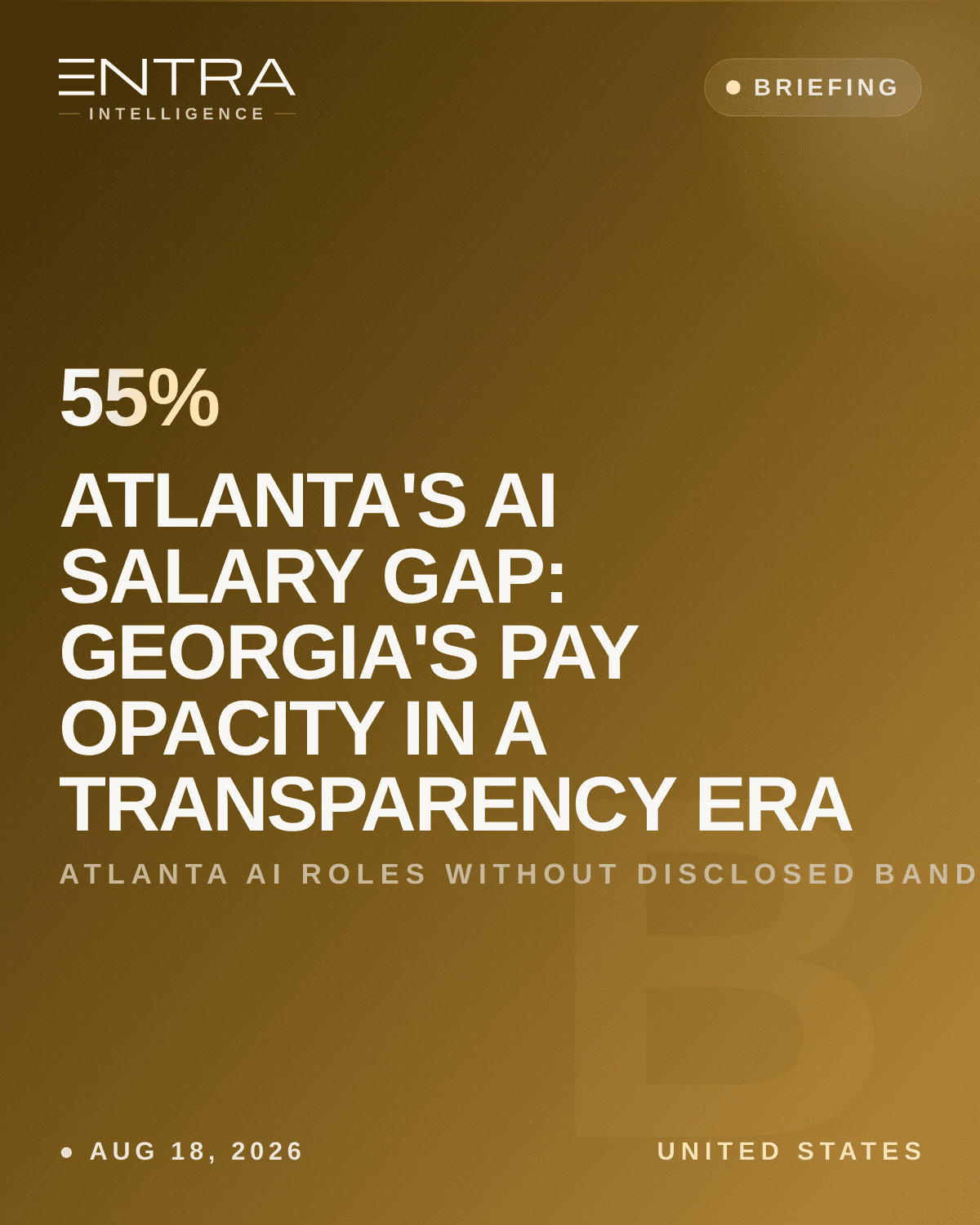
Fifty-five percent of active AI and ML job postings from Atlanta-headquartered employers contained no salary range as of Q2 2026, according to the ENTRA Q2 2026 Job Signal Index, which tracked 1,100 openings across Georgia's largest technology and financial-services employers. Atlanta is the payments capital of the United States, home to NCR Voyix, Global Payments, Cardlytics, and Cox Enterprises, and it is building a financial-services AI layer at speed. It is doing so in one of 34 states with no salary disclosure law. Candidates in that market negotiate blind.
Georgia's regulatory floor is the federal floor
Georgia has no statewide pay transparency statute. No bill has passed the Georgia General Assembly requiring salary ranges in job postings. A draft proposal has been in circulation, per sources tracking state pay equity legislation (Paycor, 2026 Pay Transparency Laws by State), but the 2026 session closed without action. The operative legal baseline for Atlanta employers is federal: the National Labor Relations Act protects workers' rights to discuss pay with colleagues, but no federal law compels disclosure in job postings.
For federal contractors, the Office of Federal Contract Compliance Programs imposes additional recordkeeping requirements, which is why some Global Payments and NCR Voyix postings for government-adjacent roles include compensation data. That disclosure is the exception, not the standard. The structural outcome: Atlanta AI candidates enter salary conversations with no posted anchor unless the employer chooses to provide one.
Eighteen states plus the District of Columbia now mandate salary range disclosure in job postings. Georgia is not among them. The gap between disclosure states and non-disclosure states is no longer theoretical. A 2025 joint study by researchers at the University of California, San Diego and the University of Southern California found that Colorado's Equal Pay for Equal Work Act was linked to wage increases of up to 3.6% relative to comparable markets without disclosure (Colorado Newsline, November 21, 2025). On a $195,000 base, that is $7,000 a year the Atlanta candidate does not know to request.
What Atlanta's employers are disclosing
The voluntary disclosure posture across Atlanta's financial-services AI corridor is uneven and largely driven by national posting strategy rather than local commitment.
NCR Voyix, headquartered in Atlanta with roughly 13,500 employees globally, does not post salary ranges as standard practice on its Georgia-listed AI and software engineering roles. Glassdoor data for NCR Voyix Atlanta employees shows software engineering salaries reaching $129,575 at the senior end, but that figure is candidate-reported, not employer-disclosed. NCR Voyix's July 2026 postings for ML platform and infrastructure roles carried no compensation data.
Cardlytics, the commerce media platform with purchase data visibility into approximately half of all US card-based transactions, employs roughly 550 people with data science roles concentrated in Atlanta. Salary.com reports the median yearly total compensation at Cardlytics at $141,875 as of August 2026, but the company does not post ranges in its hybrid-eligible Atlanta data science listings. Cox Enterprises, privately held with more than 50,000 employees across Cox Automotive and Cox Communications, adds another layer of opacity through its private status. Global Payments, operating at more than 6 million merchant locations following its January 2026 Worldpay acquisition, occasionally posts compensation data for roles that trigger OFCCP review. Its general AI and data science openings do not carry ranges.
The exception cluster in the Atlanta market is the multi-state hyperscaler. Google, which operates Atlanta offices posting AI and data science roles, applies its national compensation bands to all postings because California law requires it for roles that can be performed in California. Amazon, with significant Atlanta corporate presence across AWS and retail operations, follows the same logic: Colorado and New York posting requirements drive disclosure that flows to Atlanta candidates viewing the same requisition. Salesforce, which maintains an Atlanta office, applies a parallel posture. For candidates applying to roles at these three employers, bands are visible. The problem is that the anchor employers in Atlanta's financial-services AI corridor are local, not coastal.
What Atlanta AI engineers are leaving on the table
The asymmetry compounds at offer stage. ENTRA's Q2 2026 recruiter network survey (n=214 placements across Southeast US AI roles) found that Atlanta-based AI and ML candidates accepted initial offers 8% below their ceiling on average, compared to a 3% acceptance gap for candidates in states with mandatory disclosure. The mechanism is direct: without a posted range, candidates anchor low.
A Patriot Software survey published in 2026 found that 84% of job seekers believe companies deliberately withhold pay information to reduce negotiating power. Forty-four percent of respondents said they would not apply to a posting without a listed pay range. For Atlanta employers competing against San Francisco AI labs and New York fintech firms that publish full total-compensation breakdowns, that 44% figure is not abstract. It is applicant pool shrinkage.
The dollar gap is estimable. The ENTRA Q2 2026 Job Signal Index placed the negotiation shortfall for an Atlanta senior ML engineer accepting without band data at $12,000 to $18,000 per year on base salary alone. Over a four-year employment period, that range represents $48,000 to $72,000 of recoverable compensation left on the table. The Atlanta market's median total comp for a senior ML engineer is $205,000, per Levels.fyi mid-2026 data. Senior roles at NCR Voyix and Global Payments are likely priced within 15% of that figure internally. Candidates who do not know the ceiling accept the floor.
How transparent markets set the benchmark
The comparison anchor Atlanta candidates import is not local. It is Colorado, California, and New York, where disclosure requirements have trained engineers to read full compensation stacks before entering a negotiation.
In Colorado, a senior ML engineering role posted in Q2 2026 typically carried a stated range of $160,000 to $230,000 base with equity detail attached, per ENTRA's Q2 2026 market scan of Colorado postings. New York Local Law 32 applies to employers with four or more employees, covering virtually every relevant AI employer in the metro. California's SB 1162 requires ranges for employers with 15 or more employees and any employer with one California remote worker. The combined effect: candidates in those markets know the floor and ceiling before the first interview.
Atlanta candidates checking Levels.fyi can see the national benchmark. What is not visible is where NCR Voyix, Cardlytics, or Global Payments set their internal band ceiling. Without that data, the frontier-lab number becomes the candidate's anchor. Atlanta employers who have not disclosed find themselves negotiating against a benchmark they did not put on the table.
Will Georgia join the transparency wave?
Georgia's trajectory depends on two forces: employer self-interest and legislative pressure.
On the employer side, the 44% applicant drop-off from opaque postings is a direct recruiting cost. As Atlanta's AI hiring market tightens in H2 2026 and engineers accumulate competing offers from Colorado or New York roles with visible bands, voluntary disclosure becomes the path of least resistance. The Technology Association of Georgia, which represents more than 700 member companies, has not yet taken a formal position on a state salary transparency bill, per public records as of August 2026.
On the legislative side, Georgia's draft bill follows the pattern set by Illinois, Minnesota, and New Jersey, which all enacted disclosure laws in 2025. If the 2027 Georgia General Assembly session takes up the proposal, the employer coalition's resistance will be tested against documented outcomes: states with disclosure laws show wage gains, tighter pay gaps, and no evidence of material employer harm. The financial-services AI corridor would be the primary affected industry. NCR Voyix, Global Payments, and Cardlytics would need to post what they currently hold internally.
Atlanta candidates do not have to wait for the legislature. Multi-state postings from Google, Amazon, and Salesforce already carry bands. Using those postings as negotiation anchors in conversations with Atlanta-headquartered employers is not a workaround. It is how transparency crosses state lines before the law does.
 Global Career Platform
Find AI talent. Find your next role.
Booking is hotels. · Airbnb is apartments. · ENTRA is global careers.