
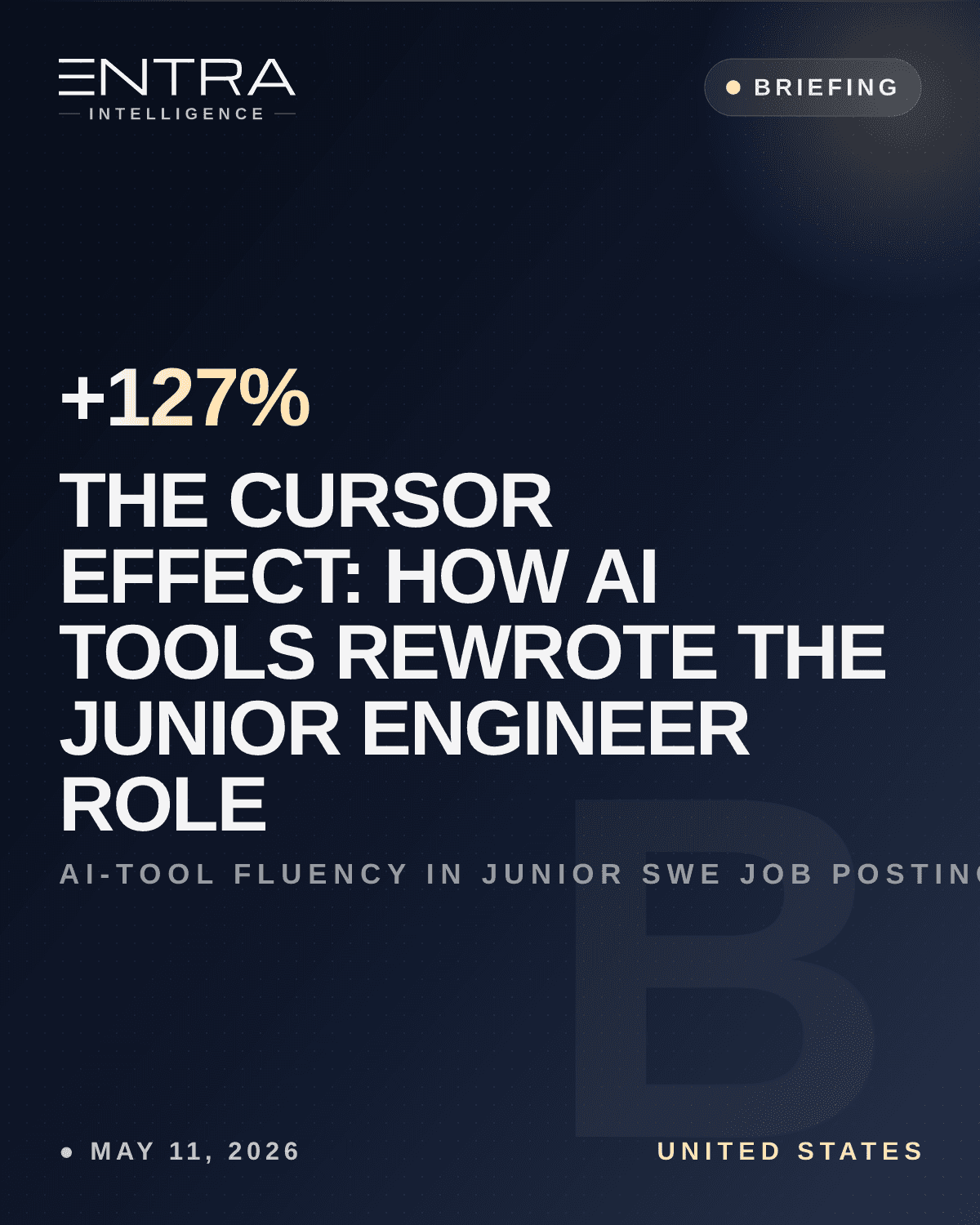
Mentions of "AI-assisted development" or "AI tool fluency" in US junior SWE job postings have risen 127% year-over-year, according to the ENTRA Job Signal Index, which tracks live postings across LinkedIn, Greenhouse, Ashby, and Lever. The question "do you know Python?" has been replaced — at a growing cohort of SF and New York-based startups and scale-ups, the screening question is now closer to: "Walk me through your Cursor workflow on your last project." The bar for a first engineering job has not lowered — it has rotated ninety degrees.
What Changed and When
The inflection happened over roughly eighteen months. GitHub Copilot crossed 1.8 million paid subscribers by mid-2024. Cursor, built on top of VSCode by Anysphere, hit a reported $2 billion in annualized revenue by early 2026 with roughly 50 full-time employees — a ratio that itself tells a story about AI-amplified output. Replit's Agent moved beyond toy projects and into production-grade application scaffolding. By the time the Class of 2026 was submitting applications in the fall of 2025, the AI coding layer was already embedded in professional workflows at every tier of the market.
The Stack Overflow 2025 Developer Survey put a number on adoption: 84% of professional developers use AI tools in their workflow, up from 76% the prior year, with 51% using them daily. But adoption statistics miss the hiring signal. What matters is that AI tools moved from optional productivity boost to baseline expectation — and that transition showed up in job descriptions before it showed up in onboarding documentation.
GitHub Copilot now appears in approximately 35% of software engineering postings that specify AI tool proficiency. Cursor and Windsurf-class agentic IDEs appear in roughly 20%. The composite figure — any mention of AI-assisted development as a skill or expectation — is where the 127% YoY growth sits. In January 2025, such language was a differentiator. In May 2026, its absence from a hiring manager's evaluation rubric is the anomaly.
Three Companies, Three Versions of the New Bar
Replit is the most explicit case. The Foster City-based company describes itself as "the agentic software creation platform that enables anyone to build applications using natural language," and its Summer 2026 New Grad Software Engineer posting reflects that identity directly. New grads are expected to work on "AI coding agents that understand intent and generate production-ready applications" — not as a future roadmap item, but as day-one scope. Replit does not list AI tool proficiency as a soft preference; its product is the tool, and new hires are expected to work at the system level of what they are shipping to users. Amjad Masad, Replit's CEO, told the 20VC podcast in April 2026 that he considers it "pretty dumb" to pursue a CS degree motivated solely by financial expectations, arguing that AI is reshaping what software careers require at the foundation. His actual hiring posture is narrower: he wants engineers who are "genuinely interested in the field" rather than those who learned the job description's language.
Vercel operates on a parallel logic. The company's 2026 AI Accelerator cohort and its active engineering JDs — including roles on the AI Gateway, Agent, and Workflows teams — share a common expectation: candidates should understand "the difference between a demo and a system that works reliably at scale." Vercel's New Grad compensation sits between $168K and $232K in total comp according to 6figr data, placing it at the high end of the AI-native startup band. Guillermo Rauch, Vercel's CEO, described the hiring signal he prioritizes in a Sequoia podcast appearance: "people on the rise," specifically those who are shipping high-quality work using AI tools and who can communicate clearly about what they built. That framing — output quality plus communication, with AI tools assumed as the production method — is the 2026 hiring thesis in a sentence.
Windsurf (formerly Codeium) runs the shortest new grad hiring process in this cohort: as fast as 7 days from application to offer for Software Engineer New Grad roles, per Glassdoor interview submissions. Speed is itself a signal. When a company that builds agentic IDEs posts a new grad role, it is not screening for whether candidates know the tool — it assumes they do. The screening is for whether candidates can think at the level of the tool's users, which requires having used it seriously.
The AI-Native Gap
Here is where the bootcamp-versus-CS-degree debate acquires new texture in 2026. Traditional four-year CS programs at research universities still provide the strongest foundation for ML systems, infrastructure, and the kind of theoretical depth that Anthropic and DeepMind screen for. That path is not diminished.
What has changed is the competitive position of candidates who lack that background but have built AI-native workflows from day one. Bootcamps have pivoted faster than curricula committees. Programs at institutions like Metana and nucamp have reoriented around AI prompt engineering, agentic workflow orchestration, and code review rather than syntax instruction. A 2025 LeadDev survey of engineering leaders found that 54% plan to hire fewer junior engineers specifically because AI copilots have extended senior engineer capacity. Entry-level SWE postings have dropped roughly 40% since early 2024. The roles that remain are concentrating in companies where the product is the AI layer itself — and those companies, counterintuitively, are more willing to hire candidates without a traditional CS pedigree, provided those candidates can demonstrate output.
The practical divide looks like this: a CS grad from a top-20 program who never used Cursor because their algorithms professor banned it in coursework, versus a bootcamp grad who spent six months building production applications with Cursor, Replit Agent, and Claude Code. In the traditional hiring playbook, the CS grad wins on credentials. In the 2026 hiring playbook at AI-native companies, the interview is a live coding exercise — and the live coding exercise assumes you have your tools.
This is not an argument that CS fundamentals are obsolete. It is an observation that the signal companies use to evaluate new grads has shifted toward demonstrated AI-assisted output, and that shift creates a gap that runs through the middle of the Class of 2026.
The Screening Has Changed Too
Companies are not just asking about AI tools — they are designing interviews around them. Kore1's 2026 screening guide for engineering hirers — circulated among talent operators at SF startups — explicitly coaches hiring managers to ask candidates to "explain the AI-generated code they used, not just produce it," walking through snippets line-by-line to assess comprehension versus dependence. The concern is the share of developers the Stack Overflow 2025 Developer Survey identified as accepting AI output without reviewing or understanding it — a behaviour pattern the survey tracks under the "vibe coding" label. That cohort is disqualifying itself in live exercises at companies with engineering bars.
The standard that is emerging is what several talent operators are calling the "AI accountability layer": you used the tool, you own the output, you can defend every line. That is not a lower bar than writing code from scratch. In some ways it is higher, because it requires both the generative instinct and the debugging judgment.
Where This Is Heading for the Class of 2027
Three signals are worth watching for candidates entering the job market in a year.
First, agentic IDE fluency will be table stakes in the same way that knowing Git is table stakes today. No one lists "Git proficiency" as a differentiator in 2026. By 2027, listing "Cursor fluency" will read the same way. The candidates who stand out will be those who can demonstrate workflow architecture — how they structure a complex build across an AI-assisted session, not just that they used the tools.
Second, the "AI accountability layer" standard will formalize into structured interview rubrics. Companies are already moving in this direction. Expect the 2027 hiring season to include standardized AI-tool-integrated take-home exercises at companies above 50 engineers.
Third, the institution-to-employer pipeline is rewiring. Vercel, Replit, Anysphere, and peers like them are increasingly pulling candidates from non-traditional channels: open-source contributions to AI tool ecosystems, public build logs, GitHub commit histories on AI-adjacent projects. A candidate who contributed to the Cursor plugin ecosystem or shipped an LLM-powered tool with measurable users has a stronger signal than a candidate whose portfolio is LeetCode completions.
The Class of 2026 walked into a market where the job description changed faster than the curriculum. The Class of 2027 has no excuse not to know what the new description says.
The ENTRA Job Signal Index tracks live job postings across LinkedIn, Greenhouse, Ashby, and Lever for AI-industry roles in the United States. YoY comparisons reference May 2025 to May 2026 posting windows. Compensation data sourced from 6figr and Levels.fyi public datasets.