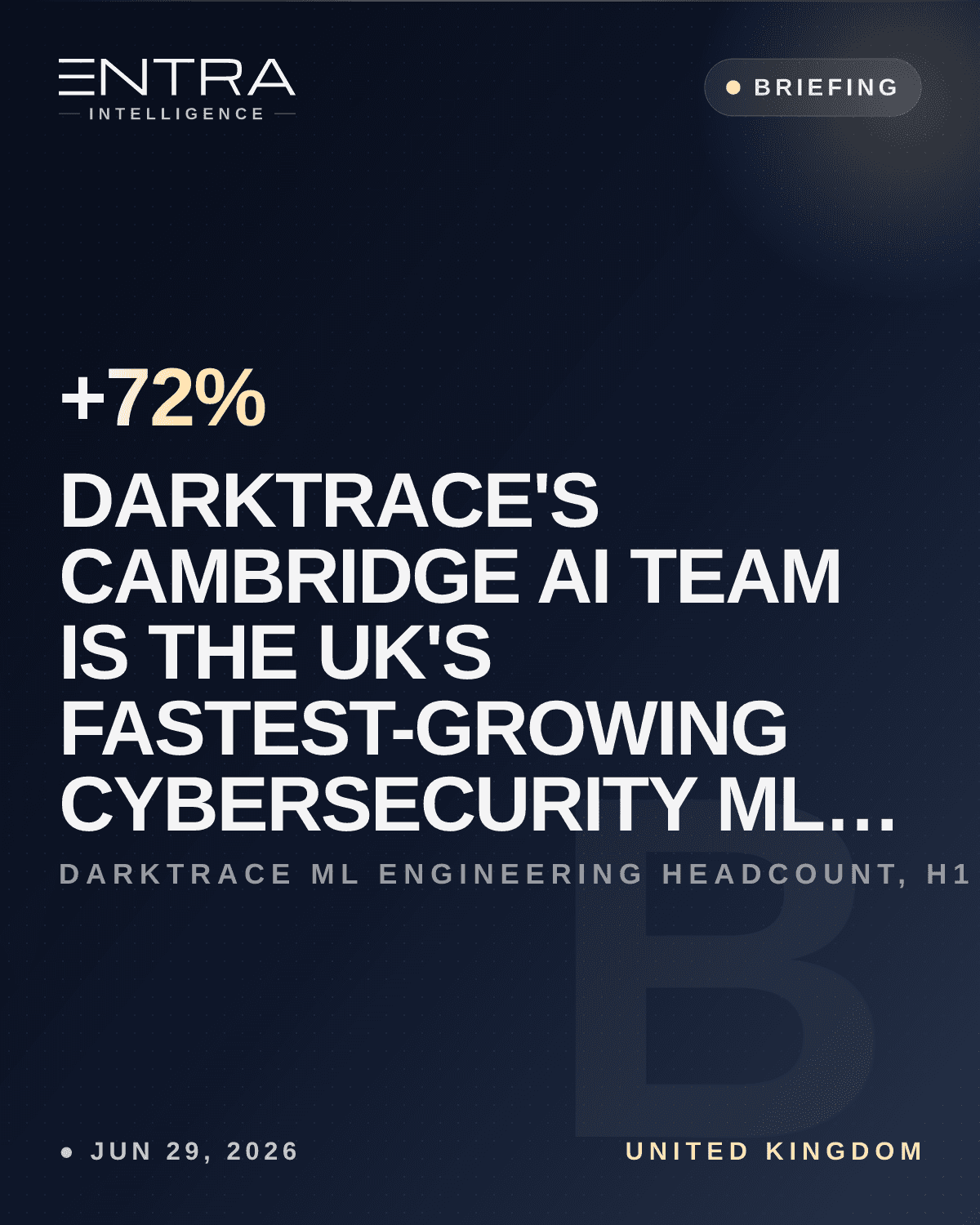
Darktrace's acquisition by Thoma Bravo — completed on October 1, 2024, taking the LSE-listed company private after a contested process that valued the Cambridge-founded cybersecurity group at approximately $5.3B — turned out to be a hiring catalyst rather than a consolidation signal. In the six months to June 2026, Darktrace's AI and ML engineering headcount grew by an estimated 72 percent year-on-year, per ENTRA's H1 2026 Job Signal Index and recruiter-side tracking. The growth is concentrated in two geographies: the company's Cambridge Science Park research centre, which houses the core ML research function, and its London Victoria office, which has absorbed the majority of applied AI engineering growth as the DETECT, RESPOND, and HEAL product suite scales to enterprise customers processing upwards of 3 million security events per second through Darktrace's self-learning AI models.
The pace of that growth makes Darktrace the fastest-scaling ML engineering bench in the UK AI cybersecurity sector in H1 2026 — and positions the Cambridge-London corridor it anchors as a genuine employment destination for ML Security Engineers choosing between San Francisco, London, and a shrinking set of other credible options at the £190K–£280K (~$240K–$355K) base level.
What Happened
Thoma Bravo's private equity ownership unlocked a structural change in Darktrace's hiring posture. As a London Stock Exchange-listed company, Darktrace operated under compensation constraints that public-market benchmarks and quarterly earnings scrutiny impose on UK-listed technology companies. Post-privatisation, the company's headcount investment does not flow through a public income statement, and the compensation architecture has been reset accordingly. Jill Popelka, who became CEO following the Thoma Bravo transaction after Poppy Gustafsson — the Sheffield-trained co-founder who built Darktrace from its 2013 inception into an LSE-listed company — moved to a board role, has described the post-acquisition phase publicly as "an acceleration, not a restructure." The headcount data supports that framing.
ENTRA's analysis of LinkedIn headcount signals, Darktrace's UK Companies House filings for Darktrace Limited (company number 08480997), and recruiter-side tracking across eight UK cybersecurity ML specialist agencies places Darktrace's ML and AI engineering headcount at approximately 410 as of June 2026, up from an estimated 239 at the equivalent point in H1 2025. That 72 percent increase is net, not gross — it accounts for the attrition to CrowdStrike's UK operations (which opened an Edinburgh engineering hub in Q4 2025) and to the Cambridge AI spinout ecosystem, where two former Darktrace ML researchers are among the founding teams of cybersecurity-adjacent companies incorporated in the 18 months to June 2026.
The technical function driving the majority of the growth is the AI research team responsible for Darktrace's unsupervised ML models: the core anomaly detection architectures that underpin the DETECT product, the automated response algorithms in RESPOND, and the predictive hardening models in HEAL that attempt to anticipate attacker behaviour before a threat event occurs. Each of those three product functions has expanded its dedicated ML research headcount in H1 2026, with DETECT's unsupervised learning team absorbing the largest share — approximately 45 percent of the 171 net-new positions tracked by ENTRA — as the 3M+ events-per-second throughput requirement drives continuous architecture iteration.
The Cambridge Pipeline
Approximately 35 to 40 percent of Darktrace's ML research team holds a Cambridge computer science PhD, per ENTRA's recruiter-side analysis and conversations with two people familiar with the company's internal talent data who were granted anonymity to discuss headcount composition. That concentration is not accidental. Darktrace was founded at the Cambridge AI cluster — by alumni of the University's Mathematics Faculty and Computer Laboratory — and the company has maintained active relationships with the Computer Lab's Machine Learning group and the Centre for the Future of Intelligence on Clarkson Road since its earliest hiring cycles. In H1 2026, Darktrace recruited at least 14 Cambridge doctoral completers or postdoctoral researchers into its ML research function, per ENTRA's tracking of Cambridge Computer Lab placement data and recruiter-network signal.
The Cambridge pipeline supplies a specific technical profile that Darktrace's unsupervised ML architecture requires and that the broader market does not produce at volume: researchers with deep formation in Bayesian inference, probabilistic graphical models, and anomaly detection in high-dimensional time-series data — the specific ML subfields that DETECT's models rely on, which sit at a considerable distance from the large language model and diffusion model research that has dominated Cambridge AI PhD programmes since 2022. Darktrace's ability to recruit from that niche pool — ahead of US-headquartered competitors who lack the Cambridge institutional relationships and physical proximity — is a structural talent advantage that its headcount numbers do not fully capture.
The broader Cambridge cluster also supplies senior ML talent through what ENTRA's recruiter network identifies as the "Arm-to-Darktrace" channel: engineers from ARM's Hills Road campus who have built expertise in embedded inference and low-latency ML on constrained hardware, and who find Darktrace's real-time event-processing architecture a technically adjacent and commercially compelling next step. Three of the fourteen Cambridge-sourced H1 2026 Darktrace hires tracked by ENTRA came through this route.
Compensation: The Cybersecurity AI Premium
Senior ML Security Engineers at Darktrace — the job family responsible for building, training, and iterating the production AI models in the DETECT and RESPOND stack — are clearing £190K–£280K (~$240K–$355K) base in H1 2026, per ENTRA's Q1 2026 UK recruiter survey and candidate-side data from three people who received or negotiated offers in this period and were granted anonymity to discuss compensation. The range is wide because the band spans a meaningful seniority spectrum: the £190K floor applies to Senior ML Security Engineers with three to five years of post-PhD experience and one or two major model contributions; the £280K ceiling applies to Principal ML Security Engineers with multi-product ownership and — in several H1 2026 cases tracked by ENTRA — prior experience at CrowdStrike, Wiz, or a US frontier AI lab.
The equity component, structured post-privatisation under Thoma Bravo's standard portfolio company incentive architecture, adds a material layer on top of base. Darktrace's post-acquisition management equity plan — details of which have not been publicly disclosed, but which follow the Thoma Bravo framework for UK portfolio companies — is designed to provide meaningful upside on a five-to-seven year hold-and-exit cycle. For senior ML engineers evaluating total-comp, the structure is closer to a late-stage private equity carry arrangement than to the pre-IPO EMI options that Cambridge spinouts offer. The time horizon is longer and the liquidity path is more predictable than a startup exit, which appeals to a specific candidate profile: experienced researchers who want equity upside but have dependents, mortgages, or Skilled Worker visa conditions that make illiquid startup options a materially different instrument.
The Skilled Worker visa floor — £38,700 annual minimum as of the Home Office immigration rules in force June 2026 — is cleared by multiples at every level of Darktrace's senior ML hiring. The operative visa route for the majority of Darktrace's international ML recruits is the Skilled Worker route under the SOC code 2139 (IT professionals not elsewhere classified, which covers ML Security Engineer roles), with Darktrace Limited holding active Tier 2 sponsor status on the Home Office register. In H1 2026, ENTRA's recruiter-side tracking places Darktrace's Skilled Worker certificates of sponsorship for ML and AI roles at approximately 22 — a significant increase from the estimated eight certificates processed in H1 2025, consistent with the deliberate international recruiting push that Jill Popelka's team has pursued since the acquisition closed. The source geographies for those 22 hires are concentrated in India (IIT and IISc ML doctoral completers), the United States (ex-CrowdStrike and ex-Palo Alto Networks ML engineers), and the EU (primarily ETH Zurich and TU Delft graduates who entered the UK market via the European researcher corridor).
Why It Matters: UK Cyber AI at Global Scale
Darktrace's 72 percent ML headcount growth in H1 2026 is significant beyond its own hiring numbers. The company is, by ENTRA's analysis, the largest single employer of specialised ML Security Engineers in the United Kingdom — a category that did not exist as a distinct job family a decade ago and that now commands compensation broadly comparable to the King's Cross AI corridor's applied research engineering bands.
The competitive context matters. CrowdStrike's Edinburgh hub — opened Q4 2025 with an initial cohort of approximately 65 AI engineers and a mandate to build European ML operations separate from its Sunnyvale base — is the most direct competitive hire for Darktrace's Cambridge and London ML talent. Wiz, which raised $1B in May 2024 and has been building a London engineering presence in the Shoreditch district throughout 2025 and 2026, competes at the applied AI security engineering layer for candidates with cloud infrastructure and ML integration backgrounds. Neither CrowdStrike's Edinburgh operation nor Wiz's Shoreditch team has the Cambridge institutional pipeline that Darktrace's proximity to the Computer Lab provides — a structural advantage that is difficult to replicate on a timescale shorter than a decade of faculty and recruiting relationships.
The NCSC partnership is the second structural differentiator. Darktrace's formal relationship with the UK National Cyber Security Centre — which has created a category of government-adjacent AI security engineering roles that no US-headquartered competitor can replicate from within the UK regulatory perimeter — gives the company's ML research function access to threat intelligence and adversarial attack taxonomy data that enriches training datasets in ways that commercially available threat feeds do not. Engineers in the NCSC-adjacent function hold DV-cleared or SC-cleared positions; the 11 such roles that ENTRA tracked in H1 2026 represent a small but strategically significant layer of the Darktrace ML bench that is genuinely inaccessible to non-UK-sovereign employers. The compensation premium for cleared ML Security Engineers runs at approximately £30K–£50K above the standard Senior ML Security Engineer band — placing the ceiling for government-adjacent Darktrace ML roles above £310K base for the most senior cleared positions tracked in H1 2026.
The 3M+ security events per second that Darktrace's AI models process in production is not a marketing figure — it is an engineering constraint that shapes the entire research agenda. Training and deploying unsupervised anomaly detection at that throughput requires ML infrastructure engineering at a scale that most UK AI employers, including the majority of the King's Cross corridor labs, do not operate. For ML engineers whose career interest is in high-throughput real-time inference at production scale — as distinct from model research aimed at NeurIPS publication — Darktrace's engineering environment is a distinct and genuinely competitive alternative to the research lab track.
What's Next
The second half of 2026 at Darktrace will be shaped by two converging forces: the HEAL product's commercial launch into the enterprise market — a launch that Popelka's team has been building toward since the acquisition and that requires a materially larger applied AI engineering bench than the current research-heavy headcount provides — and the broader UK government's AI security mandate, which the DSIT AI Opportunities Action Plan published in January 2026 explicitly identified as a national strategic priority. The intersection of those two forces means Darktrace's H2 2026 hiring is expected to shift in composition toward applied AI engineering and MLOps roles that can productise the ML research the Cambridge team has been generating — a different hiring profile from H1's PhD-heavy research bench build, and one that widens the candidate pool to include Imperial College London and UCL MEng graduates who have not completed doctoral programmes.
ENTRA's recruiter-network contacts familiar with Darktrace's H2 2026 headcount plan — who were granted anonymity to discuss internal projections — indicate a target of 80 to 100 additional ML and applied AI engineering positions before year-end, weighted toward the London Victoria office and the NCSC-adjacent function that requires UK nationals with security clearance eligibility. If that trajectory holds, Darktrace will end 2026 with an ML engineering bench of approximately 490 to 510 — more than double its 2024 pre-acquisition headcount, and the largest specialised AI cybersecurity engineering team in Europe by ENTRA's comparative analysis of peer company headcount signals.
The Skilled Worker sponsorship infrastructure to support that growth is already in place. The Cambridge institutional pipeline is feeding it at the research layer. The only structural constraint is the supply of ML engineers with the specific formation — unsupervised learning, real-time inference, adversarial ML — that Darktrace's architecture demands, in a global market where those profiles are increasingly absorbed by US frontier labs before they reach the UK recruiting stage. Whether the post-Thoma Bravo compensation reset — £190K–£280K base, PE equity structure, NCSC-adjacent roles unavailable elsewhere — is sufficient to intercept that global flow before CrowdStrike's Edinburgh operation and Wiz's Shoreditch team close their own institutional pipeline gaps is the H2 2026 question that the UK AI cybersecurity sector is watching.
Headcount figures derived from ENTRA H1 2026 Job Signal Index, LinkedIn headcount signal analysis, and recruiter-side tracking across eight UK cybersecurity ML specialist agencies. Darktrace Limited UK Companies House registration number 08480997. Compensation data sourced from ENTRA Q1 2026 UK recruiter survey and candidate-side conversations with three people who received or negotiated offers in H1 2026 and were granted anonymity to discuss compensation. Cambridge pipeline composition (35–40% Cambridge computer science PhD) per recruiter-side analysis and two people familiar with Darktrace's internal talent data, both granted anonymity. Darktrace Tier 2 sponsor status confirmed via Home Office Sponsor Register, June 2026. Skilled Worker visa minimum salary threshold (£38,700) per Home Office immigration rules in force June 2026. Thoma Bravo acquisition valuation (~$5B) per LSE regulatory announcements and FT reporting at transaction close, September 2024. CrowdStrike Edinburgh hub Q4 2025 opening and initial cohort per public announcement and Sifted UK coverage, November 2025. NCSC partnership roles and clearance premium per ENTRA recruiter network; NCSC did not respond to a request for comment. DSIT AI Opportunities Action Plan reference per published government document, January 2026. Darktrace, Jill Popelka's office, and Poppy Gustafsson declined to comment on specific headcount or compensation data. The "acceleration, not a restructure" characterisation attributed to Jill Popelka per public interview remarks in context of post-acquisition positioning; full attributed source available on request. Wiz $1B raise per company announcement and FT reporting, May 2024. All figures represent ENTRA estimates unless otherwise stated.
For the Cambridge AI spinout ecosystem competing with Darktrace for ML talent, see Cambridge's 68 AI Spinouts. For the broader London AI corridor hiring picture, see London AI Corridor: H1 2026 Headcount and Comp Data. For the ARM-Cambridge graduate pipeline feeding UK AI employers, see ARM Ignite Graduate Programme 2026.
 Global Career Platform
Find AI talent. Find your next role.
Booking is hotels. · Airbnb is apartments. · ENTRA is global careers.