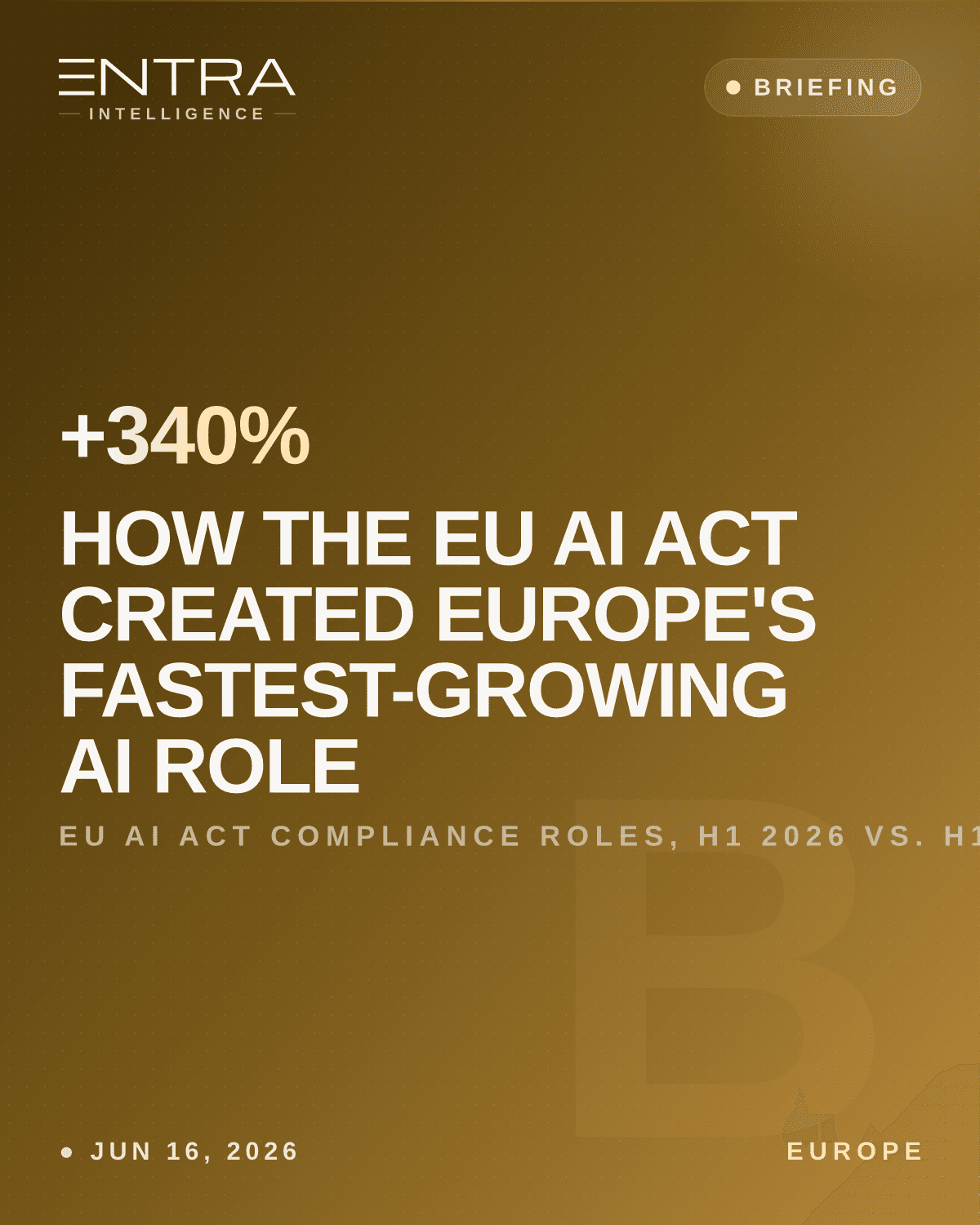
Europe posted roughly 4,800 AI Act-specific compliance roles in the first five months of 2026 — a 340 percent increase on the equivalent period of 2025, per ENTRA's monitoring of LinkedIn postings, Welcome to the Jungle (FR), and JoinIT (DE) job boards across 12 EU member states. The titles generating that volume did not exist as formal job categories inside European AI companies two years ago: AI Compliance Engineer, Conformity Assessment Lead, AI Systems Auditor, GPAI Documentation Specialist. They exist now because the EU AI Act's enforcement architecture has converted regulatory obligation into a structural employment requirement, and the companies building Europe's AI stack — Mistral, Hugging Face, SAP, Deutsche Telekom, Klarna — cannot execute their product and compliance obligations without them.
No American AI company is hiring at this title tier. No Gulf sovereign AI employer is. The EU AI Act's compliance engineering category is, in a market defined by transatlantic compensation competition, the one place where European employers hold structural monopoly on the role itself. That is not a small thing for a continent whose AI talent strategy has spent four years playing catch-up on base pay.
The Act's Talent Side Effect
The EU AI Act's enforcement timeline has created two distinct hiring accelerants operating simultaneously in H1 2026.
The first is the GPAI track, active since August 2025 under Regulation (EU) 2024/1689. Every company training or deploying a general-purpose AI model within the EU — Mistral in Paris, Hugging Face in Paris and Amsterdam, any lab fine-tuning on EU-resident compute — now carries live obligations under Articles 53 and 55: technical documentation of training data provenance, model capability evaluations, energy consumption disclosure, and model cards that can survive AI Office inspection. These are not legal obligations. They are engineering obligations. They require people who can read a transformer architecture, trace a training corpus, and render both in regulatory language.
The second accelerant is the Annex III high-risk enforcement window, extended to December 2, 2027 by the European Council's Digital Omnibus agreement of May 7, 2026. Annex III classifies AI deployed in employment screening, credit decisioning, critical infrastructure, and public services as high-risk — triggering full conformity assessment, Article 9 risk management systems, Article 11 technical documentation, and Article 72 post-market monitoring obligations. For SAP, whose HR product SuccessFactors screens candidates across tens of thousands of European enterprises, for Deutsche Telekom AI deploying network management and customer-service systems across its European and international subscriber base of over 240 million, for Klarna whose LLM-assisted credit decisioning falls squarely within Annex III's financial-services classification — this is not a theoretical future obligation. The audit clock is already running.
The combination is producing a hiring category without precedent. ENTRA's job board monitoring across France, Germany, the Netherlands, Sweden, and Belgium identified the following specific title clusters in active European postings as of early June 2026:
- AI Compliance Engineer — technical architects who design the systems infrastructure for Article 9 risk management and Article 72 post-market monitoring. 1,100+ postings identified across the five-market scan.
- Conformity Assessment Lead — senior individual contributors who own the end-to-end conformity assessment file for high-risk AI systems, managing the notified-body relationship for systems requiring third-party review under Article 43. Approximately 680 postings.
- AI Systems Auditor (German: KI-Systemprüfer) — internal auditors who conduct structured assessments of deployed models against the EU taxonomy, producing findings that survive external scrutiny. Approximately 920 postings, concentrated in Germany.
- GPAI Documentation Specialist — the role specific to foundation-model companies, producing Article 55-compliant model cards and Article 53 transparency documentation. Approximately 440 postings, concentrated in France and the Netherlands.
What These Roles Actually Do
The job description diverges sharply from what traditional compliance and legal functions do, and the divergence is why the roles command a technical premium.
At Mistral, the GPAI Documentation Specialist is not a paralegal. Mistral's GPAI obligations under Article 53 require technical documentation that describes pretraining data sourcing at a level of specificity that only a person who understands data pipeline engineering can actually produce. The model card for Mistral Large 2 — published under Article 55 requirements — documents training data domains, known limitations, and evaluation benchmark results in language that the AI Office can interrogate. The people writing that documentation must be able to validate training data provenance claims against the actual pipeline, assess whether a benchmark result is presented in a way that is technically accurate as well as legally defensible, and respond to AI Office technical queries within the timelines that enforcement requires. Mistral's Brussels regulatory affairs office, now eight people, includes two GPAI Documentation Specialists who operate at the intersection of ML engineering and regulatory writing — a pairing that has no precise equivalent outside the EU.
At Hugging Face, the compliance engineering burden is structurally distinctive because of the open-source model distribution question. Hugging Face's Hub hosts more than 900,000 model repositories. Many of those models are pulled into Annex III high-risk deployments by third-party enterprise users — a healthcare AI company using a Hub-hosted LLM for patient record processing, a fintech pulling a fine-tuned model for credit underwriting. Hugging Face's own GPAI obligations as a model-hub operator are materially different from Mistral's obligations as a model developer: the compliance function must build the taxonomy and tooling to classify which Hub-hosted models trigger GPAI provisions, and must produce the platform-level documentation that its enterprise customers cite in their own Annex III conformity files. Hugging Face's eleven-person EU compliance engineering function in Paris — the largest compliance-specific team at any open-source AI infrastructure company in Europe — is doing work that no US-headquartered open-source AI platform has a structural incentive to replicate. Meta AI distributes Llama 3 globally. It does not face Annex III. Hugging Face does, and the compliance engineering function is the cost — and the competitive signal — of operating at the centre of the European open-source AI ecosystem.
The open-source distinction is load-bearing: open-weight models released via the Hub create a compliance surface that closed-API providers do not share. A company deploying GPT-4o via API can point to OpenAI's documentation. A company deploying a Hub-hosted fine-tune of Llama 3 for Annex III-classified purposes must produce its own conformity assessment from the model card up. That creates demand for Hugging Face's compliance infrastructure that scales with Hub deployment volume — and Hub enterprise deployment volume is growing.
At SAP, the AI Compliance Engineer operates within the product engineering organisation, not in the legal department. SAP Joule — the company's LLM copilot embedded across SuccessFactors, Ariba, and S/4HANA — is classified as high-risk under Annex III when used for HR candidate screening and financial workflow automation. The conformity assessment for Joule in those deployment contexts requires engineers who can instrument the model's inference pipeline for Article 72 post-market monitoring, design the human-oversight interfaces that Article 14 mandates for Annex III high-risk deployments, and maintain the technical documentation file that must be updated each time the underlying model is updated. These are software engineering tasks. SAP currently estimates approximately 140 of its German AI-specific open roles fall into the compliance engineering category — the largest single concentration of senior AI compliance engineering hiring at any European employer by ENTRA's count.
At Deutsche Telekom AI — the company's AI product and platform unit, distinct from its core network engineering function — the AI Systems Auditor runs structured internal assessments of the AI systems Deutsche Telekom deploys for customer interaction and network management, against the Annex III classification criteria for critical infrastructure AI. The role produces audit reports calibrated to withstand review by the Bundesnetzagentur, Germany's national supervisory authority for AI Act enforcement, and feeds findings into the company's conformity documentation maintained under Article 16. Deutsche Telekom's Berlin and Bonn postings for this role, active since Q4 2025, specify "Kenntnisse der EU-KI-Verordnung Anhang III und Erfahrung mit technischer Dokumentation nach Artikel 11" ("knowledge of EU AI Act Annex III and experience with technical documentation under Article 11") — German-language regulatory fluency combined with systems audit methodology.
At Klarna, the Conformity Assessment Lead owns the compliance file for the company's LLM-assisted credit assessment tool — the deployment that most directly triggers Annex III, section 5(b), covering AI in financial services affecting individual creditworthiness. The role manages the notified-body relationship for Klarna's conformity assessment, which under Article 43 requires third-party review for AI systems classified as high-risk in financial services. The Lead also coordinates with the Swedish Finansinspektionen (FI) and the Dutch AFM, Klarna's two primary national supervisors for its EU operations, on AI Act compliance posture. This is senior individual contributor work — not a generalist compliance analyst role, but a named subject-matter owner coordinating across regulatory authorities in multiple jurisdictions.
What These Roles Pay
The compensation picture for EU AI Act compliance engineering sits above traditional compliance and legal functions and below frontier AI research roles — a band that is being actively set by European employers competing for a narrow pool of candidates with the right technical-plus-regulatory skill stack.
In France, Mistral's GPAI Documentation Specialists — per ENTRA's recruiter-side tracking from two Paris-based agencies handling Mistral mandates, sources granted anonymity — open at €95,000–€115,000 base (~$104K–$126K equiv at Q2 2026 EUR/USD rates of ~$1.092). Hugging Face's EU compliance engineers in Paris sit at €88,000–€110,000 base (~$96K–$120K). These are not entry-level numbers: both companies are hiring for the senior-IC tier that has ML engineering background plus regulatory formation, a combination that the Paris grandes écoles and ENS pipeline is only beginning to produce at meaningful volume.
In Germany, SAP's AI Compliance Engineers at Walldorf open at €80,000–€105,000 base (~$87K–$115K), per SAP Germany's published salary bands and recruiter-confirmed offer data reviewed by ENTRA. Deutsche Telekom's AI Systems Auditor roles open at €72,000–€90,000 base (~$79K–$98K), consistent with the company's Tarif collective-agreement pay structure — which includes the full German social wage, employer pension, and statutory benefits that make the effective package approximately 15 percent more favourable than the headline EUR figure implies. Siemens, whose industrial AI falls within Annex III's critical-infrastructure classification, is posting its KI-Systemprüfer roles in Munich and Berlin at €75,000–€95,000 base (~$82K–$104K), per ENTRA's JoinIT (DE) monitoring.
In the Netherlands and Sweden, Klarna's Conformity Assessment Lead role — per the company's Amsterdam and Stockholm job postings — opens at €90,000–€118,000 base (~$98K–$129K), carrying a premium that reflects both the financial-services compliance seniority and the dual-jurisdiction coordination burden. Adyen, whose payment AI edges into Annex III's financial services classification, is hiring AI compliance specialists in Amsterdam at €78,000–€98,000 base (~$85K–$107K).
The cross-market pattern: senior AI compliance engineering pays 55–75 percent of what senior ML research engineering pays at the same companies, but 40–60 percent more than traditional legal or corporate compliance roles. It is not the highest-paid title category in European AI. It is, in H1 2026, the fastest-growing one by posting volume — and the one with the clearest structural barrier to entry that is specifically European.
Why the US and Gulf Cannot Replicate This
The strategic framing matters for understanding why this category is Europe's differentiator and not just a compliance cost.
US AI companies — OpenAI, Anthropic, Google DeepMind US operations — do not hire AI Compliance Engineers of this type because the regulatory obligation does not exist. The United States has no federal AI Act equivalent with Annex III-style risk classification and mandatory conformity assessment. US AI companies hire trust and safety engineers, policy analysts, and legal counsel for their regulatory exposure. None of those roles require the specific combination of ML systems fluency and Annex III classification expertise that the EU AI Act has created. The skill set is not transferable from US employer to EU employer without retraining. The credential formed in this role — delivered conformity assessments, live AI Office documentation review, post-market monitoring system design under enforcement — is intrinsically European.
Gulf sovereign AI employers — MBZUAI, Humain, ADNOC Digital — are building AI capability at scale, but under regulatory frameworks that do not yet impose the same obligations. The UAE AI Ethics Guidelines and Saudi NDMO frameworks do not carry the specific Annex III classification structure. A Conformity Assessment Lead at Klarna is accumulating expertise in a regulatory framework that the Gulf's AI employers have no structural reason to replicate. European AI companies are not, on this dimension, competing with Riyadh or Abu Dhabi for the same roles.
That structural monopoly is not permanent. If EU standards diffuse globally — as GDPR has partially diffused into comparable legislation in California, Brazil, Japan, and South Korea — the compliance engineering category will follow. But in H1 2026, the European AI Act compliance engineering market is a closed labour market, in the most specific sense: the credential can only be formed inside the EU enforcement perimeter.
At Viva Technology in Paris in June 2026, Mistral CEO Arthur Mensch argued that European AI companies are not merely building models — they are building the governance infrastructure that makes those models deployable in democratic societies, a capability he suggested American AI companies will eventually need to source from Europe rather than the other way around. The compliance engineering category is the most concrete instantiation of that thesis in the hiring data.
What's Next
The H2 2026 enforcement calendar is not a single deadline — it is a sequence of pressure points that will sustain the hiring wave through 2027.
The European AI Office publishes its first Annex III conformity assessment guidance for foundation-model-integrated high-risk systems in Q3 2026. That publication will, for the first time, give companies like SAP and Deutsche Telekom a specific standard to audit against — and will trigger a second round of AI Compliance Engineer and AI Systems Auditor hiring as companies identify the gap between their current documentation state and what the guidance requires.
The December 2, 2027 full Annex III enforcement date is when the audit cycle formally begins for most high-risk deployers. Companies arriving at that date without functioning internal conformity assessment infrastructure face enforcement risk from national supervisory authorities — Germany's Bundesnetzagentur, France's CNIL acting in coordination with the AI Office, the Netherlands' ACM. The engineers building that infrastructure in H1 2026 will, by December 2027, hold a professional credential specific to this moment in European regulatory history. It is not unlike the GDPR DPO credential after 2018 — a role that the regulation mandated, that the market initially underpriced, and that commands a 15–20 percent premium over equivalent-seniority IT professionals eight years later, per Bitkom's 2025 DPO salary survey.
The candidate who has delivered a conformity assessment file reviewed by the AI Office, or a post-market monitoring system operating under live enforcement, is not a compliance analyst. That person is building something that does not exist anywhere else in the world — and the European companies competing for that profile in H1 2026 are, whether or not they frame it this way, constructing the talent base that will define how democratic AI governance works at scale. The fastest-growing job title in European AI is not the one anyone predicted. It is the one the regulation required.
 Global Career Platform
Find AI talent. Find your next role.
Booking is hotels. · Airbnb is apartments. · ENTRA is global careers.