
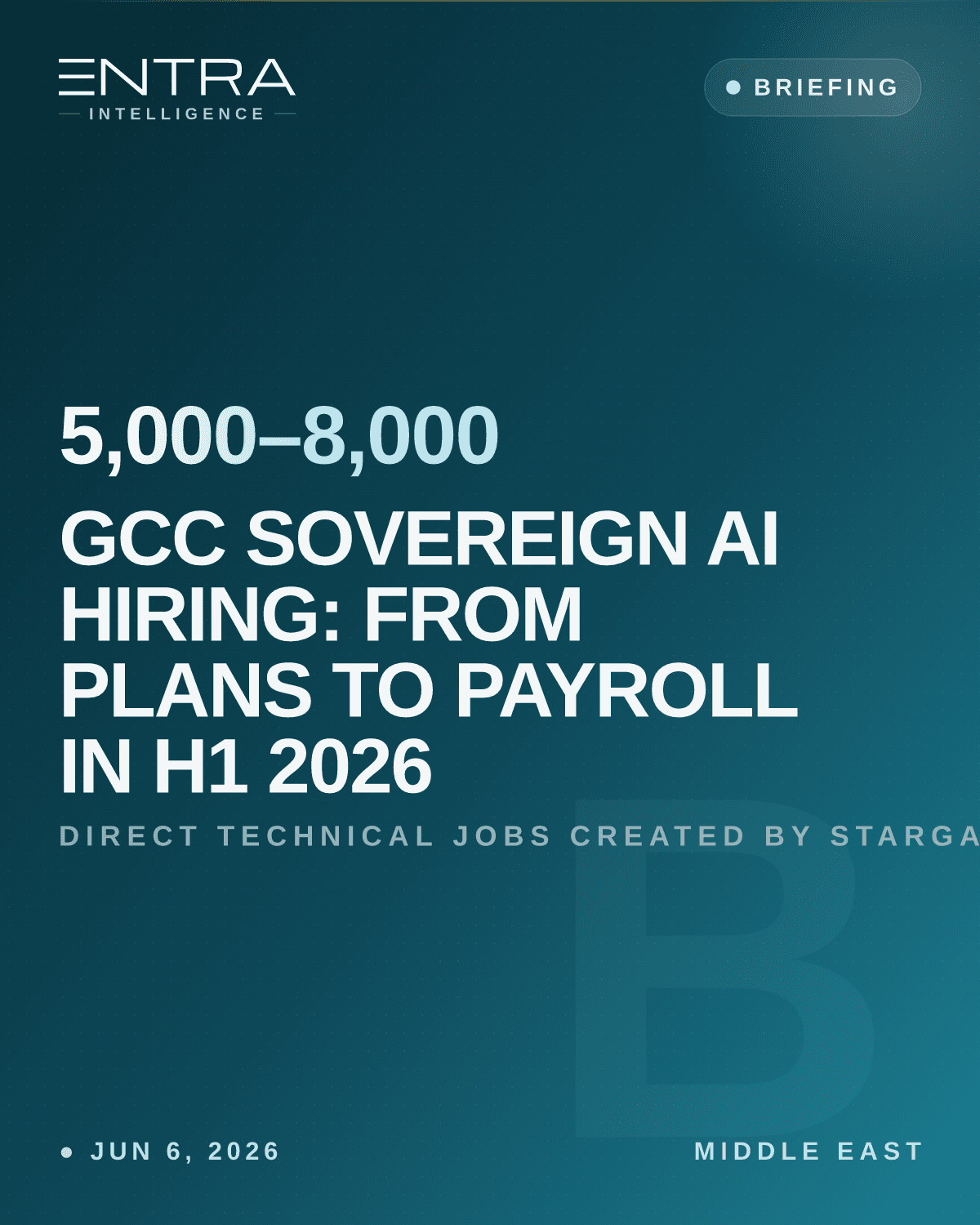
At the midyear mark, the GCC's sovereign AI hiring wave has stopped being a forecast and become a payroll line. G42's Stargate UAE first phase — 200MW of NVIDIA GB300 infrastructure in Abu Dhabi — is on track to complete in Q3 2026, and the talent acquisition pipeline it is forcing is measured in thousands, not hundreds. In Riyadh, Saudi Arabia's Cabinet-designated Year of Artificial Intelligence is compressing SDAIA's 2030 headcount targets into a 2026 execution timeline. At Aramco Digital in Dhahran, 29 active job openings posted in May 2026 alone trace the contour of an energy-AI convergence that has cleared $1.8 billion in documented AI-driven value. Across all three nodes — Abu Dhabi, Riyadh, Dhahran — H1 2026 is the period in which sovereign AI hiring shifted from announced intent to active competition for named individuals.
What Happened
G42 and Core42, Abu Dhabi. The Stargate UAE announcement on April 10, 2026, confirmed a $30 billion AI campus co-developed by G42, OpenAI, and Oracle — but the talent story sits beneath the infrastructure headline. G42 CEO Peng Xiao, speaking at the World Economic Forum in Davos in January 2026, framed the scale directly: "We have KPIs this year to produce over 1 billion AI agents to boost our GDP. These agents range from petroleum engineers to cybersecurity analysts." Building and operating a 1GW cluster against that mandate requires human engineers before it requires AI agents. Phase 1 alone is projected to create 5,000 to 8,000 direct technical jobs during its build-out, with an additional 15,000 to 20,000 indirect roles across the Abu Dhabi AI ecosystem, per analysis compiled by industry trackers covering Stargate UAE in April 2026. Developer demand in Abu Dhabi is expected to increase 60 to 80 percent within 18 months of Phase 1 going live, driven by ML infrastructure, sovereign cloud, and GPU systems engineering roles.
Core42 — the G42 sovereign AI infrastructure subsidiary, not to be conflated with G42's broader holding group or with M42, the healthcare-AI entity — closed the first half of 2026 with two named senior hires that signal the depth of the talent search. In March, former Microsoft executive Sherif Tawfik joined as Chief Business Officer. In April, former Google Cloud executive Emma Cloney was appointed Senior Vice President, International Sales and Strategy. Cloney, based in Core42's Dublin European headquarters, is the operational anchor for the trans-Atlantic talent corridors Core42 is building. Tawfik's public framing at appointment — "Sovereignty, resilience, and infrastructure are becoming the deciding factors" — is not marketing language. It describes the category of engineer Core42 is hiring for: infrastructure specialists who understand national-scale compute obligations, not commercial cloud migration.
The financial architecture enabling this hiring pace is also now confirmed. Core42 secured $550 million in structured trade finance from HSBC across two tranches — $240 million in February 2026 and $310 million in May 2026 — to accelerate AI cloud and compute deployments in the US and Europe. That capital does not stay overseas: the engineering talent to design, deploy, and maintain those international nodes is recruited from and managed through Abu Dhabi, creating a genuine cross-border hiring rationale for ex-US and ex-European engineers who want Abu Dhabi's tax treatment and international scope simultaneously.
The compensation arithmetic for senior AI engineers at G42-group entities in Abu Dhabi runs AED 600,000 to AED 900,000 annually ($163,000 to $245,000+) at principal and director levels, with housing allowances of AED 150,000 to AED 250,000, annual return flights, and children's education support layered on top. UAE levies zero personal income tax. A principal ML engineer earning AED 750,000 in base salary ($204,000) takes home AED 750,000 — no withholding, no FICA, no state liability. The 10-year renewable UAE Golden Visa, available to engineers earning a minimum AED 30,000 monthly basic salary in an MOHRE Level 1 or Level 2 classified role, removes annual visa dependency entirely. G42's hiring team files Golden Visa documentation as a standard offer component, not an afterthought.
SDAIA, Riyadh. Saudi Arabia's Cabinet formally designated 2026 the Year of Artificial Intelligence — a national declaration that translates at the operational level into government-wide AI procurement mandates, regulatory frameworks requiring domestically employed AI engineers, and SDAIA's 20,000-specialist hiring target being pulled forward from a 2030 aspiration toward a mid-decade execution schedule. SDAIA has grown its headcount by 42 percent over the past two years, per industry headcount tracking compiled for the ENTRA ME Bureau. The Future SDAIA Graduate Development Programme, launched in H1 2026, targets new national university graduates for formation in generative AI — a direct pipeline from Saudi institutions into the regulatory authority that sets the rules for every AI deployment in the Kingdom.
The broader Saudi AI labour market framing matters for international candidates evaluating Riyadh. The Kingdom issued more than 8,000 KSA Premium Residency permits in 2024, the largest single-year issuance on record, with the majority under the Exceptional Competence category. The Special Talent Residency product, which targets executives and senior technical professionals earning a minimum SAR 80,000 per month ($21,500), is the instrument SDAIA and HUMAIN — the PIF-majority AI company launched in May 2025 — are using to structure international senior hires. Between January 2024 and July 2025, more than 40,000 people applied for Saudi Premium Residency; the acceptance cadence has accelerated as the Year of AI mandate created urgency around filling senior roles. Unlike the UAE Golden Visa, which is employer-sponsored at the point of qualification, the KSA Premium Residency from year two carries no employer dependency — a structural advantage for senior engineers who want the optionality to move between SDAIA, HUMAIN, and Aramco Digital without restarting their residency clock.
Aramco Digital, Dhahran. Saudi Aramco's technology subsidiary — headquartered in Al-Midra Tower, Dhahran, and distinct from the upstream Aramco business and from NEOM Tech and Digital in the northwest — posted 29 active job openings in May 2026 across IT, AI engineering, and data science. The underlying demand signal is the $1.8 billion in AI-driven Technology Realized Value that Aramco recorded in 2024, 442 identified AI use cases, and over 200 solutions already deployed across the upstream, midstream, and downstream value chain. The open hiring campaign reflects an execution backlog — more deployed AI systems than engineers to iterate on them.
The senior-end Aramco Digital compensation for international AI specialists runs up to SAR 75,000 per month ($20,000) in base salary, with access to the Shaheen supercomputer for model training workloads. Aramco Digital's active postings in H1 2026 include a Computational Research Expert (AI Specialist) requiring a PhD and five years minimum experience — a posting that opened in December 2025 and remains live through December 2026, indicating sustained demand rather than a point-in-time vacancy. The role profiles map directly to the energy-AI intersection: seismic interpretation AI, reservoir simulation ML, and large-language-model development on proprietary Aramco operational data spanning 70-plus years of subsurface records.
Why It Matters
The H1 2026 GCC sovereign AI hiring surge is structurally different from the announcement cycles of 2023 and 2024 because it is now timed to infrastructure delivery. Core42's $550 million HSBC financing is not for planning — it is for hardware procurement and deployment operations. Stargate UAE Phase 1 comes online in Q3 2026 and needs staffed operations teams on the day it does. SDAIA's Year of AI regulatory requirements take full procurement-rule effect in Q3 2026, creating compliance-engineering demand that cannot be satisfied by consultants billing from London.
For a senior IC engineer — ex-DeepMind, ex-Google Brain, ex-Anthropic — evaluating a GCC move, the H1 2026 evidence resolves three prior uncertainties. First, capital availability: Core42's HSBC facilities, G42's Stargate UAE positioning, and HUMAIN's $100 billion-plus planned investment confirm this is not a cycle-dependent hiring surge. Second, technical scope: G42's 1GW compute target and Aramco Digital's proprietary subsurface AI dataset represent infrastructure and data access that Western frontier labs cannot replicate in kind. Third, career permanence: the UAE Golden Visa and KSA Premium Residency mechanisms provide decade-scale residency certainty without employer dependency, removing the immigration volatility that historically compressed GCC offers relative to US alternatives.
The tax-adjusted comparison now closes decisively for senior roles. A principal AI engineer at a US frontier lab earning $400,000 total comp in California nets approximately $260,000 after federal and state income tax. An equivalent package in Abu Dhabi — AED 900,000 base ($245,000) plus AED 200,000 housing allowance ($54,500) — delivers $299,500 fully retained. The GCC corridor is not a compensation trade-off. At the senior level, on a tax-adjusted basis, it is a compensation upgrade.
What's Next
The H2 2026 acceleration has four concrete signals already visible.
Core42's European deployments in Italy and France, anchored from the Dublin hub, will require a second wave of infrastructure engineers hired in Abu Dhabi and embedded internationally — a talent flow that runs the opposite direction of historical Gulf hiring patterns. Watch Core42's LinkedIn postings for a surge in infrastructure and MLOps roles in Q3 2026.
SDAIA's Year of AI procurement mandates take full effect in Q3 2026. The compliance-engineering roles created by those mandates — roles that regulatory architecture requires to be held by Saudi-domestically-employed engineers — will generate a hiring event distinct from SDAIA's own headcount growth. HUMAIN, Aramco Digital, and the emerging Saudi AI Act compliance consultancy layer will all be hiring for the same specialist profile in the same compressed window.
MBZUAI, Abu Dhabi's AI research university, is executing a sustained faculty expansion toward 300 faculty by 2030 from its current 80-plus — with 50 faculty hires per year as the target cadence. H2 2026 is the third year of that cadence. The research-to-industry pathway between MBZUAI and Core42 is established, operational, and producing engineers who begin their careers inside the G42 ecosystem with sovereign compute access from week one.
G42's first NVIDIA GB300 chip shipments are arriving "within months," per Peng Xiao's January 2026 statement — placing the first 200MW compute commissioning squarely in Q3 2026. The operations and engineering teams required to run a live 200MW cluster do not get hired after commissioning. They get hired now. The Q3 2026 go-live date is the hiring-calendar driver that makes June and July 2026 the optimal entry window for senior engineers who want to be part of the commissioning cohort rather than the second wave.
The GCC sovereign AI hiring market in H2 2026 is not a pipeline building toward a future state. It is a live staffing operation running against fixed infrastructure milestones. The offers going out this week are real. The visa mechanisms are operational. The compute is arriving.