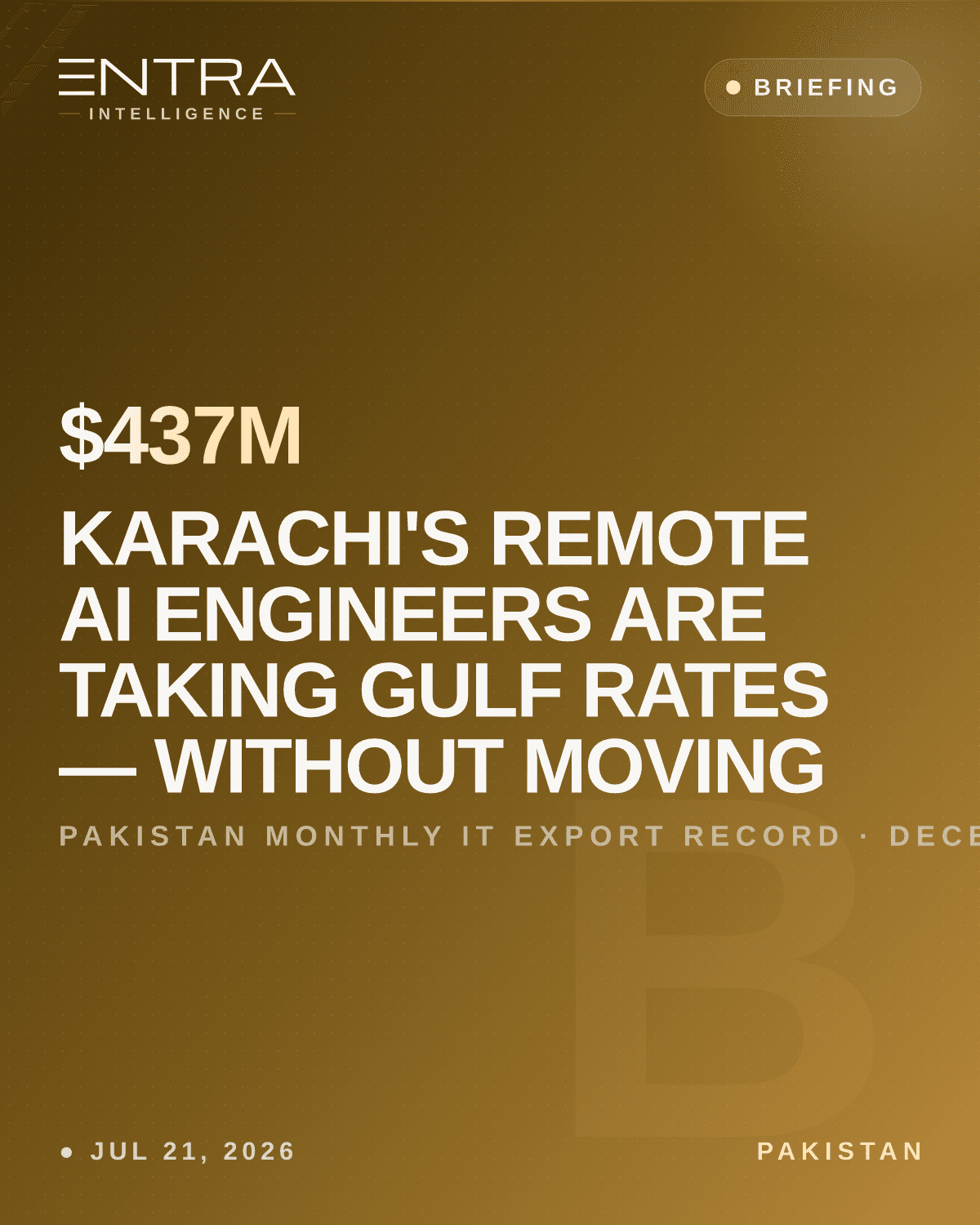
Pakistan's IT export sector recorded $437 million in a single month in December 2025, the first time monthly IT exports crossed the $400 million threshold, per PSEB (Pakistan Software Export Board) data. Behind that number, at the center of the corridor producing it, is Karachi: Pakistan's commercial capital, home to the largest private-sector technology employer base in the country, and operating at UTC+5, precisely one hour ahead of Gulf Standard Time (UTC+4), which governs the UAE (Abu Dhabi, Dubai) and Oman. Saudi Arabia operates on Arabia Standard Time (UTC+3), placing Karachi two hours ahead of Riyadh. The scheduling gap between a Karachi engineering team and a Dubai or Abu Dhabi team lead is a single hour; for Riyadh-based leads, it is two hours — still compact by global remote standards. Gulf AI employers are pricing that in.
The comp spread defines the model. A Karachi-based senior ML engineer on a domestic contract at a top Pakistani technology firm earns between PKR 8 million and PKR 15 million annually (ENTRA Pakistan AI Salary Index Q2 2026, cross-referenced against levels.fyi Systems Limited Pakistan data and Glassdoor Pakistan ML engineer rates, Q2 2026) — equivalent to approximately $29,000 to $54,000 at prevailing State Bank of Pakistan exchange rates. A Gulf AI employer engaging the same profile on a remote USD-denominated contract through an employer-of-record structure pays $40,000 to $80,000 annually (ENTRA estimate, cross-referenced against Jobicy Pakistan AI engineer remote rate data and NaukriGulf UAE ML engineer market rates, Q2 2026). The engineer earns more. The Gulf employer pays 35 to 55 percent below the cost of the equivalent in-Dubai hire. Neither party relocates.
The Gulf Pipeline: In-Market vs. Remote-from-Karachi
Pakistani engineers are not new to the Gulf. They constitute one of the largest professional diasporas across the UAE, Saudi Arabia, and Qatar — a structural fact reflected in Emirate-level visa statistics and in the composition of engineering teams at entities ranging from PIF-anchored Humain to Mubadala-backed G42. The in-market track still runs. A Pakistani senior ML engineer relocating to Dubai under a UAE Golden Visa-eligible employer earns AED 25,000 to AED 45,000 per month (approximately $82,000 to $148,000 annually, tax-free), with standard Gulf package additions including housing allowance and school fee contributions for dependents.
What shifted in 2025 and into 2026 is the formalization of the parallel track: remote-from-Karachi under a Gulf entity employer-of-record structure. Careem, the Dubai-headquartered super-app subsidiary of Uber co-founded by Pakistani-born Mudassir Sheikha, built its engineering culture with a core Pakistan hiring pipeline from the outset. Careem's NextGen graduate programme has supported engineers across Pakistan, Jordan, and Egypt since inception; data science, platform infrastructure, and ML roles in the Pakistan engineering base contribute to shared Gulf-serving functions, including demand forecasting and Arabic-language customer experience tooling that runs across the Careem network in Riyadh, Abu Dhabi, and Manama. The Karachi engineering output is not separate from the Gulf AI product. It is the Gulf AI product, distributed.
The employer-of-record structure enabling the broader remote model is mature. Deel and Remote.com both cover Pakistan as a standard jurisdiction, processing payroll in USD or PKR at SBP prevailing rates with full Pakistani labour law compliance. Gulf AI employers do not require a Pakistan-registered entity to engage Karachi engineers at the $40,000-to-$80,000 band. The EOR layer absorbs the compliance overhead, and PSEB-registered remote engineers on foreign-origin income pay a final tax of 0.25 percent — confirmed at that rate until June 2029 under current FBR and PSEB regulatory frameworks — against the one percent rate for unregistered individuals. The State Bank of Pakistan additionally raised the foreign currency retention limit for IT exporters from 35 percent to 50 percent in 2025, allowing engineers on Gulf remote contracts to retain a larger USD-denominated share of their earnings without mandatory conversion to PKR at spot rates.
Key Remote AI Employers and Compensation Bands
Systems Limited, listed on the Pakistan Stock Exchange (PSX) with approximately 3,600 professionals, is the largest publicly traded IT services firm in Pakistan and the most legible anchor for Gulf AI employers building a remote engineering bench in Karachi. Its AI and data practice covers enterprise ML deployments in banking, healthcare, and financial services — verticals that map directly to what ADNOC Digital, QIA-portfolio entities in Doha, and stc Group's technology subsidiaries are executing in 2026. A senior ML engineer at Systems Limited earns a median PKR 4.61 million annually on domestic contract (levels.fyi Systems Limited Pakistan data, Q2 2026). A Gulf remote rate at $55,000 to $65,000 represents a 2.5x to 3x step-up in USD terms on that domestic ceiling, making remote conversion straightforward to negotiate.
Arbisoft, a technology firm with 1,000-plus professionals operating across Pakistan, offers a dedicated AI solutions practice spanning generative AI development, data science, and AI training data pipelines (Arbisoft official practice documentation, 2025-26). The training data capability is the precise specialisation that Gulf frontier-AI employers and sovereign compute entities including G42 and Core42 require as they build Arabic-language model training datasets. Arbisoft functions as a supply-side partner rather than a staff augmentation vendor — its engineers are building production AI systems, not providing bodies.
TRG Pakistan, the Karachi-headquartered holding company founded by Zia Chishti, is among the most operationally scaled Pakistan-side AI contractors accessible to Gulf employers. TRG's subsidiary Ibex Global operates AI-powered customer experience automation at scale across Pakistan and the Philippines. The CX AI infrastructure Ibex has built is directly relevant to Gulf employers constructing Arabic conversational AI products — it provides annotated production data, trained CX model infrastructure, and operational-scale deployment experience without requiring the Gulf employer to build internal annotation pipelines from ground zero.
Microsoft maintains an active partner network and developer community in Karachi, producing a certified ML engineering cohort legible through the Microsoft Partner Network. Gulf AI employers sourcing Karachi engineers through Microsoft's partner ecosystem inherit Microsoft's own training and certification screening, reducing pre-hire assessment overhead. Google's developer relations presence in Pakistan supports a similar pipeline of TensorFlow and Google Cloud-certified engineers visible to Gulf cloud AI teams via standard GCP certification registries.
The Cost Arbitrage: Karachi vs. Dubai
A two-bedroom apartment in DHA (Defence Housing Authority) or Clifton — Karachi's premium professional residential zones, occupying the same coastal strip where the AAE-1 submarine cable lands at Clifton beach — rents at $800 to $1,100 per month (ENTRA Pakistan Cost Index Q2 2026, cross-referenced against Zameen.com Karachi residential data, May-June 2026). The Dubai equivalent for a comparable JLT-to-DIFC two-bedroom runs AED 9,000 to AED 14,000 monthly ($2,450 to $3,800). A Karachi engineer on a $60,000 Gulf remote contract retains purchasing power comparable to a Dubai-resident engineer earning approximately $110,000 to $130,000 before allowances. No UAE income tax applies to the Dubai engineer; no Pakistani income tax applies to the Karachi engineer's foreign-origin income at rates above 0.25 percent (PSEB registered, FBR Final Tax Regime). The Karachi engineer is not taking a discount. They are, by purchasing-power equivalence, accessing a better deal.
Pakistan's freelance and remote-export sector is already the fourth-largest globally by online labour volume, per the Oxford Internet Institute's Online Labor Index (OLI), reflecting a workforce that has been pricing remote work accurately for more than a decade. Pakistan's total IT exports for the nine-month period ending March 2026 reached $3.39 billion, up 20 percent year-on-year, with freelancers and remote workers accounting for approximately one in every four dollars of that total (PSEB, State Bank of Pakistan remittance data, 2026). The Karachi engineer on a Gulf remote contract at $60,000 is not an exception in the Pakistani market. They are the median outcome of an export-oriented engineering economy that has been building since 2015.
Digital Infrastructure: The Clifton Bandwidth Stack
The connectivity case for Karachi remote work rests on a geographic fact. Pakistan's AAE-1 submarine cable lands at Clifton beach — the same district anchoring Karachi's DHA and Clifton premium residential zones where the Gulf remote engineering cohort is concentrated. Across six active undersea systems (AAE-1, SMW4, SMW5, PEACE, TWA-1, 2Africa), Pakistan holds 13.2 Tbps of international subsea bandwidth (PTA infrastructure data; SubseaCables.net, 2025-26). SMW6 adds approximately 4 Tbps of additional capacity upon activation in late 2026, a 30 percent expansion. Cybernet's Nokia-partnership 12T-per-lambda backbone, activated in May 2025, interconnects more than 25 Pakistani cities and provides the data center interconnect layer that Karachi-to-Gulf real-time collaboration infrastructure requires (Cybernet-Nokia press release, May 2025).
Transworld Associates (TWA) opened a Tier III-certified data center in Karachi in January 2026, providing enterprise-grade colocation and compute infrastructure that underpins Gulf employer equipment delivery and data compliance for Pakistan-side remote engineering pods. StormFiber is the primary residential fiber ISP expanding across Karachi's DHA, Clifton, and Gulshan districts. Pakistan's Connect Pakistan 2030 strategy targets 100 Mbps baseline speeds and 10 million fiber-connected households nationally; Karachi's premium residential districts are operating above the current national median on StormFiber fiber-connected premises.
H2 2026 Catalysts
Three catalysts compress the timeline for Gulf employers evaluating Karachi.
Pakistan's first-ever IT Census, announced in 2026 in collaboration with the Pakistan Bureau of Statistics, will produce the first audited, geography-disaggregated count of the country's technology workforce by specialisation and employment model (Pakistan Ministry of IT and Telecom, 2026). Until the census data publishes — expected in Q4 2026 — Gulf employer estimates of the Karachi senior ML engineer pool rely on proxies: PSX filings from Systems Limited, PSEB registration counts, and LinkedIn profile tracking. The census will close that gap and make Karachi AI engineer supply as legible for Gulf employers as Egypt's MCIT programme data has made Cairo.
The UAE-Pakistan Special Economic Zone and digital cooperation MoU signed in April 2025, between Pakistan's Board of Investment and UAE's International Free Zones Authority (IFZA), facilitates direct Pakistan-side entity establishment under IFZA digital licensing frameworks — company registration in 48 hours (Modern Diplomacy, IFZA MoU coverage, April 2025). Gulf AI employers currently running Pakistan remote teams through EOR-platform intermediaries gain a direct-entity alternative in H2 2026 under that bilateral framework. Direct-entity structures reduce per-engineer compliance overhead at the 10-plus-engineer cohort size, below which EOR platforms remain the more efficient route.
Karachi's planned IT Park — 1.12 million square feet, targeting approximately 13,400 technology jobs — advances from planning into active development in 2026 under Sindh government and Board of Investment SEZ financing. When operational, it consolidates the Karachi AI supply bench into a single co-location infrastructure with Gulf employer-ready entity registration, equipment delivery, and physical data compliance capabilities, replacing the current dispersed DHA and Clifton office address model that remote engineering pods currently use.
The Karachi UTC+5 advantage is structural. One hour from Dubai/Abu Dhabi standups; two hours from Riyadh. No relocation overhead. A domestic talent pool that is already exporting $437 million a month. Gulf employers who build the contracting architecture in H2 2026 will access that spread before it prices to match the Cairo corridor — where competition has already narrowed the cost advantage on the same timeline.
 Global Career Platform
Find AI talent. Find your next role.
Booking is hotels. · Airbnb is apartments. · ENTRA is global careers.