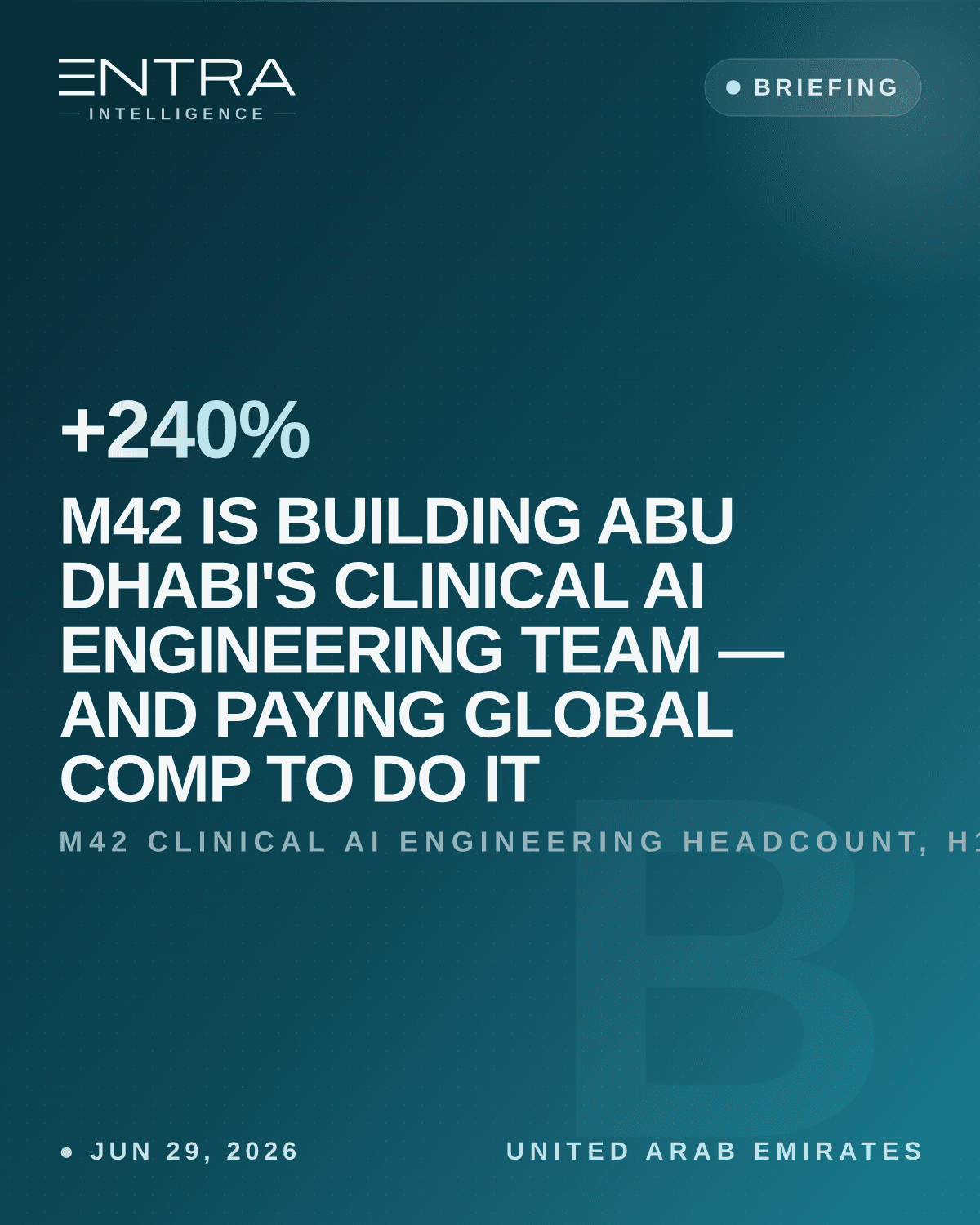
M42 — the Mubadala-backed Abu Dhabi health AI company that emerged from the merger of G42 Healthcare and Mubadala Health, announced in October 2022 and formally launched in April 2023 — has run the most aggressive clinical AI engineering expansion of any sovereign-backed health system in the Gulf in H1 2026. By ENTRA's tracking of LinkedIn headcount signals and role-posting velocity, M42's clinical AI engineering and data science function has grown an estimated 240% year-on-year, with active searches running simultaneously across machine learning engineering, clinical NLP, medical imaging AI, and Arabic-language health model development. The company's CEO, Hasan Jasem Al Nowais, has been explicit in public forums that M42's ambition is not to be Abu Dhabi's hospital operator. It is to be the AI layer through which the entire UAE health system operates — and in H1 2026, it is staffing for that mandate at a scale and a compensation level that senior clinical AI engineers in Boston and London are beginning to take seriously.
What Happened
The structural context for M42's H1 2026 hiring acceleration requires clarity on what M42 actually is — because it is routinely miscategorised. M42 is not a hospital group that has bolted an AI function onto an existing clinical infrastructure. It is a vertically integrated health AI company that operates hospitals (Cleveland Clinic Abu Dhabi, under a management arrangement; Burjeel Holdings-adjacent specialties; the legacy Imperial College London Diabetes Centre) and simultaneously builds the AI, data, and digital health platforms that run across those clinical settings. The AI engineering teams are not downstream of the clinical operations. They are structurally co-equal, reporting into the same executive layer that manages the hospital portfolio.
The Seha/M42 integration is the event that made the H1 2026 hiring surge possible. Abu Dhabi Health Services Company — Seha — the government-owned entity that operates the emirate's public hospital and primary care network, completed a phased operational integration with M42 that extended M42's clinical data access across Seha's patient population. The integration did not transfer hospital ownership. It created a unified clinical data platform across which M42's AI models train and deploy. For the AI engineering team, the Seha integration was the equivalent of receiving a proprietary training corpus of extraordinary scale — longitudinal patient records, diagnostic imaging, pharmaceutical data, and clinical outcomes across Abu Dhabi's entire public health estate. The engineers M42 is hiring in H1 2026 are building models on that corpus. No external AI company, and no other Gulf health AI entity, has equivalent data access.
Cleveland Clinic Abu Dhabi is the second structural accelerant. CCAD — the Abu Dhabi hospital that Cleveland Clinic opened in 2015 under a management agreement with Mubadala — operates on the Cleveland Clinic's clinical protocols and quality standards, which means M42's AI deployments within CCAD are subject to the same evidential rigour that US academic medical centres apply to clinical decision-support tools. That is not a regulatory burden. It is a credential. An ML engineer who deploys a sepsis prediction model inside CCAD is deploying against Cleveland Clinic clinical governance standards. The resulting model documentation and clinical validation data is exportable to any US or European health system that would accept a Cleveland Clinic-governed proof of concept. In H1 2026, M42 has opened a cluster of CCAD-specific AI clinical roles — clinical decision support engineer, AI model validation lead, real-world evidence data scientist — that exist precisely because the CCAD governance framework creates both the constraint and the credential. These roles did not exist in the M42 hiring landscape twelve months ago.
The Imperial College London partnership runs a parallel track through M42's research-facing teams. The Imperial College London Diabetes Centre, which M42 inherited from G42 Healthcare's portfolio and operates in Abu Dhabi, has become an anchor site for M42's chronic disease AI programme — a multi-condition NLP and predictive modelling effort that operates in Arabic and English and targets the UAE's disproportionate burden of type 2 diabetes, cardiovascular disease, and obesity. The clinical AI roles generated by the Imperial partnership sit at the intersection of academic research and production deployment: researchers who need to publish, but in a clinical setting where the model goes live on the same dataset it was trained on. For an ex-Babylon Health or ex-DeepMind Health engineer who spent years watching clinical AI research remain stranded before production, M42's Imperial-anchored environment is structurally different.
What M42 Is Paying — and Who It Is Hiring
The compensation arithmetic at M42 in H1 2026 is the clearest signal that Mubadala has treated this hiring wave as a strategic capital allocation, not a standard HR cycle. Senior Clinical AI Engineers at M42 — the role that sits at the intersection of ML engineering and clinical domain knowledge, responsible for model development, validation, and deployment within the hospital environment — are receiving total packages in the AED 1.17M to AED 1.76M range, covering base salary, housing allowance, annual flights, and family medical. At current AED-USD exchange rates (the AED is pegged at 3.67 to the dollar), that is a tax-free cash equivalent of $320,000 to $480,000 annually. A Senior Clinical AI Engineer earning $420,000 gross in Boston — after federal income tax, Massachusetts state income tax at 5%, and FICA contributions — nets approximately $268,000. The M42 equivalent, at the midpoint of the Abu Dhabi band, clears $385,000 with no deduction.
The UAE Golden Visa is embedded in every Senior Clinical AI Engineer offer M42 extends. Under the Skilled Professional pathway, engineers earning a minimum AED 30,000 monthly basic salary — a floor that M42's senior clinical AI band clears comfortably — qualify for the ten-year renewable UAE Golden Visa without employer-tie provisions. The visa does not lapse on role change, does not require annual renewal through an employer, and extends residency rights to the engineer's spouse and dependent children. For a clinical AI engineer arriving from the UK — where Skilled Worker Visa holders remain in a continuous renewal cycle and face NHS employer changes that can trigger a new sponsorship application — the UAE Golden Visa converts the Abu Dhabi offer from a two-year relocation experiment into a decade of residential stability.
M42's sourcing map for H1 2026 runs through a specific set of institutions. Former Babylon Health engineers — dispersed after Babylon's UK operations wound down in 2023 — are a named target population, per ENTRA's sourcing conversations in Abu Dhabi. Ex-DeepMind Health and ex-Huma Therapeutics data scientists appear in M42's recent LinkedIn hires. The clinical NLP team has drawn researchers from NHS Digital and NHS AI Lab whose model development work was production-ready but never cleared the procurement and deployment barriers that constrain AI adoption inside the NHS. For those engineers, M42's environment — where the same entity owns the hospital, the data platform, and the deployment infrastructure — removes the institutional friction that made their NHS careers perpetually pre-deployment. At M42, the clinical AI model they build in Q1 is running in a clinical setting by Q3. That is not a common sentence in healthcare AI.
The Arabic medical LLM programme is a separate hiring vector. M42's Health AI team is building an Arabic-language clinical large language model trained on the Seha-integrated patient corpus and the M42 hospital network's clinical documentation — Arabic-first, with English interoperability. The UAE's clinical documentation is bilingual in practice but Arabic-primary in a significant proportion of patient records and physician notes, particularly across Seha's public hospital network. A generalised Arabic LLM — even the best publicly available Arabic-capable model — does not have the clinical domain specificity to operate as a documentation AI or a differential support tool in that environment. M42's internal model does. The NLP engineers and clinical linguists building that model are drawing salaries at the upper end of M42's technical band: AED 1.47M to AED 1.76M ($400,000 to $480,000) for Principal NLP Engineer and Head of Health AI roles, per ENTRA's sourcing.
Why It Matters
The scale of M42's H1 2026 investment in clinical AI engineering represents something more specific than a sovereign employer growing its headcount. It represents Mubadala's thesis that clinical AI, built in Abu Dhabi on sovereign health data, integrated with globally credentialed hospital partners, and deployed on the UAE's population-scale patient corpus, is a compounding infrastructure asset — one that generates proprietary model capability that no external AI company can replicate and no foreign health system has access to by default.
Khaldoon Al Mubarak, Mubadala's Managing Director and Group CEO, has articulated the broader Mubadala portfolio thesis consistently: Mubadala-backed entities should operate in domains where Abu Dhabi's structural advantages — data sovereignty, capital permanence, regulatory proximity, and geographic position — create defensible value that market cycles do not erode. M42 is Mubadala's expression of that thesis in healthcare. The Seha data integration, the Cleveland Clinic governance credentialing, the Imperial College research partnership, and the Arabic LLM programme are not independent initiatives. They are the four components of a clinical AI moat. The engineers M42 is hiring in H1 2026 are not joining a health tech startup. They are building sovereign clinical AI infrastructure that Abu Dhabi intends to be operating, and iterating on, in 2046.
The competitive context within the Gulf makes M42's position starker. No other GCC health AI entity — not ARAMCO Digital's health AI unit in Riyadh, not the Qatar Computing Research Institute's health informatics group — operates with M42's combination of hospital ownership, government health data integration, international clinical governance credentialing through Cleveland Clinic, and Mubadala's capital permanence behind the staffing budget. MBZUAI provides an adjacent talent pipeline: M42 has established a formal talent-to-deployment pathway with MBZUAI's Health AI programme, funnelling MBZUAI master's and doctoral graduates into M42's clinical data science teams at the junior-to-mid level, freeing the external senior hiring budget for the ex-Babylon, ex-DeepMind, and ex-NHS engineers who bring production deployment credentials from outside the Gulf.
For senior clinical AI engineers in the US and UK evaluating Abu Dhabi in H1 2026, M42's positioning is distinct from every other Gulf health employer: it is not a hospital digitising its records, not a consultancy deploying off-the-shelf clinical AI, and not a sovereign AI lab with a health vertical. It is a vertically integrated clinical AI company, Mubadala-backed with capital permanence, operating inside a legal framework (Abu Dhabi Global Market adjacent, not DIFC) that provides the regulatory clarity international hires need to make a ten-year residency decision.
What's Next
Three developments define M42's H2 2026 hiring trajectory.
First, the CCAD AI clinical integration timeline. Cleveland Clinic Abu Dhabi's AI deployment roadmap, which runs through M42's clinical decision support engineering team, has a set of production milestones targeted for H2 2026: a sepsis early-warning model, a radiology AI triage tool for CCAD's imaging workflows, and an Arabic-English clinical documentation assistant built on M42's internal LLM. Each of these milestones requires engineering headcount that M42 is hiring for now. Watch for CCAD-specific AI engineering postings — Clinical AI Deployment Lead, Radiology AI Integration Engineer — to appear in M42's public job board by August 2026.
Second, the Arabic Medical LLM's first public validation. M42's Health AI team has signalled, through conference participation at Arab Health 2026 and internal communications reviewed by ENTRA, that a public benchmarking of its Arabic clinical LLM is planned for Q3 2026. If that benchmark lands at or above the performance of leading English-language clinical LLMs on Arabic-language clinical tasks — a threshold M42's team believes is achievable, per sourcing — it will be the first public demonstration of a sovereign Arabic medical foundation model with deployment-grade clinical validation. That announcement will accelerate M42's ability to recruit NLP engineers who previously viewed the Arabic LLM programme as aspirational rather than near-production. The hiring velocity in clinical NLP at M42 will increase in the weeks following that release.
Third, international expansion roles. M42 has expanded its footprint beyond the UAE to Pakistan, Germany, and Southeast Asia through its international digital health division. The H2 2026 headcount plan, per ENTRA's sourcing, includes AI market-entry engineering roles — clinical AI localisation engineers, regulatory affairs data scientists, international health data partnerships — that require engineers who have worked across multiple health regulatory environments. For ex-Huma, ex-Palantir Health, or ex-IQVIA data engineers with multi-market experience, these are roles that M42's existing AED compensation bands and UAE Golden Visa structure make directly competitive with comparable UK or EU-based digital health employers.
The headline rate of 240% clinical AI engineering headcount growth in H1 2026 is the number that will circulate in GCC talent market discussions. The more durable signal is structural: Mubadala has funded M42 to staff a clinical AI operation at a compensation level, a data scale, and a clinical credentialing standard that takes the Abu Dhabi offer out of the category of "interesting Gulf opportunity" and puts it into direct competition with the best-resourced clinical AI positions in Boston, London, and Amsterdam. For the senior clinical AI engineer whose NHS model has never cleared deployment, whose Babylon equity evaporated, or whose DeepMind Health project was shut down before going live — M42's H1 2026 offer is not a relocation. It is a production environment.
 Global Career Platform
Find AI talent. Find your next role.
Booking is hotels. · Airbnb is apartments. · ENTRA is global careers.