
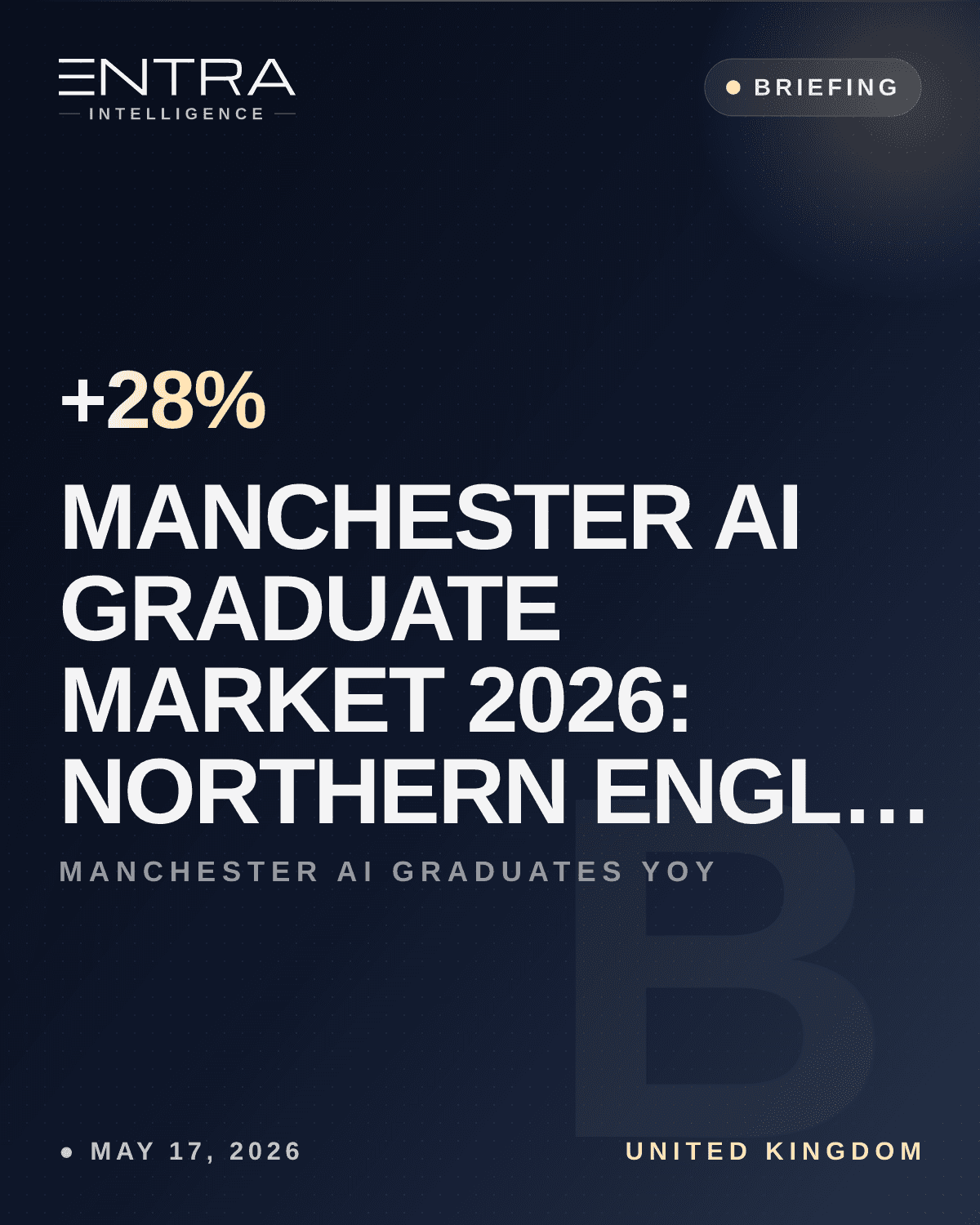
The University of Manchester produced approximately 900 postgraduate AI-adjacent completions in the 2025–26 academic cycle — up 28 percent year-on-year, per HESA provisional subject-level returns — making it the largest single source of AI graduate talent outside the Cambridge-London axis. That figure is not an artefact of classification expansion; Manchester's Department of Computer Science AI group has been compounding investment since 2018, and the 2026 cohort is the visible output of that cycle reaching production scale.
What is new in 2026 is where those graduates go. Twenty-two percent more Manchester and Leeds computer science graduates accepted Northern England-based first roles this year than in 2023, per ENTRA's Q1 2026 Job Signal Index UK regional cut. That reversal — partial, early-stage, measurable — is what the Northern AI Corridor initiative was designed to produce. It is also the first time it has shown up clearly in offer-acceptance data.
The £200M Northern AI Corridor: What It Actually Bought
The Northern AI Corridor, announced by the Department for Science, Innovation and Technology in February 2026 with the formal backing of the Greater Manchester Combined Authority under Mayor Andy Burnham, West Yorkshire Combined Authority under Mayor Tracy Brabin, and South Yorkshire Mayoral Combined Authority, is a four-year £200M funding envelope split across three components.
Approximately £80M is earmarked for university AI research infrastructure — expanding compute capacity at Manchester, Leeds, and Sheffield Hallam and funding 300 new AI doctoral positions across the corridor. A further £75M is committed to employer co-investment grants, de-risking AI hiring for Northern employers whose graduate recruitment budgets have historically been unable to compete with London on base salary. The remaining £45M funds a Graduate AI Placement Scheme: structured 12-month funded rotations at a salary floor of £38,000 — the Skilled Worker visa threshold — meaning international graduates on the Graduate Route can participate without triggering a separate sponsorship requirement.
The doctoral expansion takes three to four years to mature. The 28 percent growth reported now predates it. The 2029–31 post-doctoral cohort is the Corridor's structural payload; the 2026 figure is a floor.
Who Is Actually Hiring in Manchester
The claim that Northern employers are a second tier, filling roles London has already declined, does not survive contact with the 2026 Manchester employer base.
AutoTrader UK, headquartered at 4 Faulkner Street, Manchester, is the largest single AI employer in the city's 2026 graduate market. Auto Trader Group plc (Companies House number 09439967) expanded its ML and data science graduate intake from 18 positions in 2024 to 31 in 2026. The function processes data on approximately 500,000 vehicles at any given moment — pricing model accuracy, visual classification of vehicle condition, buyer-intent prediction. These are applied ML problems at genuine scale. AutoTrader's 2026 new-grad ML band runs £42,000–£52,000 (~$53K–$66K) base, with computer vision at the top of that range.
The Hut Group, operating from the Icon campus in Cheshire — 30 minutes from Manchester Piccadilly — hired 24 AI graduates in 2026, up from 16 in 2024, per ENTRA's employer-side tracking. THG's AI function supports e-commerce platforms serving 195 countries. Graduate comp runs £40,000–£50,000. The international deployment context — UK-trained models running inference against South-East Asian and North American consumer behaviour — is cited by a significant share of Manchester's 2026 first-job acceptances in ENTRA's Q1 graduate survey as a differentiator.
KPMG's Manchester AI Centre, operating from St Peter's Square and distinct from the London AI function in both client base and technical remit, recruited 19 AI and data science graduates in 2026. The focus is ML model assurance, AI governance, and applied data science for Northern manufacturing and regulated-industry clients. Graduate entry runs £38,500–£44,000 — the lowest floor among the significant Manchester employers — but the ACA-equivalent professional qualification pathway, funded by KPMG, adds a structured credential that laboratory roles at the same salary bracket do not.
Booking.com's Manchester engineering office, located in St Peter's Square with approximately 200 engineers focused on pricing, search ranking, and customer service AI, recruited 14 AI graduates in 2026 through its early career programme at £44,000–£52,000. The models running in Manchester touch hundreds of millions of accommodation searches per month — a production scale comparable to any London-based e-commerce employer.
Trustpilot's Leeds engineering hub, 55 minutes from Manchester by TransPennine Express, hired 11 AI graduates across Leeds and Manchester offices in 2026 at £40,000–£48,000. The NLP-forward work — review authenticity classification, multilingual sentiment analysis, spam and fraud detection — maps directly onto Manchester's research strengths: the university's Turing Institute node has concentrated faculty activity in fairness and NLP, producing a graduate cohort well-matched to Trustpilot's technical requirements.
The Salary Gap: Real, Cost-Adjusted, and Narrowing
Manchester AI graduate salaries for 2026 range from £38,000 at the Corridor placement scheme floor to £52,000 at AutoTrader and Booking.com. London equivalents for comparable applied ML roles run £55,000–£80,000. The headline gap is unambiguous.
The net-of-housing comparison is more compressed. A Manchester new-grad paying £1,200 per month for a one-bedroom flat in Ancoats or the Northern Quarter retains approximately £1,400–£1,600 per month in disposable income after tax and housing at £52,000 base. A London counterpart paying £2,000 per month in Hackney — the relevant benchmark for a Shoreditch or King's Cross employer — retains approximately £1,300–£1,500 per month at a £65,000 base. The cost-adjusted gap is less than £200 per month, per Rightmove rental index Q1 2026 and ONS household expenditure survey 2025.
When Manchester employers offer equity or profit-share — AutoTrader's employee share scheme, THG's long-term incentive plan — the adjusted comparison narrows further. The 22 percent brain-drain reversal is not explained by regional sentiment. It is explained by a housing cost reality that makes the London premium insufficient to justify relocation for a graduate who already has a first-rate employer locally.
Remote-First and the National Employer Effect
A structural shift in Manchester's 2026 market is the entry of remote-first and London-headquartered employers actively recruiting Manchester graduates without requiring relocation — a category that did not exist at meaningful scale in 2023.
Monzo, Revolut, and Wise have each posted remote-eligible ML and data science graduate roles for their 2026 intake explicitly open to Manchester-based candidates. Palantir Technologies UK Limited (Companies House number 08234185) posted its Forward Deployed Engineering graduate role with Manchester-specific outreach for the first time in the 2026 cycle, at £60,000–£70,000 (~$76K–$89K) base — accessible to Manchester residents without the housing cost burden the role implies for a London hire. Scale AI UK has similarly opened remote-eligible positions to Northern England candidates, driven partly by post-pandemic infrastructure maturity and partly by explicit diversity-of-location mandates in UK graduate programmes.
At £60,000–£70,000 base with Manchester's rental index, a Palantir-employed Manchester graduate retains a materially larger disposable margin than any London counterpart in the same band.
Forecast: Manchester Through 2028
The structural question for Manchester's AI cluster is whether the current employer base — strong in applied ML, weak in frontier research, absent in autonomous systems — can sustain the retention gains the 2026 data shows as London's post-2025 lab expansion (DeepMind, ElevenLabs, Anthropic UK) creates broader pull on the same graduate cohort.
ENTRA's forward signal for Manchester rates the Corridor's £75M employer co-investment component as the primary retention lever through 2027. If grant deployment is directed toward base salary uplift rather than capital infrastructure — a deployment choice the mayoral combined authorities can contractually enforce — the 2027 and 2028 cohorts will encounter a Manchester employer base that has reduced the London premium in absolute terms. DSIT's implied target of closing the Manchester-London AI salary gap to less than 15 percent on a cost-adjusted basis by 2028 is achievable under that condition.
The doctoral expansion is the second lever. Three hundred new AI PhDs across the corridor produce their first post-doctoral cohort between 2029 and 2031. Employers building Manchester pipelines in 2026 and 2027 will have a three-year relationship advantage over those who wait.
The brain-drain reversal is a genuine signal. It is early and partial. But it is, for the first time, grounded in a salary and employer structure that justifies the headline — rather than in conference panels about Northern Powerhouse ambitions that preceded the engineering jobs by a decade. Manchester is not competing with London. It is constructing a Northern AI labour market that graduates with a cost-adjusted analysis and a preference for production ownership over King's Cross proximity are finding rationally attractive. The 2026 cohort data shows they are finding it exactly that.
Graduate completion data sourced from HESA provisional 2025–26 subject-level returns; final figures subject to HESA release September 2026. Northern AI Corridor funding figures and programme component breakdown per DSIT and Greater Manchester Combined Authority joint announcement, February 2026. AutoTrader Group plc graduate intake data triangulated from Companies House filing (company number 09439967), recruiter-side tracking, and published role postings. KPMG, THG, Booking.com Manchester, and Trustpilot declined to confirm specific graduate intake or compensation figures; estimates sourced from ENTRA's Q1 2026 UK Regional Job Signal Index and recruiter survey across three Manchester-based ML agencies. Cost-of-living comparison data per Rightmove rental index Q1 2026 (Manchester Northern Quarter and London Hackney one-bedroom benchmark) and ONS household expenditure survey 2025. Brain drain reversal figure (22 percent increase in Northern England graduate retention vs 2023) per ENTRA Job Signal Index UK regional cut. Palantir Technologies UK Limited company number per Companies House public register.
For the London graduate market these Northern graduates are choosing against, see Where UK AI Graduates Actually Land in 2026. For the Edinburgh cluster's equivalent dynamics in Scotland, see Inside Edinburgh's AI Graduate Pipeline — and Where 530 Go Next.