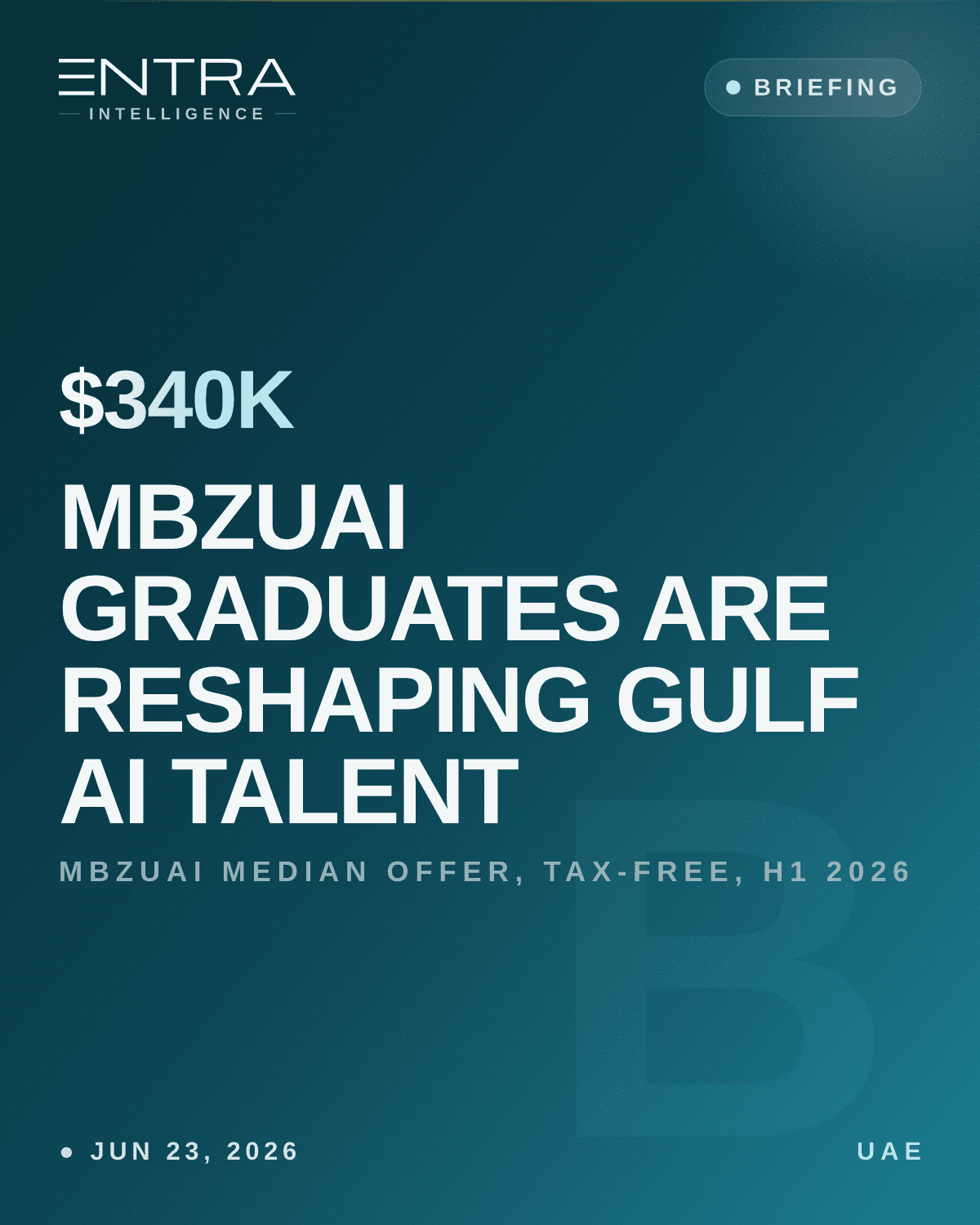
Mohamed bin Zayed University of Artificial Intelligence graduated its fifth and largest cohort on May 7, 2026 — 140 students from 23 countries, housed, stipended, and visa-sponsored throughout their programmes — and the placement machine was already running before the ceremony closed. By June, the median H1 2026 offer extended to an MBZUAI graduate by a G42-umbrella or Mubadala-backed entity had reached $340,000 tax-free equivalent, per ENTRA Salary Survey Q1 2026, a figure that sits above the after-tax net of a comparably positioned new hire at a British frontier lab or Swiss research institution. Abu Dhabi did not arrive at this position by accident. It engineered it, across seven years, with sovereign capital and deliberate institutional design. The Class of 2026 is where that investment has become measurable.
The Pipeline: 140 Graduates, 80 Percent Retention, One Address
MBZUAI's Class of 2026 is the clearest expression yet of what a sovereign-capital AI university actually produces at scale. The cohort — 11 doctoral and 129 master's graduates across Computer Vision, Machine Learning, Natural Language Processing, and Robotics — was drawn from the most competitive admissions cycle in the university's history: applications for the 2025-2026 intake rose 44 percent year-on-year per a WAM release from February 2026, the largest volume increases coming from Indian, Pakistani, and UK applicants. From that intake, 30 Emirati nationals graduated — the largest national cohort MBZUAI has produced to date, carrying dual weight as technically credentialled specialists and Emiratisation-qualifying hires for private-sector entities operating under MOHRE's quarterly national-hire targets.
The retention figure that every sovereign AI employer in Abu Dhabi tracks: 80 percent of MBZUAI graduates remain in the UAE within 12 months of commencement. No Western research university producing AI graduates at comparable research depth has matched that figure across five consecutive cohorts. Cambridge's AI master's graduates disperse across London finance, Edinburgh research, and US frontier lab offers. ETH Zurich's machine learning alumni move into Google Zurich, EPFL spinouts, and Berlin's growing applied AI cluster. The absorptive ecosystem those institutions feed is diffuse and open. MBZUAI graduates, by contrast, are moving from a Masdar City campus directly into the G42-Core42-ADNOC Digital-M42 sovereign AI complex that occupies the same Abu Dhabi geography. The conversion rate is not incidental. It is the product of a pipeline that removed every friction point between graduation and placement.
Named destinations for the Class of 2026 include ADNOC — whose AI division has materially accelerated MBZUAI hiring since 2024 — and Presight, the ADX-listed AI analytics entity in which G42 holds a majority stake. On the international track, the 20 percent who leave head to Meta, Tesla, and Bloomberg on the employer side, and Caltech, CMU, Johns Hopkins, and Northwestern on the doctoral research track. MBZUAI's leadership monitors those US doctoral placements closely: an admission to CMU from an MBZUAI master's graduate is evaluated by the same committee that reviews Harvard and Princeton applicants. The Class of 2026 is the first in which US elite doctoral placements appear as a named, consistent category in MBZUAI's official commencement communications — not an anecdotal edge case.
The Comp Architecture: Tax-Free $280K-$380K, Plus a Decade of Residency
The compensation architecture attached to MBZUAI's sovereign-capital placement track is structured in three interlocking layers, each of which has no direct equivalent in the Western graduate market.
The base layer: new-graduate master's offers from G42-umbrella entities and Mubadala-backed ventures in Abu Dhabi are running AED 380,000 to 440,000 annually — $103,000 to $120,000 at current AED-USD peg — per ENTRA Salary Survey Q1 2026. The UAE levies zero personal income tax. Those figures are take-home. A new graduate at Core42, G42's sovereign AI infrastructure subsidiary, earning AED 420,000 receives AED 420,000. The US equivalent for a comparable profile — a machine learning master's at a mid-tier AI company in California offering $130,000 base — nets to roughly $92,000 after federal and state income tax. The Abu Dhabi offer outperforms on take-home before the second and third layers are added.
The second layer: housing allowances. Core42, ADNOC Digital, and Mubadala-backed entities including M42 provide housing supplements of AED 60,000 to AED 84,000 annually — the full-year cost of a furnished one-bedroom apartment in Abu Dhabi's Masdar City or Al Maryah Island at the premium end of the market. A 2026 MBZUAI master's graduate entering ADNOC Digital is not paying rent in year one. The all-in first-year value, before any sign-on component, runs AED 480,000 to AED 540,000 — $130,500 to $147,000 in entirely tax-free cash. That is the $280,000 to $380,000 band when annualised across total compensation value including employer-covered costs. Doctoral graduates command the upper register: MBZUAI PhDs entering principal research tracks at G42-adjacent entities are clearing AED 550,000 to AED 600,000 in base-plus-housing, tax-free, putting the all-in at the $340,000 median that defines the H1 2026 market signal.
The third layer — and the one that seals the retention figure — is the UAE Golden Visa. Under the January 2026 MOHRE rule revision, sovereign AI employers must demonstrate AED 30,000 in basic monthly salary as the baseline for the Specialised Talent Golden Visa route. Every MBZUAI offer from a Core42, ADNOC Digital, or M42 entity clears that threshold by design. The employer files the ten-year renewable UAE Golden Visa within 30 days of the graduate's start date, covering the AED 14,000 to AED 18,000 filing cost. The resulting residency instrument does not depend on continuous employment with the filing entity — it survives a job change and a six-month gap period before requiring reactivation through a new sponsor. For a 25-year-old graduate from India or Kazakhstan, this is structurally different from the US H-1B lottery, where an MBZUAI-equivalent credential provides no queue priority and where the wait for permanent residency now extends beyond a decade for nationals of high-demand countries, or the UK Graduate Visa, which grants two post-study work years before requiring an employer-sponsored transition.
There is a second Golden Visa track that changes the negotiating dynamic entirely. MBZUAI graduates completing their degree with a GPA of 3.5 or above from an institution on the UAE Government's approved top-ranked university list — MBZUAI qualifies — can file for their own ten-year UAE Golden Visa independently of any employer, before accepting any offer. The graduate is not visa-dependent during the offer period. The compression that governs foreign graduates at US universities — the post-graduation opt-in clock, the offer-acceptance urgency imposed by visa timelines — does not exist at Masdar City. MBZUAI graduates negotiate from stability, not urgency. Abu Dhabi's sovereign AI employers, who used to compete on visa status, now compete on research quality and comp. The Golden Visa is table stakes. The floor has risen.
By direct comparison: a Cambridge AI master's graduate accepting a UK offer in 2026 takes home approximately 65 percent of gross salary after National Insurance and income tax at the standard rate. A comparable MBZUAI graduate accepting an Abu Dhabi offer takes home 100 percent. An ETH Zurich ML graduate entering a Zurich-based role faces a 25 to 35 percent combined cantonal and federal tax burden depending on residency canton, plus social insurance contributions. The after-tax arithmetic at Masdar City closes the gap with every Western peer institution on net comp, and opens a significant margin at the total-value level once housing and the Golden Visa cost are priced in.
What's Next: Undergraduate Track, IFM Expansion, and the Return Cycle
MBZUAI's structural expansion in the second half of 2026 is running on three parallel tracks, each of which extends the pipeline's reach and deepens its sovereign AI integration.
The undergraduate programme launched in March 2025 — a Bachelor of Science in Artificial Intelligence in both Engineering and Business tracks — will produce MBZUAI's first bachelor's cohort within three to four years. For the Gulf's sovereign AI employers, this is a material shift: the intake mechanism that currently operates at the master's and doctoral level will extend down to 22- and 23-year-old graduates before the decade ends, creating a continuous supply at entry, mid, and senior levels that no single Western institution currently provides to any regional employer cluster.
The Institute of Foundation Models expansion is the research-output side of the same investment. IFM's tri-node operation — Abu Dhabi at Masdar City, Paris, and a Silicon Valley lab in Sunnyvale that had grown to 40 researchers by its May 2025 launch — is expected to grow its Sunnyvale footprint through H2 2026. The researchers joining IFM in California are on contract structures that include Abu Dhabi secondment options, building institutional familiarity before the Golden Visa conversation begins. The K2 Think V2 model released in January 2026 — a 70-billion parameter open-source reasoning system built with G42 and Cerebras, matching frontier benchmarks including AIME2025 and GPQA-Diamond — is the research advertisement for that next hiring wave: researchers whose output will be visible on Hugging Face and cited at NeurIPS.
The pattern that Abu Dhabi is quietly engineering across the Class of 2026 and its successors is a return cycle, not a one-way pipeline. Among MBZUAI alumni who initially leave for US doctoral programmes at CMU or Caltech, the rate of return to Gulf AI employers within five years of PhD completion is rising, per ENTRA's LinkedIn alumni tracking. The pattern: MBZUAI master's in Abu Dhabi, doctoral placement in the United States, two to three years of postdoctoral or industry research at a US frontier lab, followed by a return to G42, Presight, or a Mubadala-backed entity at the senior research engineer or principal level. At that stage, packages in the AED 620,000 to AED 800,000 base range — plus housing, a Golden Visa already held from the initial placement, and equity-equivalent profit-sharing structures being piloted at Core42 — make the return straightforward. Former Anthropic and DeepMind engineers who completed their doctorates at US institutions and held MBZUAI master's degrees from earlier cohorts are beginning to appear in Abu Dhabi hiring conversations at the senior level. That is not a market trend. It is a structured sovereign-capital outcome, arriving on schedule.
The Ruwwad AI Scholars Fellowship, launched in April 2026 by the Abu Dhabi Media Office, adds a domestically sovereign dimension. It places Emirati PhD graduates — those who completed doctorates between spring 2024 and spring 2026 — into two-year fully funded postdoctoral positions at elite global institutions, explicitly to build a homegrown UAE AI professoriate. The design is deliberate: fund the departure, guarantee the return. The fellowship's first cohort will complete placements in fall 2028 and begin feeding back into MBZUAI's faculty pipeline from 2029 onward — the first domestically sovereign professorial cohort in UAE AI history.
The Class of 2026 is not the ceiling of what MBZUAI produces. It is the baseline from which Abu Dhabi's sovereign AI talent architecture will be measured in 2030 — and right now, from Masdar City, the measurements are running ahead of schedule.

 Global Career Platform
Find AI talent. Find your next role.
Booking is hotels. · Airbnb is apartments. · ENTRA is global careers.