
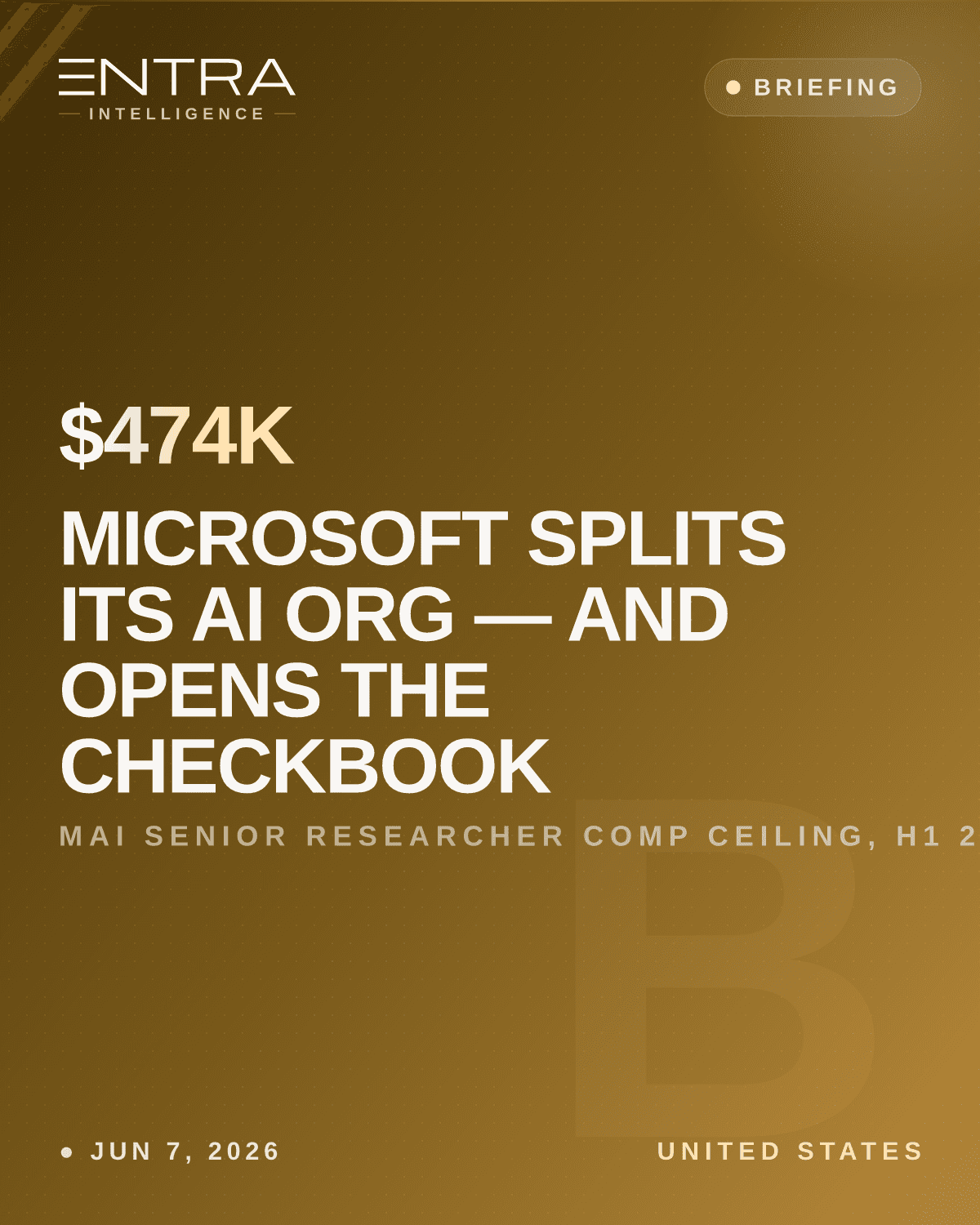
Microsoft cut roughly 6,000 jobs in May 2025, offered voluntary buyouts to another 8,750 US employees under an April 2026 program, and simultaneously ran one of the most aggressive AI researcher acquisition campaigns in the US market. The mechanism that makes both things true across the same strategic cycle is the March 17, 2026 reorganization that split Copilot from frontier research and handed each half its own leadership and its own hiring mandate. What looked from the outside like a sidelining of CEO Mustafa Suleyman was, in practice, a structural expansion of the company's AI talent surface — two distinct funnels, each recruiting against a different competitive set.
What Happened
On March 17, Satya Nadella announced that Jacob Andreou — previously a corporate vice president of product and growth at Microsoft AI, and before that a senior vice president at Snap — would become Executive Vice President of Copilot, reporting directly to Nadella and owning design, product, growth, and engineering for Copilot across consumer and commercial lines. Suleyman, whose Inflection acqui-hire cost Microsoft an estimated $650 million in 2024, was simultaneously moved to full-time ownership of what the company is now publicly calling its MAI Superintelligence Team.
The MAI team itself had been formed in November 2025, the same month Microsoft renegotiated its OpenAI contract to formally permit independent frontier model development. Suleyman described that contract change to VentureBeat at Build 2026 in early June: "We were only sort of set free from our contract with OpenAI about six months ago to formally pursue superintelligence." The restructuring in March translated that contractual freedom into an org chart and a hiring brief.
At Build 2026, Microsoft unveiled seven in-house MAI models — a full multimodal family spanning reasoning, code, image generation, transcription, and voice — built entirely on Microsoft's own data pipelines and without, Suleyman specified, distillation from OpenAI models. The models are the first public evidence of what the MAI team has been staffing toward.
The staffing itself has moved fast. In March, GeekWire reported that Microsoft hired Ali Farhadi, the former CEO of the Allen Institute for AI (Ai2), along with researchers Hanna Hajishirzi and Ranjay Krishna, both University of Washington Allen School faculty. The acquisition pattern is notable: rather than pulling individual contributors from competitor labs, Microsoft absorbed an established collaborative unit — Farhadi, Hajishirzi, and Krishna had worked together at Ai2 and UW for years. The company has also reported hires from Google DeepMind, Meta, OpenAI, and Anthropic into the MAI org, though it has not published a total headcount figure for the team.
The open-role inventory at microsoft.ai as of early June tells the same directional story. Active listings include Member of Technical Staff positions across machine learning, multimodal, compute orchestration and scheduling, applied science, AI platform engineering, developer experience, and responsible AI — with the MAI Superintelligence Team named directly in several postings. The role architecture maps to a lab building from infrastructure up: compute orchestration and data platform roles are posting ahead of product-layer roles, which is the staffing sequence Anthropic and OpenAI ran in 2022 and 2023 respectively.
Meanwhile, the layoff and buyout activity ran on a separate track. The 6,000 involuntary cuts — announced May 13, 2025 — targeted managers and legacy-product engineers, not AI teams. Azure OpenAI Service, GitHub Copilot, and the Turing research organization were explicitly exempt from the March 2026 hiring freeze that preceded the buyout program. The voluntary buyout program — announced April 23, 2026 to roughly 8,750 US employees meeting a "Rule of 70" formula (age plus years of service) — similarly excluded AI and Copilot personnel. The net composition shift across both actions: fewer engineers maintaining products built before 2022, more engineers building the frontier model stack.
Why It Matters
The structural move Microsoft made in March is one the rest of enterprise tech will study for the next 18 months. By separating the Copilot product layer (Andreou's mandate: distribution, adoption, enterprise revenue) from the frontier research layer (Suleyman's mandate: model capability, safety, IP ownership), Microsoft created two distinct talent markets inside one company — and two distinct compensation logics.
The Copilot org competes for product engineers and applied ML talent against Google, Meta, and enterprise software companies. The MAI Superintelligence Team competes for frontier researchers against Anthropic, OpenAI, and Google DeepMind. Those are different candidate pools with different clearing prices, different interview cultures, and different notions of what a compelling offer looks like. Running them under the same EVP structure had made both optimization problems harder. The March split made each tractable.
The compensation data from Levels.fyi confirms the bifurcation is real at the pay layer as well. Microsoft AI Researcher roles are currently tracking $315K–$474K in total annual compensation at levels 63–66, with a reported median of $422K. Research Scientist roles span $156K to $625K depending on level, with the upper end reflecting distinguished-hire packages at L67. Machine Learning Engineers at Microsoft run $155K–$340K with a $223K median — a band that competes with Copilot-layer peers at Google and Meta but not with frontier-lab research comp, which for senior roles at Anthropic and OpenAI now routinely clears $700K in total annual compensation.
The Ai2 acquisition is the clearest single signal of what MAI is actually competing for. Farhadi, Hajishirzi, and Krishna are not applied ML engineers. They are researchers with deep training-efficiency and open-source model expertise — exactly the skill set needed to build frontier models from scratch, at scale, on a timeline that produces public results within 12 months of the team's formation. Microsoft can afford to pay frontier-lab rates for that cohort because the Copilot org, reporting to Andreou, does not require the same comp structure.
The layoff-plus-hire dynamic also has a workforce-cost logic. Exiting 6,000 legacy-product employees (May 2025) and offering voluntary buyouts to 8,750 additional employees (April 2026) frees compensation budget that can be redeployed into AI research comp without a net increase in total headcount spend. Microsoft CFO Amy Hood has signaled publicly that AI infrastructure investment will increase while overall operating cost discipline holds — the workforce recomposition is the mechanism.
Three Signals to Watch
MAI headcount disclosure at Q4 earnings. Microsoft has not published a total headcount figure for the MAI Superintelligence Team. The first time a specific number appears — likely in a shareholder letter, earnings call, or Bloomberg-reported leak — will set the benchmark against which all future growth is measured. Watch for it in the October 2026 Q1 FY2027 earnings call.
Andreou's Copilot commercial results. The logic of the March split depends on Copilot generating enough enterprise revenue to justify its separate structure. If Microsoft's Copilot ARR figures disappoint in Q2 FY2027 (reported January 2027), pressure will build to re-consolidate the orgs — and with it, the two-track talent architecture. Strong Copilot numbers, conversely, validate the split and likely accelerate hiring on both sides.
Whether MAI comp bands reset upward. The current Levels.fyi data for Microsoft AI Researcher roles peaks at $474K for L66. Anthropic and OpenAI senior researcher total comp for comparable roles now starts near $700K. If Microsoft lands two or three more high-profile external research hires in H2 2026 and those candidates' comp is disclosed on Blind or Levels, it will reveal whether Microsoft has quietly reset the band ceiling or is accepting a comp gap in exchange for the Microsoft platform advantages Suleyman has described — compute scale, enterprise distribution, and the OpenAI model access that persists despite the new in-house development mandate.
The story Microsoft is telling its recruits is the same one Suleyman told at Build: that access to a trillion-fold increase in compute over 15 years, a renegotiated partnership with the company that built GPT-4, and a blank mandate to pursue superintelligence adds up to something worth trading a higher offer number for. Whether the senior research market agrees is the question H2 2026 will answer.
Sources: VentureBeat, June 2026 · GeekWire, March 2026 · Microsoft Official Blog, March 17 2026 · CNBC, March 17 2026 · The Key Executives, April 2026 · Levels.fyi Microsoft AI Researcher · Levels.fyi Microsoft ML Engineer · Microsoft AI Careers · American Bazaar Online, March 2026