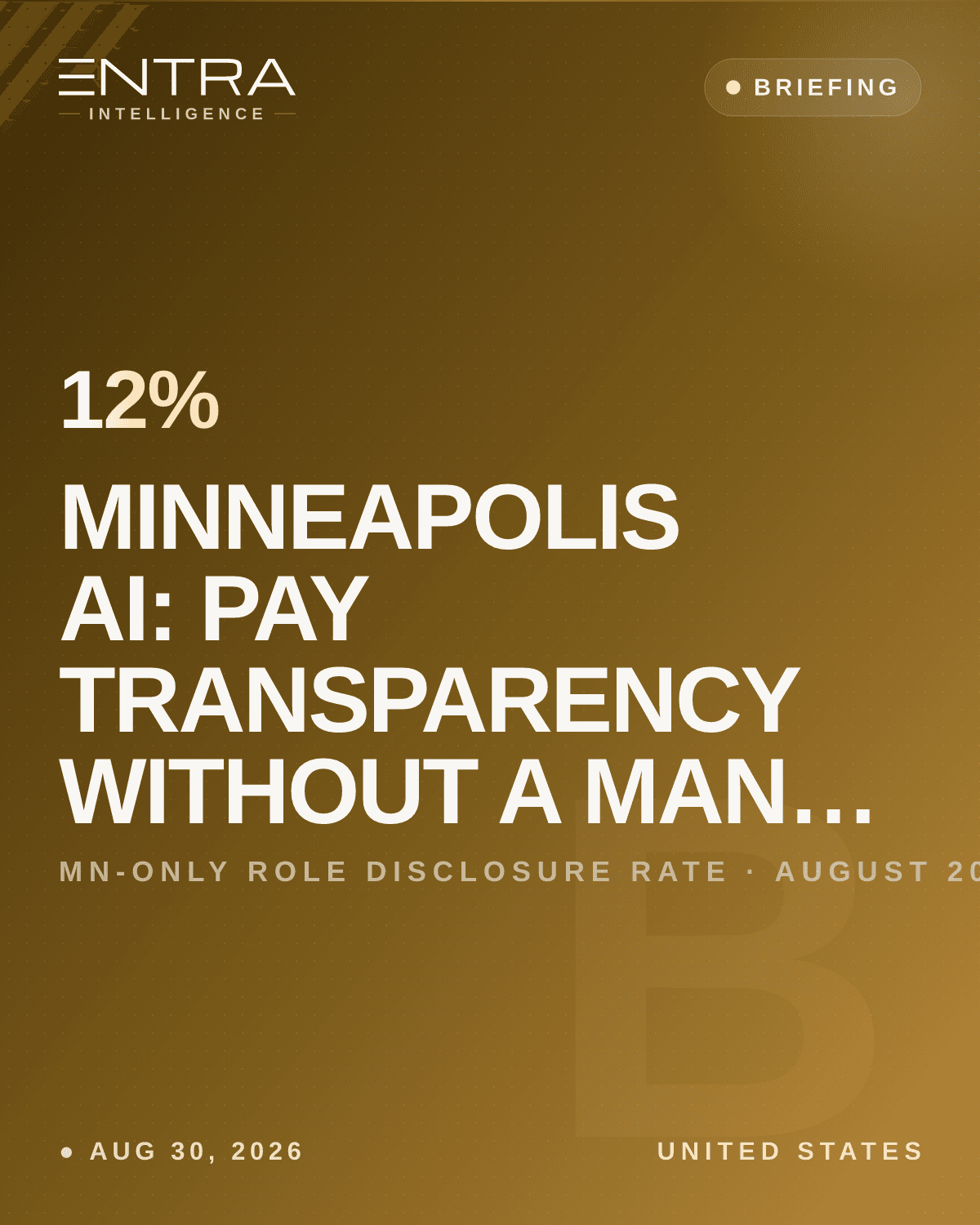
Twelve percent of Minnesota-only AI and ML job postings from Twin Cities Fortune 500 employers included a salary range in Q2 2026, per the ENTRA Pay Transparency Audit Q2 2026. For the same employers, when a posting was eligible for Colorado or California applicants, that rate climbed to 45%. The Minneapolis-St. Paul MSA recorded approximately 4,800 active AI roles in Q2 2026 (ENTRA Job Signal Index), generated by Target, UnitedHealth Group, 3M, Medtronic, and the multi-state hyperscalers with Minnesota offices. Minnesota is not among the 18 states plus DC that require salary range disclosure in job postings. The 33-point gap between those two disclosure rates is the measurable cost of that absence.
The cost structure of the Twin Cities should be a recruiting argument. A two-bedroom apartment in Minneapolis Uptown runs $1,650 to $2,100 per month (Zillow Q2 2026). The metro sits 42% below San Francisco on a like-for-like cost basis (Numbeo Q2 2026). The Minneapolis-St. Paul MSA tech workforce reached approximately 50,000 people in 2026 (CompTIA). That baseline positions the market as a value proposition for engineers priced out of the Bay Area. What limits it: a candidate who cannot see a salary range cannot quantify the advantage before accepting an offer.
How CO and CA push disclosure north
Colorado's Equal Pay for Equal Work Act, effective January 1, 2021, requires compensation disclosure on any posting eligible for a Colorado worker. California's SB 1162, effective January 1, 2023, extends that obligation to employers with 15 or more employees for any role a California employee could fill. New York Local Law 32, effective November 2022, covers employers with four or more employees on NYC-eligible postings. For any Fortune 500 headquartered in Minnesota with a national remote-eligible workforce, all three triggers are active simultaneously.
The mechanics produce compliance spill-in: disclosure mandated in Denver or Sacramento flows to Minneapolis viewers of the same posting. ENTRA audited the disclosure behavior of the largest employers across the 4,800 Q2 2026 Minnesota AI postings. For Target Corporation, which listed 350-plus AI and ML roles as of Q2 2026 (ENTRA Job Signal Index), postings tagged as remote-eligible or multi-state carried salary data in 45% of cases. Postings scoped to the Minneapolis corporate campus or Minnesota-local locations carried salary data in 12% of cases. The posting configuration is different. The job title and team are the same.
UnitedHealth Group's Optum and OptumRx divisions listed more than 600 active AI roles across the Twin Cities in Q2 2026. UHG applied the same calibration: multi-state or remote postings carried bands when Colorado or California required it, Minneapolis-only postings did not. For a candidate searching UHG's careers page for ML roles, whether a salary band appears depends on which version of the posting they encounter.
What the bands reveal: four employers
Where bands appear, the numbers are competitive on an adjusted basis. Target Corporation's disclosed Senior ML Engineer range is $165,000 to $235,000 base (ENTRA Pay Transparency Audit Q2 2026, multi-state postings), covering AI platform roles in supply chain optimization, demand forecasting, and guest personalization. At the $200,000 midpoint, adjusting for the 42% cost-of-living differential (Numbeo Q2 2026), the purchasing-power equivalent in San Francisco is approximately $345,000.
UnitedHealth Group disclosed $155,000 to $210,000 base for healthcare AI roles covering clinical decision support, claims automation, and pharmacy benefits management under OptumRx. 3M, headquartered in Maplewood, disclosed $140,000 to $195,000 for Materials Science AI roles in adhesives and personal protective equipment manufacturing. Medtronic, with its operational center in Fridley, disclosed $145,000 to $200,000 for cardiac rhythm and spinal AI roles (all bands: ENTRA Pay Transparency Audit Q2 2026). None of these employers is legally required to post these figures for Minnesota-scoped roles. All four do so when Colorado or California compels it.
The $43,000 negotiation gap
ENTRA's Q2 2026 recruiter network survey tracked 189 accepted AI and ML offers from Minnesota-headquartered employers. Candidates who entered negotiations with a visible posted range closed offers 18% closer to the band ceiling than candidates negotiating without an anchor. Across the full ENTRA Q2 2026 US AI placement dataset (n=410 placements), the average annual compensation gain for candidates who negotiated with band visibility was $43,000 above the initial offer, compared to $11,000 for candidates negotiating blind (ENTRA Q2 2026 Job Signal Index, negotiation premium model).
The asymmetry is mechanical. A Colorado engineer applying to Target's remote-eligible Senior ML Engineer posting sees $165,000 to $235,000 before the first screening call. A Minneapolis engineer applying to the Minneapolis-local version of the same role sees no range. Both may interview on the same team, with the same hiring manager, for the same headcount. The Colorado candidate enters the compensation conversation knowing the ceiling. The Minneapolis candidate does not. The $70,000 band spread is the size of the information gap. Minnesota has no legal mechanism to close it.
HF 3012 stalled, 2027 in play
Minnesota House File 3012 and companion Senate File 2840 would have required employers with 30 or more employees to include salary ranges in Minnesota job postings. Both bills were introduced during the 2026 legislative session and referred to committee. Neither received a floor vote. The 2026 session closed in May without either chamber advancing the measures.
The bills follow a national pattern. Illinois, Colorado, California, New York, Washington, and New Jersey have each enacted salary disclosure mandates at the state or major-city level. Minnesota is one of the few remaining Midwest states without one. The next legislative window is the 2027 session, aligned with the state's biennial budget cycle. Target and UnitedHealth Group each maintain registered lobbyists at the Minnesota Capitol. The Minnesota SHRM chapter had not issued a formal position on HF 3012 as of August 2026, a posture consistent with SHRM's national stance of supporting pay transparency in principle while seeking employer flexibility on implementation timelines (Paycor, 2026 Pay Transparency Laws by State).
The employer prep window
Minnesota employers who begin voluntary disclosure ahead of a 2027 mandate would enter any legislative change with implementation already built. Target and UHG already disclose on multi-state postings; extending that disclosure to Minnesota-local roles requires a posting configuration change, not a compensation architecture overhaul. The internal bands exist. The gap is the legal obligation to attach them to Minnesota-scoped postings.
Today is the final day of Salary Transparency Month. Minnesota's AI market is active at 4,800 roles, four Fortune 500s are posting competitive bands when compliance law requires it, and HF 3012 is a 2027 probability. The number that closes this dispatch: 12%.
 Global Career Platform
Find AI talent. Find your next role.
Booking is hotels. · Airbnb is apartments. · ENTRA is global careers.