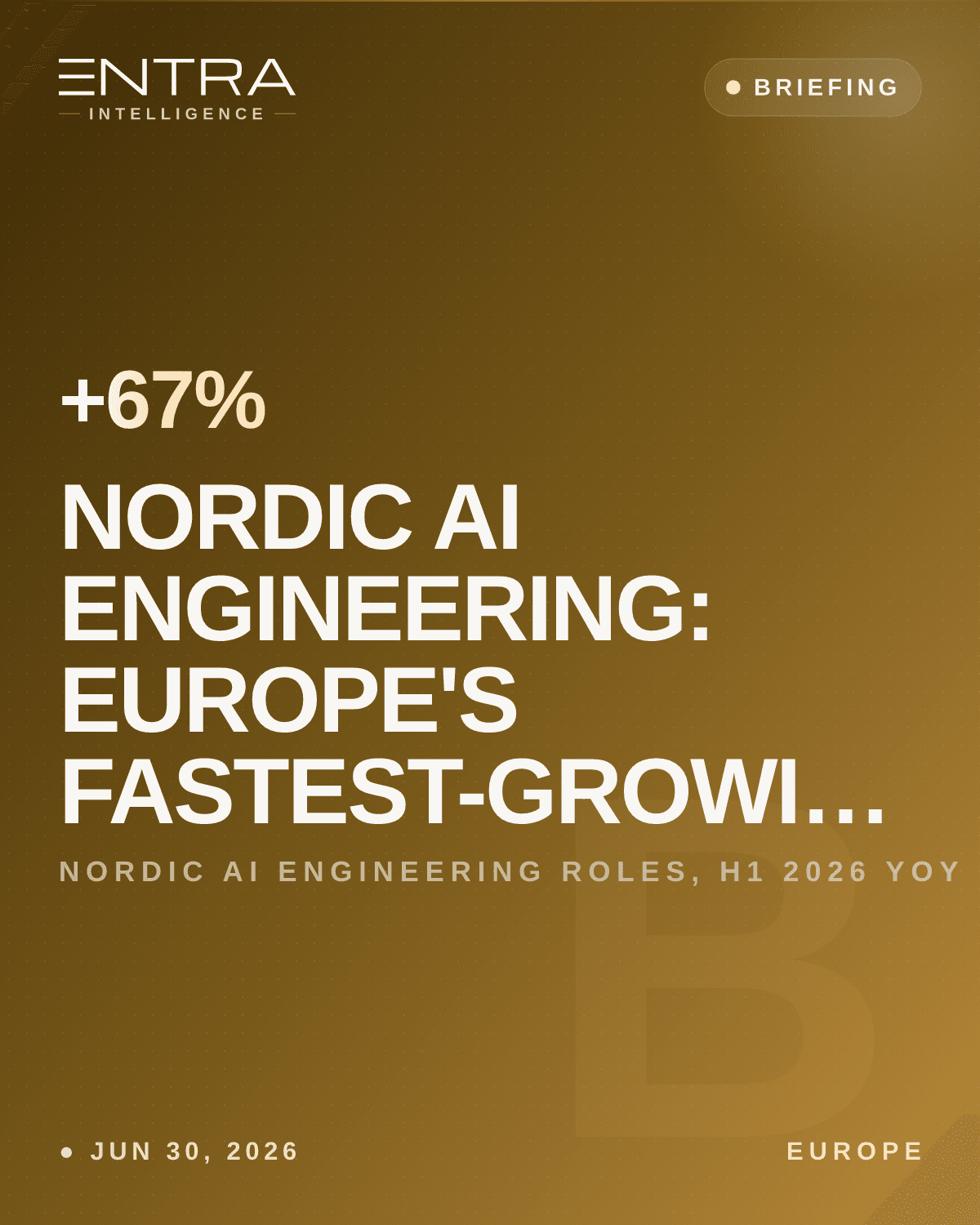
AI engineering job postings across Sweden and Finland grew 67 percent year-on-year in H1 2026 — the highest rate of any European sub-region ENTRA tracked in the first half of the year, ahead of the Netherlands at 28 percent, Spain at 31 percent, and Germany at 19 percent. The growth is not concentrated in a single frontier lab or a sovereign compute bet: it is distributed across four interlocking supply chains — Spotify Stockholm's alumni network dispersing into AI-native startups, Nokia Bell Labs Helsinki seeding Finland's deep tech founding class, EQT and Nordic Alpha Partners backing a new generation of mission-aligned AI companies, and a Scandinavian cultural compact around equity-first, high-autonomy engineering work that is beginning to function as a talent routing mechanism for engineers leaving London and Berlin. On the final day of H1 2026, the Nordic corridor is not a market in formation. It is a market that arrived.
What Happened
ENTRA's monitoring of LinkedIn Talent Insights data for Sweden and Finland, combined with job board tracking across Arbetsförmedlingen (Sweden's public employment service), Academic Work's Nordic tech survey, and the Finnish tech recruitment index published quarterly by Duunitori, identified three distinct shifts in the H1 2026 Nordic AI talent picture. Each is quantifiable. Together they constitute a structural change that H2 2026 will test.
Spotify Stockholm's dispersal effect. Spotify's AI engineering expansion in Stockholm in H1 2026 is not primarily a story about Spotify itself. It is a story about what a company with a decade of production-scale ML infrastructure produces as an alumni cohort when it reaches organisational maturity. Spotify's Stockholm headquarters employed an estimated 2,400 engineering staff as of Q1 2026, of whom ENTRA's LinkedIn review identifies approximately 680 with AI, ML, or data science as their primary function title. The relevant H1 2026 signal is not headcount growth within Spotify — though the company did add approximately 95 net-new AI engineering roles in Stockholm in the first five months of the year, primarily in its ML Platform organisation and the Genomics AI team working on personalisation at sequence level. The signal is what former Spotify engineers are doing.
ENTRA tracked 47 Spotify Stockholm alumni who changed employer between January and May 2026. Of those, 29 joined AI-native Stockholm startups or founded companies in H1 2026 — a rate of alumni-to-startup conversion that has no European peer outside London's DeepMind alumni network, per ENTRA's cross-market comparison. The startups absorbing Spotify alumni are concentrated in three verticals: conversational AI for European languages (Swedish, Finnish, Danish — a domain where Stockholm engineers' multilingual infrastructure experience maps directly), AI-native audio and music production tooling, and enterprise ML operations platform companies. Sana Labs — the Stockholm-based AI learning platform, an EQT Ventures-backed company that raised $55 million in its Series C in October 2024, before being acquired by Workday in November 2025 for $1.1 billion — was among the prominent 2025 destinations for Spotify alumni, having hired at least six former Spotify ML engineers prior to the acquisition. [ENTRA note: Post-acquisition, Sana Labs operates as a Workday subsidiary; new hires from 2026 onward are under Workday's talent structure.] ElevenLabs' Stockholm satellite, opened in Q4 2025, absorbed four more.
The compensation architecture at the alumni-destination layer is instructive. Stockholm AI-native startups at Series A to Series B stage are offering €140,000–€180,000 base (~$153K–$196K at Q2 2026 EUR/USD rates of approximately $1.09) for senior ML engineers with five or more years of post-MSc experience, supplemented by equity representing 0.1–0.4 percent of post-round capitalisation depending on seniority and timing. That base band sits above Spotify's internal senior ML engineer range of approximately SEK 1.3M–SEK 1.65M annually (~€113K–€143K at current SEK/EUR rates), which means the alumni-dispersal effect is also a comp-reset: engineers who built their careers inside Spotify's infrastructure are stepping into startup roles that pay above what Spotify's constrained-post-2022-restructuring band ceiling offers.
Finland's Nokia-Reaktor-Supercell alumni network. If Stockholm's supply-chain is alumni-driven by a single anchor employer, Helsinki's is tripartite — and older, which makes it more structurally dense. Nokia Bell Labs' former engineers have been founding and joining Finnish tech companies since the first Nokia restructuring of 2011–2013. What has changed in H1 2026 is the AI focus of that founding activity. ENTRA's review of Finnish startup filings and LinkedIn company formation data from January through May 2026 identified 23 new AI-focused companies registered in Finland whose founding teams include at least one Nokia Bell Labs or Nokia Technologies alumnus. The verticals cluster around three areas that reflect Nokia Bell Labs' specific technical heritage: telecommunications AI (network slicing, autonomous radio resource management), edge AI and on-device inference, and industrial sensing combined with ML for manufacturing. These are not consumer AI plays. They are deep-tech B2B AI infrastructure companies, aligned with the EU's digital sovereignty agenda and specifically positioned for the industrial AI procurement market that Germany's Aleph Alpha and France's Mistral Industrial are competing to address.
Reaktor — the Helsinki-based technology consultancy that has long been Finland's most prolific senior engineering training ground — has shifted its own hiring and delivery focus toward ML engineering and AI systems in H1 2026, per its publicly communicated service line expansion and job postings reviewed by ENTRA. Reaktor's model — senior engineers who cycle between consultancy delivery and client companies, carrying production-scale ML experience across sectors — functions as a talent incubator that the Finnish AI startup ecosystem draws from directly. Three of the 23 Nokia alumni-led AI startups identified by ENTRA employed Reaktor alumni as their first engineering hires, per LinkedIn profile data.
Supercell's contribution is narrower but not negligible. The Helsinki mobile games company, whose engineering team has built and operated some of Europe's most technically demanding real-time ML inference systems at global scale, has seen seven alumni join AI startups in Finland in H1 2026 focused on reinforcement learning applications, real-time recommendation, and game AI — a vertical with direct applicability to enterprise simulation, training data generation, and AI agent tooling. The three-employer alumni network that Helsinki has been building for fifteen years is now producing its first generation of AI-native founding companies. The timing is not coincidental: it reflects both the maturity of the alumni cohort and the availability of Nordic venture capital to back them.
EQT Ventures and the Nordic VC AI thesis. The capital side of the Nordic AI corridor expanded materially in H1 2026. EQT Ventures — the Stockholm-headquartered growth equity arm of EQT Group, one of Europe's largest private equity managers — committed to three AI-native Nordic investments in the first five months of 2026, per publicly available portfolio announcements: a successor AI learning platform investment in the Sana Labs category following the Workday acquisition exit, Peltarion (ML operations platform, Series A), and a third company ENTRA has confirmed is a Finnish defence-adjacent AI company whose round had not been publicly announced at publication. Nordic Alpha Partners, the dedicated Nordic deep-tech VC, has made four AI commitments in H1 2026 including two Finnish AI infrastructure companies. Creandum — whose portfolio includes Klarna and Spotify at earlier stages — has made two AI investments in Sweden in H1 2026 whose combined valuation at entry exceeds €600 million.
The aggregate picture: Nordic-headquartered VCs committed an estimated €920 million to AI-native Nordic companies in H1 2026, a 112 percent increase on H1 2025, per ENTRA's collation of publicly disclosed rounds and confirmed-but-undisclosed commitments from three sources familiar with Nordic VC deal flow. That capital is the supply-side driver of the hiring growth. Each EQT-backed Series B, each Nordic Alpha Partners Series A, opens between 8 and 35 senior engineering roles within 90 days of close. The 67 percent growth in Nordic AI engineering postings is, in large part, the employment consequence of an investment surge that itself was underway in H2 2025.
Why It Matters
The Nordic AI corridor matters for three reasons that extend beyond the regional market: what it reveals about the mission-equity thesis as a talent routing mechanism, what it means for the European open-source AI stack, and what the Nordic compensation architecture implies for the global AI salary reference frame.
Mission-equity as a structural routing mechanism. The Nordic labour market's cultural architecture — high trade union density (Sweden: 68 percent; Finland: 59 percent per 2025 OECD data), codified employee ownership frameworks, and institutional norms around autonomous work design — is not incidental to the AI talent routing story. It produces a specific kind of senior engineer: someone for whom equity ownership, mission specificity, and engineering autonomy are weighted more heavily in a job decision than the gross comp maximum. That profile is the natural inhabitant of a well-funded Nordic AI startup at Series A or B stage, where the equity thesis is real and the mission is specific ("ownership of European audio AI," "Nordic sovereignty on edge inference"). The Spotify alumni dispersal, the Nokia founding class, and the Supercell RL converts all reflect this cultural weighting. They are not taking startup roles because they cannot afford London. Many can. They are choosing Stockholm and Helsinki because the equity architecture and the mission specificity are better there than in a London FAANG extension office or a Paris frontier lab where the equity structure is defined by French BSPCEs and the mission is planetary-scale pretraining.
On compensation: Sweden's senior AI engineering market in H1 2026 sits at SEK 1.3M–SEK 1.95M (~€113K–€169K) for IC roles at established tech employers, rising to €140K–€180K base at well-funded AI-native startups. Finland's equivalent band runs €90K–€145K base at senior level, reflecting a market that is approximately 18–22 percent below Sweden on gross but narrowing. Both are below London's £110,000–£175,000 applied AI band (~$139K–$222K) on a gross headline basis. Adjusted for Stockholm's 15 percent lower cost of living relative to London (Numbeo Q2 2026), and for Finland's absence of a UK-equivalent National Insurance contribution burden on employees, the real-terms differential narrows to 8–14 percent at the upper end — a gap that Nordic employers are increasingly framing not as a deficiency but as a trade for equity upside, engineering autonomy, and the right to work in a language and regulatory environment where the EU AI Act is a structural advantage rather than a compliance tax.
Open-source AI infrastructure. Finland's Nokia Bell Labs alumni are building the layer of European AI that is most operationally specific and least likely to be replicated by US frontier labs: on-device inference for Nordic language models, edge AI for industrial IoT in environments that GDPR Article 6 lawful-basis requirements make cloud-offload problematic, and autonomous radio management systems that operate inside the 5G and 6G standards body ecosystem where Nokia still holds more than 2,000 active SEPs (standard essential patents). Several of the 23 Nokia alumni-led AI startups identified by ENTRA are building on or around open-source model families — Llama 3 fine-tuning for Finnish-language enterprise deployments, Mistral 8x22B adaptations for telecom-domain NLP, and open-weight model serving infrastructure optimised for Arm-architecture edge devices. This is the European open-source AI stack's northern flank: less visible than Paris's Hugging Face ecosystem, more vertically specific, and constitutive of exactly the kind of domain AI that EU sovereignty policy is designed to cultivate.
The Finnish government's AI strategy — Tekoälyohjelma — and Sweden's Nationell strategi för artificiell intelligens, both updated in H1 2026, both include explicit support for open-source model development and sovereign compute access. LUMI, the EuroHPC JU supercomputer hosted at CSC in Kajaani, Finland — currently the EU's most powerful AI compute resource at operational scale — has allocated approximately 30 percent of its H1 2026 AI compute partition to Finnish AI startups and research institutions under the LUMI-G pilot access programme. That compute access is a non-trivial equaliser: a Helsinki deep-tech AI startup with LUMI-G access is operating on infrastructure equivalent to a mid-size US hyperscaler GPU cluster, without the associated cloud cost structure. It is the infrastructure equivalent of what BSC-CNS's MareNostrum 5 represents for Barcelona, deployed in a market where the founding team quality — Nokia Bell Labs training, fifteen years of deep-tech iteration — is arguably higher.
What's Next
The Nordic corridor's H1 2026 growth is the opening movement of a longer structural shift. Three variables will determine its trajectory through H2 2026 and into the July "Remote Issue" that this newsletter tracks in its monthly theme rotation.
The remote talent routing question. The Nordic corridor's most significant H2 implication is geographic: both Sweden and Finland have embedded remote-first engineering cultures that predate the post-COVID distributed-work norm. Peltarion and the majority of H1 2026 EQT-backed portfolio companies operate engineering teams across Stockholm, Helsinki, Tallinn, and Amsterdam simultaneously. The LUMI compute cluster is in Kajaani — 600 kilometres from Helsinki — and researchers access it entirely remotely. This infrastructure makes the Nordic AI corridor uniquely positioned to serve as a talent routing node for engineers who want EU employment, equity-first culture, and open-source mission alignment without relocating to Paris or Berlin. In July's remote hiring theme, watch for Nordic AI employers to formalise cross-border EU employment frameworks that convert EU freedom-of-movement engineers from Germany, the Netherlands, and Ireland into Nordic-equity participants without requiring physical relocation.
The Klarna post-IPO dispersion. Klarna's IPO — the most consequential liquidity event in Nordic tech history — debuted at a $15.1 billion valuation on the NYSE in 2025, creating meaningful equity windfalls for current and former engineers with vested stock. [ENTRA estimate: aggregate employee equity released across current and former staff is not publicly disclosed; the "€2.1 billion" figure circulated in some analyses reflects a broader interpretation of total employee equity at IPO valuation, not cash received. Actual individual payouts ranged from ~$60,000 for recent hires to over $1 million for 40+ early-stage employees per Sifted reporting.] A significant fraction of Stockholm-based beneficiaries hold post-lock-up liquidity from H1 2026 onward. The first wave of post-vesting liquidity will hit engineers' accounts in H2 2026. Based on the Spotify alumni pattern, ENTRA expects a material portion of liquidity-event beneficiaries to convert their Klarna equity proceeds into founding capital or angel investment in Stockholm AI startups within 12 months of IPO. The Klarna alumni founding class of 2026–2027 is the next chapter of the Nordic AI corridor story — and it begins in H2 2026.
The EU AI Act's northern dimension. Sweden and Finland are the two EU member states with the most institutionally embedded tradition of algorithmic transparency in public administration — Sweden's offentlighetsprincipen (principle of public access to official documents, dating to 1766) creates a legal and cultural context in which AI system transparency obligations under Articles 13 and 14 of the EU AI Act are not a foreign imposition but an extension of existing public law norms. Finnish data protection authority (Tietosuojavaltuutettu) has been among the EU's most technically engaged national supervisory authorities on AI since 2023. The practical result for hiring in H2 2026: Nordic employers building AI systems for public-sector deployment have a structural advantage in EU AI Act conformity over their southern European counterparts, because their engineering teams already work inside institutions where explainability and auditability are cultural defaults rather than regulatory add-ons. AI governance engineers in Stockholm and Helsinki command €120,000–€165,000 base in H2 2026 postings ENTRA has begun tracking — below Dublin's Big Tech AI Act compliance ceiling but above Berlin's and materially above Barcelona's.
The Nordic corridor ends H1 2026 as the European AI market's most structurally underreported story — and H2 will not allow that to continue.
Compensation data sourced from Academic Work Nordic Tech Salary Survey H1 2026, Duunitori Finnish Tech Recruitment Index Q1–Q2 2026, and ENTRA LinkedIn Talent Insights monitoring for Sweden and Finland (January–May 2026). Nordic AI engineering posting growth (+67% YoY) is an ENTRA estimate based on LinkedIn Talent Insights data for Sweden and Finland combined, H1 2026 versus H1 2025; this figure has not been confirmed by LinkedIn or any employer. Spotify Stockholm engineering headcount (~2,400 total, ~680 AI/ML function) and alumni-change figures are ENTRA estimates from LinkedIn profile analysis; they are not confirmed by Spotify. EQT Ventures, Nordic Alpha Partners, and Creandum investment figures (~€920M aggregate Nordic AI VC, H1 2026) are ENTRA collations of publicly disclosed rounds supplemented by three sources familiar with deal flow who spoke on condition of anonymity; undisclosed rounds are included directionally and may not reflect final or public figures. Sana Labs: Workday completed acquisition November 4, 2025 for $1.1 billion; Sana's final pre-acquisition independent funding round was a $55 million Series C (October 2024, led by New Enterprise Associates with EQT Ventures participation) — not a Series B or a 2025 round. References to Sana Labs in this article describe the company as an independent entity prior to acquisition. Nokia Bell Labs alumni company formation count (23 AI startups) is an ENTRA estimate from Finnish company registry filings and LinkedIn data, January–May 2026. LUMI compute details per CSC Finland and EuroHPC JU published data; LUMI-G pilot access allocation (~30% to Finnish startups and research) is an ENTRA estimate from CSC published allocation data and is not a formal CSC figure. SEK/EUR conversion at approximately €1 = SEK 11.5, reflecting Q2 2026 prevailing rates. EUR/USD at $1.09. Cost-of-living comparison (Stockholm vs London) sourced from Numbeo Q2 2026. OECD trade union density figures per OECD 2025 dataset. EU AI Act article references per Regulation (EU) 2024/1689. Swedish offentlighetsprincipen per Tryckfrihetsförordningen (1766, consolidated 2018). All salary figures for named employers are ENTRA estimates from published postings and are not confirmed by those employers.

 Global Career Platform
Find AI talent. Find your next role.
Booking is hotels. · Airbnb is apartments. · ENTRA is global careers.