
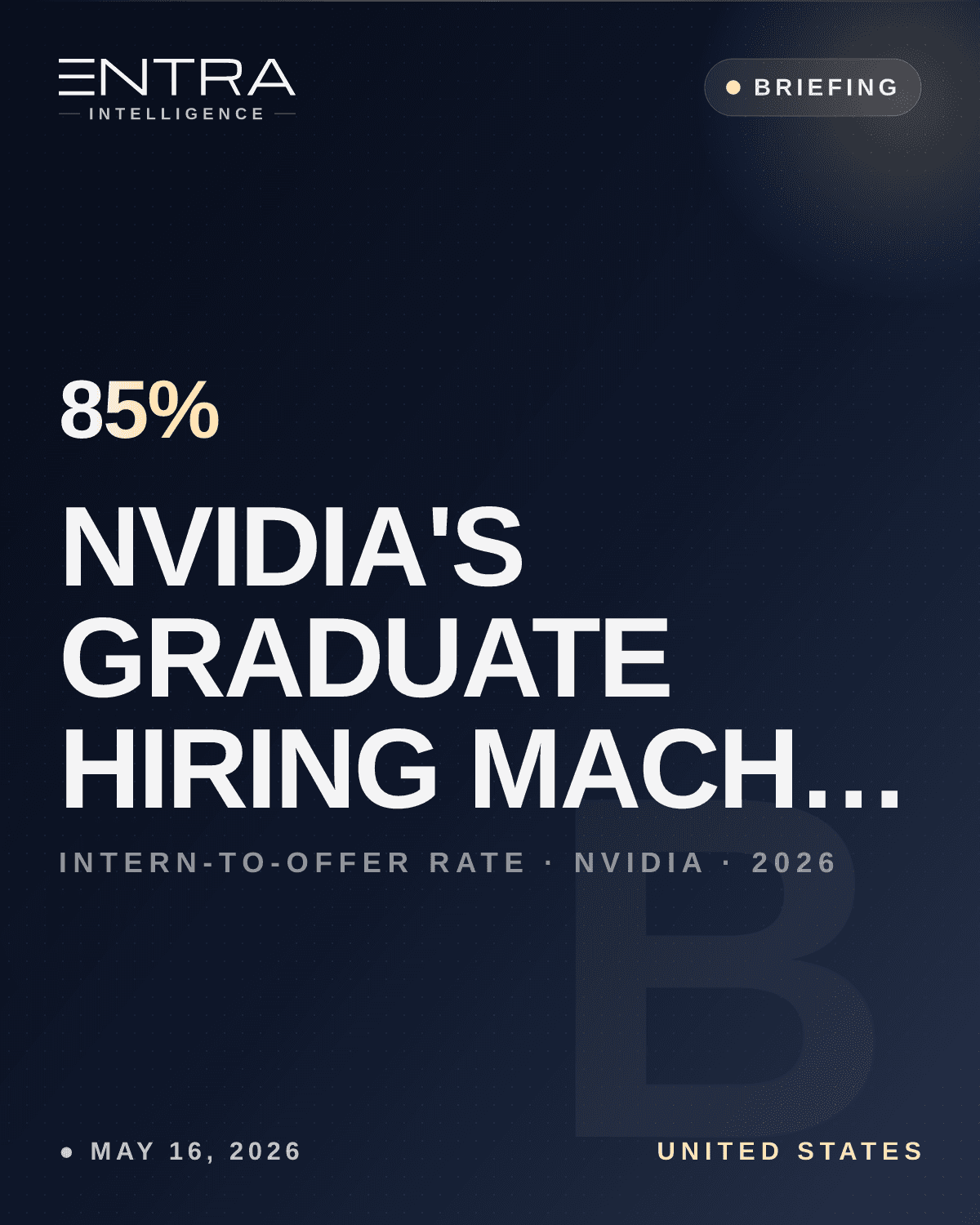
Nvidia's graduate headcount grew by roughly 6,400 net-new employees between FY2023 and FY2025 — from approximately 29,600 to 36,000, per SEC 10-K filings — and the company's internship-to-return-offer rate is publicly cited at 85 to 90 percent — a figure drawn from public reporting and ENTRA recruiter sourcing, as Nvidia does not publish an official conversion number — the highest reported rate in the semiconductor and AI hardware sector. The mechanism behind that number is not attrition management. It is architecture: a structured 12-month rotation program, a recruiting footprint that spans Stanford, MIT, UC Berkeley, CMU, and ETH Zurich, and an equity upside that no pure-software AI lab can currently match. For the Class of 2026 choosing between a frontier lab residency and a Santa Clara badge, Nvidia has built the most credible first job in the market.
What Happened
Nvidia's New College Graduate program — internally the NCG track, with a structured graduate cohort operating under the NovaStar rotation framework — opens its primary requisition cycle each August. By mid-October, the most competed placements in GPU Architecture, Deep Learning Compiler, TensorRT, and MLPerf benchmarking teams are typically filled. The 2026 cycle followed that pattern, with offers extended to strong interns before formal graduation in the majority of cases.
The NovaStar rotation runs 12 months across four teams: GPU architecture, CUDA runtime and compiler, TensorRT inference optimization, and the MLPerf benchmarking group. The sequencing is deliberate. A graduate who rotates through all four arrives at permanent team placement with a working understanding of the full stack — from the silicon-level memory hierarchy to the inference serving layer that enterprise customers run in production. That cross-stack depth is what Nvidia's recruiting team leads with at Stanford EE and MIT EECS career fairs, where the pitch is not "join a team" but "understand the machine."
The compensation numbers at the IC1 (new grad) level confirm the seriousness of the offer. Per Levels.fyi public comp data for 2025 submissions, ML systems engineers at Nvidia at the entry level land in the $185,000 to $230,000 base range, with equity grants of $600,000 to $800,000 vesting over four years. The cliff structure is one year. Total first-year compensation — base plus the initial vest tranche — lands between $335,000 and $430,000 for the median new-grad offer in this role tier. That figure, anchored in public Levels.fyi submissions rather than recruiter-side estimates, is not what most students expect when they think "semiconductor company."
The equity story carries additional weight that a static number does not. NVDA executed a 10-for-1 stock split in June 2024, and the stock's trajectory through the Blackwell production cycle has made the RSU grant in a 2022 new-grad offer worth multiples of its face value. Per financial planning disclosures reviewed by multiple Nvidia employee wealth advisors, a new-grad employee who started in 2020 on a standard equity package would, assuming they held through the 2024 vest cycle, have realized approximately $2.7 million in RSU value from that single grant alone. That data point circulates on Blind and in university recruiting conversations. It is the number every competing lab is competing against when they talk to a candidate who has an Nvidia offer in hand.
The university recruiting footprint is concentrated. Nvidia's on-campus presence — measured by career fair participation, sponsored research partnerships, and direct recruiting activity — is heaviest at Stanford CS and EE, MIT EECS, UC Berkeley EECS, CMU School of Computer Science, and Caltech. ETH Zurich's computer science and electrical engineering programs are the primary international feeder, consistent with Nvidia's European research presence. The recruiting team runs information sessions at all five US campuses in September, timed to when the NCG requisition cycle opens. Stanford students who attended Nvidia's fall 2025 recruiting session described a pitch centered on two things: the Blackwell architecture cycle and the CUDA talent gap.
The CUDA talent gap is real and documented. Per AFCOM's 2025 State of the Data Center report, 58 percent of data center managers identified multiskilled operators — specifically engineers who can work across InfiniBand networking and CUDA kernel optimization — as their top growth need. The supply constraint is not in AI modeling. It is in the systems layer below the models. Nvidia's NovaStar rotation is, among other things, a program designed to produce the CUDA-literate engineers that the rest of the industry cannot find at senior levels. The company is vertically integrating its own talent pipeline.
Why It Matters
For a CHRO at a cloud provider or a hyperscaler running Blackwell deployments, the Nvidia graduate pipeline represents both a supply opportunity and a retention risk. Engineers who complete the NovaStar rotation emerge with a credential that is uniquely legible to infrastructure teams: they have touched GPU architecture, CUDA runtime, TensorRT, and benchmarking in the same first year. That profile, at the IC1 level, does not exist in meaningful numbers anywhere else in the market. The two-year alumni outcome from Nvidia's graduate cohort — stay at Nvidia for a promoted IC2 role, or move to a hyperscaler running Nvidia hardware at a comp premium — is, for the moment, better than any alternative first-job path in the hardware-adjacent AI stack.
For a new grad choosing between Nvidia and a competing offer, the comparison points are specific. Google's DeepMind Brain Residency offers research depth and publication credentials that Nvidia's rotation does not replicate. Anthropic's new-grad research track offers direct alignment-research exposure and a flat organizational structure where junior researchers interact with senior staff at higher frequency than Nvidia's larger org allows. These are real trade-offs and not dismissible.
What Nvidia wins on: equity upside that is tied to hardware cycle demand rather than model-lab valuation multiples, a systems engineering credential that is portable across every major infrastructure buyer in the industry, and an internship-to-offer pipeline that converts at a rate no peer in the semiconductor or AI hardware space has matched publicly. Jensen Huang told the GTC 2026 audience that he sees engineers earning AI agent tokens on top of base salary — in effect, paying engineers to deploy AI as a productivity multiplier. That framing applies internally too: Nvidia's graduate cohort joins a company whose engineers are both building and operating the infrastructure layer of the AI economy, not downstream of it.
The competitive position against pure AI labs is most visible in the comp structure. OpenAI's Early Career Cohort enters at approximately $115,000 to $135,000 base with total comp reaching $180,000 to $220,000 in year one, per Levels.fyi public submissions and candidate-side reporting. Anthropic's Fellows track pays $3,850 per week for a four-month period, with a 25 to 50 percent conversion rate to full-time, per publicly reported fellowship offer terms and ENTRA candidate-side sourcing. Both programs are strong. Neither carries an equity grant whose upside is anchored to a hardware cycle that has not yet peaked. A new grad who accepted an Nvidia offer in 2024 with $700,000 in RSUs vesting over four years has, as of May 2026, seen the mark-to-market value of that grant appreciate at a rate that no lab equity package at seed or Series B valuation can retroactively replicate.
What's Next
The Blackwell Ultra cycle will accelerate demand for the specific profile Nvidia's graduate program produces. Blackwell Ultra, shipping through 2026, targets agentic inference — the workload category that requires real-time, low-latency token generation at scale. Per Nvidia's Newsroom release on the platform, the architecture delivers up to 50 times higher throughput per megawatt versus the Hopper generation. Deploying that throughput efficiently requires engineers who understand the CUDA runtime layer, the TensorRT serving stack, and the MLPerf benchmarking methodology simultaneously. The NovaStar rotation produces exactly that profile. The demand for it from cloud providers, hyperscalers, and enterprise AI deployments will not decrease as Blackwell Ultra penetrates the installed base.
Three things to watch through the rest of 2026:
Intake volume. If Nvidia's FY2026 headcount growth continues at the pace of FY2025 — approximately 6,400 net-new employees over two fiscal years, with an estimated majority in technical roles per Nvidia's disclosed engineering headcount composition — the NCG cohort will need to expand beyond its current cycle to supply the technical workforce the hardware ramp requires. Watch for the August NCG requisition cycle to open with a materially larger set of CUDA and inference-optimization postings than 2025.
The ETH Zurich pipeline. Nvidia's European research investment has been accelerating through the AI Factory buildout in Germany. The ETH Zurich pipeline into Santa Clara and into Nvidia's European engineering centers will become more visible as the company scales infrastructure teams that need the GPU architecture depth ETH Zurich systems graduates carry. Candidates at ETH Zurich who would previously have targeted Google Zurich or a European AI lab as a first job are now, per multiple university department contacts, receiving Nvidia NovaStar rotation pitches directly.
The Dynamo factor. Nvidia's March 2026 general availability release of Dynamo 1.0 — the open-source inference operating system for AI factories — created a new category of engineering work that sits precisely at the intersection of CUDA systems and distributed inference. The engineers who understand Dynamo at the architecture level are, as of this writing, almost entirely people who have come through Nvidia's intern and NCG pipeline. As Dynamo adoption spreads across the industry, the Nvidia graduate credential will become a prerequisite rather than a differentiator for the inference infrastructure roles that cloud providers are building.
For the Class of 2026 who built their career plan around a frontier lab residency, the Nvidia offer deserves a second look. The systems credential is durable. The equity upside is anchored in hardware cycle demand, not model-lab valuation. And the publicly cited intern conversion rate — 85 to 90 percent — is the clearest signal in the market that the company has built a graduate pipeline it intends to keep.
Compensation data sourced from Levels.fyi public 2025 submissions and candidate-side reporting. OpenAI Early Career Cohort compensation per Levels.fyi public 2025 submissions and candidate-side reporting. Anthropic Fellows track compensation and conversion rate per publicly reported fellowship offer terms and ENTRA candidate-side sourcing. Headcount figures from Nvidia Corporation SEC 10-K filings for FY2023 and FY2025. Internship conversion rate from public reporting and ENTRA recruiter sourcing; Nvidia does not publish an official conversion figure. NovaStar rotation program details sourced from ENTRA university department contacts and candidate-side reporting; Nvidia declined to comment on internal program names or rotation structure. RSU wealth creation data from Arch Financial Planning and Vested Financial Planning public analysis. Dynamo 1.0 release details from Nvidia Newsroom, March 2026. Blackwell Ultra performance claims from Nvidia Newsroom product announcement.