
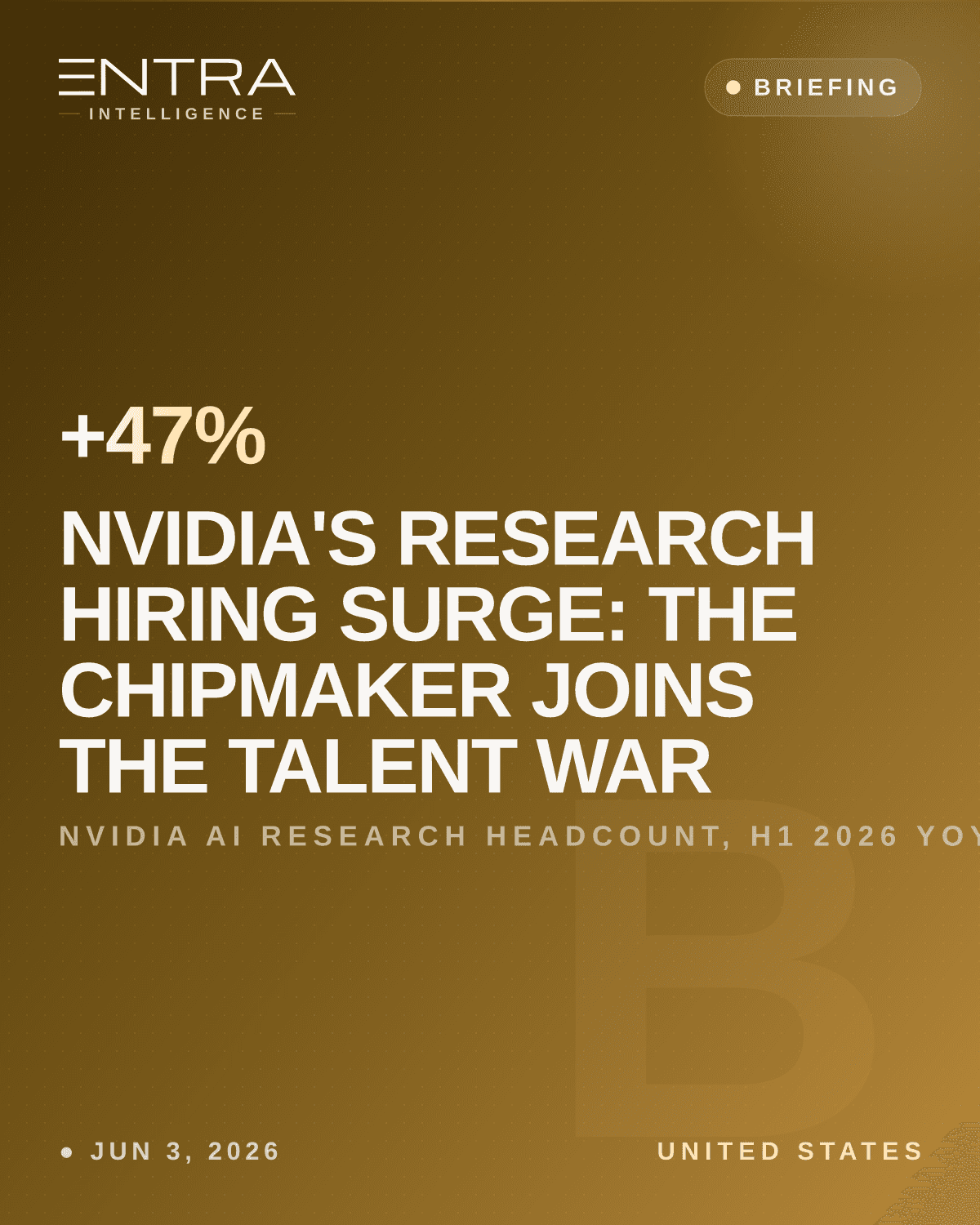
NVIDIA's AI research headcount crossed approximately 3,200 globally in H1 2026 — a 47% increase year over year — as the company's $3.5T market-cap balance sheet enables it to match frontier-lab compensation dollar for dollar while offering something neither Anthropic nor OpenAI can yet provide: equity that is already liquid on public markets. The chipmaker now operates as a third pole in the competition for ML PhDs and senior research scientists, sitting alongside the frontier labs and hyperscalers as a primary destination for the world's top AI talent. At NVIDIA's current NVDA stock price, a senior research engineer grant issued today is worth real money on the next quarterly vest — not a paper promise contingent on a successful IPO.
What Happened
NVIDIA Research, led by Chief Scientist and SVP Bill Dally, has operated since Dally joined from Stanford in 2009 — when the lab employed roughly a dozen people focused on ray tracing. Per public reporting from TechCrunch in August 2025, the lab had by that point grown to more than 400 people. The trajectory from 2025 into H1 2026 accelerated sharply.
NVIDIA's total employee base grew from approximately 36,000 in FY2025 to 42,000 as of January 2026, per the company's Form 10-Q filed with the SEC (covering FY2026 Q1, through April 26, 2026) — a 16.7% total headcount gain in a single fiscal year. Yahoo Finance data citing NVIDIA's own disclosures indicates approximately 31,000 employees sit in research and development functions — nearly 74% of total headcount, up from prior-year R&D concentration figures around 68%. The AI research bench specifically — which includes both pure research (publishing-track) and applied research (CUDA, inference, NeMo, Megatron) — represents the fastest-growing segment within that R&D mass, reaching approximately 3,200 globally with roughly 60% concentrated in Santa Clara and the broader Bay Area.
The lab's structure divides into two tracks that increasingly blur at the edges. The pure-research side — Dally's original mandate — publishes at NeurIPS, ICLR, ICML, and CVPR, with NVIDIA papers in generative AI, neural operators, and robotics appearing at ICLR 2026 and NeurIPS 2025. The applied side is led by Bryan Catanzaro, VP of Applied Deep Learning Research, whose team built Megatron-LM — the transformer training framework now integrated into NVIDIA's NeMo platform — and drives compute optimization and inference efficiency work that feeds directly into NVIDIA's product margin. Catanzaro has described the mandate publicly as finding "new ways to use AI to improve projects ranging from language understanding to computer graphics and chip design." At NVIDIA's GTC conference in March 2026, Dally told Google Chief Scientist Jeff Dean that inference has become "THE job now — easily 90% of the power in data centers is going into inference," signaling where the lab's applied headcount growth is concentrated.
The geographic split within those 3,200 is significant. Santa Clara remains the center of gravity for both tracks, with Dally's core team and the ADLR group collocated on campus. The Seattle Robotics Lab — separately staffed, focused on full-stack robotics research across perception, planning, and reinforcement learning — represents the largest satellite concentration outside California. NVIDIA's Tel Aviv research outpost, active at NeurIPS 2025 with papers on hallucination detection and RL robustness, is the primary international node.
The open-role signal is the most direct read on where headcount is heading in H2. Per NVIDIA's public job board as of June 3, 2026, active research postings include: Senior Research Scientist, Fundamental Generative AI (Santa Clara); Senior Research Scientist, Post-Training LLM and DLM (Santa Clara); Research Scientist, Embodied and Agentic AI — New College Grad 2026 (Santa Clara); Research Scientist, Robotics Research — PhD New College Grad 2026 (Seattle); and PhD Research Intern, Generative AI — 2026, which explicitly references NVIDIA's Cosmos world foundation model program for Physical AI. Each of these roles lists base salary floors between $168K and $224K, with total comp reaching as high as $357K in stated ranges — before equity.
Why It Matters
The compensation structure is where NVIDIA's position in the talent war becomes analytically distinct from its competitors.
Per Levels.fyi public data updated through May 29, 2026, NVIDIA senior research scientist total compensation in the United States ranges from $304K to $690K+, with the median package for IC5-level researchers landing around $580K–$630K. The structure has three levers — base salary, NSU (NVIDIA Stock Units, the company's RSU equivalent), and sign-on bonus — with no traditional annual performance bonus. NSUs vest quarterly at 6.25% per quarter, meaning a researcher who joins today begins realizing equity value within 90 days.
Compare that to the frontier labs. Anthropic closed a $65 billion Series H round in late May 2026 at a post-money valuation of $965 billion, per CNBC reporting. OpenAI was valued at $852 billion following its own $122 billion round in late March 2026. Both companies are now filing confidentially for IPO. But the operative word is "filing." Anthropic's RSUs remain pre-IPO paper today. OpenAI issues Profit Participation Units — a more complex structure — and removed its new-hire equity vesting cliff in December 2025, per Fortune reporting, specifically to respond to competitive pressure. Neither company can hand a candidate a grant denominated in publicly traded shares with a live spot price.
NVIDIA can. NVDA stock closed at $225.61 on June 2, 2026, per Yahoo Finance data, and the company's market capitalization stands at approximately $3.5T on a trailing basis — making it, alongside Apple and Microsoft, one of the largest pools of liquid equity available to any technology employee on earth. The practical implication for a mid-career research scientist: an NVIDIA grant that vests in the next 12 months is bankable, financeable, and sellable on Day 1. A comparable Anthropic grant — even at a $965B implied valuation — remains illiquid until a public offering prices, which the most optimistic timelines place in late 2026 or early 2027. A candidate choosing between two packages that are numerically similar in total comp is choosing between a dollar in hand and a dollar contingent on IPO timing, lock-up expiry, and post-IPO trading range.
This dynamic was explicit in NVIDIA's H1 2026 hiring conversations, per federal H-1B wage filings reviewed publicly. NVIDIA certified roughly 1,200 H-1B positions in the first two quarters of FY2026 — up from approximately 1,000 in the same period a year prior — with base salaries for research-track roles reaching $391,000 per year for senior software engineers and $356,500 for research scientists. Director-level architecture roles are posted at $488,750 in base alone, per the same filing data. These figures, drawn from federal Labor Condition Applications, represent floor numbers — actual total comp runs higher when NSU grants are added.
Anima Anandkumar, who served as Senior Director of Machine Learning Research at NVIDIA while holding a concurrent professorship at Caltech, exemplifies the lab's researcher profile: a world-class academic with a public research agenda who found NVIDIA's compute access and applied mission complementary to her Caltech work. Anandkumar received the 2025 IEEE Kiyo Tomiyasu Award for contributions to AI including tensor methods and neural operators — work conducted largely in the context of her NVIDIA role. The talent archetype NVIDIA is recruiting against now is the same: researchers who want to publish at top venues but also have access to the H100 and Blackwell clusters that no academic lab — and few frontier labs — can match at scale.
What's Next
Three things to watch in the second half of 2026.
1. The IPO liquidity reset. Anthropic's confidential IPO filing, confirmed in late May 2026, changes the competitive math — but only at close. The moment NVIDIA's liquid-equity advantage over Anthropic narrows, NVIDIA's talent team will face its first real test in years: recruiting against a public competitor that also carries "frontier AI lab" prestige. The window between now and Anthropic's anticipated public debut is the period during which NVIDIA can harvest the most senior researcher lateral moves. Expect a final acceleration in offers extended to PhD researchers who are currently at Anthropic or OpenAI and are watching IPO timing with liquidity anxiety.
2. The agentic inference build-out. Dally's GTC 2026 comment — "inference is THE job now" — maps directly to hiring. The open roles signal that NVIDIA's headcount growth in H2 will concentrate in post-training LLM work, embodied AI, and agentic inference optimization. The Cosmos Physical AI program, built around robotics and autonomous vehicle world models, requires researcher profiles with combined expertise in video generation, RL, and sensor fusion — a slice of the PhD pool that overlaps heavily with Waymo, Tesla Autopilot, and the robotics teams at Google DeepMind. Expect NVIDIA to compete hard in that specific corridor.
3. Comp pressure on the applied side. The IC5–IC6 research engineer range at NVIDIA ($580K–$710K total comp) is already in territory that Big Tech applied-science teams at Google and Meta treat as their senior-researcher benchmark. If NVDA stock continues its trajectory — the stock was up more than 14-fold since late 2022, per CNBC data — the effective value of NSU grants issued in H1 2026 will have appreciated before they vest. That creates a second-order pressure on every lab recruiting against NVIDIA: not just matching the stated number, but matching the expected value of equity that compounds as a function of a company whose product is, in fact, the GPU that every frontier model runs on.
NVIDIA's research bench is no longer a support function for the chip roadmap. It is a primary destination — and the H1 2026 headcount data confirms that destination is becoming more crowded, one hired PhD at a time.