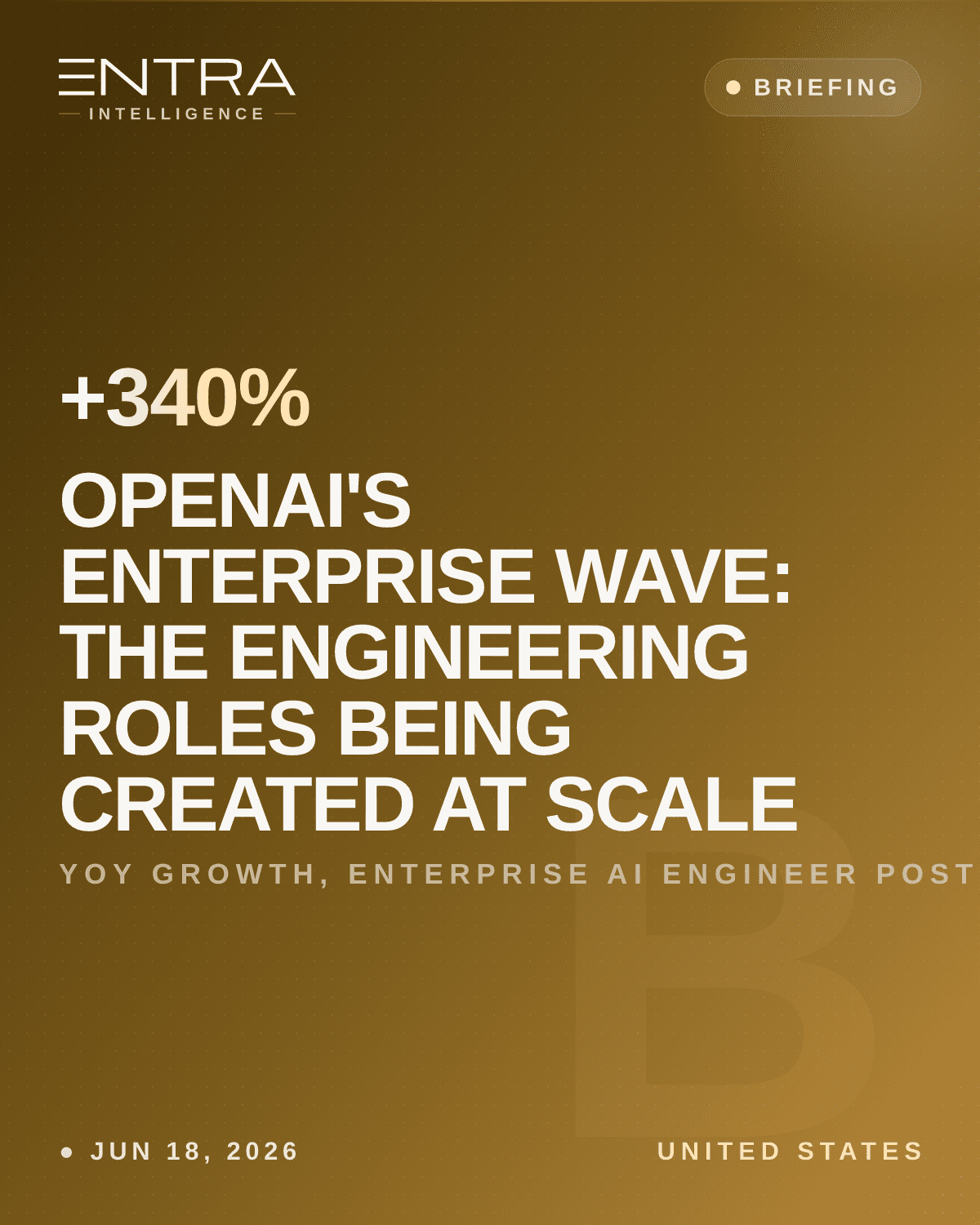
92 percent of Fortune 500 companies are now OpenAI API customers — a figure OpenAI disclosed in its spring 2026 enterprise platform announcement — and that single statistic explains a hiring surge that is reshaping the US engineering job market in ways that show up not at OpenAI's own headcount, but inside the companies deploying its models. Enterprise AI engineers, forward deployed engineers, AI solutions architects, and LLM integration specialists are now among the fastest-growing job titles in US tech — with US job postings for roles requiring OpenAI API experience up more than 340 percent year-on-year by the close of Q1 2026. The wave is second-order: OpenAI built the models; Salesforce, ServiceNow, Adobe, and Workday are now staffing to ship them.
What Happened
OpenAI's enterprise business crossed 1 million business customers in November 2025 and has not slowed. Enterprise revenue now accounts for more than 40 percent of OpenAI's total — projected at $29.4 billion for 2026 — and CFO Sarah Friar has guided toward 50 percent parity with consumer by year-end. The API layer processes more than 15 billion tokens per minute. On May 11, 2026, OpenAI announced the launch of its OpenAI Deployment Company (internally called "DeployCo"), a standalone business unit backed by more than $4 billion in initial investment, explicitly designed to embed AI into enterprise operations at Fortune 500 scale. Early production customers named in the rollout include HP, Intuit, State Farm, Thermo Fisher Scientific, and Uber.
The downstream effect on hiring is structural. Each enterprise customer deploying OpenAI APIs at production scale needs engineering staff who did not exist as a category two years ago. The role titles have proliferated faster than the talent pipeline: AI Integration Engineer, Enterprise AI Architect, LLM Solutions Engineer, AI Forward Deployed Engineer, Prompt Reliability Engineer. Roles requiring prompt engineering skills increased threefold between 2024 and 2026, even as the standalone "Prompt Engineer" title declined 30 percent — the skill absorbed upward into higher-seniority, higher-pay categories.
Salesforce is the clearest case study in second-order hiring. CEO Marc Benioff has held total engineering headcount flat — approximately 15,000 engineers, unchanged for roughly two years — while building Agentforce, its proprietary AI agent system, on top of OpenAI API infrastructure. The productivity argument is explicit: AI-generated output per engineer has risen sharply enough that Benioff is publicly comfortable with a frozen headcount. But the roles being backfilled are not the roles that attrited. Salesforce announced a target of 1,000 Forward Deployed Engineers to staff Agentforce customer deployments, disclosed in a LinkedIn post by Salesforce's talent team in April 2026. Salesforce's US job postings for AI engineering roles rose from approximately 14,000 in May 2024 to more than 31,000 by September 2025, a 121 percent increase within the company's own ecosystem alone. For a Senior or Lead AI Software Engineer on the Agentforce for Supply Chain team — a posted role as of June 2026 — the base salary range is $148,500–$260,100 nationally, with the San Francisco and New York metro band reaching $178,900–$285,800 base. Agentforce-specific skills command a $30,000 salary premium over equivalent-level generalist Salesforce engineering roles, a premium that appeared in the market in under two years.
ServiceNow formalised its OpenAI relationship in a collaboration announcement that named OpenAI models as a "preferred intelligence capability" offered directly to ServiceNow enterprise customers. The latest OpenAI models, including GPT-5.2, are now integrated with ServiceNow's Now Assist product, enabling what the company describes as "autonomous digital workers" inside enterprise workflow. To staff these deployments, ServiceNow has built an Applied AI Forward Deployed Engineering team — the company's direct equivalent to the FDE category — that works embedded with customers in production environments. On its careers page as of June 2026, ServiceNow listed an AI Solution Architect role in Los Angeles carrying a posted base salary of $151,875–$250,575, with requirements including hands-on experience with Model Context Protocol (MCP) and external AI ecosystem integrations with providers including Azure OpenAI, Amazon Bedrock, and Anthropic. A separate AI Advisory Solution Architect posting, also Los Angeles, ran concurrently. Professionals with hands-on Now Assist and Autonomous Workforce implementation experience are receiving $20,000–$30,000 salary premiums above traditional ServiceNow architecture bands, according to current market rate data tracked by ServiceNow specialist recruiter SNPro.jobs.
Adobe is running a parallel build under a different branding: AI Software Engineer, Forward Deployed, a role posted to Adobe's San Jose careers page on March 25, 2026. The role is explicitly tied to Adobe Firefly's generative AI models and involves embedding with enterprise customers to deploy production AI systems. Adobe's FDE role sits within a broader AI engineering expansion driven by Firefly's integration across Creative Cloud and the company's enterprise content supply chain product line. The San Jose posting signals Adobe's judgment that enterprise AI deployment is sufficiently distinct from core ML research to require a dedicated customer-facing engineering track.
Workday is building the equivalent inside its HR and finance platforms. The company's careers page describes AI agents that "process real-time data to improve business processes, contract reviews, and other complex challenges at scale — from LLMs to enterprise-ready frameworks." The target candidates are engineers with production RAG system experience and cloud platform fluency, with Workday publicly competing for the same talent pool as Salesforce and ServiceNow.
Why It Matters
The role taxonomy emerging from OpenAI's enterprise expansion tells a specific story about where value is being captured in the AI stack. OpenAI trains the models and controls the API. The enterprise SaaS layer — Salesforce, ServiceNow, Adobe, Workday — integrates the models into workflows and charges customers for the orchestration. The engineering labor required to make that orchestration work in production sits squarely in the enterprise deployment layer, not at the model labs.
The compensation implications are significant. AI Solutions Engineers at the mid-level in US markets command $130,000–$185,000 base in 2026. At the senior level, $190,000–$260,000 base, with total compensation in San Francisco and New York regularly clearing $350,000–$400,000 once equity is included, according to salary benchmark data from KORE1 and levels.fyi. Forward Deployed Engineers — the highest-touch customer-facing variant — run $160,000–$210,000 base at mid-level and $210,000–$290,000 at senior level in major US metros. OpenAI's own Solutions Architect median total package at the company is $418,000, with the highest reported total compensation for the role reaching $540,000.
The skills premium for LLM-specific experience is measurable and still widening. Engineers with production RAG systems experience command rates $60–$95 per hour in contract markets. LLM fine-tuning specialists earn 25–40 percent above generalist ML engineers. Engineers who can certify in both cloud-native AI infrastructure and OpenAI's API tooling see a 20–25 percent premium over non-certified peers.
Time-to-hire for enterprise AI engineering roles has compressed sharply. Roles that were taking 45–60 days to fill in early 2025 are now closing in 21–28 days at Salesforce and ServiceNow, according to recruiter market observations — not because the hiring bar has dropped, but because a recognizable talent pool has formed around the specific skill cluster these roles require: API integration, prompt reliability, RAG architecture, and production deployment experience in enterprise SaaS environments.
The sourcing pattern for this talent is also clarifying. Salesforce's 1,000-person FDE target is pulling from three pools: former big-tech solutions engineers who already have enterprise customer engagement skills; self-trained developers who built on OpenAI APIs during the GPT-3 and GPT-4 wave and can show production deployments; and a smaller cohort of early-career engineers from Salesforce's own AI-native graduate hiring program, which Benioff announced in April 2026. ServiceNow and Adobe are running comparable sourcing strategies, with the FDE title acting as a recruiting signal to the candidate market that the role is neither purely research nor purely sales engineering — it sits at the intersection.
What to Watch
Three indicators will determine whether this hiring wave sustains through H2 2026 or begins to plateau.
First: OpenAI's DeployCo trajectory. If the $4 billion Deployment Company scales its customer base beyond the initial HP, Intuit, State Farm, and Uber cohort and signs mid-market enterprises directly, the downstream pressure on enterprise SaaS companies to staff faster will intensify. DeployCo creating direct enterprise deployment channels could also create a competitive dynamic in which Salesforce and ServiceNow have to justify their integration layer value against OpenAI's own professional services arm — which would put further upward pressure on compensation for the most skilled enterprise AI engineers.
Second: the Salesforce Agentforce numbers. Benioff's flat-engineering-headcount thesis is only sustainable if Agentforce revenue accelerates in Q2 and Q3 2026. If Agentforce hits its stated targets, expect the 1,000-FDE target to be revised upward by year-end. If Agentforce underperforms, expect the role title to become the first casualty of an enterprise AI hiring correction.
Third: salary band convergence between enterprise SaaS and AI labs. The current spread — enterprise SaaS senior AI engineer at $190,000–$260,000 base versus frontier lab equivalent at $280,000–$380,000 base — is creating a structural poaching risk for Salesforce and ServiceNow. If those companies do not close the gap in H2 2026, the most experienced enterprise AI engineers will migrate toward OpenAI's own DeployCo, Anthropic's enterprise team, or the growing FDE orgs at model-layer companies. The talent math is not sustainable at current differentials.
The engineering roles that OpenAI's enterprise wave created are paying at rates the SaaS industry has no precedent for, and they are filling faster than expected. The question for H2 2026 is whether the companies building on top of OpenAI's API can retain those engineers once the model lab directly enters the deployment market.
 Global Career Platform
Find AI talent. Find your next role.
Booking is hotels. · Airbnb is apartments. · ENTRA is global careers.