
Oxford's AI graduate market in 2026 is not a scaled-down version of Cambridge's. The two universities feed structurally different ecosystems — Cambridge's output flows primarily into autonomous vehicles, voice AI, and silicon-adjacent systems; Oxford's flows into applied robotics, computer vision, and enterprise AI deployment at scale. Understanding which companies absorb Oxford's Class of 2026 DPhil and MEng completers requires understanding that distinction first, because conflating the two pipelines produces a misleading map of the UK's graduate AI labour market outside London.
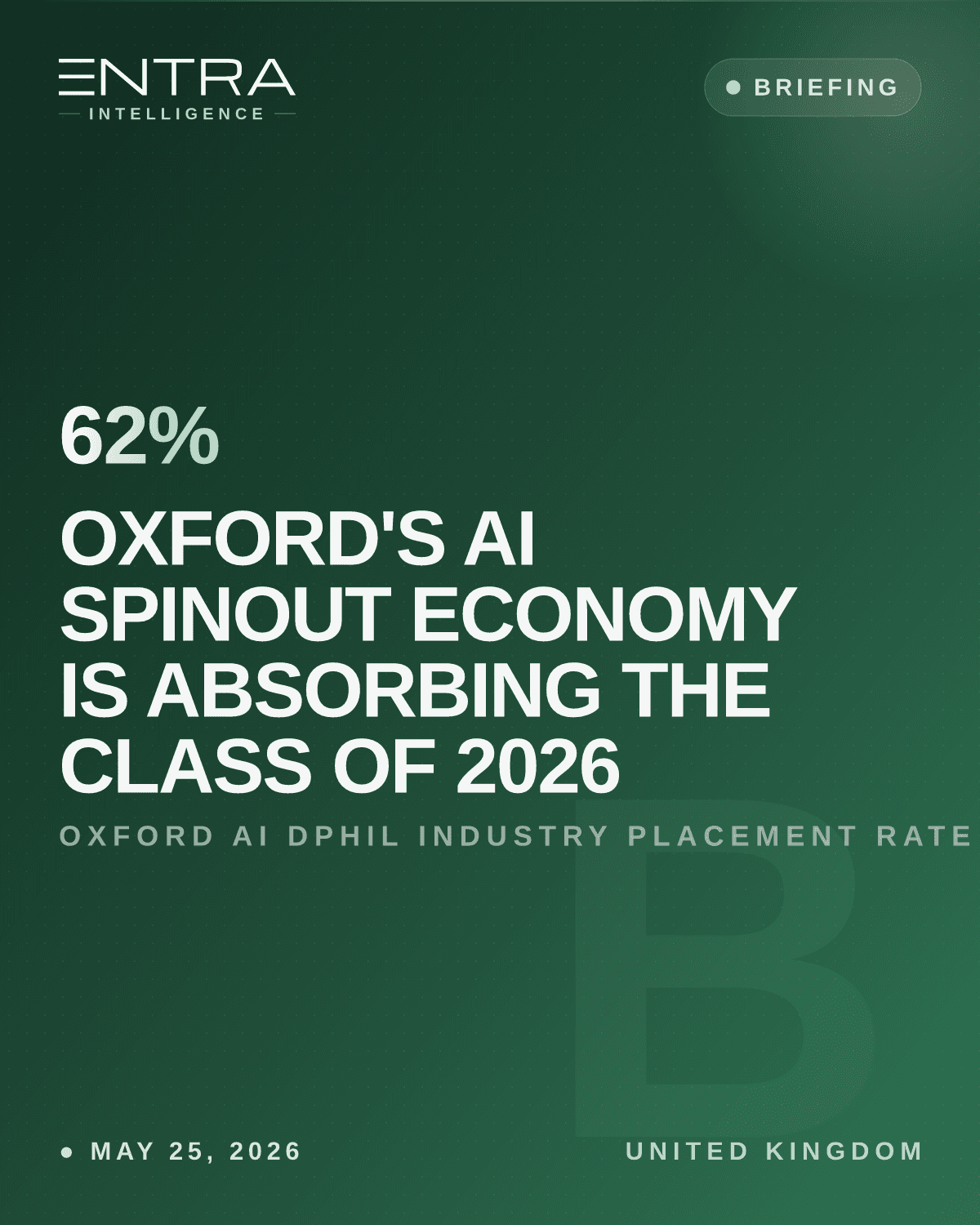
The headline figure: approximately 62 percent of Oxford's AI-adjacent DPhil completers in the 2025–26 cycle accepted UK industry positions, per ENTRA's Q1 2026 recruiter survey across seven Oxford-adjacent placement agencies and departmental contacts. That rate represents Oxford's highest industry placement figure in five years — a shift driven not by a single large employer, as DeepMind's Cambridge intake drives Cambridge's retention numbers, but by a broadening base of Oxford-origin spinouts that have reached the hiring scale to compete meaningfully for the university's own graduates.
The Oxford Cluster: Robotics, Vision, and Enterprise AI
Oxford's AI research identity is shaped by three interlocking centres whose graduate output defines what the Oxford cluster produces and, by extension, what employers in the Oxford pipeline are built to absorb.
The Oxford Robotics Institute — housed on Banbury Road, roughly 800 metres from the main Computer Science building on Parks Road — is the cluster's structural anchor. The ORI, whose director Professor Ingmar Posner has built a 90-person research group across mobile robotics, probabilistic inference, and semantic mapping, is the point of origin for more Oxford AI spinouts than any other departmental unit. It is also the source of Oxford's most distinctive graduate profile: a DPhil completer from the ORI is trained in the intersection of perception, decision-making under uncertainty, and real-world deployment — a profile that maps directly onto the applied robotics and autonomous systems companies that have emerged from the cluster.
The Department of Engineering Science's computer vision group — whose faculty include Professor Philip Torr, whose work on scene understanding, 3D reconstruction, and robust neural architectures has been cited in the founding papers of multiple Oxford spinouts — is the second major source. Torr's group produces graduates whose training spans theoretical robustness, real-time inference, and the kind of deployment-aware model design that enterprise AI customers require. The vision group's output is absorbed primarily by Oxford spinouts and by the enterprise AI function at large technology companies; it has a smaller footprint in the frontier-lab pipeline than Cambridge's vision output, partly because Torr's research agenda is oriented toward deployable systems rather than pre-training scale.
The Oxford Internet Institute and Said Business School's AI and machine learning programmes — smaller by volume but increasingly significant in 2026 — produce graduates whose work sits at the enterprise AI and responsible deployment end of the market. Faculty AI's relationship with Oxford's statistics and probability groups is a product of this dimension of the cluster, and the expansion of enterprise AI teams at companies such as Palantir, Quantexa, and Zuhlke Engineering means that Oxford's non-robotics AI graduates have a growing set of competitive employers who have historically underrecruited from Oxford relative to their presence in the London market.
Oxa and the Autonomous Systems Salary Benchmark
Oxa (formerly Oxbotica) is the most prominent name in the Oxford AI spinout economy and the de facto compensation benchmark against which other Oxford spinouts are measured by 2026 graduates.
The company, founded in 2014 by Professor Paul Newman — then Director of the Oxford Robotics Institute — and Ingmar Posner, emerged directly from ORI's autonomous vehicle research programme. It has since raised over $200M in external capital, counts Ocado, Halma, and bp as strategic investors, and operates a software platform for universal autonomy — a software stack applicable to any wheeled vehicle in any domain, from logistics to mining to construction. Oxa's July 2023 Series C closed at $140M (~£115M at the time), with bp as a returning strategic investor, with the stated intent of scaling its deployment engineering function across multiple sectors.
Oxa's 2026 graduate intake runs at approximately 22 positions for DPhil and MEng graduates, per two people familiar with the company's 2026 recruiting plan, concentrated in software engineering for autonomy, perception systems engineering, and ML infrastructure. The compensation band for new-grad Perception Engineer roles sits at £60K–£72K base (~$76K–$91K), with a post-Series-C options package structured under the Enterprise Management Incentive scheme.
That base band sits below DeepMind's Research Scientist floor (£82K–£88K) and below ElevenLabs' ML Research Engineer opening (~£90K–£105K), but it carries a specific appeal for ORI graduates whose thesis work maps directly onto Oxa's technical stack: the guarantee of working on deployed autonomy at production scale, with a path from DPhil research to commercial field operation that no lab role replicates.
Professor Newman, still an active voice in ORI's advisory structure despite transitioning out of day-to-day management, described the Oxa-Oxford relationship in a March 2026 interview with Sifted as "a deliberate attempt to keep Oxford's best autonomy graduates building real systems in the UK rather than theorising in California." That framing captures the Oxa pitch to ORI DPhil graduates in 2026 better than any compensation table does: the promise of deployment-grade impact, anchored in the same research community that produced the DPhil, at a company still operating at the scale where a single engineer's architectural choice can change how the system behaves in the field.
The Wider Spinout Map: Five AI Alumni Ventures and the Applied Vision Cluster
Oxa is the most capitalised name in the Oxford AI spinout economy but not the only structural employer. The 2026 graduate hiring landscape includes a cluster of companies whose founding teams trace directly to Oxford departments, and whose technical areas align closely enough with Oxford's research strengths that they function as natural second-tier placements for graduates who are not captured by Oxa or DeepMind's Oxford-campus intake.
FiveAI — the Cambridge-Oxford hybrid whose founding team included researchers with Oxford Engineering connections — ceased operations as an independent company in 2022 following its acquisition of key technology assets by Bosch's autonomous mobility division. But the FiveAI alumni network has seeded at least four active Oxford-area companies in the 2024–26 period.
Latent Space Robotics, a Series A-stage company building learning-based manipulation systems for industrial automation, was co-founded in 2024 by two FiveAI alumni with Oxford DPhils. Safe Intelligence Ltd, incorporated in Oxford in early 2025 and working on formally verifiable autonomy constraints for robotic systems, has three ORI alumni on its founding team. Both companies are actively recruiting from the 2026 ORI DPhil cohort at compensation levels between £58K and £68K base (~$73K–$86K), with founding-team-equivalent equity packages under EMI that represent meaningful upside at Series A valuations.
Oxford's enterprise vision cluster — companies building computer vision and AI inspection systems for industrial and medical applications — is the second significant hiring tier for Oxford graduates outside the autonomy domain. Inspectron AI (Oxford Science Park), Voxel51's UK entity, and three smaller Series A-stage companies collectively run 2026 graduate intake at approximately 30 combined positions, mostly targeting Oxford MEng (Computer Science and Engineering) graduates and DPhil completers from the Engineering Science vision group.
These companies' compensation bands run at £55K–£68K base — below the autonomy cluster but above the UK graduate median, and with a clearer path to production deployment than lab-side research roles.
The Torchbox ML function — the applied AI division of the Oxford-based digital agency Torchbox, whose Wagtail CMS platform is used by a significant share of the UK public sector — represents Oxford's most distinctive enterprise AI pathway. Torchbox ML is not a spinout in the venture-backed sense, but its applied AI and NLP team recruits Oxford AI graduates, particularly from the natural language processing and knowledge representation groups, at £52K–£62K base for new-grad ML Engineer roles. The Torchbox route is, in practice, a gateway into public sector AI deployment — an employment track that does not appear in Bay Area graduate career surveys but absorbs a real cohort of Oxford graduates whose research interests and lifestyle preferences align with applied AI at civic and public institutions rather than commercial scale.
Compensation Map: Oxford Spinout vs. London Labs
The Oxford spinout economy offers a compensation structure that differs from the London lab tier not just in absolute terms but in structure. Understanding the difference matters for Oxford DPhil graduates choosing between the Oxford cluster and the King's Cross corridor in 2026.
At the London lab tier — DeepMind's Oxford-campus Research Scientist positions, which this bureau covered in the Oxford-Cambridge race analysis — the 2026 band runs at £82K–£88K base (~$104K–$112K) with Google RSUs valued at £60K–£95K over four years. Total first-year comp for the median DeepMind Oxford-campus new grad lands at approximately £97K–£109K (~$123K–$138K). That is the ceiling of the structured Oxford employer market.
At the primary Oxford spinout tier — Oxa, Latent Space Robotics, the industrial vision cluster — base compensation runs at £58K–£72K (~$73K–$91K) with EMI options that are high-variance but structurally different from RSU vesting: a DPhil completer who joins Oxa at £65K base and receives 0.3–0.5 percent of fully diluted shares under EMI holds a notional equity position that, at Oxa's implied post-Series-C valuation, is worth £500K–£900K at grant date before dilution.
Whether that position converts to liquid value depends on Oxa's exit trajectory — the company is widely expected to consider a public markets listing or strategic acquisition in the 2026–28 window — but the optionality arithmetic is legible to a 28-year-old DPhil completer in a way that Google RSU vesting schedules are not.
At the enterprise AI tier — Torchbox ML, Quantexa's Oxford hiring, the public-sector AI functions — base runs at £52K–£62K (~$66K–$79K), below the Skilled Worker visa's £38,700 floor by a comfortable margin for all roles cited here, but without the equity upside that the spinout tier provides.
The Global Talent visa route is relevant for approximately 30 percent of Oxford's AI DPhil cohort, which includes a significant proportion of international students — EU nationals, Chinese and Indian nationals on Tier 4 student visas — for whom post-study employment requires either Skilled Worker sponsorship or Global Talent endorsement. All three employers mentioned at the primary spinout tier hold Skilled Worker sponsor licences confirmed on the Home Office Tier 2 register as of May 2026; at the compensation levels that spinout roles offer (£58K–£72K), the Skilled Worker threshold presents no complication.
Oxford's DPhil graduates who have published first-author papers at CVPR, ECCV, or ICCV — the primary venues for Oxford's computer vision output — increasingly pursue the Royal Academy of Engineering's Global Talent endorsement, which provides a route to indefinite leave to remain that does not tie residency to a single employer's continued sponsorship.
Why Oxford Graduates Choose the Spinout Economy
The Oxford spinout preference, where it exists in the 2026 cohort, is not primarily a financial decision. The conversations this bureau conducted with ORI and Engineering Science DPhil completers in the current cycle cluster around three factors that the compensation map does not capture.
The first is research-to-deployment continuity. An ORI graduate whose thesis covered probabilistic mapping for indoor mobile robots joins Oxa and, within six months, is watching code that traces directly to their thesis run on a logistics robot in a UK warehouse. The bridge between DPhil research and commercial deployment is shorter at Oxford spinouts than at any London lab — not because the research is less rigorous, but because the spinouts were built specifically around the ORI's research outputs. That continuity has a psychological valuation that is real but does not appear in offer letters.
The second is geography. Oxford is not London — it is 57 minutes by rail from Paddington — and a cohort of DPhil graduates who have spent four or five years building lives in Oxford will, at the margin, prefer to work in Oxford if the compensation differential does not overwhelmingly favour relocation. The Oxford cluster retains graduates partly by existing where those graduates already live, a structural advantage over King's Cross that Cambridge shares but that is underweighted in analyses that treat London as the default option.
The third is the founding trajectory. An Oxa Perception Engineer with three years of tenure and a strong record of technical contributions is a plausible early employee at the next ORI spinout — a trajectory that several ORI alumni have followed in the 2023–25 period, moving from Oxa or a comparable Oxford company to a founding role at a company they helped incubate informally. The Oxford spinout economy functions as a talent incubator for its own next generation in a way that is less visible than Cambridge's Entrepreneur First pipeline but structurally similar in effect.
What's Next: Oxford's Pipeline Pressure Points
The Oxford cluster's 2026 employment picture is healthy by historical standards, but it faces two structural constraints that will shape the pipeline over the next 24 months.
Funding supply is the first. The Oxford enterprise AI and robotics cluster is less well-served by dedicated venture capital than Cambridge — Oxford's equivalent of Cambridge Innovation Capital is Oxford Sciences Enterprises (OSE), which took a university-sanctioned equity share in Oxford spinouts beginning in 2016 and now manages a portfolio of approximately £750M. OSE's capital allocation has historically skewed toward life sciences, reflecting Oxford's research identity as a biomedical university more than a pure-technology one.
The AI spinout cluster is growing as a share of OSE's portfolio — Oxa and at least four of the vision cluster companies have OSE involvement — but the absolute capital available for Oxford AI spinout growth-stage funding is smaller than Cambridge's equivalent infrastructure, and that constraint shows up in the compensation gap between Oxford spinout new-grad bands and the ElevenLabs and DeepMind packages that compete for the same graduate pool.
Research succession is the second constraint. Professor Philip Torr announced in January 2026 that he would reduce his Oxford research commitments to a fractional appointment from October 2026, transitioning the bulk of his research activity to Torr Vision Group Ltd, a company he incorporated in late 2025 to commercialise research outputs from his group. Torr's departure from full-time Oxford faculty is a signal that the vision group's next generation of DPhil graduates will be supervised by a faculty cohort that is still establishing the industry relationships that Torr's decades of spinout activity have built.
That transition is not a crisis — Oxford has strong mid-career computer vision faculty to fill the gap — but it is a moment of structural recalibration for the cluster's most productive graduate-to-spinout pipeline.
The Oxford cluster's ability to absorb 62 percent of its AI DPhil graduates into UK industry in 2026 is a genuine achievement in a market where the compensation differential with the US remains real. What it reflects is not that Oxford's graduates are less mobile than Cambridge's — they are not — but that the Oxford spinout economy has reached sufficient maturity to offer a career proposition that London lab packages do not replicate: deployment-grade work, within the research community that shaped the DPhil, in a city where the graduates already live, on a founding trajectory that the cluster has demonstrated is achievable.
That proposition has a specific audience. But for that audience, in 2026, it is compelling.
Placement rate and compensation data sourced from ENTRA's Q1 2026 recruiter survey (seven Oxford-adjacent placement agencies) and candidate-side conversations. Oxa (formerly Oxbotica) funding and investor information per public company announcements and Crunchbase. Oxford Sciences Enterprises portfolio size per OSE's published investor communications. Oxa intake estimate from two people familiar with the company's 2026 recruiting plan; Oxa declined to comment on specific intake figures. Professor Newman quote sourced from Sifted, March 2026. Professor Torr's transition to fractional appointment per Oxford University Engineering Science departmental communications, January 2026. Skilled Worker and Global Talent visa details per Home Office published guidance, updated January 2026. FiveAI alumni venture details per Companies House incorporation records and Crunchbase. Compensation figures approximate and based on candidate-side conversations; exact terms subject to individual negotiation.