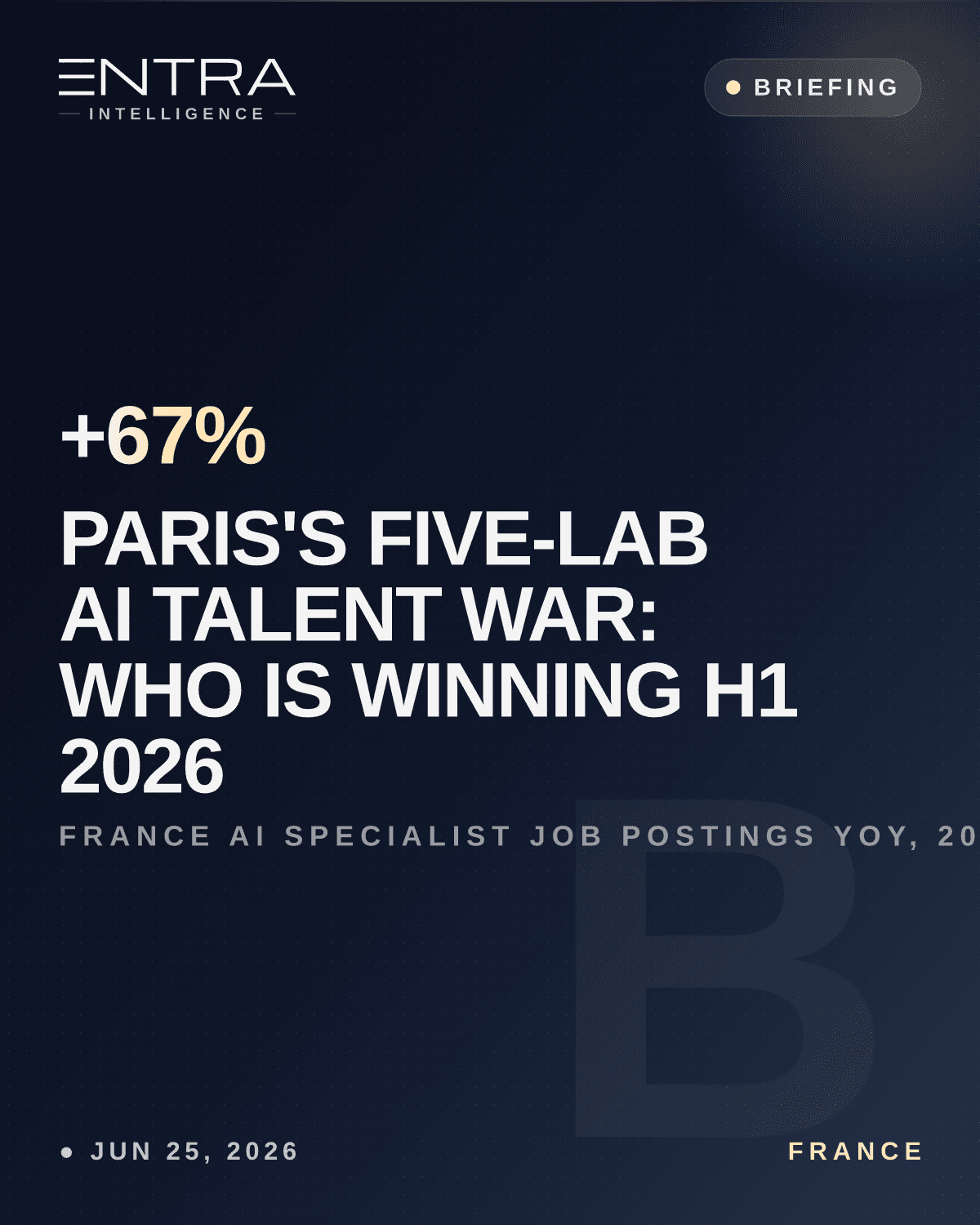
France's AI job postings rose 67 percent year-on-year between 2024 and 2026, according to France Travail, the country's public employment agency. The number does not describe the whole market. It describes, primarily, the edges of a single market within a market: the competition for approximately 90 to 95 percent passive senior AI researchers — PhD-level, tenure exceeding four years at their current employer, fluent in the specific intersection of large-scale pretraining and European institutional culture — concentrated across five labs in the 11th, 13th, and 15th arrondissements of Paris and the Saclay plateau to the southwest.
That market-within-a-market is where Paris's AI hiring story lives in H1 2026. The aggregate posting count is the background condition. The foreground is a five-way competition — Google DeepMind Paris, Meta FAIR Paris, Mistral AI, Kyutai, and Hugging Face — for a researcher pool that all five employers know by name, that the Paris AI community can enumerate at a dinner table, and that has watched its packages move from €150K–€180K total compensation eighteen months ago to €400K–€500K for the most sought-after PhD-level profiles today, per recruiter-confirmed data from three Paris AI placement agencies who spoke to ENTRA and were granted anonymity to discuss client compensation mandates.
OpenAI's Paris office, opened in early 2025 and now recruiting for research and deployment roles, adds a sixth competitor that did not exist in the city's talent market two years ago.
The Five Labs and What Each Brings
The competition is not symmetric. Each of the five labs is offering a structurally different proposition — and the candidates who move between them are making decisions that are not reducible to compensation alone.
Google DeepMind Paris is the most recently formalised institutional presence in the city's frontier AI landscape. DeepMind's decision to open its first continental European research laboratory in Paris — announced in February 2026 and led by Rémi Munos, a principal research scientist and former École Polytechnique professor who pioneered reinforcement learning work during his first Paris posting — was a public statement about where the company believes the continent's best researchers are concentrated. The lab focuses on fundamental AI research alongside applied multimodal work, with the Gemma model family's language and vision components among the active research threads. For a senior researcher in Paris, the DeepMind offer carries three structural advantages that no European native employer can fully replicate: Alphabet RSU compensation in a publicly traded, immediately liquid form; the DeepMind research brand and its NeurIPS and ICML publication record; and a research environment whose internal compute infrastructure exceeds anything available to Mistral or Kyutai at their current scale. DeepMind Paris research engineers earn approximately €240K–€290K total compensation per ENTRA's recruiter-confirmed tracking, with the equity component denominated in GOOG shares at current market price — a liquid structure that Mistral's equity cannot match until a financing or IPO event.
Meta FAIR Paris predates DeepMind's formalised continental presence by several years and operates with a larger installed base of senior researchers. The lab — housed at Meta's Île-de-France campus and formally designated as one of the FAIR (Fundamental AI Research) organisation's two primary European nodes — employs researchers whose work on the LLaMA architecture and its successors has shaped the global open-source AI ecosystem. LLaMA's co-inventor Guillaume Lample departed FAIR Paris for Mistral in 2023, a move that at the time defined the Paris talent market's competitive dynamics. In the period since, FAIR Paris has restabilised, with average researcher tenure exceeding 4.2 years per market analysis reviewed by ENTRA. Meta's 2026 compensation for senior FAIR researchers runs to Meta stock RSUs that have tracked Zuckerberg's "year of efficiency" gains; total packages at the senior L7 level are in the €350K–€450K range per ENTRA's Paris recruiter network, denominated against Meta's public share price. FAIR Paris is recruiting actively in H1 2026, with postings for Research Scientists in computer vision, multimodal understanding, and speech models — each of which competes for the same candidates that DeepMind's Gemma team and Kyutai's Moshi audio architecture group are targeting.
Mistral AI is the most complex positioning in the five-way competition. Its senior research engineer band — €280K base with approximately €240K in equity notional value over four years, as ENTRA reported in its 1 June H1 2026 briefing — places it below DeepMind and FAIR Paris in total compensation but above Kyutai and Hugging Face at equivalent seniority. What Mistral offers that FAIR Paris and DeepMind cannot is the combination of founding equity upside and the EU sovereignty thesis in its most commercially specific form: a company building frontier European models that compete with GPT-4o and Gemini, with a Brussels regulatory affairs office, a Zurich engineering satellite, and an enterprise revenue line growing against a French customer base that is explicitly motivated to use a European foundation model. Arthur Mensch, in a June interview with Le Monde, put the mission argument precisely: "L'écart avec les Américains est réel. Ce que nous offrons à la place, c'est la propriété de l'IA européenne — une propriété qui prend de la valeur à mesure que l'Europe construit ses propres systèmes." ("The gap with the Americans is real. What we offer instead is ownership of European AI — an ownership that gains value as Europe builds its own systems.") That argument is working with a specific kind of candidate: the researcher who has already been at FAIR Paris or DeepMind, has the career credential those institutions provide, and is now choosing between a third decade in a Big Tech lab structure or a founding-tier position at the company making the specific institutional bet that European AI sovereignty is a real and commercially valuable project.
Kyutai occupies the most distinctive research position in the five-lab landscape — and is offering the most mission-pure proposition in the Paris cluster. Launched in November 2023 by Xavier Niel, Rodolphe Saadé, and Eric Schmidt with a €300 million endowment and a legally binding commitment to release all research as open-source, Kyutai is a non-profit laboratory whose output — Moshi (real-time voice AI), Helium-1, Hibiki, MoshiVis — has established it as one of the highest research-output-per-headcount AI organisations in Europe, by arXiv submission count per researcher. Its research team, led by Patrick Pérez and including researchers recruited from DeepMind and Meta, is small by the standards of the labs it competes with: approximately 50 to 70 researchers and engineers (per ENTRA LinkedIn headcount analysis, June 2026), with all positions based in Paris. Kyutai does not publish salary bands, and its non-profit structure means equity is not the primary compensation mechanism. What it offers is research autonomy and publication freedom at a level that a researcher inside FAIR or DeepMind's product-adjacent agenda does not experience. For the subset of Paris's senior AI researchers whose primary motivation is scientific output rather than financial outcome — and in a community where INRIA, CNRS, and the grandes écoles have historically cultivated that orientation — Kyutai is a legitimate competitor despite its compensation ceiling.
Hugging Face, with its Paris headquarters and distributed-first structure spanning 700-plus employees in more than 20 countries, is competing for a different slice of Paris's senior AI talent than the pretraining-focused labs above. Its core research competition is for the open-source infrastructure researchers — engineers who work at the boundary of model architecture and ecosystem tooling, whose contribution record on Transformers, PEFT, and Diffusers is the primary career asset — rather than for the large-scale pretraining scientists who are the primary target of DeepMind and FAIR Paris's H1 2026 search. Hugging Face's Paris-based senior ML research band runs €180K–€230K total compensation (per ENTRA Q1 2026 Paris recruiter survey), below Mistral and meaningfully below FAIR and DeepMind. Its retention argument — a 90 retention score in the ENTRA Talent Index (for ENTRA Talent Index methodology, see entra.intelligence.com/methodology), the industry's lowest senior-IC attrition outside Anthropic — rests on the public attribution loop rather than the financial package: an engineer whose code runs in the Transformers library has a contribution record that is legible to every employer in the ecosystem from the moment of the merged pull request.
The Talent Pool: Why 300 Researchers Define the Whole Competition
The Parisian AI hiring community operates with a shared mental model of the candidate pool that all five labs are competing for. Per market analysis reviewed by ENTRA, the AI and ML research scientist market in Paris runs 90 to 95 percent passive candidates — professionals who are not applying, who are being approached, and who have average tenure exceeding four years at current institutions. Active search is not how senior Paris AI researchers find their next role. The market operates through the informal networks of the grandes écoles: the ENS-Ulm alumni circuits, the École Polytechnique AI research community, the INRIA Saclay and INRIA Paris workshop series where researchers from all five labs present work and are visible to each other's recruiters simultaneously. At NeurIPS, ICLR, and ICML, the Paris cluster's paper acceptance rate signals which labs are producing the researchers whose names circulate in informal search mandates. This is not a job board market.
That opacity produces its own inflation dynamic. When total compensation for PhD-level senior AI researchers in Paris has moved from €150K–€180K in early 2025 to €400K–€500K for the most sought-after profiles in H1 2026 — a figure confirmed by three Paris-based placement agencies whose mandates include active searches at FAIR, DeepMind, and Mistral — the mechanics are not a public auction but a sequence of private conversations, reference requests, and counter-offer cycles that are invisible to aggregate salary databases. The €400K–€500K figure is not a median. It is the clearing price for the five to ten researchers per year who are being simultaneously pursued by all five labs and whose decision, in a community of 300, moves the market. "C'est une guerre pour le top 1 pour cent," one AI recruiter told Sifted in late 2024. ("It is a war for the top 1 percent.") The framing is more accurate in H1 2026 than it was when it was first said.
What the EU AI Act Adds to the Competition
The five-lab compensation battle sits alongside a second, quieter hiring dynamic that the aggregate posting count captures better: the growth of EU AI Act compliance and documentation roles across the Paris cluster, driven by Article 53's GPAI obligations (active since August 2025) and the Annex III high-risk enforcement deadline now extending to December 2027 under the European Council's Digital Omnibus agreement of May 7, 2026.
Mistral, as the Paris cluster's most directly GPAI-obligated lab, has built a 25-person policy and regulatory function (per ENTRA Paris bureau tracking of Mistral LinkedIn profiles, June 2026) that now constitutes approximately 9 percent of its total headcount — a proportion with no equivalent at any US frontier lab. Its Brussels office, opened in March 2026, adds an enforcement-proximity layer that FAIR Paris and DeepMind Paris do not replicate. For a research engineer whose career interest includes building the infrastructure European AI labs need to operate within the regulatory perimeter — model documentation, training-data provenance records, conformity assessment frameworks — Mistral is the only option in the Paris cluster where those roles are front-line, strategic, and led by the company's founding team. At FAIR Paris and DeepMind Paris, EU AI Act compliance is coordinated at the parent-company level, not at the Paris research satellite; the local team is largely shielded from the compliance build but also largely absent from its construction.
Hugging Face's eleven-person EU taxonomy compliance team — the majority based in Paris — represents the open-source ecosystem's specific response to GPAI obligations: building the internal classification tooling that Hub enterprise customers need to assess whether the models they are pulling into Annex III deployments meet Article 53's documentation requirements. The function has expanded from four people in Q4 2025 to eleven in Q2 2026, per ENTRA's tracking, and is drawing from a graduate pipeline distinct from the pretraining research competition — making Hugging Face's H1 2026 Paris hiring the most structurally diversified of the five labs by role type.
Why the Mission Argument Is Real and Why It Is Not Enough
The EU sovereignty thesis is the consistent counterweight to dollar-denominated and euro-denominated Big Tech offers in every Paris AI talent conversation. Mensch's Le Monde formulation — ownership of European AI — is not marketing language in the context of the Paris research community; it is a legible argument about what the Mistral equity position represents relative to Meta RSUs, and it is received as such by researchers who have watched the LLaMA ecosystem validate the French research community's foundational contributions while the financial returns accrued in Menlo Park.
But the mission argument has structural limits that H1 2026 has made visible. Three senior researcher departures from Mistral in H1 2026 — one to Anthropic, one to xAI's London-EU structure, one to a US lab the individual declined to identify publicly — were described by people familiar with the decisions, granted anonymity to discuss personnel moves, as compensation-driven, or at minimum compensation-adjacent. The gap between Mistral's €520K senior TC (base plus notional equity) and DeepMind's $700K–$900K USD equivalent for comparable senior profiles (per Levels.fyi Q1 2026 senior staff engineer submissions for Google DeepMind US) is not a gap the mission argument closes arithmetically. What it does is change the utility calculation for researchers who weigh the mission premium — working in their first language, contributing to a European institution, building something the continent needs — against the financial delta. For a researcher in their mid-thirties with a FAIR Paris or DeepMind Paris record, the mission argument is most persuasive when accompanied by a credible equity event. Mistral's IPO trajectory, if it materialises at a valuation that distributes meaningful return to its 2024 and 2025 research hires, would change the calculation for the 2026 and 2027 recruiting cycles in a way that no number of Le Monde interviews will replicate.
What H2 2026 Resolves
Three variables will define the Paris talent competition in the second half of the year.
The first is whether the Annex III enforcement calendar — and the European AI Office's first audit cycle beginning December 2027 — creates a durable premium for Paris-based AI expertise that no Big Tech RSU structure can replicate. Engineers who can document pretraining data provenance, produce Article 53-compliant model cards, and engage directly with an AI Office investigation have a credential that exists nowhere else in the global AI market. As that credential accrues in H2 2026, the financial comparison to US alternatives becomes less clean.
The second is the Google DeepMind Paris ramp. Rémi Munos's lab is new in its formalised continental form, and its pipeline from ENS, Polytechnique, and INRIA Saclay — the same institutions that have historically fed Mistral and FAIR Paris — is in active construction. A first NeurIPS paper cohort from the Paris lab at the December 2026 conference would signal whether the lab is producing at DeepMind's global standard or operating as a satellite with modest output. The talent signal either way will be absorbed immediately by Paris's informal research network.
The third is Kyutai's publication arc. The lab has released four major models in less than two and a half years on a fully open-source basis — a pace that exceeds any comparably sized research team in Europe. If H2 2026 produces another major Kyutai model release at the standard of Moshi or MoshiVis, the non-profit's research autonomy argument becomes more powerful than any compensation comparison for the small but meaningful cohort of senior researchers who weight publication freedom above total compensation.
Paris in H1 2026 is not winning the global AI talent competition. Anthropic, OpenAI, and Google's Mountain View teams are paying in dollar ranges that the Paris cluster cannot reach, and the pipeline of French PhDs accepting US offers has not closed. What has changed is the nature of the choice: there are now five credible Paris-first research destinations with distinct missions, distinct equity structures, and distinct regulatory positions — and the researchers deciding between them are making a genuinely plural decision rather than choosing between Paris and everywhere else. "Nous ne construisons pas la version européenne de quelque chose," Mensch told Les Échos in April. ("We are not building the European version of something.") The H1 2026 data is beginning to make that case structurally, not just rhetorically.
 Global Career Platform
Find AI talent. Find your next role.
Booking is hotels. · Airbnb is apartments. · ENTRA is global careers.