
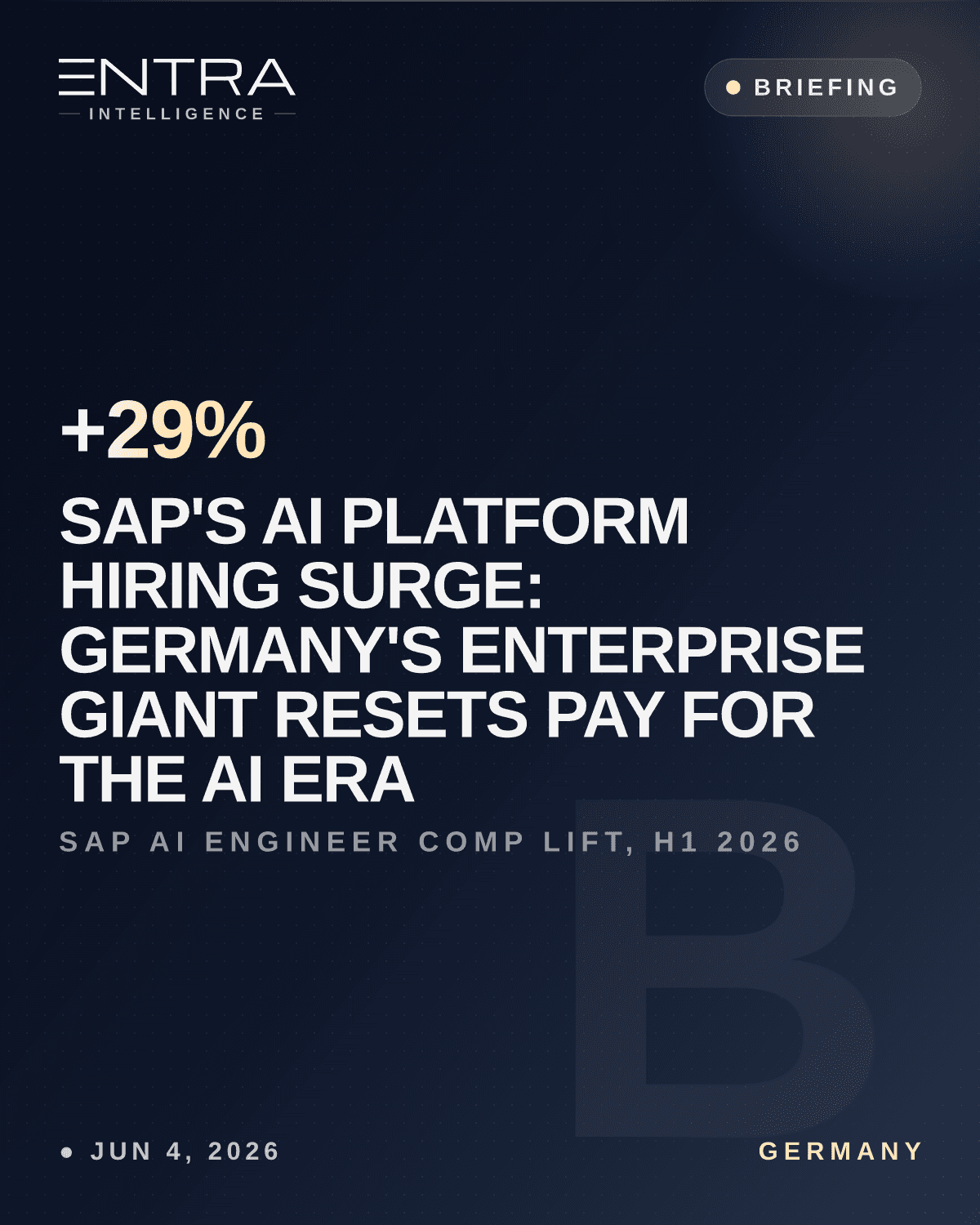
SAP has opened more than 1,100 AI-specific roles globally in the first five months of 2026, with Germany accounting for roughly 420 of them — split unevenly across a Walldorf headquarters that anchors enterprise architecture and a Berlin hub that has become the company's de facto LLM integration centre. The compensation reset is real and measurable: senior AI engineers at SAP Germany are being offered base bands of €160,000–€195,000 (~$174K–$213K equiv at Q2 2026 EUR/USD rates of ~$1.09), a 29 percent uplift from the €124,000–€151,000 bands that applied to equivalent-seniority software principals twelve months ago. The driver is SAP Joule — the company's generative AI copilot embedded across its entire enterprise application suite — and a Business AI revenue line that grew 34 percent year-on-year in 2025, creating an engineering demand that SAP's traditional HR pay architecture was not built to satisfy.
What Happened
Christian Klein stated on the Q1 2026 earnings call in April that SAP's AI-driven cloud revenue had surpassed €3.2B on an annualised basis and that the company intended to "move aggressively to build the engineering base that this product transition requires." That phrase — "move aggressively" — had a specific organisational meaning visible in SAP's job board activity through Q1 and into May 2026: a deliberate expansion of the AI role taxonomy beyond SAP's conventional engineering bands and into categories the company had not historically hired at scale.
The new role clusters fall into four categories. LLM Integration Specialists — engineers building the grounding and retrieval architecture that connects SAP Joule to S/4HANA Cloud, SuccessFactors, and Ariba data layers — are being hired primarily into SAP's Berlin AI hub at Rosenthaler Platz, where the company established a satellite engineering centre in 2023. ENTRA's monitoring of SAP's LinkedIn Germany postings through May 2026 identified 187 Berlin-posted roles in this category, paying €120,000–€150,000 base (~$131K–$163K) at the junior-to-mid level and €155,000–€190,000 (~$169K–$207K) at senior level. Enterprise AI Architects — the senior technical layer responsible for designing SAP Joule deployments inside Fortune 500 client environments — are concentrated at Walldorf HQ, where SAP's enterprise customer engagement infrastructure sits. Walldorf postings for this category ran 94 roles as of May 1, paying €175,000–€210,000 base (~$191K–$229K), SAP equity participation, and a relocation package calibrated to the Rhine-Neckar labour market. AI Product Managers — a role type SAP had fewer than 30 of globally as recently as 2023 — now represent 96 Germany-based open roles, posted across both Walldorf and Berlin, with compensation at €130,000–€165,000 (~$142K–$180K), reflecting the premium SAP is paying for candidates who can translate enterprise customer requirements into LLM product specifications. The fourth category is the fastest-growing: EU AI Act Compliance Engineers, a functional cluster that barely existed as a named role inside SAP two years ago and now accounts for an estimated 140 of the German open roles, as the company builds the technical documentation and post-market monitoring infrastructure that SAP Joule's Annex III high-risk system classification requires.
The geographic split matters for candidates evaluating SAP's H1 2026 build-out. Walldorf — a small town of 16,000 in Baden-Württemberg, between Heidelberg and Stuttgart — offers SAP's full enterprise architecture and the proximity to the company's most senior product leadership, but the cost-of-living case is sharply different from Berlin. SAP is offsetting the geography gap with a €6,000 relocation grant for non-local hires taking Walldorf roles, and with a remote-flex policy — formalised in a March 2026 HR announcement — that allows Walldorf-registered AI engineering roles to operate at three days per week in-office. The Berlin roles carry no relocation grant and are explicitly in-hub, reflecting the company's judgement that LLM integration work benefits from the proximity to Berlin's broader AI ecosystem: Aleph Alpha's Berlin satellite, Hugging Face's Berlin engineering team, and the technical talent density of Berlin's startup corridor are all within commuting distance of SAP's Mitte hub. The Bangalore dimension completes the distribution picture: SAP's Bangalore development centre, which houses the company's largest single engineering workforce at approximately 12,000 engineers, is absorbing AI platform infrastructure roles — model serving, fine-tuning pipeline engineering, BTP AI Core backend development — at junior-to-mid seniority levels, while Germany retains the architecture, product, and compliance-facing roles that require European regulatory context and client proximity.
Why It Matters
SAP's H1 2026 AI hiring push is the most significant single-company contributor to Germany's enterprise AI employment picture in the first half of this year, and its comp reset is changing the reference frame for what German AI engineers can expect outside the startup and defence corridors.
The German AI labour market in H1 2026 is characterised by a structural supply shortage that ENTRA has documented extensively: roughly 41,000 open AI-grade roles against an annual graduate supply of approximately 3,000 deeply ML-fluent engineers from the country's top technical universities. SAP's 420 Germany-based AI opens represent roughly 1 percent of national demand from a single employer — not a solution to the structural problem, but a measurable signal about where enterprise demand is concentrating. More consequentially for the broader market, SAP's compensation reset is establishing a new floor for mid-to-senior AI engineering pay at non-startup German employers. The €160,000–€195,000 base band for SAP senior AI engineers puts enterprise tech compensation within 15 to 20 percent of Helsing's all-in new senior-hire packages (~€185,000–€220,000 all-in for senior ML engineers, per ENTRA estimates from people familiar with the company's H1 2026 hiring), and within 10 percent of what Aleph Alpha was paying pre-Cohere-acquisition. The industrial corridor — BMW, Volkswagen CARIAD, Siemens — is now observing SAP's bands as the reference ceiling for what enterprise software pays, not what it used to pay.
The EU AI Act dimension is not incidental. SAP Joule is classified under Annex III of the AI Act as a high-risk system when deployed for HR decision support (SuccessFactors) and financial workflow automation (Ariba). SAP's legal obligation under Article 9 of the AI Act — to establish risk management systems for these deployments — and under Article 11 to maintain technical documentation reviewed by notified bodies, is creating a genuine engineering hiring requirement that is distinct from the product build-out. The 140 estimated Germany-based EU AI Act Compliance Engineer roles are not box-ticking positions. They are technical roles requiring documented understanding of Annex III classification criteria, Article 72 post-market monitoring architecture, and the data governance requirements of Article 10 for training-data quality. SAP is, by ENTRA's estimate, the largest single employer of senior AI compliance engineers in Germany in H1 2026 — a position the company did not hold and could not have held twelve months ago, before the EU AI Act's high-risk system obligations became operationally imminent.
For Germany's position in the EU AI employment picture at H1, the SAP signal carries a specific weight: it demonstrates that enterprise software — not just frontier labs, not just defence AI, not just infrastructure startups — is now competing at AI-market compensation levels. The €45,000 gap between Stuttgart's industrial AI floor and Berlin's startup ceiling that characterised Germany's AI pay structure as recently as Q1 2026 is narrowing from above, with SAP's Walldorf roles pulling the enterprise benchmark upward. The gap is not closed. But it is contracting, and SAP is the primary contractor.
What's Next
SAP has not published H2 2026 hiring targets, but the company's product trajectory gives a directional read. The S/4HANA Cloud migration pipeline — still the largest single source of SAP's enterprise revenue — is producing a multi-year demand curve for AI integration work as customers moving off on-premise ABAP environments require Joule deployment and BTP AI Core configuration at scale. SAP's pipeline of RISE with SAP customers committed to cloud migration through 2028 represents, by the company's own investor guidance, the largest addressable engineering deployment in European enterprise software. The engineering headcount required to deliver that migration at AI-enriched specification does not plateau at H1 2026 levels.
The Berlin AI hub trajectory is the most consequential near-term variable. SAP's Mitte office has capacity constraints: the current lease, per two people familiar with SAP's German real estate planning, supports approximately 300 engineering seats, and the company has been in lease-expansion discussions for a second Berlin location since Q1 2026. If those discussions resolve on the timeline SAP's hiring rate implies — an additional 150 to 200 Berlin seats by Q1 2027 — it will position SAP as one of Berlin's top-five AI engineering employers by headcount, competing directly with Aleph Alpha's Berlin satellite and ElevenLabs' Berlin engineering team for the same pool of LLM-literate engineers.
The EU AI Act enforcement calendar hardening is the structural tailwind that will sustain SAP's compliance engineering build-out beyond H1. The European AI Office's publication in May 2026 of its first Annex III conformity assessment guidance — covering general-purpose AI integrated into high-risk applications, precisely SAP Joule's classification profile — gave SAP's legal and engineering teams a confirmed documentation standard to build toward. The December 2, 2027 Annex III enforcement date is the deadline against which SAP must demonstrate conformity for its SuccessFactors and Ariba Joule deployments. The engineers being hired now are the engineers who will produce that conformity case file. The hiring window for that credential-forming work is, by definition, closing — those who are inside SAP's compliance engineering function when the first formal EU AI Office Annex III review cycle begins will hold a professional credential with no non-European equivalent.
Klein's April earnings call statement — "mission und Markt sind nicht im Widerspruch" ("mission and market are not in contradiction") — was directed at investors making the case that SAP's AI transition is financially disciplined as well as strategically coherent. For the engineers receiving the comp reset that transition is funding, the phrase has a more immediate meaning: the European enterprise AI market is paying at a rate the continent's largest software company did not pay two years ago, and the roles it is creating at that rate are structurally different from the ones they are replacing.