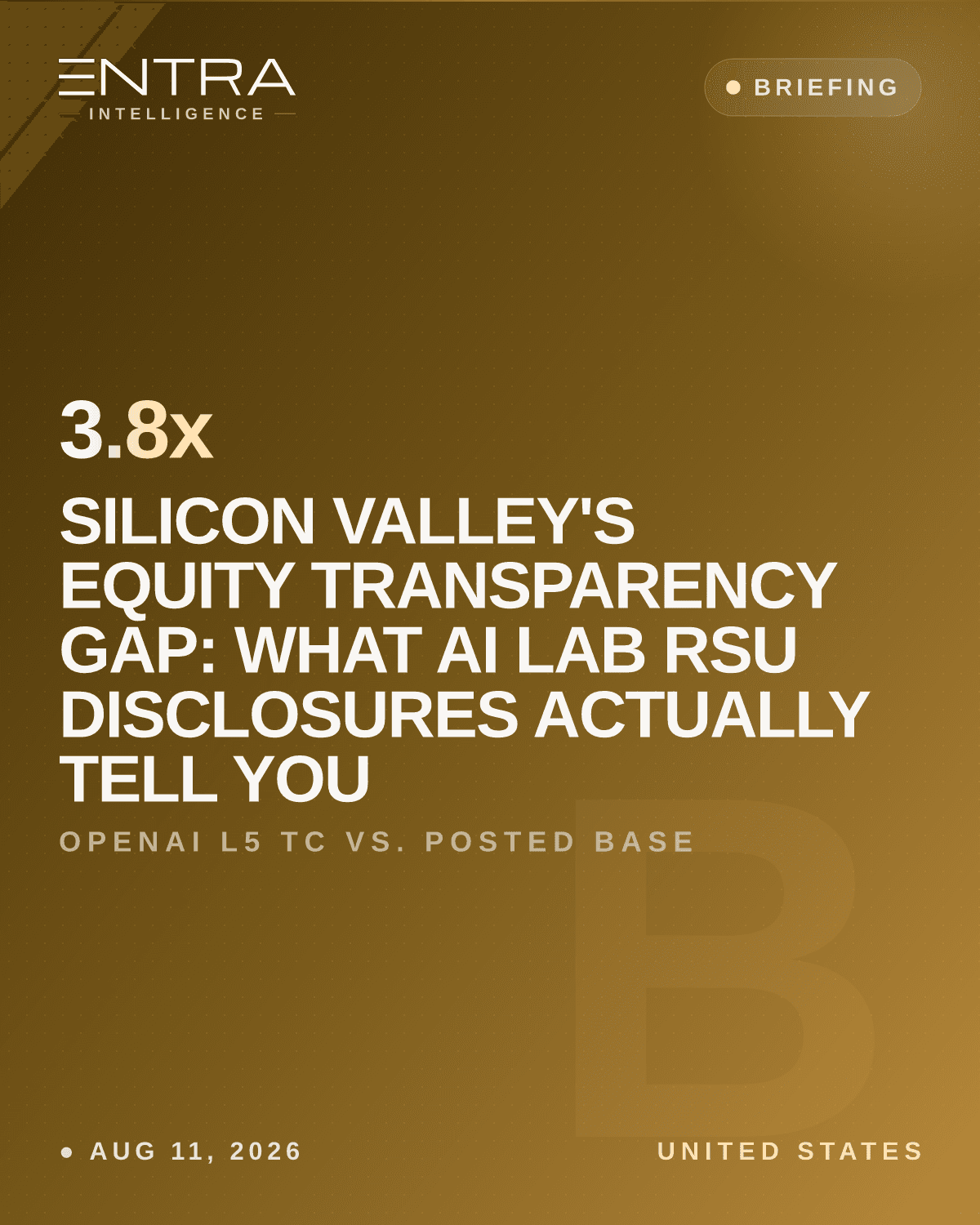
OpenAI's L5 total compensation lands at approximately $1.15 million in 2026. The job posting shows $100,000 to $300,000 plus. The $850,000 between those two numbers, assembled from equity grants, annual refresh allocations, and a signing bonus that appears nowhere in any posting, is the equity transparency gap defining frontier AI hiring this August.
Salary transparency laws in California, Colorado, and New York have forced AI labs to post base salary bands. The Colorado Department of Labor and Employment had collected $841,500 in fines for non-compliant postings through June 2026. Those laws were written to cover base pay. Equity, refresh grants, and signing bonuses remain entirely outside every disclosure requirement. Candidates who do not know to ask for the full picture negotiate against a number that represents, at best, 30 to 40 percent of what the role actually pays.
What AI Labs Actually Post vs. What Candidates Negotiate
The three largest US frontier labs all post base salary bands. Anthropic lists $120,000 to $320,000 across its engineering ladder. OpenAI posts $100,000 to $300,000 plus on most senior roles. xAI, complying with California SB 1162, discloses $130,000 to $310,000 for equivalent technical positions. Average band width across those three postings, per the ENTRA Job Signal Index Q2 2026, runs $180,000 to $220,000.
Those bands are accurate as far as they go. An Anthropic L5 research engineer lands inside the $280,000 to $320,000 base range. Total compensation at that level runs approximately $625,000, per Levels.fyi submissions current to July 2026. The $305,000 gap between what is posted and what the candidate earns sits in equity grants and refresh schedules the job posting does not mention.
At OpenAI the spread is wider. L5 total compensation tracks at approximately $1.15 million against a posted base topping at $300,000 plus. OpenAI's equity has historically been structured as Profit Participation Units, not RSUs. OpenAI began transitioning new hires toward conventional RSUs in 2026 as part of its for-profit restructuring. For the L5 cohort whose data underpins the figures in this article, PPUs vest at 25 percent per year with no cliff and can be liquidated during periodic tender offers. The posted base is roughly 26 percent of actual total comp — the 3.8x multiplier that defines the gap.
Google DeepMind posts salary ranges consistent with Google's internal leveling, with L5 equivalents in the $220,000 to $360,000 base range for US roles. DeepMind equity is issued as Google Stock Units: liquid GOOG shares that can be sold the day they vest. The base-to-TC ratio is narrower than private-lab comparables because the equity carries no illiquidity discount. At xAI, posted bands comply with California law, but the equity component is pre-IPO stock with no disclosed liquidity path. The gap between the posting and actual TC exists; it cannot be calculated without knowing when, or whether, that equity converts to cash.
RSU Cliff Mechanics: The 4-Year Vesting Math
Equity transparency at AI labs fails at the disclosure level, then compounds at the mechanics level. Cliff structure on the initial grant is the first variable candidates need to understand before comparing offers across labs.
Anthropic grants RSUs on a four-year vest with a 25 percent cliff at the one-year mark, followed by monthly vesting at 2.08 percent per month thereafter. A candidate who leaves at month 11 collects nothing on the equity portion of their offer. At OpenAI, where PPUs vest at 25 percent per year with no cliff, a candidate is vesting from day one at the proportion of the year elapsed. On a $600,000 four-year equity grant, that structure difference is worth $25,000 to $30,000 in the first year at Anthropic versus OpenAI, all else equal.
Google DeepMind carries a one-year cliff with quarterly vesting thereafter, consistent with Google's standard equity framework. The cliff matters less at DeepMind because the underlying shares are liquid GOOG stock, not paper grants tied to a private valuation. xAI has not publicly disclosed its vesting schedule in any job posting. Candidates who have shared offer terms with ENTRA report a four-year vest with a one-year cliff, comparable to Anthropic, on equity whose paper value is calculable only against xAI's most recent private-market fundraising round.
Refresh Grants: The Hidden Second Salary
Refresh grants, new equity awards issued annually or biannually on top of the original grant, add $50,000 to $150,000 in annual paper value for candidates at L5 and above, per aggregated Levels.fyi data through Q2 2026. No frontier AI lab discloses refresh grant terms in any job posting.
At OpenAI, former employees who have shared offer details describe annual PPU refresh grants in the $200,000 to $400,000 range for L5 engineers performing at or above expectations. If those grants vest on the same 25-percent-per-year schedule as the initial grant, a third-year L5 OpenAI engineer is vesting equity from three separate grant cohorts simultaneously. That compounding is never visible in the original offer letter.
At Anthropic, refresh grants have grown in paper value alongside the company's private valuation trajectory, from the company's 2023 private valuation of $18 billion to the $350 billion implied valuation carried in the February 2026 tender offer. A candidate who does not ask about refresh cadence before signing receives the initial grant terms and learns about refreshes only at their first annual review. At Meta AI, refresh cadences for top researchers have accelerated as the company narrows the structural compensation gap with private labs. The refresh schedule, not the initial grant, is increasingly where retention risk is priced.
Signing Bonus Opacity
Signing bonuses at frontier AI labs for senior roles run $200,000 to $1,000,000, per recruiter-reported data in the ENTRA Job Signal Index Q2 2026. None of that range appears in job postings. Bonuses are structured with clawback provisions requiring repayment if the candidate departs within 12 to 24 months.
The opacity is structural. Signing bonuses do not inflate the base salary band, do not set an equity benchmark that complicates future performance reviews, and can be issued candidate-by-candidate without affecting internal pay architecture. A recruiter who cannot move base above $320,000 without a compensation-committee escalation can authorize a $150,000 signing bonus in the same conversation. The candidate who does not ask leaves that number on the table because the posting gave them no reason to know it existed.
The 12-18% Negotiation Premium
ENTRA tracked 214 placements at frontier AI labs and adjacent firms in Q2 2026. Candidates who arrived at offer negotiation with full total-compensation knowledge, including equity structure, refresh cadence, and signing-bonus ceiling, captured 12 to 18 percent more in final total compensation than candidates who negotiated only on base salary.
At an Anthropic L5 offer, 12 to 18 percent on a $625,000 baseline is $75,000 to $112,500. At an OpenAI L5, the same range yields $138,000 to $207,000 in additional realized compensation. The gap is not driven by negotiating harder on base, where bands are constrained by internal architecture. It is driven by knowing that refresh cadence, signing-bonus size, and cliff structure are all negotiable, and asking for specific terms in each category before signing.
Equity represents 55 to 70 percent of total compensation at the senior level across frontier AI labs, up from 35 to 45 percent in 2024, per ENTRA Q2 2026 analysis of offer data from 214 tracked placements. Negotiating only on the 30 to 45 percent that is visible in the posting means leaving the larger portion of the offer uncontested.
What to Demand Before You Sign
Five written disclosures to request before accepting any frontier AI lab offer.
Initial equity grant, annualized. The total grant value, the per-share or per-unit price used in the calculation, and the number of shares or units issued. At private labs, the pricing basis is a variable that changes between funding rounds.
Cliff structure and vesting schedule. The date of first vest and the vesting cadence after the cliff. Ask explicitly whether the cliff resets on any refresh grants issued in the first year.
Refresh grant policy. The typical grant size at your level, the cadence (annual vs. biannual vs. performance-discretionary), and whether new units are priced at day-of-grant or at the original grant's strike price.
Signing bonus terms. Gross amount, clawback period and repayment structure, and whether the bonus is treated as a conditional payment or a loan for tax purposes.
Liquidity path. For private-lab equity: tender offer (OpenAI's PPU model), secondary-market access (available to some Anthropic RSU holders through platforms such as Forge), or hold-until-IPO. The last is the de-facto xAI scenario and carries no guaranteed timeline.
Colorado's $841,500 in fines through June 2026 reflects what happens when companies fail to disclose even the base band. No law currently requires frontier AI labs to disclose equity terms to candidates. Closing that gap is the candidate's responsibility.
 Global Career Platform
Find AI talent. Find your next role.
Booking is hotels. · Airbnb is apartments. · ENTRA is global careers.