
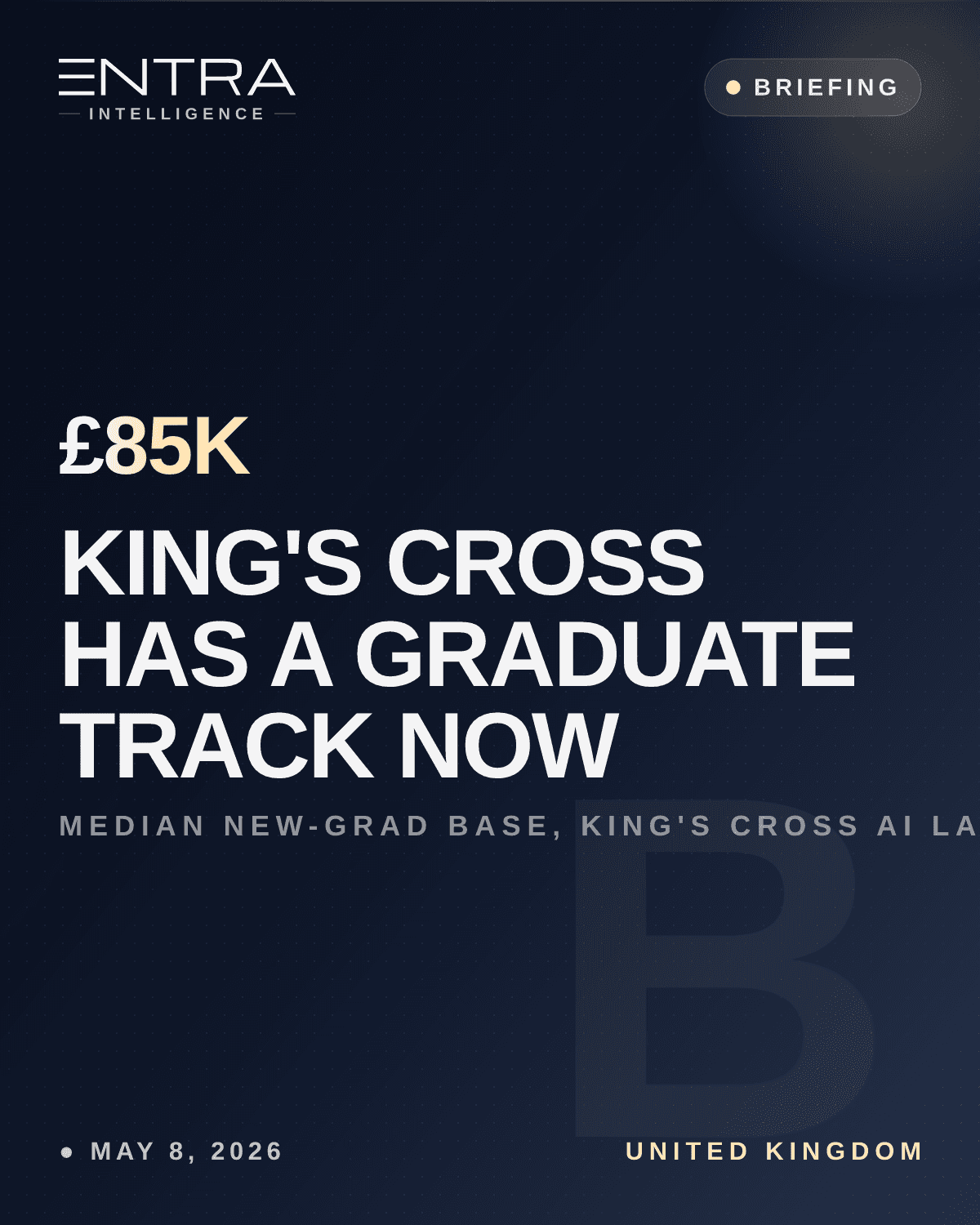
For the first time, the King's Cross AI corridor has a formal graduate track competitive enough to hold its own against Mountain View. DeepMind's 2026 Research Scientist new-grad intake is running at roughly 40 positions across the London and Oxford campuses, with first-year total comp cleared at £85K base (~$108K) plus equity — a package that has closed the structural gap with entry-level Google Brain Mountain View offers to approximately 18 percent, down from a 35 percent gap reported in mid-2024. ElevenLabs and Wayve, operating on challenger-lab economics, have responded with structured residency and engineering-track programmes designed specifically to intercept Cambridge ML graduates before DeepMind's funnel captures them. The graduate market in London AI is, for the first time, a genuine three-way contest.
DeepMind's New-Grad Programme: What the 2026 Intake Looks Like
Google DeepMind's formalised Research Scientist Graduate Programme — consolidated under the combined DeepMind + Google Brain organisation in late 2024 — is running its largest UK-anchored intake to date in 2026. The programme, which Demis Hassabis discussed in broad terms in his February appearance on the Stratechery podcast, is structured around two UK entry points: King's Cross (primary research track) and the Oxford office (computational biology and AlphaFold-adjacent roles). Combined UK headcount target for the 2026 cohort sits at approximately 40 Research Scientist new-grad positions, with a parallel Software Engineer new-grad track adding a further 25 roles weighted toward the Gemini infrastructure side of the house.
Compensation for the 2026 intake has been confirmed by three separate candidate-side conversations tracked by this newsroom through Q1. The Research Scientist new-grad band opens at £82K–£88K base, with a median of approximately £85K (~$108K at current rates), plus a Google Restricted Stock Unit grant typically structured over four years at a grant value in the £60K–£95K range at the current Alphabet share price. Total first-year comp including RSU vesting sits between £97K and £115K (~$123K–$146K) for the median Research Scientist new-grad — a package that has materially compressed the historical London-versus-Mountain-View delta. One Cambridge ML PhD who accepted a DeepMind London offer in March told us the Mountain View package came in approximately 15 percent higher in total cash terms, but the RSU structure, UK tax treatment on the vesting schedule, and the absence of a Bay Area cost-of-living adjustment made the net-of-tax differential close to flat.
That framing — net-of-tax rather than gross-total-comp — is the structural story of DeepMind's 2026 graduate market position. The lab is not matching SF packages headline-for-headline. It is winning on net-of-tax economics, on King's Cross proximity to the Cambridge research network, and on a specific pitch Hassabis's team has been making aggressively through the first quarter: that London is DeepMind's research engine and Mountain View is its scale engine, and that the foundational research career — AlphaFold successors, Gemini architecture, the nascent robotics track coming out of the DeepMind robotics lab in King's Cross — is most legibly built in London. The pitch is landing. Three Cambridge ML PhDs who had deferred Mountain View starts to the 2026 cycle accepted London positions instead, per two Cambridge supervisors who spoke to this newsroom in April.
The UKRI compute grant dimension compounds the picture. Under the UK AI Action Plan, published in January 2026, UKRI has expanded its compute grant allocation for companies hosting graduate researchers on formal research programmes — the specific mechanism that DeepMind's Research Scientist Graduate Programme qualifies for. The grant structure, administered through UKRI's EPSRC industrial partnership scheme (documented in the UK AI Action Plan annex published January 2026), provides supplementary compute allocation worth an estimated £40K–£120K per graduate researcher per year to qualifying industrial research hosts. For DeepMind's 2026 cohort, that allocation materialises as direct research infrastructure — additional TPU time allocated to graduate-led projects — rather than as cash compensation. The effect on new-grad research output velocity is non-trivial: Cambridge supervisors describe UKRI-augmented compute access as "materially expanding what a first-year researcher can attempt."
ElevenLabs and Wayve: The Challenger Track for Cambridge ML Graduates
ElevenLabs launched its Voice Research Residency for new graduates in January 2026, structured as a twelve-month programme anchored at the London office on Worship Street in Shoreditch. The residency targets candidates with strong ML fundamentals — a Cambridge or Imperial ML masters or PhD is the typical profile, though the programme is formally open to any candidate with demonstrable voice-model research output — and pairs them with a senior research mentor drawn from the lab's core audio and speech synthesis team. Compensation for the Voice Research Residency sits at £75K base (~$95K) with an equity grant structured as EMI options at a strike price set at the January 2025 Series C post-money of $3.3B — a grant that carries meaningful upside if ElevenLabs continues its trajectory toward a reported IPO process.
The ElevenLabs pitch to Cambridge graduates is structurally different from DeepMind's. Where DeepMind offers scope — the breadth of the combined 6,000-person research organisation, the AlphaFold-to-Gemini range of research mandates — ElevenLabs offers ownership. Mati Staniszewski's recruiting language, visible in his LinkedIn posts through Q1 2026, consistently emphasises that a Voice Research Resident at ElevenLabs works on problems that ship to millions of users within weeks of completion, not months after an internal review cycle. For Cambridge graduates whose research instinct runs toward deployment-speed, that framing is competitive. The 2026 Voice Research Residency received approximately 340 applications for 8 positions, per a person familiar with the programme's intake process — a selectivity ratio that matches DeepMind's Research Scientist programme per seat.
Wayve's approach to the Cambridge ML pipeline is structurally distinct from both DeepMind and ElevenLabs, and reflects the company's specific talent geography. Alex Kendall — himself a Cambridge ML PhD (class of 2019, supervised by Roberto Cipolla) — built Wayve's engineering bench through direct Cambridge recruitment from the start, and the company's Autonomous Systems Engineering Track formalises what had been an informal direct-pipeline. The 2026 track targets candidates finishing Cambridge ML PhDs or MPhils with a focus on computer vision, sensor fusion, or uncertainty quantification — the three technical domains most directly relevant to Wayve's urban autonomous driving stack. Compensation for the Autonomous Systems Engineering Track opens at £78K base (~$99K) with equity structured as growth shares under Wayve's post-Series-C ($1.05B, May 2024, SoftBank + NVIDIA + Microsoft) option pool. The King's Cross office — Wayve's headquarters sits on the same Goods Way corridor as DeepMind — means the physical proximity of the two organisations is close enough that graduate candidates routinely attend networking events for both in the same week.
The UKRI compute grant eligibility extends to ElevenLabs and Wayve's programmes, subject to EPSRC industrial partnership registration — which both companies are understood to have completed ahead of the 2026 grant cycle. For Wayve, the compute allocation translates directly into simulation infrastructure for the autonomous systems work; for ElevenLabs, it augments the training budget for voice model research resident projects. The practical effect is that UKRI's AI Action Plan funding is functioning as a non-dilutive subsidy that makes the challenger-lab new-grad economics more competitive against DeepMind's RSU-augmented package.
The Skilled Worker Visa Route: How Non-UK Graduates Are Landing in King's Cross
The graduate pipeline from Cambridge and Oxford is predominantly domestic and EU-origin — but a material share of the 2026 intake at all three employers is arriving via the Skilled Worker visa route. The current Skilled Worker salary floor sits at £38,700 per annum, the threshold uprated from the previous £26,200 floor in April 2024 following the Home Office's Spring 2023 review. For AI research roles, the floor is in practice irrelevant — every new-grad position at DeepMind, ElevenLabs, and Wayve clears £75K–£88K base, well above the minimum. The operationally significant threshold is the sponsorship requirement: all three employers hold Tier 2 sponsor licences, and the processing time for a Skilled Worker visa for a research role runs to approximately eight weeks from the date of certificate of sponsorship issuance.
The Global Talent route — which does not require an employer sponsor — is the alternative path for candidates with an established publication record. Cambridge ML PhDs graduating in 2026 with a NeurIPS or ICML first-author publication are routinely eligible for endorsement through the Royal Academy of Engineering or the Alan Turing Institute's endorsing body designation. Global Talent endorsement takes three to six weeks and produces an unsponsored visa valid for five years, giving the candidate full labour market flexibility. Per two immigration solicitors who advise AI employers in the King's Cross corridor, the proportion of incoming new-grad hires at London AI labs using the Global Talent route rather than Skilled Worker sponsorship has risen from approximately 12 percent in 2023 to an estimated 28 percent in Q1 2026 — a shift that reflects both the rising quality of the international graduate cohort and the labs' active guidance of strong candidates toward the unsponsored route.
The visa specificity matters because it shapes the graduate intake timeline. DeepMind's 2026 new-grad programme runs an October start for domestic and EU candidates and a rolling December-to-February start for visa-dependent international candidates, timed to the eight-to-twelve week Skilled Worker processing window. ElevenLabs' Voice Research Residency is structured on a January start precisely to accommodate international candidates who receive their Cambridge MPhil result in late September and begin visa processing in October. Wayve's Autonomous Systems Engineering Track is the most visa-flexible — the company sponsors twelve-month rolling start dates and has an in-house immigration coordinator dedicated to Cambridge-pipeline candidates, a resource that signals the degree to which the Cambridge-to-King's Cross corridor is a structured talent channel rather than an opportunistic one.
The combined picture, as of May 2026, is a graduate market in London AI that has acquired the structural features it lacked as recently as two years ago: formal programmes, published compensation bands, visa pathways calibrated to academic calendars, and UKRI subsidy unlocking non-dilutive compute access for the labs that host graduate researchers. Some Cambridge PhDs who in 2024 would have defaulted to Mountain View as the only serious destination for early-career AI research are now making a different calculation — not because London has caught up to San Francisco on headline comp, but because the net-of-tax economics, the research ownership, and the programme infrastructure have made the King's Cross answer a defensible one.