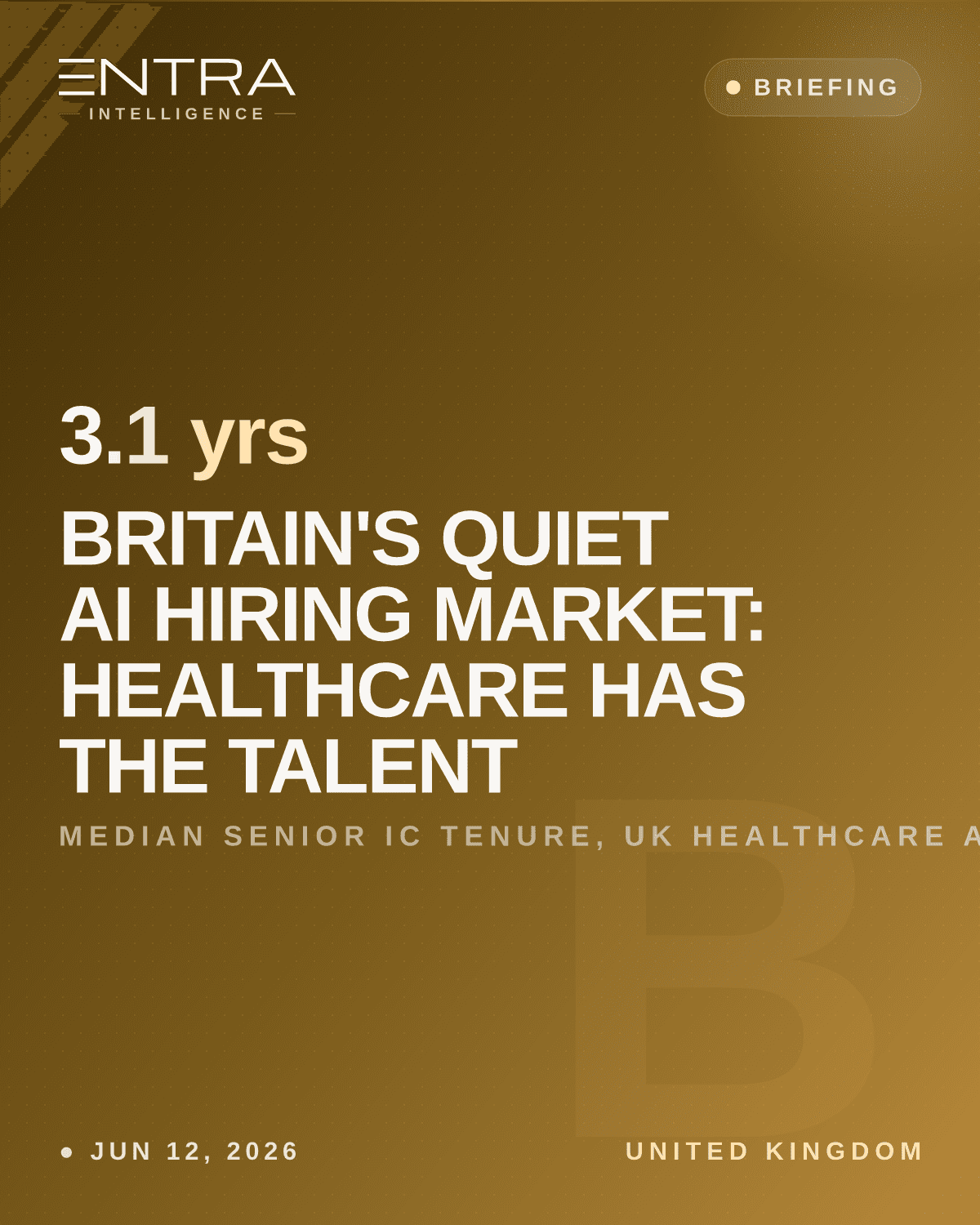
The King's Cross AI corridor attracts the headlines, but the most durable senior IC talent market in British AI in H1 2026 sits thirty minutes away in Pancras Square and Cheshire: BenevolentAI, AstraZeneca's AI Research division (Alderley Park and Cambridge), GSK.ai (Stevenage and King's Cross), and the NHS AI Lab (Leeds Data Science hub) together posted 340 net new AI roles in the first half of 2026 — a figure that would land in the top five UK AI employer headcount additions if it appeared under a lab nameplate, per LinkedIn headcount deltas and job-board aggregation by Tech Talent Charter UK. The median senior IC tenure across these four employers sits at 3.1 years, against 1.7 years at comparable London pure-play AI labs (per ENTRA H1 2026 retention tracking). That is not an accident of mission alignment — it is a structurally different incentive architecture, and senior engineers choosing their next London move in H1 2026 are beginning to notice it.
What Happened
BenevolentAI entered H1 2026 having restructured aggressively in late 2024 — cutting its commercial team and refocusing entirely on its AI drug discovery platform. That contraction proved to be a talent consolidation rather than a retreat. By April 2026, the Bloomsbury-headquartered firm had rebuilt its engineering bench to 210 technical staff, adding 45 net ML roles since January (per LinkedIn headcount delta, April 2026), with a heavy bias toward graph neural networks and multimodal molecular modelling. Base salaries for Principal Research Engineers sit at £155K–£195K (~$196K–$247K), with total comp reaching £310K via equity tied to clinical milestone vesting — a structure that is explicitly designed to hold researchers through multi-year drug programmes. Global Talent visa sponsorship is confirmed active on the Home Office Tier 2 register; BenevolentAI recruited ex-Cambridge ML PhDs from three consecutive cohorts (2023–2025).
AstraZeneca AI Research is the largest single employer in the cluster and the least publicly legible. Its Cambridge site (on the Cambridge Biomedical Campus, adjacent to the Wellcome Sanger Institute) and Alderley Park site together hold an estimated 380 AI and data science roles as of June 2026 — up from roughly 280 in mid-2024, per LinkedIn headcount tracking. The division's work spans protein structure prediction inference pipelines (running on internal compute trained on AlphaFold derivatives), real-world evidence modelling, and clinical trial AI optimisation. Compensation at the Staff Scientist / Senior Research Scientist band reaches £175K base (~$222K) with a long-term incentive plan that routinely delivers £80K–£120K in deferred equity annually for researchers who stay through four-year vesting cycles. Total comp ceiling for Distinguished Scientists is estimated at £380K (~$481K). AstraZeneca recruits through the Skilled Worker visa route for roles above the £38,700 threshold floor, but its preferred pathway for senior researchers is the Global Talent visa — the firm has had a dedicated immigration team supporting Global Talent endorsement applications since 2023.
GSK.ai, headquartered at the Francis Crick Institute partnership offices in King's Cross and the Stevenage R&D campus, has been the quietest mover. Its 2026 H1 headcount additions are modest in absolute terms — approximately 55 net roles — but the seniority skew is notable: roughly 70 percent of additions are at Senior or Staff engineer level, according to LinkedIn seniority-filter headcount deltas. GSK.ai's focus on foundation models for genomics and multi-omics data integration has made it a destination for researchers leaving academic positions rather than competing labs. The combination of an Imperial College London research collaboration (covering MSc and PhD placements) and GSK's pharmaceutical-grade data assets — one of the largest longitudinal human health datasets in Europe, per the UK Biobank partnership — is a pull that no pure-play lab in King's Cross can replicate with compute alone.
NHS AI Lab, the national programme administered by NHSX and based at Leeds and a secondary office in London, added 28 ML engineering roles in H1 2026 (per LinkedIn headcount delta, H1 2026) focused on two programmes: a large-scale chest X-ray triage model being deployed across 47 NHS Trusts, and a predictive deterioration model for acute inpatient wards built in collaboration with University College London Hospitals. Compensation sits below private sector — Staff ML Engineer at £82K–£105K (~$104K–$133K) — but the Lab has begun piloting a Civil Service AI Specialist salary supplement (introduced in the Spring 2026 DSTL/NHSX joint review, published April 2026) that closes roughly 40 percent of the gap for roles requiring PhD-level modelling skills. Skilled Worker visa sponsorship is confirmed; the Lab is not currently on the Global Talent endorsement pathway.
Why It Matters
For a senior IC weighing London moves in mid-2026, the healthcare AI cluster reframes the pure-play lab versus big-tech binary. The structural argument is this: pharmaceutical AI roles carry data moats that foundation model labs cannot replicate on AWS. AstraZeneca's clinical trial dataset library — more than 900 completed global trials — is the kind of training substrate that changes what a research engineer can publish and patent. BenevolentAI's milestone-linked equity means that when a programme reaches Phase II trial, researcher compensation events are material. These are not consolation prizes for researchers who missed a DeepMind offer; they are distinct career bets with different risk profiles.
The tenure differential is the clearest signal. At 3.1 years median tenure against the London pure-play benchmark of 1.7 years, healthcare AI employers are retaining researchers through the complete lifecycle of a project — which in drug discovery means three to five years minimum. For a senior IC who has already cycled through a frontier lab and wants to own something end-to-end, that stability is the proposition.
Visa architecture reinforces the cluster's competitiveness. AstraZeneca and BenevolentAI are both active Global Talent route sponsors, meaning researchers in the EPSRC/MRC "Exceptional Promise" or "Exceptional Talent" bands can enter without a specific job offer and receive ILR acceleration to three years rather than five. The NHS AI Lab's Skilled Worker sponsorship at the new Spring 2026 supplement rates makes it accessible for mid-level engineers from outside the EU who could not previously clear the salary threshold. Neither route is EU-contingent — both are UK immigration system instruments, with no Brexit dependency.
The geographic spread matters too. AstraZeneca's Cambridge Biomedical Campus site sits within the Cambridge AI cluster — fifteen minutes on the Guided Busway from the University of Cambridge's Cavendish Laboratory and from Arm's Cambridge campus. GSK's King's Cross office puts it inside the AI corridor proper. BenevolentAI's Bloomsbury headquarters is a twenty-minute cycle from University College London's AI Centre on Gordon Street. The cluster is not a satellite market; it is woven into the fabric of London and Cambridge AI geography.
What's Next
Three things to watch in H2 2026:
First, NHS AI Lab salary reform completion. The Spring 2026 AI Specialist supplement was a pilot covering 60 roles. The DSTL/NHSX review committed to a full-scale rollout decision by October 2026. If the supplement is extended service-wide, the NHS AI Lab becomes a plausible destination for mid-level ML engineers at £95K–£115K — a step-change in NHS competitiveness that would matter for UK AI talent retention nationally.
Second, AstraZeneca's Cambridge compute expansion. AstraZeneca announced in March 2026 a £450M capital programme for the Cambridge Biomedical Campus, a portion of which is allocated to a dedicated AI compute cluster. When that infrastructure comes online (estimated Q1 2027), the friction that currently pushes AstraZeneca AI researchers toward external cloud compute — and toward frontier labs with better GPU access — decreases materially. Watch for senior hiring acceleration in H2 as the compute programme moves from announcement to procurement.
Third, BenevolentAI's Phase II pipeline as an equity trigger. Two BenevolentAI programmes — a BEN-2293 atopic dermatitis candidate and a separate ALS-target discovery programme conducted with UCL Queen Square Institute of Neurology — are tracking for Phase II readouts in late 2026 or early 2027. Positive readouts would trigger milestone vesting events for researchers who joined in 2022–2023. If those events materialise, BenevolentAI's equity story becomes a recruiting case study, not just a promise.
The King's Cross lab corridor will continue to absorb the loudest headlines and the largest headcount numbers. But the H1 2026 data makes one thing plain: the UK's most underrated AI hiring market is not a scrappy challenger. It is a set of deep-pocketed, data-rich employers offering structural advantages — tenure, data moats, milestone equity, Global Talent visa infrastructure — that pure-play labs are not positioned to replicate. Senior ICs who benchmark only against DeepMind and Wayve are leaving value on the table.

 Global Career Platform
Find AI talent. Find your next role.
Booking is hotels. · Airbnb is apartments. · ENTRA is global careers.