
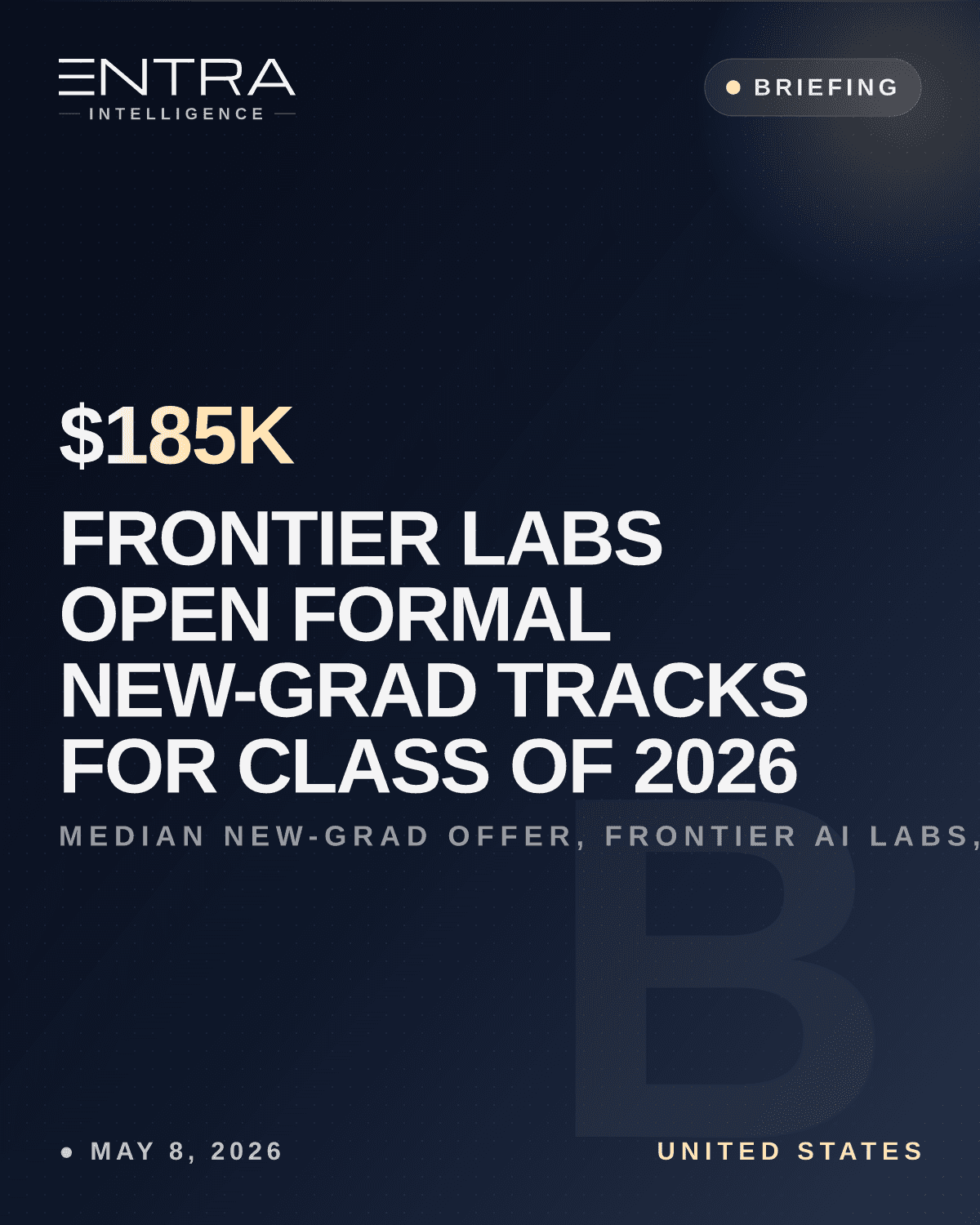
For five years, the unspoken rule at frontier AI labs was that entry-level meant PhD-plus, and new graduates without three years of post-degree work had nowhere to start. That rule broke in 2026. OpenAI launched a structured Early Career Research Cohort starting June 3, Anthropic opened two new cohorts of its Fellows Program for May and July, and Google DeepMind's Student Researcher program is accepting rolling applications through July 17. The bottleneck is no longer talent — it is pipeline.
The New-Grad Pipeline: What Launched in 2026
Three programs, three architectures, one shared logic: convert promising but unproven candidates into lab-ready researchers before committing to permanent headcount.
OpenAI's Early Career Cohort is the most structured of the three. The program opens June 3 in San Francisco, on a hybrid in-office schedule, and is designed explicitly for current undergraduates and recent graduates. The first month is a research bootcamp — direct immersion in the core problems behind modern AI systems — followed by a structured team-matching process before participants join a permanent research team. OpenAI is not calling this a trial. Participants join as full-time Research Scientists or Research Engineers from day one, with relocation assistance available. The selection bar is high and deliberately non-credential-based: OpenAI screens for elite competition performance (Olympiads, Putnam, ICPC), top performance in OpenAI-hosted challenges, and evidence of rapid independent learning. A CS degree is not listed as a requirement. A history of original output is.
The OpenAI Residency, separately, runs six months at $18,300 per month — $109,800 for the full term — with stock options, medical, dental, vision, a learning and development stipend, daily office meals, and wellness credits included. The 2026 application window has already closed, which itself signals demand: the program filled before most universities posted their spring career fair schedules.
Anthropic's Fellows Program is structured differently. Fellows are not employees. The program runs four months at $3,850 per week — roughly $61,600 for the full term — plus approximately $15,000 per month in compute credits and direct mentorship from Anthropic researchers. The aim is producing public research outputs: over 80 percent of fellows from prior cohorts published a paper. The conversion rate to full-time employment is 25 to 50 percent per cohort, with some cohorts tracking above 40 percent. Two cohorts open in 2026: May and July. The program has expanded from its original AI safety focus to cover ML systems and performance, AI security, and societal impact. For the Class of 2026, the Fellows Program is the most direct structured path into Anthropic without a senior hire's credentials.
Anthropic CPO Mike Krieger — who moved in January 2026 to co-lead Anthropic's Labs incubator alongside Ben Mann — stated publicly on the "Hard Fork" podcast that Anthropic has "tended less to hire fresh college grads" and that he retains "some hesitancy" about entry-level workers as AI models absorb the task load that entry-level roles historically carried. That hesitancy is the organizing logic behind the Fellows structure: a four-month paid trial at $3,850 per week before a permanent decision is made.
Google DeepMind's Student Researcher program is the largest-volume of the three. Applications for the 2026 cohort are open on a rolling basis through July 17, with start dates running January through July. The program covers BS, MS, and PhD candidates and is distributed across Google DeepMind, Google Research, and Google Cloud. One important distinction: the Student Researcher program is explicitly non-conversion-eligible. Google DeepMind does not guarantee, or structurally offer, a path from Student Researcher to full-time employment. It is a research credential, not a hiring pipeline. Candidates who want a Google DeepMind full-time role will use the Student Researcher engagement as a credential in a separate application.
Google's separate AI Residency, which predates the DeepMind merger and runs twelve months as a fixed-term full-time employee role, has historically converted a meaningful share of residents to permanent positions on the Brain team. The 2026 cohort details were not publicly disclosed at time of publication.
The Money: What Entry-Level AI Pays in the US Right Now
The new-grad compensation picture in frontier AI differs by program type, and the spread is wider than most candidates expect.
At the top of the market: OpenAI Residency at $18,300 per month — annualized, that is $219,600 in cash alone, before stock options. Anthropic Fellows at $3,850 per week annualize to approximately $200,200, plus $15,000 monthly in compute credits that represent real productive value even if they do not land in a bank account.
For direct new-grad full-time hires in San Francisco — the Early Career Cohort path at OpenAI, or a successful conversion from any of the fellowship tracks — market data from Levels.fyi and sector compensation trackers puts the entry-level band at $115,000 to $135,000 base salary, with total compensation including equity reaching $180,000 to $220,000. The median lands around $185,000 total comp for an ML engineer or research engineer at a frontier lab in the Bay Area. Per candidate reports reviewed by ENTRA, OpenAI extended retention bonuses in the $250,000–$300,000 range for new-grad technical hires in August 2025, on a two-year vest, for candidates who had competing offers at the time of signing — figures that distort the median upward for the most competed candidates.
The ML engineer salary picture at broader market rates, per Kore1's 2026 guide, runs $128,000 to $186,000 in base salary across experience levels, with the San Francisco market carrying a 20 to 35 percent premium over national figures. For a candidate coming out of a top CS program with a published paper or competition result on their resume, the floor in San Francisco is not $115,000 — it is whatever number their second-best offer says.
One structural note on comp: Anthropic and OpenAI both set bands that include performance-tied cash components beyond base and standard equity. Anthropic's senior-research offer template — covered separately in our briefing on the Anthropic talent stack — uses a one-time "scale-of-impact" cash component tied to model-launch milestones. That structure is filtering down to the entry-level cohort track as labs compete to make program-track offers look comparable to direct-hire offers at peer firms.
The AI Trainer On-Ramp: Mercor, Scale, Outlier as Feeder Programs
The most consequential structural shift in Class of 2026 hiring is not the residency programs. It is the normalization of AI trainer work as a verifiable credential.
Mercor, Scale AI's Outlier platform, and Surge AI collectively employ or have employed hundreds of thousands of contractors performing RLHF annotation, model evaluation, and domain-expert data generation. That work, done at sufficient volume and documented clearly, is now being read by hiring managers at frontier labs as a proxy for the kind of deliberate, model-proximate technical practice that a research internship used to signal.
Mercor's network runs to more than 30,000 expert contractors, weighted toward PhDs and domain specialists, at an average rate of $95 per hour. Per Mercor's own press materials and investor disclosures, the firm disburses over $1.5 million per day to evaluators and counts OpenAI, Anthropic, and six of the Magnificent Seven among its clients. Mercor's October 2025 Series C — reported by TechCrunch and Bloomberg — raised $350 million at a $10 billion post-money valuation, reflecting a revenue trajectory the company has described publicly as growing from $1 million to $500 million ARR in 17 months. The valuation reflects the structural position Mercor holds as the talent layer between AI labs and the human evaluation work that trains their models.
Outlier, Scale AI's contractor platform, runs a network that the company has described as exceeding 700,000 annotators with graduate degrees — a figure consistent with Scale AI's public statements on contractor scale. Per Outlier's public pricing pages, pay rates tier sharply by domain: generalists earn $15 per hour, CS and coding RLHF specialists earn $50 to $65 per hour, and domain experts in medicine or law command $250 to $450 per hour on Surge AI. For a new computer science graduate who cannot land a direct residency slot, six months of coding RLHF work at $50 to $65 per hour represents two things simultaneously: $50,000 to $75,000 in cash, and a line item on a resume that reads, in effect, "I have spent 1,000 hours working directly on the models you are hiring me to improve."
That logic is the on-ramp. Scale AI's March 2026 launch of Scale Labs — an expanded research division built on the foundation of its Safety, Evaluation, and Alignment Lab, announced via Scale AI's official blog — formalizes what has been happening informally: contractors who demonstrate consistent high-quality output on evaluation tasks are now being identified as candidates for the research roles Scale Labs is building. The pipeline from annotator to researcher is not yet common. It is becoming legible.
The implication for the Class of 2026: the traditional sequence of degree, then internship, then job offer is no longer the only path. The alternative sequence is degree, then AI trainer role (Mercor, Outlier, or direct lab contracting), then a residency application that leads with demonstrated model-proximate work. Several people who entered the OpenAI Residency's 2025 cohort had Mercor or Outlier contractor experience on their applications. The labs are not advertising this. Their hiring managers are not denying it.
One data point that anchors the shift: per NACE's Job Outlook 2025 and BLS Occupational Employment data, computer science graduates are running 6.1 percent unemployment in 2025, nearly double the rate of humanities majors — a reversal of the historical pattern that reflects not a reduction in demand for CS skills but a compression in the number of traditional software roles that entry-level CS graduates used to fill. The AI trainer economy did not create that compression. It is absorbing it, and creating a new first rung.
The Class of 2026 enters a market where the residency track is documented, the compensation is competitive, and the on-ramp through AI trainer platforms is legible. The question is whether the graduating class moves fast enough to use it.
Sources: OpenAI Early Career Cohort listing — OpenAI Residency Program 2026 — Anthropic Fellows Program 2026 — Google DeepMind Student Researcher Program — Levels.fyi OpenAI Salaries — Kore1 ML Engineer Salary Guide 2026 — Mercor Wikipedia — speedyapply 2026 AI College Jobs — Anthropic CPO on entry-level hiring, Final Round AI — AI Compensation Benchmarks 2026, Pin