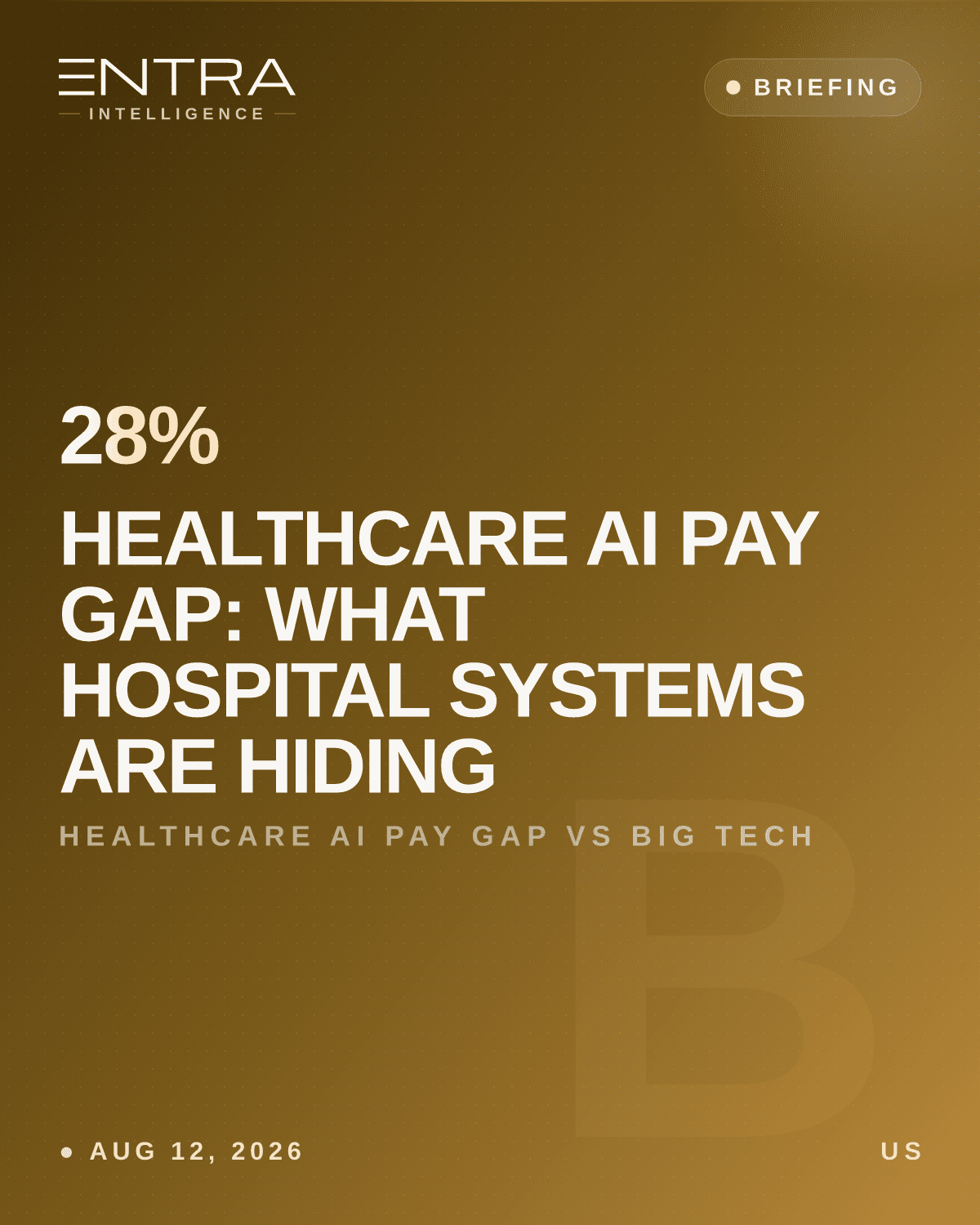
68% of US job postings now include a disclosed salary range, up from 45% in 2023 — but inside healthcare AI, those ranges are exposing an inconvenient number. Senior ML engineers at hospital systems and medical AI companies are posting base salaries of $130,000 to $230,000 while the same title at Meta, Google, or Microsoft commands base salaries of $200,000 to $285,000. That differential — roughly 28% at the senior IC level when comparing base-to-base — has always existed. Pay transparency laws are now making it impossible to obscure.
Healthcare is the largest employment sector in the United States and, by active job-posting volume, one of the fastest adopters of AI in 2026. Demand for healthcare AI roles — ML engineers, clinical data scientists, health AI product managers — rose 2.4x in the first four months of 2026 compared to the same period in 2025, per KORE1's 2026 Healthcare AI Hiring Trends analysis. The hiring volume is real. The compensation has not kept pace with the ambition.
Why Healthcare AI Salaries Trail Big Tech
The healthcare AI pay gap is structural, not incidental. Hospital systems are predominantly nonprofit entities governed by boards that benchmark compensation against peer institutions, not against Anthropic. Medical AI companies — even well-funded, publicly traded ones — operate under drug development and regulatory timelines that compress their equity value proposition relative to a hyperscaler on a six-month product cycle.
The result is a compensation ladder that sits a full tier below Big Tech at every level. An ML engineer at the midpoint of their career earns a median of $105,973 annually in a healthcare AI context, per ZipRecruiter aggregated data from July 2026. The 75th percentile is $141,000. A mid-career ML engineer at Google or Microsoft sits in the $220,000 to $280,000 total comp range for equivalent seniority, per Levels.fyi data cited across multiple 2026 salary benchmark reports.
The gap narrows — but does not close — for specialized roles that command regulatory premiums. FHIR-fluent ML platform engineers, required for interoperability work under CMS rules, post at $190,000 to $295,000 at larger health systems and health-tech vendors. Ambient clinical AI engineers — the people building tools like real-time documentation assistants in surgery suites — post at $175,000 to $260,000. At the executive layer, Chief Medical AI Officers, a title that did not widely exist before 2024, now post salary bands of $320,000 to $720,000 at major health systems. Several of the largest US academic medical centers are posting above the $450,000 base threshold for the most senior AI leadership roles, per publicly disclosed job postings in 2026.
Even with those specialist premiums, the gap at the IC (individual contributor) level persists. Workers with AI-relevant skills commanded a 56% wage premium in 2024 across the broad economy, per McKinsey Global Institute's 2025 labor market analysis. Inside healthcare, that premium is real but compressed by institutional pay structures that move in annual budget cycles, not real-time market signals.
Who's Disclosing What
Five state laws are now actively shaping what healthcare employers must put on a job posting: New York (4+ employees, $1,000-$3,000 per violation), California (15+ employees, $100-$10,000 per violation), Colorado (full range plus benefits description required), Illinois (15+ employees, range plus general benefits), and Washington (full pay range required). Together these five jurisdictions cover the majority of major US hospital systems and the headquarters of nearly every significant medical AI company.
In New York, the law that took effect in November 2022 now applies to Mount Sinai Health System, NYU Langone, NewYork-Presbyterian, and Weill Cornell Medicine — all of which operate AI and data science teams actively hiring in 2026. In California, UCSF Health, Cedars-Sinai, Kaiser Permanente, and Stanford Health Care fall under the disclosure mandate. In Illinois, Northwestern Memorial, Rush University Medical Center, and, most visibly in the medical AI context, Tempus AI, are all covered.
Tempus AI, the Chicago-based genomics and clinical data company that trades publicly at an $8 billion-plus valuation, posts its AI roles with salary ranges as required under Illinois law. A Staff ML Scientist role posted in 2026 listed $170,000 to $230,000 annually. A Senior Data Scientist role in the Chicago market ran $90,000 to $135,000. Both figures sit below the Big Tech equivalents — a fact visible to every candidate who opens both a Tempus posting and a Google Careers listing in the same browser session.
Flatiron Health, the oncology data company owned by Roche and headquartered in New York, falls under New York's salary range mandate. Flatiron's total compensation range, as reported by employees on salary-tracking platforms, spans $79,600 at the low end (program management) to $386,875 at the high end (software engineering management) — a wide band that reflects a company at the intersection of pharma and tech compensation cultures. The disclosed base ranges for senior engineering roles sit at roughly $160,000 to $210,000, putting Flatiron above nonprofit hospital budgets but below pure-play tech.
Nuance Communications, acquired by Microsoft in 2022 and now operating as Microsoft's clinical AI division inside Azure Health, presents a different profile. As a Microsoft subsidiary, Nuance employees are on Microsoft pay scales, which brings them closer to Big Tech bands. Nuance-specific roles posted in mid-2026 report a median annual salary of approximately $155,000, with the full range running $125,500 to $173,000 for individual contributor positions. Microsoft's Washington State headquarters means the company is subject to Washington's full pay range disclosure requirement, and those ranges are visible on Microsoft's careers portal.
Epic Systems, the dominant EHR vendor based in Verona, Wisconsin, occupies a notable exception. Wisconsin has no statewide pay transparency law, and Epic does not post salary ranges voluntarily. A software engineer in the Madison area reports total compensation of $150,000 to $267,000 per Levels.fyi aggregation, but candidates see none of that on the initial posting. Epic's workforce of roughly 15,000 employees is largely Wisconsin-based, which means the largest EHR software company in the US — now building AI-assisted charting, predictive deterioration tools, and patient communication bots — operates outside the salary disclosure mandates that cover nearly every other major medical AI employer in coastal markets. That asymmetry is not lost on candidates choosing between an Epic offer letter and a Tempus or Flatiron posting where the number is visible from the first click.
The Talent War Implication
What salary transparency reveals is not just the gap — it is the strategy each organization is deploying to compete around it. Three patterns are visible in 2026.
Hospital systems in mandatory disclosure states are posting wide bands. A senior data scientist posting at a major New York health network that lists $110,000 to $195,000 is not describing pay equity — it is describing a negotiating window where the floor is set by compliance and the ceiling is set by how badly the hiring manager needs that specific candidate. That 78% spread is a negotiating tactic made visible.
Medical AI companies are leaning on mission and equity to close the cash gap. Tempus, Flatiron, and comparable companies compete for ML talent by offering clinical impact narratives, publication opportunities through hospital partnerships, and equity stakes that, in Tempus's case as a public company, are more liquid than startup equity but still meaningful at senior levels. The disclosed base range anchors the negotiation lower; the equity and mission narrative is intended to lift the candidate's total perceived value above it.
The third pattern is the talent leak that transparency accelerates. When a senior ML engineer at a Chicago hospital system can see in a single afternoon that Tempus posts $170,000 to $230,000 and a Microsoft Azure Health role in Redmond posts $220,000 to $310,000, the information cost of switching is near zero. Before mandatory disclosure, that comparison required months of networked conversations and was weighted toward candidates with dense professional networks. Now it is a fifteen-minute job board session. Healthcare AI hiring managers at organizations interviewed by KORE1 in 2026 cite salary range visibility as the single factor most accelerating candidate pipeline defection to Big Tech and AI labs.
The counter-argument — that healthcare candidates self-select for mission and stability over maximum compensation — is supported by some data. 70% of organizations that post pay ranges report receiving more applicants, per SHRM research, and 66% say candidate quality improved. But quality improvement does not automatically mean quality retention. The candidates who apply because they can see the range are also the candidates who can most efficiently locate the next competing range.
Where Healthcare AI Pay Transparency Heads in 2026-2027
Three signals to track over the next eighteen months.
Federal action on salary disclosure. As of August 2026, 16 states plus Washington DC have active pay transparency laws, and at least 10 additional states have active bills. A federal pay range disclosure standard — which would eliminate the Epic-in-Wisconsin exception and normalize requirements across all healthcare employers regardless of headquarters state — remains a legislative proposal without a 2026 floor vote. If a federal standard clears in 2027, it removes the geographic arbitrage that currently lets large hospital systems in non-mandated states operate posting practices a decade behind their peers.
Healthcare AI compensation reset. The 2.4x increase in healthcare AI job demand in early 2026 has not yet fully repriced the compensation bands at nonprofit hospital systems, which remain anchored to annual budget processes. Medical AI companies operating under commercial models — Tempus, Nuance, and their peers — will be forced to revise bands upward as transparent data makes the gap legible to every candidate in real time. Watch for mid-year compensation reviews at publicly traded medical AI companies in Q3 2026 earnings calls, where forward guidance on R&D headcount spending will indicate whether the repricing has begun.
The Epic variable. Epic's voluntary adoption — or continued resistance — of pay range disclosure will function as a benchmark for the non-mandated healthcare software sector. Epic's workforce is large enough and its training programs credentialed enough that its compensation model functions as a floor for EHR-adjacent software jobs in the Midwest. If Epic moves toward voluntary disclosure, it signals sector normalization. If it does not, the gap between Wisconsin-based healthcare tech employers and coastal peers will compound the existing geographic compensation divide in ways that reshape where healthcare AI talent clusters over the next decade.
Healthcare AI is hiring at a pace that cannot be sustained without closing the transparency gap. The salary range is now the first handshake — and for the cohort of ML engineers with clinical fluency that every health system in the country is currently trying to recruit, a handshake with a number they cannot see is a handshake they are learning to decline.
 Global Career Platform
Find AI talent. Find your next role.
Booking is hotels. · Airbnb is apartments. · ENTRA is global careers.