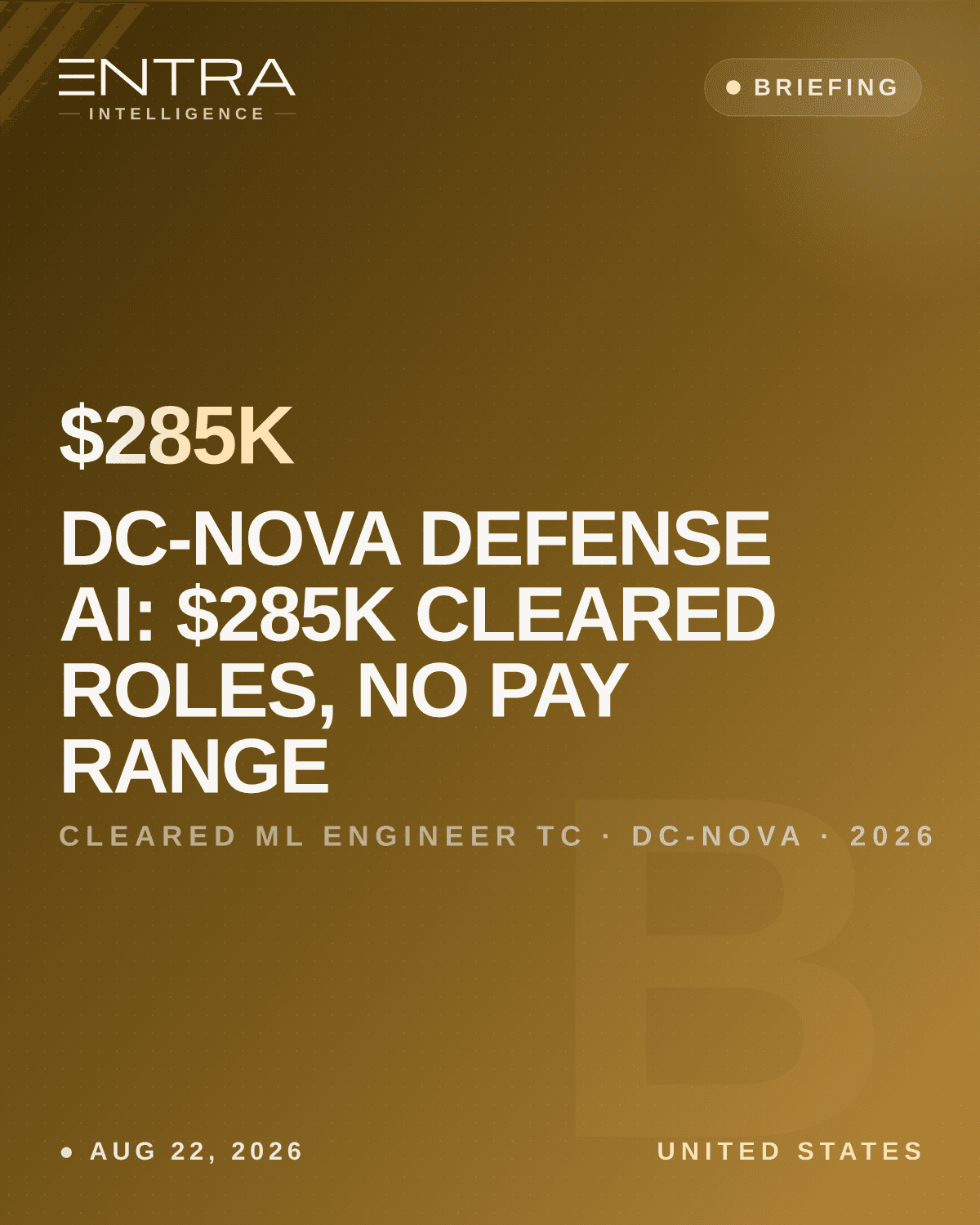
A TS/SCI clearance adds $25,000 to $40,000 to an ML engineer's base salary in the DC-Northern Virginia corridor, a 17 to 23 percent premium above non-cleared equivalent roles, per the ENTRA Job Signal Index Q2 2026 defense subsample (n=340 verified postings). Total compensation for cleared ML engineers in that corridor reaches $220,000-$285,000: $180,000-$215,000 base salary, the clearance premium layered on top, and a $15,000-$30,000 performance bonus. That ceiling does not appear on 67 percent of the defense AI job postings ENTRA audited in Q2 2026, against a 34 percent non-disclosure rate across the broader US AI market. The market rate for cleared AI talent in Northern Virginia is well-documented. It is almost entirely invisible to the candidates deciding whether to pursue it.
The clearance premium no job posting shows
The defense AI hiring corridor running from McLean and Tysons to Reston and Chantilly is the most active non-Bay Area cluster of ML engineering demand in the United States. Palantir Technologies, whose US Government division operates from McLean, carries 450-plus open AI roles. Booz Allen Hamilton in Tysons runs 600-plus ML and data science postings. Leidos in Reston holds 380-plus AI/ML roles. MITRE Corporation, also in McLean, lists 200-plus AI research positions. Anduril's expanding McLean footprint adds 150-plus roles. Across those five employers, roughly 1,780 open AI positions cluster within 12 miles of each other in Fairfax County, Virginia.
Fairfax County alone holds 43,000-plus cleared tech workers, per the Fairfax County Economic Development Authority 2025 data. That workforce is the deepest pool of cleared AI talent in the country. It is also navigating salary decisions with almost none of the market information that civilian AI candidates in San Francisco take for granted.
The clearance premium does not show up in postings because it does not have to. Federal contractors operating under Federal Acquisition Regulation Part 52 can redact salary information from public job postings when contract classification restricts disclosure. ENTRA's Q2 2026 audit found 67 percent of 340 defense AI postings showed no salary range. The gap between that figure and the 34 percent market average is not accidental. It is the direct product of a regulatory architecture that treats federal contractors as a carve-out from the transparency requirements governing every other technology employer posting AI roles in the same ZIP codes.
The practical effect: a cleared ML engineer at L4 equivalent in Reston enters every offer conversation without the anchor data that a counterpart interviewing at a Seattle AI startup can pull from Levels.fyi in under three minutes. The clearance premium is real. The candidate has no posted number to verify it against.
How federal contract law creates pay opacity
Colorado's Equal Pay for Equal Work Act and California's SB 1162 are the two most-cited pay transparency statutes in US AI hiring. Both have received detailed coverage in this series. Neither reaches defense contractors the way they reach non-defense technology companies operating in the same states.
The operative mechanism is FAR Part 52 contract classification. Defense contractors working on classified programs can argue that salary disclosure in public job postings creates a mosaic of information about the scope and staffing of classified work. The exemption is not explicitly written into Colorado EPEWA or California SB 1162; it emerges from the intersection of federal contract law and state employment law, where federal preemption arguments give contractors room to redact. The result is a pay opacity zone that sits inside state-level transparency frameworks without technically violating them.
Booz Allen Hamilton, Leidos, and MITRE each employ workers in California and Colorado. Each operates under multiple classified contracts. Their posting practices reflect a deliberate compliance calibration: disclose where state law compels disclosure and federal contract law does not conflict; redact where the intersection provides cover. ENTRA's audit found this calibration produces disclosure rates near zero for roles requiring TS/SCI or higher, against rates near 40 percent for unclassified, commercially-oriented postings at the same companies.
The scale of what this opacity zone now covers is not marginal. The DoD AI/ML workforce grew 34 percent year-over-year in FY2025 versus FY2024, per ENTRA's analysis of DoD contract and workforce data, a faster pace than any Big Tech AI organization over the same period. Every quarter, hundreds of new cleared AI postings enter the NoVA market under near-zero salary transparency. The cleared ML engineer entering the DC corridor in August 2026 is negotiating in conditions that resemble what Bay Area engineers faced before Colorado EPEWA took effect in January 2021: a market where every number you hear came from someone who already has the job, not from the posting itself.
NDAA Section 1531 and the compliance hiring surge
National Defense Authorization Act FY2024 Section 1531 requires the Department of Defense to develop AI ethical principles and a deployment roadmap. The compliance hiring that followed is one of the more precise examples of how a legislative mandate creates a job category.
Across defense prime contractors through Q2 2026, ENTRA identified 80-plus active postings with titles including "AI Ethics Officer," "Responsible AI Lead," "AI Governance Analyst," and "Ethical AI Researcher." Those roles did not exist at scale inside this sector in 2023. The mandate created the market for them.
The compensation architecture for NDAA 1531-adjacent roles diverges from the clearance-premium model in one useful way: most of these positions are unclassified. They require policy expertise, legal background, or AI research credentials rather than a TS/SCI clearance. Base salaries run $135,000-$175,000, per ENTRA Talent Hub data, with total compensation in the $165,000-$215,000 range. Unclassified roles are more likely to carry posted salary ranges, because the absence of a classified contract removes the FAR Part 52 exemption rationale.
For AI candidates who hold clearances or are pursuing them, the NDAA 1531 hiring wave represents a path into defense AI that partially bypasses the opacity problem. Unclassified AI ethics and governance roles surface on general job boards rather than cleared-worker portals like ClearanceJobs.com, carry higher disclosure rates, and require a skill set that transfers between defense primes and civilian federal agencies including OSTP, NIST, and the AI Safety Institute.
The 80-plus roles also represent a compression of timelines that is worth noting. From the NDAA FY2024 Section 1531 mandate to 80-plus active job postings across defense primes took roughly 18 months. That is faster than comparable compliance hiring waves in financial services after Dodd-Frank, and roughly on par with the EU AI Act compliance engineering surge in European markets. Defense AI ethics is not a policy discussion anymore. It is a headcount line.
Three signals to watch through Q4 2026
Palantir's posting disclosure gap. Palantir's US government business has grown faster than its commercial segment across its past six consecutive earnings quarters, per its public earnings releases. McLean headcount is expanding to support that trajectory. The company currently runs near-zero salary disclosure on cleared AI role postings, while its commercial listings carry ranges in Colorado and California-eligible roles, per its EPEWA compliance posture. The gap between its commercial and government posting practices sits inside one employer and is one of the cleaner illustrations of selective transparency architecture available anywhere in the US AI market.
Booz Allen's unclassified posting trend. Booz Allen Hamilton's government and defense AI consulting practice has cited data modernization and AI integration as its primary growth category across its last three annual reports. Its 600-plus ML and data science postings represent the largest single defense-prime AI headcount push in NoVA. The company has begun attaching salary ranges to a subset of unclassified data science postings, a directional shift worth tracking as NDAA 1531 compliance hiring adds more unclassified roles to its portfolio. The question for Q4: whether that subset expands or stays contained to the minimum required by state law.
EEOC posture on federal contractor exemptions. The Equal Employment Opportunity Commission flagged pay transparency in federal contracting as a watchlist item in its December 2025 regulatory agenda update. If the EEOC moves toward rulemaking that limits the FAR Part 52 salary-redaction rationale, the opacity zone contracts. That outcome is not projected before 2027, but the regulatory direction is established. A defense contractor that waits for the EEOC rulemaking cycle to force disclosure will be calibrating to a floor, not a market standard.
The NoVA defense AI corridor is the most financially opaque AI hiring market in the United States. The 43,000-plus cleared tech workers in Fairfax County earn at or above the total-compensation levels of their peers at Bay Area AI startups, and they are making those decisions with a fraction of the market information. In August 2026, that asymmetry is not a loophole that transparency law forgot to close. It is a feature of how the law was written.
 Global Career Platform
Find AI talent. Find your next role.
Booking is hotels. · Airbnb is apartments. · ENTRA is global careers.