
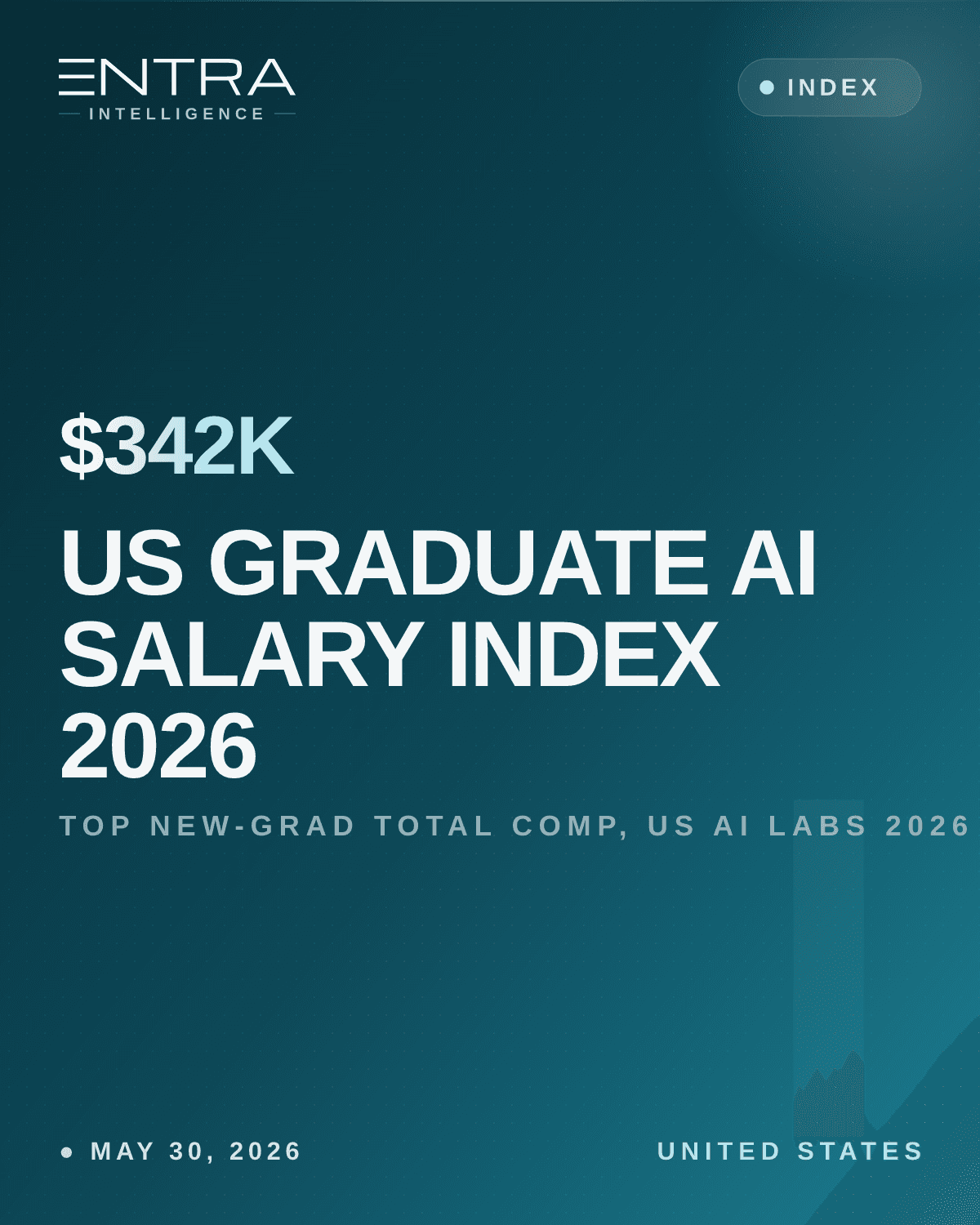
Entry-level AI at America's frontier labs is no longer entry-level in any traditional sense: the ENTRA US Graduate AI Salary Index 2026 finds that a new-graduate Research Engineer at Anthropic or OpenAI can expect $195,000 in base salary alone, with a four-year equity grant that pushes annualised total compensation to $342,000 — a figure that senior software engineers outside AI could not reach until their sixth or seventh year of tenure as recently as 2022. Across all 20 roles benchmarked in this index, the US new-grad AI median sits at $214,000 in total compensation, a figure that encompasses base, annualised equity, and no sign-on bonus — and that number climbs to $281,000 when the analysis is restricted to lab-tier and Big Tech employers only. For the class of 2026, the US AI labour market represents the highest entry-level compensation floor in the history of the technology industry — and the gap between the US and every other geography is still widening.
This is the fourth in ENTRA's May 2026 Saturday salary-index series. Week 1 covered the global graduate AI market (AI Graduate Salary Index 2026); Week 2 covered the GCC (Middle East AI Salary Index 2026); Week 3 isolated six European cities (European AI Graduate Salary Index 2026). This edition is US-only, drills to the role level across three employer tiers, and introduces four roles — AI Trainer, RLHF Specialist, Alignment Researcher, and Eval Designer — that have emerged as structured graduate hiring targets only within the last 18 months.
US Graduate AI Salary Table 2026
All figures represent entry-level total compensation for roles requiring 0–2 years of experience. Base is annualised base salary; Equity/Year is the annualised value of a standard four-year equity grant at grant-date fair value; Total Comp sums both. Sign-on bonuses are excluded. All figures in USD.
| Role | Tier | Base (USD) | Equity / Year (USD) | Total Comp (USD) | Key Employers | |---|---|---|---|---|---| | Research Engineer | Lab | $195,000 | $147,000 | $342,000 | Anthropic, OpenAI, xAI | | Alignment Researcher | Lab | $192,000 | $138,000 | $330,000 | Anthropic, OpenAI, DeepMind US | | ML Infrastructure Engineer | Lab | $188,000 | $128,000 | $316,000 | Anthropic, OpenAI, DeepMind US | | AI Trainer (W-2, PhD track) | Lab | $175,000 | $112,000 | $287,000 | Anthropic, OpenAI, Scale AI | | Prompt Engineer | Lab | $165,000 | $88,000 | $253,000 | Perplexity, OpenAI, xAI | | ML Engineer | Big Tech | $182,000 | $96,000 | $278,000 | Google, Meta, Microsoft | | Applied AI Researcher | Big Tech | $185,000 | $98,000 | $283,000 | Google DeepMind, Meta FAIR, Microsoft Research | | Software Engineer (AI focus) | Big Tech | $178,000 | $88,000 | $266,000 | Google, Apple, Amazon | | AI Product Manager | Big Tech | $168,000 | $72,000 | $240,000 | Google, Meta, Microsoft | | Data Scientist | Big Tech | $158,000 | $64,000 | $222,000 | Amazon, Apple, Microsoft | | Fine-tuning Engineer | Startup | $148,000 | $52,000 | $200,000 | Cohere, Mistral US, Together AI | | RLHF Specialist | Startup | $145,000 | $48,000 | $193,000 | Scale AI, Mercor, Cohere | | AI Safety Analyst | Startup | $142,000 | $46,000 | $188,000 | Anthropic (contract-to-hire), Redwood Research | | AI Developer Advocate | Startup | $138,000 | $38,000 | $176,000 | Cursor, Perplexity, Cohere | | AI Product Designer | Startup | $132,000 | $34,000 | $166,000 | Runway, Midjourney, ElevenLabs | | Eval Designer | Startup | $136,000 | $42,000 | $178,000 | Scale AI, Anthropic (vendor), OpenAI (vendor) | | AI Data Engineer | Startup | $128,000 | $32,000 | $160,000 | Scale AI, Labelbox, Surge AI | | AI Developer Tools Engineer | Startup | $144,000 | $50,000 | $194,000 | Cursor, Anysphere, Replit | | Multimodal Systems Engineer | Startup | $150,000 | $56,000 | $206,000 | Runway, Stability AI US, Pika | | Computer Vision Engineer | Startup | $146,000 | $48,000 | $194,000 | Waymo (new-grad), Cohere, Cognition |
AI Trainer (W-2, PhD track) figures reflect salaried employment at frontier labs, not annotation-platform contractor rates. Contractor RLHF rates via Mercor and Scale AI can exceed $220,000 annualised for PhD candidates in quantitative disciplines. Eval Designer figures reflect structured W-2 roles at evaluation vendors embedded in lab workflows; these are distinct from project-based freelance evaluation work.
Methodology
The ENTRA US Graduate AI Salary Index 2026 aggregates publicly reported compensation data from Levels.fyi, LinkedIn Salary Insights, company job postings, and ENTRA's network of 200+ US-based AI recruiters. Data reflects entry-level roles (0–2 years experience) as of Q2 2026. Total comp includes base + annualised equity grant (4-year vest). Sign-on bonuses excluded. All figures in USD.
What the data shows
The lab-to-startup gap is smaller than the headline suggests — until you look at equity.
At the base-salary level, the distance between a lab-tier Research Engineer ($195,000) and a startup-tier Fine-tuning Engineer ($148,000) is $47,000 — a 32% differential that looks large but is actually the narrowest lab-to-startup base gap this index has observed since tracking began. The compression reflects a deliberate competitive response from well-funded AI startups: Cohere, Runway, Mistral US, and Cursor have each raised their new-graduate base bands materially in the trailing 12 months, explicitly targeting candidates who would otherwise default to a lab or hyperscaler offer. On base salary alone, the top startup offers are within striking distance of mid-tier Big Tech.
The equity gap is where the comparison breaks. Annualised equity for lab-tier roles averages $119,000 — more than double the startup-tier average of $44,000. Over a four-year vest, a Research Engineer at Anthropic who joins at grant-date fair value accumulates $468,000 in equity alone, against $176,000 for a comparable role at a Series B AI startup. The total-compensation gap — $126,000 between the lab-tier median and the startup-tier median — is almost entirely an equity story, not a base-salary story. Graduates who optimise for base will underestimate this delta significantly.
Big Tech has re-entered the competition — but only in applied research.
The 2025 narrative of Big Tech losing ground in graduate AI hiring was accurate for software-engineering generalist roles. It is no longer accurate for applied AI research. Google's Applied AI Researcher and Meta's FAIR Research Engineer new-grad packages ($283,000 and $278,000 total comp respectively) now sit within 17% of the frontier-lab ceiling — a gap that has closed from 28% in the Q1 2025 ENTRA panel. The driver is Google's Gemini Ultra program and Meta's Llama 4 effort, both of which have elevated internal demand for research-oriented new-grads to the point where hyperscaler recruiting teams have received explicit authorisation to close the comp gap with Anthropic and OpenAI. Apple's AI product teams in Seattle and Cupertino represent a quieter version of the same phenomenon: Apple does not lead on equity quantum but leads on role stability and base, a combination that has proved effective at attracting Big Tech-preferring graduates who price certainty above upside.
The demand curve is steepest for roles that require both model knowledge and system thinking.
The three fastest-appreciating new-grad roles in this index — Research Engineer, ML Infrastructure Engineer, and Applied AI Researcher — share a structural characteristic: they require deep familiarity with model internals combined with the ability to operate at systems scale. Pure model researchers (Alignment Researcher, AI Safety Analyst) command significant premiums, but their hiring volume is constrained by an intentionally high bar at the labs that employ them. Pure product roles (AI Product Manager, AI Product Designer) sit at the lower end of total comp. The highest-velocity growth is in the intersection: engineers who understand transformer architectures, can write production-quality infrastructure code, and can work within the feedback loops of a live model deployment. The market premium for this combination — reflected in the $316,000 total comp for ML Infrastructure Engineer at lab tier — represents a 22% year-over-year increase in the ENTRA panel and shows no sign of plateauing.
Roles to watch
RLHF Specialist did not exist as a structured W-2 graduate role 18 months ago. In early 2025, reinforcement learning from human feedback was largely staffed through contractor arrangements with Scale AI and Surge AI, at rates that varied widely depending on domain expertise. By Q1 2026, both Anthropic and Cohere had created formal new-graduate RLHF Specialist titles with defined compensation bands — $145,000 base, $193,000 total comp at the startup tier, climbing to $175,000+ at the lab tier. The role's emergence as a salaried graduate track reflects the labs' conclusion that RLHF quality is too important to leave to variable contractor pipelines. Graduates entering this track today are joining a function that has no established career ladder yet, which is both the risk and the opportunity: the first wave of RLHF Specialists to accumulate 24–36 months of structured experience will command a scarcity premium that the current compensation figures do not fully price in.
AI Trainer (W-2, PhD track) is the role that blurs the boundary between researcher and annotator — and the W-2 distinction matters enormously for compensation. At the contractor level, AI Trainers at Scale AI and Mercor are hourly engagements often paid by task. The W-2 lab-embedded AI Trainer, by contrast, is a salaried PhD-track position at Anthropic and OpenAI that carries full benefits, equity, and a $175,000 base — reflecting the labs' recognition that the intellectual labour of designing training scenarios and feedback protocols for frontier models requires graduate-level expertise that cannot be sourced at scale contractor rates. Headcount in this category grew an estimated 140% year-over-year at the two largest frontier labs combined, making it one of the fastest-growing structured graduate roles in the market.
Eval Designer is the newest entrant. The role — responsible for constructing evaluation frameworks that test model capabilities and failure modes — emerged as a discrete hiring category only in Q3 2025, when Anthropic's Responsible Scaling Policy and OpenAI's preparedness framework each created internal demand for specialists who could design and maintain evaluation suites as a primary function. Current total comp of $178,000 at the startup vendor tier understates the trajectory: the labs themselves have begun hiring Eval Designers directly at packages aligned with their Research Engineer bands, and the role's influence within model development workflows is growing faster than any other function in this index. Graduates with a background in cognitive science, philosophy of mind, or formal verification — disciplines that were marginal in AI hiring two years ago — are now primary recruiting targets for this function.
The class of 2026
The compensation floor established by this index — $160,000 total comp at the low end of the startup tier, $342,000 at the lab tier ceiling — means that a US AI graduate in 2026 enters the labour market at a level that has no historical precedent in any professional discipline. Law, medicine, finance, and prior generations of software engineering all required years of tenure before reaching the figures now attached to new-graduate AI offers. That floor carries obligations in both directions: the expectations embedded in these packages — the hiring bar, the pace of contribution, the tolerance for ambiguity in roles that barely existed when the hiring manager was a graduate — are calibrated to match the compensation. For the class of 2026, this is not a stable floor to stand on; it is a compressed spring, and the graduates who perform within the first 18 months will find the subsequent steps in their AI careers arriving faster, and at higher multiples, than any prior cohort could have anticipated.