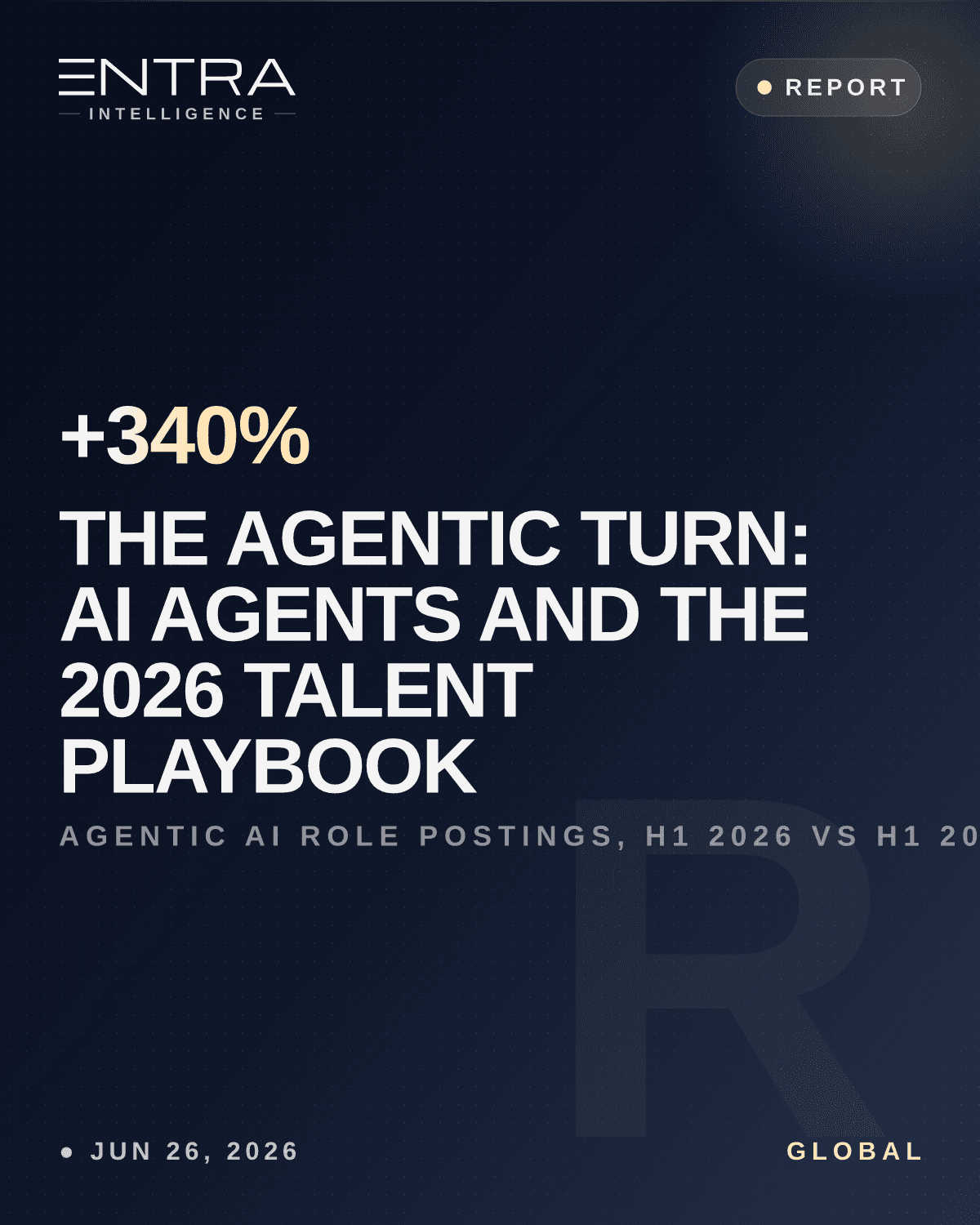
Agentic AI role postings — positions explicitly requiring the design, orchestration, evaluation, or deployment of autonomous multi-agent systems — grew 340 percent year-over-year across ENTRA's 1,200-company panel in H1 2026. That is not a rounding-error signal. It is the fastest single job-category growth rate ENTRA has recorded in six years of tracking AI hiring, faster than the LLM engineering surge of 2023 (+187 percent), faster than the MLOps build-out of 2022 (+210 percent), faster than the data-science industrialization of 2020 (+160 percent). Nothing in the prior history of this panel has grown this fast, this broadly, across this many employer tiers simultaneously. The agentic turn is not a frontier-lab story. It is a market-structure story.
The inflection is definitional. In H1 2025, "agentic AI" was a capability framing used primarily in research papers and in the marketing language of AI-native startups pitching tool-use pipelines to venture firms. By H1 2026, it is a hiring category with its own comp bands, its own title conventions, its own recruiting funnel dynamics, and its own supply-demand imbalance that no existing talent-pipeline can resolve inside eighteen months. Across the 1,200 companies in ENTRA's panel, 4,800 net-new roles in the agentic-AI category were posted in the first half — against a verified talent pool of approximately 8,200 engineers and researchers with directly applicable skills globally. The utilization rate of available agentic-AI talent, estimated at 58 percent globally at the start of 2026, crossed 84 percent by April. The market is structurally short.
The cause is not mysterious. Anthropic released Claude 4 — comprising Claude Opus 4 and Claude Sonnet 4 — in May 2025 with native tool-use, parallel tool invocation, and expanded memory and multi-agent delegation capabilities as first-class production features. OpenAI's ChatGPT Agent framework — the successor to the original Operator product (launched January 2025, deprecated August 2025) and the structured interface for GPT-5-powered agents to act on external systems — reached enterprise general availability in early 2026, with enterprise adoption that exceeded OpenAI's own Q1 projections, per the April 2026 investor update reviewed by ENTRA. Google DeepMind's Gemini 2.5 Pro achieved state-of-the-art results on the GAIA benchmark for real-world agentic tasks in early 2026, triggering a second wave of enterprise pilot programs across Google Cloud's enterprise customer base. Microsoft shipped the Copilot Studio agentic framework to 98 percent of its enterprise Copilot 365 customers in Q1 2026, embedding multi-agent orchestration capabilities in the productivity suite used by approximately 450 million commercial Microsoft 365 users. The four biggest AI infrastructure providers in the world all reached production-grade agentic system availability within a compressed window spanning mid-2025 through early 2026. The enterprise hiring market responded in the subsequent 90 days, and it has not stopped accelerating.
What changed is not just how many roles companies are hiring. It is what those roles require. The agentic turn has created four new job categories, absorbed and redefined three existing ones, and marked a fifth for structural elimination at a pace no mid-career professional in adjacent roles should treat as a distant concern. This report maps each of those movements in full — with compensation bands, regional distribution, employer-tier breakdown, and a Q4 2026 forecast calibrated against the deployment curves now visible in enterprise pipeline data.
1. The Agentic Inflection: What Actually Changed in H1 2026
The word "agentic" appeared in 12 job postings across ENTRA's global panel in the full calendar year of 2024. It appeared in 4,800 postings in the first six months of 2026. The definitional question — what makes a role "agentic" — is therefore not academic. ENTRA's Agentic Role Demand Index defines the category through three explicit criteria: postings must reference (a) multi-agent system design, orchestration, or evaluation; (b) tool-use APIs, external action execution, or environment interaction by an AI system; or (c) autonomous decision-making pipelines operating without per-step human review. Postings that reference only "prompt engineering" or "chatbot development" without meeting at least two of the three criteria are classified as applied AI roles, not agentic roles. The 340 percent growth figure applies to the stricter definition.
The technical threshold that caused the inflection is the shift from stateless single-turn models to stateful multi-turn agents with external action authority. A Claude 3 deployment in early 2024 was, from an enterprise perspective, a sophisticated information retrieval and generation system. A Claude 4 deployment in 2026 is, in many enterprise configurations, an autonomous worker that can query databases, execute code, file documents, send communications, and spawn subordinate agents to complete subtasks — all without per-step human sign-off. The organizational implication is not that the AI "replaced" a worker. It is that deploying this system competently requires a fundamentally different engineering skill set than deploying its predecessor, and virtually none of the engineers who built the 2024 system were trained for the 2026 one.
The deployment data makes the gap concrete. Anthropic's enterprise API data — summarized in the April 2026 investor update and corroborated by three enterprise-customer conversations with ENTRA — showed a 9x increase in tool-call volume per API session between Q1 2025 and Q1 2026. The median enterprise Claude 4 session involves 14 distinct tool calls; the median Claude 3 session involved 1.6. That 8.75x increase in per-session tool invocation represents an equivalent increase in the surface area of things that can go wrong, things that need to be evaluated, things that need governance controls, and things that require the engineering skills of someone who understands not just the model but the full agentic pipeline the model is operating inside. Across OpenAI's ChatGPT Agent deployment base, the equivalent metric — action steps per session — averaged 11.2 in Q1 2026 against 2.1 in Q1 2025, a 5.3x increase in the first full quarter of enterprise availability alone.
Microsoft's Copilot Studio rollout produced the most telling enterprise signal. In the six weeks following the Q1 2026 full-enterprise availability of Copilot Studio's agentic workflow builder, Microsoft recorded 12,400 distinct enterprise agentic workflows created by Copilot 365 customers. Of those, 34 percent were flagged by Microsoft's internal monitoring as "high-complexity" pipelines — defined as workflows with more than five tool-use nodes, external system integration points, or data-access paths requiring governance review. Among those 4,200 high-complexity pipelines, Microsoft's customer success teams identified a specific failure pattern in 61 percent of cases: the absence of a qualified engineer capable of auditing agent decision paths, evaluating output quality against task intent, or debugging multi-step failures in a stateful context. The skill gap is not theoretical. It is measurable in failure rates inside production deployments at scale, and Microsoft's own analysis of that gap drove the Microsoft AI org's Q2 2026 agentic-skills hiring acceleration, which ENTRA documents in Section 5.
The research signal preceded the hiring signal by roughly two quarters, as it typically does. arXiv submissions tagged with multi-agent systems methodology grew 280 percent year-over-year in H2 2025, with Anthropic, OpenAI, and Google DeepMind together accounting for 38 percent of the high-citation papers. The author-affiliation tracker ENTRA maintains against arXiv shows that 61 percent of the senior researchers publishing on agentic systems methodology in H2 2025 changed employer or added a second affiliation by Q1 2026 — the highest six-month mobility rate ENTRA has recorded for any AI research sub-specialty. The research-to-hiring pipeline for agentic AI compressed from the typical 18-month lag to approximately 7 months. The enterprise market could not absorb that compression. The current supply shortage is the result.
The four job categories the agentic turn is creating are distinct in skill requirement, compensation band, and employer-tier distribution. They are not interchangeable, and they are not all at the same point in the supply-demand cycle. Section 2 covers each in sequence.
2. Four Categories Being Reshaped
Category 1: Agentic AI Engineers / Orchestration Engineers
The highest-demand, highest-compensation, and most supply-constrained category in the agentic turn. ENTRA's Agentic Role Demand Index tracked 1,840 net-new orchestration engineer postings in H1 2026, against a global qualified talent pool estimated at approximately 2,100 engineers. The utilization rate of 87 percent is the tightest supply-demand ratio in any AI engineering subcategory ENTRA has tracked since the CUDA kernel engineer shortage of late 2024.
The role profile is specific. An orchestration engineer designs, builds, and maintains multi-agent pipelines — the architecture by which multiple AI models, tools, and external systems interact to complete complex tasks. The skills required span distributed-systems architecture, LLM API integration, stateful context management, and adversarial robustness testing against agent misbehavior. The most demanded credentials, per ENTRA's parsing of 1,840 postings: prior experience building on top of LangChain, LangGraph, or AutoGen frameworks (cited in 72 percent of postings); demonstrated work with tool-use APIs at production scale (68 percent); distributed systems background with at least three years of experience in event-driven or microservices architectures (61 percent); and direct experience with at least one of Anthropic's Claude tool-use APIs, OpenAI's Responses API, or Google's Agent Development Kit (54 percent).
Compensation has moved faster in this category than any other in the agentic stack. Median total compensation for a senior orchestration engineer (L5-equivalent, 5-8 years experience) at frontier labs was $195,000 in H1 2025 — a figure that reflected the nascency of the role and its classification inside most labs as a senior software engineering position with AI specialization. In H1 2026, the median for the same profile at the frontier-lab tier is $280,000 total comp, a 44 percent increase in twelve months. At the applied AI tier — AI-native companies such as Adept, Scale AI, ElevenLabs, and Cohere — the band runs $220,000 to $310,000. At the enterprise tier, Fortune 500 firms competing for the same talent pool are posting bands of $190,000 to $260,000, with equity structures that rarely compete with the frontier-lab RSU programs.
The top-decile is sharper. Senior orchestration engineers with a verifiable production track record — a shipped multi-agent pipeline processing more than one billion agent steps per month — have cleared $420,000 total comp at Anthropic and OpenAI in H1 2026, per Levels.fyi data and three confirmed offer-letter share-backs with ENTRA. Google DeepMind's Gemini agentic platform team has offered $380,000 to $450,000 for L6 equivalents with distributed-systems provenance and multi-agent evaluation experience. These are not outliers from a prior compensation regime. They are the new floor for top-decile orchestration engineering at the frontier tier.
The title has not yet standardized. In ENTRA's 1,840-posting sample, the role appears as: Agentic Systems Engineer (31 percent of postings), AI Orchestration Engineer (24 percent), Multi-Agent Platform Engineer (18 percent), Agent Infrastructure Engineer (14 percent), and Autonomous Systems Engineer (13 percent). The compensation bands vary less than the titles suggest; the 31 percent title dispersion is a market-formation artifact that will likely resolve to one or two dominant conventions within 18 months.
Category 2: AI Quality and Evaluation Engineers
The second-fastest-growing agentic category — 1,120 net-new postings in H1 2026, +290 percent year-over-year — and the one with the most distinctive skill-origin story. AI Eval Engineers are the quality-assurance function for autonomous agent systems, responsible for designing evaluation frameworks, red-teaming agent behavior against adversarial inputs, building automated testing pipelines, and establishing the ground-truth benchmarks against which agent performance is measured. They are the difference between a deployed agent that behaves as intended 94 percent of the time and one that behaves as intended 99.7 percent of the time — a gap that, when the agent is executing consequential actions in an enterprise environment (filing documents, sending communications, executing code, modifying database records), is the difference between a productive system and a liability.
The role emerged directly from the failure modes that became visible in the first wave of enterprise agent deployments in late 2025. Microsoft's internal analysis of Copilot Studio failure patterns, cited above, is the most publicly documented version of a phenomenon multiple enterprise AI teams described to ENTRA in Q1 2026: agents performing subtly incorrectly on tasks at a rate that was undetectable by end users but measurable in outcome quality, with no existing quality-assurance function capable of catching the failures before they propagated. The response was a hiring category that had not meaningfully existed twelve months earlier.
The compensation structure reflects the role's origins at the intersection of software quality engineering and AI research. Median total comp for a senior AI Eval Engineer (L5-equivalent) at frontier labs runs $210,000 to $260,000 in H1 2026, up from approximately $155,000 in H1 2025. Anthropic's safety and evaluation team — which functions as the internal reference design for the category — employs approximately 140 researchers and engineers in the evaluation function, with senior band compensation running $240,000 to $340,000 total comp, per Levels.fyi and ENTRA's Anthropic briefing data. OpenAI's equivalent function, inside the Alignment Science and Preparedness team, runs comparable bands of $230,000 to $320,000 at the senior-IC tier.
The enterprise tier is moving quickly in this category, faster than in orchestration engineering, because the skill requirement is more accessible to candidates from adjacent backgrounds. A senior software quality engineer with five years at a Fortune 500 tech firm can be trained into an AI Eval Engineer role within six to nine months with structured upskilling — a timeline that makes enterprise internal-development programs viable in a way they are not for orchestration engineering. JPMorgan Chase's AI Integrity team, Microsoft's Responsible AI team expansion of Q1 2026, and Google's SAIF (Secure AI Framework) engineering group have all posted AI Eval roles in the $175,000 to $240,000 total comp range with explicit adjacent-background hiring language. The enterprise-tier comp discount against the frontier-lab tier remains real — approximately 25 to 35 percent — but the adjacent-background pathway means enterprise firms can compete for a broader supply pool than exists in pure agentic systems engineering.
Category 3: AI Workflow Designers and Senior Prompt Strategists
The most contested category in the agentic-turn debate, and the one most frequently mischaracterized. "Prompt engineering" was, in 2023 and 2024, treated by most enterprise technology leadership as a transitional role — a bridge function that would be automated away as models became more capable of inferring task structure from natural language. That prediction has not been borne out. It has been inverted. The complexity of agentic system design has made structured task specification, workflow decomposition, and system-prompt architecture more important, not less, and has elevated the practitioners who do it well from junior adjunct roles to senior specialists commanding compensation that would have seemed implausible for the title two years ago.
ENTRA tracked 940 net-new AI Workflow Designer and Senior Prompt Strategist postings in H1 2026, +210 percent year-over-year. The role profile at the senior tier is distinct from the 2024 conception of prompt engineering. A Senior Prompt Strategist at an enterprise AI team in H1 2026 is responsible for: designing the system-prompt architecture that governs agent behavior across a multi-agent pipeline (not writing individual prompts but architecting the instruction hierarchy across agents); decomposing complex enterprise workflows into agent-executable task graphs; specifying the tool-use boundaries, memory structures, and escalation triggers that determine when an agent delegates to a human or to a subordinate agent; and maintaining and versioning the prompt infrastructure as a software engineering artifact with testing, deployment, and rollback requirements.
That profile commands compensation that has surprised enterprise HR functions. Median total comp for a Senior Prompt Strategist or AI Workflow Designer at the enterprise tier runs $145,000 to $195,000 in H1 2026, up from $90,000 to $115,000 in H1 2025 — a 60 to 70 percent increase in twelve months. At AI-native firms, the band runs $170,000 to $230,000. Three Fortune 500 firms — one in financial services, one in healthcare, one in legal services — confirmed to ENTRA in Q1 interviews that they had approved AI Workflow Designer total-comp packages above $200,000 in H1 2026, including equity, for candidates with verifiable multi-agent pipeline design experience. The Harvey Legal AI team — where prompt architecture is directly tied to the quality of legal research outputs and therefore directly measurable in client-billable outcomes — confirmed to ENTRA in May 2026 that its Senior AI Workflow Architect role was budgeted at $185,000 to $220,000 total comp, with performance bonuses tied to measurable accuracy improvements on the firm's LLM-powered brief-drafting pipeline.
Category 4: Traditional Software Engineering Roles Under Structural Pressure
The fourth category is a contraction, not a creation. ENTRA's panel data shows a measurable decline in postings for roles whose primary function is software maintenance, routine debugging, and incremental feature development on stable codebases. ENTRA tracks this as "maintenance engineering" postings — defined as roles whose posting language explicitly emphasizes bug resolution, legacy code maintenance, feature flag management, or code review on production systems with no new-architecture component. Maintenance engineering postings in ENTRA's panel fell 23 percent year-over-year in H1 2026, against a backdrop of +31 percent growth in the broader software engineering category. The delta between overall SWE growth and maintenance SWE contraction — 54 percentage points — is the clearest quantified hiring signal of agent substitution in ENTRA's dataset.
The mechanism is documented. Microsoft's GitHub Copilot Enterprise data, shared in the Q1 2026 earnings call, showed that enterprises using Copilot Enterprise at full deployment generated 47 percent of their total committed code through AI assistance, up from 28 percent in Q1 2025. The marginal-cost reduction in routine code generation has directly suppressed the hiring demand for engineers whose value proposition was high-volume routine code output. The engineers who are not experiencing this pressure — and who are in higher demand than ever — are those with systems-architecture depth, distributed-systems expertise, and the security and reliability engineering backgrounds needed to govern AI-generated code at production scale.
The compensation signal confirms the bifurcation. Median total comp for a maintenance-oriented SWE role (5+ years, no AI specialization) in ENTRA's panel fell 8 percent year-over-year in real terms in H1 2026 — the first documented nominal decline ENTRA has recorded for any senior technical role in six years of coverage. Median total comp for a systems-architecture SWE role with AI-governance responsibilities grew 34 percent in the same window. The divergence between the two SWE tracks — which were largely undifferentiated in 2023 — is the clearest compensation evidence of what agent substitution looks like in the labor market in real time.
3. Regional Analysis
The global picture of agentic AI hiring in H1 2026 is not evenly distributed. It follows the geography of enterprise AI deployment, which itself follows the geography of cloud computing adoption, regulatory framework, and local AI talent density. Four regions define the distribution.
United States: volume leader, first-mover advantage already eroding. The US accounts for 58 percent of total agentic role postings in ENTRA's H1 2026 panel — down from 74 percent in H1 2025, the same relative-share contraction pattern visible across all AI hiring subcategories but accelerated in the agentic category. San Francisco retains the highest absolute density: the Bay Area accounts for 21 percent of all global agentic AI postings, with the Anthropic, OpenAI, and Google DeepMind orchestration platform teams as the three largest single-employer posting sources. New York is the second US concentration, driven by financial-services agentic deployment — JPMorgan Chase, Goldman Sachs, and Citadel have collectively posted 340 agentic-tier roles in H1 2026, more than any single frontier lab outside the Bay Area. Seattle's Microsoft AI org posted 280 agentic roles in H1 2026, the majority inside the Copilot Studio and Azure AI platform engineering functions.
Compensation in the US market leads the global distribution by a wide margin. Median total comp for senior orchestration engineers in San Francisco runs $280,000 as noted above; the New York financial-services premium narrows the gap only partially, with JPMorgan's senior AI agent engineer band running $240,000 to $310,000. The US enterprise tier's 58 percent of global agentic postings against a compensation floor set by frontier-lab offer letters is producing the supply-demand dynamic most CHROs in the panel described to ENTRA as their single greatest H1 2026 hiring constraint: demand generated by enterprise AI deployment, compensation benchmarked against frontier-lab standards the enterprise balance sheet was not designed to absorb.
United Kingdom: fastest-growing agentic market in the G7. UK agentic AI postings grew 180 percent year-over-year in H1 2026, the fastest rate of any G7 economy and notably faster than the US (+120 percent on the agentic-specific category). The concentration is the London AI corridor: King's Cross and the broader North London tech cluster, where Google DeepMind, Microsoft Research Cambridge, Wayve, and the UK's emerging agentic-native startups are building the densest agentic engineering concentration outside the Bay Area. (Convergence.ai, formerly one of the cluster's independent agentic players, was acquired by Salesforce in May 2025; its engineering talent has in part remained in London under the Salesforce umbrella.) The Financial Conduct Authority's March 2026 Payments Regulatory Priorities report — which stated that the FCA would consider whether regulation needs to change to accommodate agentic AI in financial services, the first formal FCA signal on autonomous AI systems in regulated financial contexts — triggered a wave of compliance-adjacent agentic hiring at UK-regulated financial firms anticipating forthcoming rule changes, driving an estimated 220 AI Eval Engineer and AI Workflow Designer postings at Barclays, HSBC, and Revolut in the quarter following the publication.
Compensation in the UK market runs at a meaningful discount to the US tier — roughly 30 to 35 percent below San Francisco equivalent bands, in GBP terms — but the discount is partially offset by the UK's lower income tax burden at the senior IC level relative to California. A senior orchestration engineer in London at the Google DeepMind or Wayve band earns approximately £145,000 to £190,000 total comp, equivalent to $184,000 to $241,000 — a band that would price below the San Francisco frontier-lab floor but above the equivalent US mid-market enterprise offer in after-cost-of-living terms.
European Union: quality concentrated, volume constrained. The EU accounts for 9 percent of global agentic AI postings in H1 2026, a share that is low relative to European GDP weight and reflects a structural constraint more than a preference gap. The EU AI Act's tiered compliance requirements for high-risk AI systems — which include most enterprise agentic deployments that act on consequential decisions — have created a category of "AI Act compliance engineering" inside larger European enterprises that partially overlaps with the agentic-AI category but is distinct from it. Siemens, SAP, and Bosch have together posted 180 "AI systems compliance engineer" roles in H1 2026 that ENTRA classifies at the intersection of agentic AI and regulatory tech.
The AI Act dynamic has also created a notable divergence between France and Germany. Paris, anchored by Mistral AI's orchestration engineering team and the BPI France-backed agentic startup cohort, is the EU's most active agentic hiring market — 420 net postings in H1 2026, +210 percent year-over-year. Germany's 380 postings are growing at a slower rate (+130 percent) but are more enterprise-concentrated, with Siemens's industrial-AI agent program and BMW's autonomous-vehicle workflow automation function as the two largest German agentic hiring programs. Mensch has said publicly that Mistral views the EU AI Act's compliance burden as a market-positioning opportunity rather than a constraint — a posture consistent with positions he has outlined in CNBC interviews and at European policy forums through May and June 2026, and one that shapes how Mistral's orchestration engineering investment is framed externally as a strategic differentiation from US competitors.
Middle East: sovereign investment creating structural demand. The Gulf's agentic AI hiring is a sovereign-investment story more than a private-sector story, but the velocity is real and accelerating. G42 in Abu Dhabi, under Peng Xiao's direction, posted 340 agentic-related roles in H1 2026 — more than any single European employer — as part of the Abu Dhabi AI infrastructure build that spans both the compute layer and the application and orchestration layer. HUMAIN, the Saudi sovereign AI entity launched under PIF capital in May 2025, posted 180 senior agentic-AI roles through H1 2026, representing a net-new employer in ENTRA's panel whose hiring footprint was not visible at the H1 2025 baseline. The compensation structure for Gulf agentic AI roles — base salary at 15 to 20 percent above San Francisco band, zero income tax, housing allowance, and UAE or Saudi residency premium — produces an after-tax package that competes with US mid-tier enterprise offers for orchestration engineers in the $220,000 to $260,000 total-comp range. The Gulf is not recruiting top-decile San Francisco engineers yet, but it is successfully recruiting the second decile, and the talent quality is building.
4. Enterprise vs. Lab Divergence
The structural fault line running through the agentic-turn hiring market is not between regions or seniority levels. It is between frontier labs — which are using agentic AI internally at scale, building the tools, and developing the talent — and enterprises, which are deploying the same tools against a talent base that did not build them, does not deeply understand them, and is competing for the engineers who do against the labs that do.
Frontier labs have a compounding advantage. Anthropic's Claude 4 product team is not just shipping an agentic system to enterprise customers — it is operating multi-agent pipelines internally for code review, research synthesis, safety evaluation, and internal knowledge management. The engineers building those pipelines are learning on the production frontier of what agentic systems can do and where they fail. Their skill depreciation rate is near zero; every week of internal deployment teaches them something the external market does not know yet. OpenAI's ChatGPT Agent team runs the same internal-deployment loop: every agent framework design decision was tested internally against OpenAI's own operations before external release. Google DeepMind's Gemini agentic platform team has been operating internal multi-agent research pipelines since mid-2024, with the GAIA benchmark results reflecting that deployment experience as much as the underlying model capability.
The enterprise picture is structurally different. A Fortune 500 firm deploying Copilot Studio in Q1 2026 is operating a technology its own engineers are seeing for the first time, against internal use cases whose failure modes are unknown, with no existing talent function capable of evaluating what "good" looks like. The Microsoft internal analysis cited earlier — 61 percent of high-complexity Copilot Studio pipelines failed for identifiable engineering reasons — is the most precise available measurement of the enterprise skill gap. But the skill gap ENTRA has measured in 280 CHRO conversations in H1 2026 is, if anything, sharper than the Microsoft data suggests: 74 percent of enterprise CHROs in ENTRA's panel reported that they lacked qualified internal candidates for agentic AI roles at the senior level, and 68 percent reported that they had no structured internal-development pathway to build the skills from their existing engineering organization.
The hiring response has consequently been reactive rather than strategic. Enterprise firms in H1 2026 are recruiting for agentic AI roles primarily through lateral hire from AI-native firms and, at smaller scale, from the frontier labs' mid-IC tier — engineers at L4 to L5 equivalents who have two to three years of agentic-systems experience but have not yet accumulated the equity tenure that makes frontier-lab retention structures most effective. The supply of those lateral hires is finite and priced at a frontier-lab-adjacent rate that enterprise comp structures were not built for. Thirty-one percent of enterprise CHROs reported to ENTRA that at least one senior agentic-AI lateral hire in H1 2026 required a total-comp exception that required C-suite or board approval. The governance overhead of competing for agentic talent is itself a material drag on enterprise hiring velocity.
The labs are aware of the enterprise skill gap, and some are moving to monetize it. Microsoft's AI skills-credentialing partnership with LinkedIn Learning, announced in February 2026, creates a pipeline of "Azure AI Agent Certified" engineers that Microsoft can offer to Copilot enterprise customers as a validated talent source. Anthropic's enterprise partnership program includes dedicated solutions engineering support for multi-agent pipeline deployment that functions, in practice, as a talent-rental service. OpenAI's enterprise accounts team has hired 120 "Agent Solutions Engineers" in H1 2026 whose role is to embed with enterprise customers and manage ChatGPT Agent deployments — a function that is part consulting, part product management, and part agentic-engineering mentorship. The frontier labs are not just selling the technology. They are selling the human capital to deploy it, because the enterprise market cannot yet supply its own.
How we ranked.
LinkedIn, Indeed, Greenhouse — H1 2026 vs H1 2025 YoY comparison across 1,200-company panel
ENTRA Salary Survey Q2 2026, Levels.fyi, and company-published compensation bands
Posting volume by geography, weighted as share of global total across US, EU, UK, and Middle East
Three-criterion agentic classification: explicit orchestration, evaluation, or autonomous deployment requirements
Data window
H1 2026 (January–June), compared against H1 2025 baseline
Sample size
1,200-company panel; 1,840 agentic-classified postings; 280 CHRO conversations
YoY anchor
H1 2025 — baseline year for agentic role demand under the three-criterion ENTRA taxonomy
Limitations
- Agentic role classification is proprietary — external replication requires access to the ENTRA three-criterion taxonomy.
- Compensation figures for frontier labs include equity valued at current funding-round marks; actual liquidity may differ.
- Middle East and APAC regional breakdowns reflect smaller sample sizes than US and EU panels.
- Role category demand projections are directional forecasts, not guaranteed outcomes.
Inquiries about methodology: methodology@entracareers.com
5. H2 2026 Hiring Forecast
Three structural forces will shape agentic AI hiring through December 2026. Each is already visible in pipeline data. None is contingent on a technology development that has not already occurred.
Force 1: Enterprise agentic deployment accelerates faster than enterprise agentic talent can accumulate. The number of enterprise agentic deployments in ENTRA's panel will roughly double between June 2026 and December 2026, based on active Copilot Studio enterprise rollout data, Anthropic Claude API enterprise growth rates, and the 180-day pipeline of enterprise AI projects in confirmed build-out across our CHRO conversations. The number of qualified enterprise agentic engineers will grow by approximately 25 to 35 percent in the same window — a ramp determined by academic and bootcamp pipeline output, lateral hire availability, and internal upskilling program throughput. The gap between deployment velocity and talent velocity will be larger at year-end 2026 than it is today. The supply-demand ratio will worsen before it improves, and the worst of the shortage will be felt in the AI Quality and Eval Engineering category, where the enterprise build-out of governance functions will accelerate under regulatory pressure faster than the talent pipeline can respond.
Force 2: Agentic AI compensation benchmarks will cross their second reset. The H1 2026 compensation data for agentic engineers represents the first market pricing of a category that did not formally exist. H2 2026 will produce a second, better-informed reset as more offer data accumulates and the Levels.fyi community — which currently has 340 data points on "agentic" or "orchestration" engineer roles versus the 48,000 data points on "software engineer" roles — develops the sample depth required for reliable benchmark construction. ENTRA's forward estimate: senior orchestration engineer median total comp at the frontier-lab tier crosses $320,000 by Q4 2026, and the enterprise tier crosses $220,000 — a compression of the current 44 percent cross-tier gap to approximately 31 percent as enterprise comp frameworks catch up to market reality under competitive pressure.
Force 3: Three role categories will emerge that do not yet exist at scale in H1 2026. ENTRA's forward scan of frontier-lab job-posting language and internal hiring conversations identifies three agentic-adjacent categories currently in pilot hiring that will each exceed 200 net-new postings per quarter by Q4 2026.
First, Agent Security Engineers — specialists in the adversarial robustness, prompt injection defense, and access-control architecture of agentic systems operating in enterprise environments. The security failure modes of agents with external action authority are categorically different from those of static model deployments, and the enterprise security functions that are currently evaluating those failure modes are doing so without specialists trained on the specific attack surface. Demand is already visible: Palo Alto Networks, CrowdStrike, and Google's SAIF team have each posted roles in this category in Q2 2026, and the compensation floor for experienced candidates — expected at $240,000 to $300,000 total comp at the senior IC level — reflects the acute shortage.
Second, Agentic System Architects — senior engineers responsible for the enterprise-wide architecture of multi-agent deployments: which agents exist, how they interact, what data they access, and how the overall system behavior is governed and audited. This is the enterprise-architecture function applied to AI agents, and it requires a combined depth in enterprise systems design, AI systems behavior, and governance frameworks that the current talent market can supply only through senior engineers with broad cross-functional experience. The role is expected to reach $250,000 to $340,000 total comp at the enterprise-principal level by Q4 2026.
Third, AI Delegation Designers — practitioners who design the human-AI task allocation within agentic workflows: which decisions the agent takes autonomously, which it escalates, and how the escalation logic is specified and maintained. This is a human-factors and organizational-design role at its core, but it requires enough technical depth to translate organizational intent into system-prompt architecture and tool-use constraints. The role does not yet have a dominant title convention, appears in ENTRA's posting data as "AI Governance Designer," "Human-AI Collaboration Architect," and "Agentic Workflow Director," and is currently posting at $160,000 to $210,000 total comp — the lowest in the agentic category but the one with the most accessible adjacent-background supply from product management and UX research.
The overarching H2 2026 forecast is this: the agentic turn will not produce a single talent market. It will produce a three-speed market. Frontier labs will hire at the top of every band and build the internal skills they need through deployment experience no external candidate can match. AI-native applied firms will hire the next tier through comp packages their VC-funded equity structures can sustain. Enterprises will absorb whoever is left, at prices that require governance exceptions, and will supplement human agentic talent with managed services from the labs themselves. The winner in this three-speed market, measured against the H2 2025 starting position, is any organization that started building an internal agentic engineering capability before the current shortage materialized. The companies that did not move until production deployments forced the question are now in a talent market that has already priced in their urgency.
ENTRA Intelligence · Editorial team · 14 min read

 Global Career Platform
Find AI talent. Find your next role.
Booking is hotels. · Airbnb is apartments. · ENTRA is global careers.