When a Constitutional AI researcher at Anthropic annotates a preference pair — judging whether Response A or Response B better reflects a given value constraint — they click a button on an interface that appears, from the outside, almost mundane. Two text blocks. A radio button. A submit action. The infrastructure underneath that click is anything but. The annotation event needs to be timestamped, attributed, versioned, routed into a quality pipeline, scored for inter-annotator agreement against four other evaluators' judgments on the same pair, and eventually assembled into a training batch that a model sees weeks later. Do that at 3.5 million tasks per day, across evaluators in thirty-five countries with heterogeneous expertise profiles, while maintaining a data lineage chain that will satisfy EU AI Act Article 12 record-keeping requirements, and the mundane interface reveals what it actually is: the front-end of a distributed systems problem that is genuinely hard.
The AI trainer economy generates headlines about labor — who gets paid, how much, the Mercor-tier bifurcation between elite evaluators and commodity annotators. The engineering story is quieter and more durable. The companies that built the annotation infrastructure powering the current RLHF cycle — Scale AI, Mercor, Labelbox, Prolific, Appen — have assembled platform engineering functions that command $280K–$420K total compensation and solve problems that have no precedent in classical data engineering. Those platforms are now structural assets: years of provenance-tracked preference data, hardened consensus algorithms, and HITL operational tooling that competitors cannot replicate quickly. Understanding the stack is understanding where the value actually lives.
At a glance
- Scale AI processes approximately 3.5 million annotation tasks per day at peak load, requiring sub-200ms UI response latency across the evaluator workflow to maintain throughput
- Mercor's evaluator-task matching engine evaluates 150-plus variables per assignment, including domain expertise signals, prior task performance, and task-type affinity scores
- Labelbox (San Francisco, 280-plus engineers) serves 1,200-plus enterprise clients with data lineage systems tracking annotation provenance through to model deployment across datasets reaching 500TB
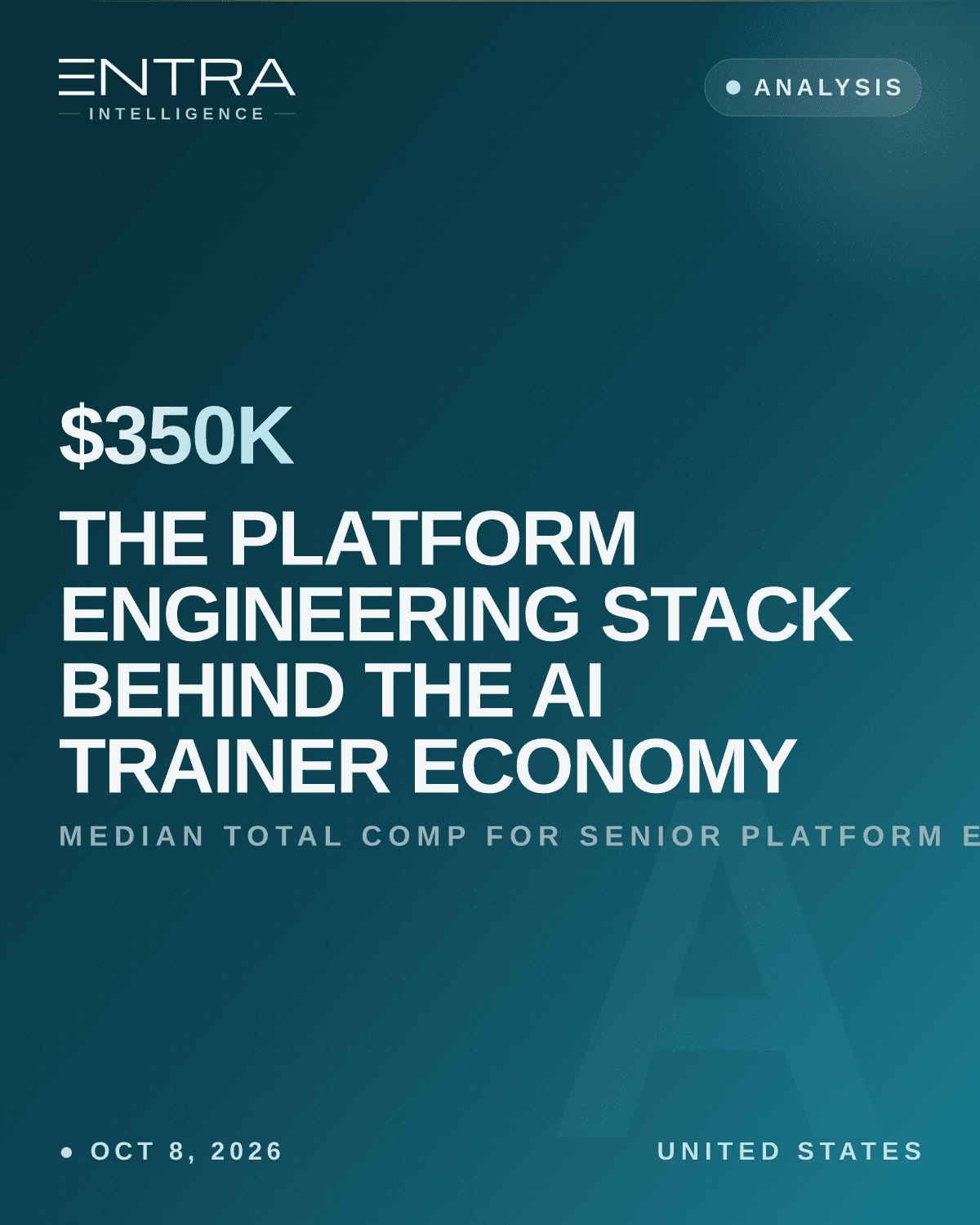
- Platform engineers at leading AI training infrastructure companies: $280K–$420K total comp (ENTRA Salary Survey Q3 2026, n=2,847); median $350K
- Equivalent senior platform engineer at non-AI SaaS: $185K–$240K — a 51–75 percent premium for annotation infrastructure depth
The Consensus Problem
The most technically underappreciated challenge in RLHF infrastructure is not the data volume. It is the aggregation problem: how do you combine preference judgments from five evaluators with different expertise profiles, different error rates on different task types, and different interpretations of the annotation rubric into a single ground-truth preference label that a model can learn from without absorbing each evaluator's idiosyncratic biases?
Majority vote is the naive answer and the wrong one. If three out of five evaluators prefer Response A, the majority-vote label is A — but if two of those three evaluators have systematically poor calibration on the specific capability dimension being evaluated (say, factual accuracy in biomedical contexts), the majority label is downstream noise, not signal. At commodity annotation scale, majority vote degrades gracefully because the dataset is large enough that noise averages out across millions of examples. At frontier RLHF scale, where each preference pair may be used hundreds of times in reward model training, the aggregation quality matters far more.
The standards that replaced majority vote — Krippendorff's alpha and Fleiss' kappa — improved on naive majority by measuring inter-annotator agreement and flagging low-consensus examples for re-annotation. Both metrics are now standard in academic annotation quality literature and in the baseline annotation platforms that serve research use cases. But neither handles expertise-weighted signals: they treat all evaluators as equivalent and therefore cannot distinguish a high-agreement label produced by five expert evaluators from a high-agreement label produced by five evaluators who collectively share the same blind spot.
Scale AI's Nucleus system, described in the company's 2025 infrastructure documentation and confirmed in engineering blog posts from the Nucleus team, approaches the problem differently. Nucleus uses Bayesian ensemble methods to maintain a running model of each evaluator's reliability profile — calibrated against their historical task performance on examples where ground truth is known — and weights their judgments accordingly before aggregation. An evaluator with demonstrated accuracy on code review tasks is weighted more heavily when judging code-related preference pairs; the same evaluator's judgments on creative writing pairs may be weighted less if the performance history suggests a different calibration. The result is an aggregated preference label that reflects epistemic quality rather than headcount.
Mercor's approach attacks the problem from the supply side rather than the aggregation side. By matching domain-verified experts to tasks within their expertise profile before annotation begins — rather than sampling from a general-purpose evaluator pool — Mercor reduces inter-annotator variance at the source. The company reports that this expert-to-task matching reduces disagreement rates by approximately 40 percent relative to general-crowdsource annotation approaches on comparable tasks, a figure consistent with the academic literature on expertise-matched annotation in specialized domains. The tradeoff is cost and throughput: expert consensus systems require three to seven evaluators per task to achieve the same statistical confidence that commodity annotation achieves with one to two, and expert evaluators command higher per-task rates. The multiplier is deliberate. For preference pairs that will drive reward model training on frontier capabilities, the quality signal is worth the cost premium.
The engineering implication is a task routing layer that most annotation platforms have not built at production scale: a real-time matching system that ingests a task, evaluates its domain and complexity signals, identifies the appropriate evaluator tier, and dispatches it to a queue — all within the latency budget of a user-facing annotation workflow. Mercor's matching engine evaluates 150-plus variables per assignment. Building that at scale, with the observability to detect when the matching model is degrading, is a non-trivial distributed systems problem.
The Data Lineage Stack
RLHF and Constitutional AI training do not just require clean preference data. They require provenance-complete preference data: every annotation carrying a record of who judged it, under what instruction version, at what timestamp, with what inter-annotator agreement score, against what model output version. The chain has to be queryable at training time so that the ML team can audit a reward model's training set, remove annotations produced under a deprecated rubric version, or filter by evaluator expertise tier. At dataset sizes running 50–500TB, the lineage requirement is not a documentation exercise. It is a data engineering challenge.
Labelbox has built its enterprise annotation platform around exactly this requirement. The company's data lineage system tracks every annotation event — creation, revision, quality review, rejection, approval — through to the downstream model deployment that consumed it. Enterprise clients including major frontier labs use Labelbox's lineage graph to satisfy both internal model audit requirements and, increasingly, EU AI Act Article 12 compliance obligations, which require high-risk AI systems to maintain documentation of training data provenance. The compliance driver has accelerated enterprise adoption of formal lineage platforms over ad-hoc scripts: in a world where regulators can request training data records, the annotation pipeline is no longer just a research infrastructure choice. It is a legal exposure question.
The storage architecture at Labelbox-scale requires thoughtful table format selection. Annotation datasets at frontier scale — 500TB and growing — cannot be efficiently managed with flat file storage. Delta Lake and Apache Iceberg table formats over S3-compatible object storage provide the versioning and time-travel query capabilities that lineage systems require: the ability to reconstruct the exact state of an annotation dataset as it existed at any prior timestamp, which is what a model audit or a regulatory inquiry demands. The data engineering function maintaining this infrastructure at Labelbox runs total compensation of $230K–$310K for senior practitioners at Q3 2026 — below the platform engineering ceiling but substantially above where data engineering sat at non-AI SaaS companies two years ago.
The EU AI Act compliance angle is a genuine demand driver that the market has not fully priced. Article 12 came into full enforcement in August 2026 for high-risk AI systems, and the frontier labs deploying systems in EU markets are now requiring their annotation platform vendors to provide documentation artifacts that meet the standard. Annotation platforms that cannot produce audit-ready lineage exports are losing enterprise contracts to those that can. The engineers building the export and compliance tooling layer at Labelbox and its competitors are, in practice, regulatory compliance engineers with data infrastructure skills — a profile that commands a meaningful premium over pure data engineering because the domain knowledge required extends beyond the technical stack.
Human-in-the-Loop at 100,000 Tasks per Day
The operational engineering of HITL systems at annotation scale involves a set of constraints that general-purpose workflow automation does not prepare engineers for.
Task queuing at 100,000 annotations per day is not a standard priority queue problem. The annotation platform needs to route high-uncertainty model outputs — examples where the model's reward signal is most ambiguous — to senior evaluators with the relevant expertise profile, while routing lower-uncertainty examples to junior evaluators who can handle higher throughput at lower cost. The routing model is itself an ML model running on the annotation stream, inferring task difficulty from features including model output entropy, task domain classification, and the annotation history for similar examples. The meta-ML problem — an ML system deciding which human annotates what — is one of the places where annotation platform engineering gets technically complex in ways no classical workflow system anticipated.
UI performance is not a soft requirement. Prolific's 2025 research on annotation behavior found that annotator fatigue increases 23 percent for every 100ms of added UI response latency. At Scale AI's peak annotation volume — 3.5 million tasks per day across hundreds of concurrent evaluators — a 200ms render latency SLA is not aspirational. It is the engineering target that keeps evaluator throughput and quality in the acceptable operating range. Building a web application that maintains sub-200ms server-side render for complex annotation interfaces — rich text comparison, multi-modal content, code review — across a globally distributed evaluator pool requires the kind of CDN architecture, edge caching, and server-side rendering optimization that would not be unfamiliar to engineers from Vercel or Cloudflare's infrastructure teams, applied to a domain-specific UI that carries far more state than a typical content delivery use case.
Prolific, headquartered in Oxford and operating a distributed research team, has built the benchmark standard for academic-grade annotation quality infrastructure. Their pre-screening, attention check, and comprehension validation pipeline — which runs before an evaluator's responses enter the usable dataset — established the quality floor that the broader annotation industry subsequently adopted. The Prolific approach treats annotation quality as a pipeline property rather than a post-hoc filter: evaluators who fail comprehension checks mid-task are removed from that task's pool before their judgments are aggregated, rather than being filtered downstream. The engineering cost is a more complex real-time session management system; the output is a cleaner dataset with less contamination from evaluators who were completing tasks without adequate engagement.
Real-time fraud detection runs on the annotation behavior stream itself. Adversarial annotators — who optimize for throughput by submitting low-effort responses as quickly as possible — produce a behavioral signature that ML models can detect: response time distributions that are too fast for genuine judgment, response entropy that is too low (selecting the same option too consistently), and inter-session behavioral patterns that deviate from the evaluator's own historical baseline. Detecting this in real time, before fraudulent annotations enter the training pipeline, requires an event stream architecture (Kafka at annotation scale, typically) feeding a lightweight classification model that flags suspicious sessions for human review. The engineers building and maintaining this fraud detection layer are, functionally, trust-and-safety infrastructure engineers with annotation domain knowledge — another cross-functional profile that commands a premium.
Platform Engineering Salary Premium
The $350K median total compensation for senior platform engineers at Scale AI, Labelbox, and Prolific (ENTRA Salary Survey Q3 2026, n=2,847) does not reflect a labor market anomaly. It reflects the specific technical breadth required to build and operate annotation infrastructure at frontier scale, across a set of problem domains that did not exist as a combined job description until approximately 2022.
The distributed systems depth required — Kafka for annotation event streaming, Flink or Spark for batch quality scoring pipelines, custom consensus aggregation systems that have no off-the-shelf equivalent — would command a premium on its own in a standard platform engineering market. The ML infrastructure fluency required to build the routing models, fraud detection models, and evaluator calibration systems that run on top of that distributed infrastructure is a second specialization that most platform engineers do not have. The domain-specific consensus algorithm knowledge — understanding the statistical properties of Krippendorff's alpha and its limitations, knowing when Bayesian ensemble weighting produces better calibration than standard inter-annotator agreement metrics — is a third. Regulatory compliance engineering for EU AI Act Article 12, GDPR data minimization requirements on evaluator behavioral data, and FTC data rules governing evaluator contracts adds a fourth.
The ENTRA Salary Survey Q3 2026 comparison is direct: equivalent senior platform engineer at a non-AI SaaS company runs $185K–$240K total comp. The annotation infrastructure premium — $280K at the floor, $420K at the ceiling, $350K at the median — represents a 51–75 percent premium over that baseline. The premium exists because the skill combination required is rare and because the platforms that have it are building infrastructure that cannot be replicated quickly by competitors. The scarcity is structural, not cyclical.
Levels.fyi Q3 2026 data for Staff-level platform engineers (L6-equivalent) at Scale AI shows a total compensation range of $320K–$410K, consistent with the ENTRA survey median. The range at Labelbox for Principal Data Engineer (the closest equivalent to Staff platform engineer in the company's job taxonomy): $290K–$360K. Both figures are substantially above what the same L-band commands at enterprise SaaS companies without AI training infrastructure depth.
The next platform engineering challenge is coming from multi-modal annotation. Video and audio annotation — simultaneous assessment of visual, acoustic, and textual signals — requires UI paradigms that current annotation platforms were not designed for, and data storage and processing capacity approximately ten times what text-only annotation requires. The companies already solving the consensus and lineage problems for text-based RLHF will have a structural advantage when the multi-modal annotation market scales. The engineers who built those systems will be the ones who understand what needs to change.
What Comes Next
The platform engineering stack powering the AI trainer economy is not a cost center. It is the accumulated capital of years of engineering work — consensus algorithms, data lineage systems, fraud detection pipelines, HITL routing models — that compound over time because each year of operation produces a larger provenance-tracked dataset and a better-calibrated evaluator pool. The frontier labs that rely on this infrastructure understand this: the annotation platform is a source of structural differentiation, not a commodity vendor relationship.
The $350K platform engineer median is not going to compress in the near term. The skills required to build and operate annotation infrastructure at frontier RLHF scale have no standard educational pipeline feeding them. The engineers who have those skills developed them through a combination of distributed systems production experience, ML infrastructure apprenticeship, and annotation domain knowledge that is only acquired by working on annotation platforms. The supply side is constrained in exactly the ways that the hyperscaler ML infrastructure market is constrained — not by lack of interest but by lack of the specific, compounded experience that production systems at this scale require.
The annotation platform infrastructure built between 2022 and 2026 is now a moat. Not because it is secret — the architectural patterns are increasingly well-documented in engineering blog posts and academic papers from the teams that built them. But because reproducing it requires time, and time is the one thing frontier AI development does not have in surplus. The engineers who built it, and the companies that employed them, sit at the infrastructure layer that makes the entire AI trainer economy possible. That position deserves to be visible, understood in technical terms, and compensated accordingly. The market, in its Q3 2026 data, suggests that it is.
 Global Career Platform
Find AI talent. Find your next role.
Booking is hotels. · Airbnb is apartments. · ENTRA is global careers.