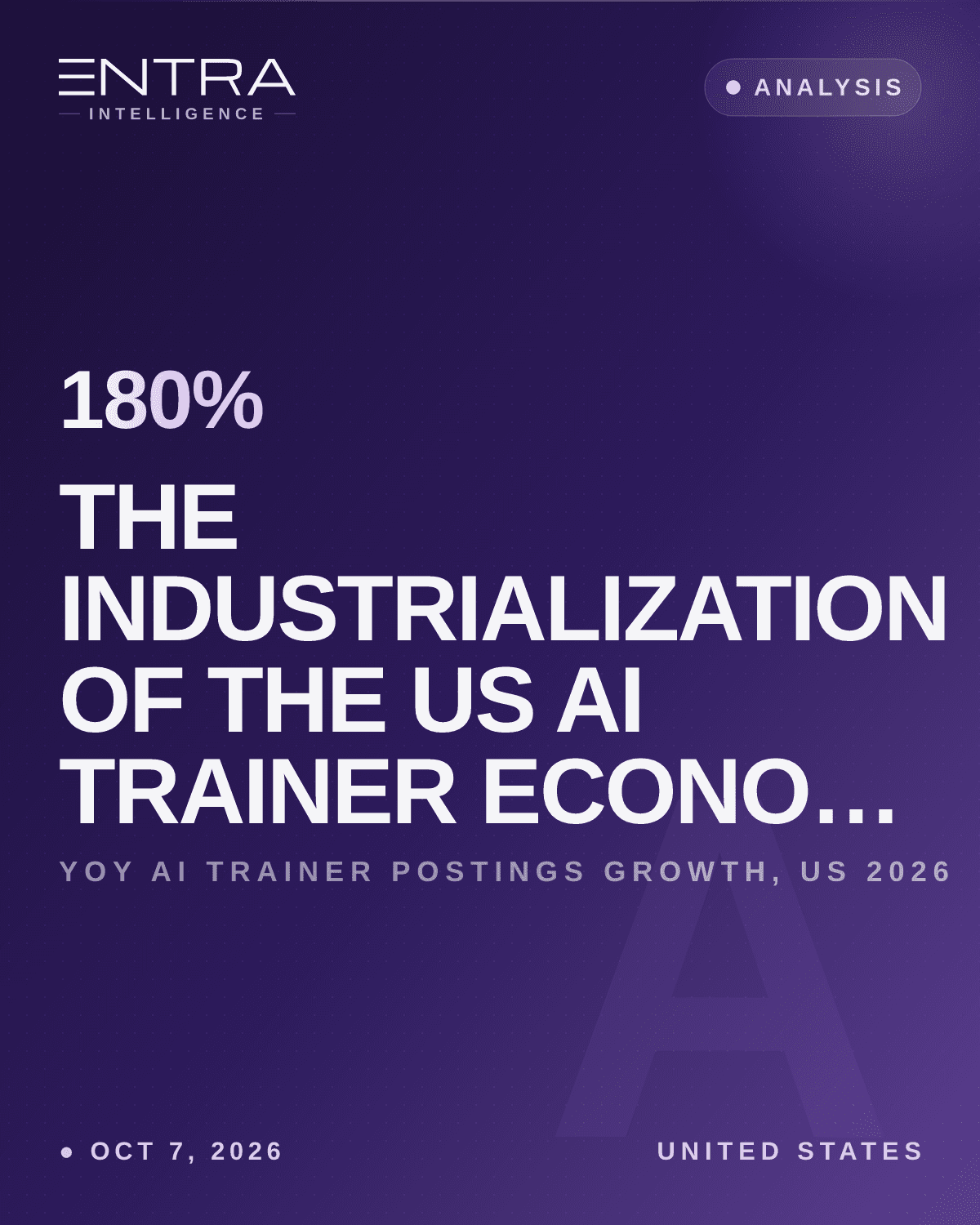
The US AI trainer economy has grown too fast for the gig-economy infrastructure that spawned it. In 2023, Reinforcement Learning from Human Feedback was a cottage industry — PhD students and crowdworkers clicking preference buttons on Scale AI for $18 an hour. By Q3 2026, the same function commands a median total compensation of $520,000 at frontier labs. That 2,800% spread is not a market malfunction. It is the footprint of an industry industrializing in real time.
Three structural forces are reshaping how the US sources, employs, and pays the humans who teach its most valuable AI systems.
The Gig-to-Salaried Transition Is Accelerating
The AI training market began as distributed piecework. Platforms like Scale AI, Surge AI, and Outlier built their initial moats on the Mechanical Turk model: task segmentation, crowdsource at scale, pay per annotation. In 2022, that model worked because the tasks were simple — image labeling, entity extraction, preference pairs on short text.
It no longer works for frontier AI development. Constitutional AI, RLHF alignment research, and safety red-teaming require sustained cognitive engagement that cannot be segmented into five-minute microtasks. The skills are not transferable between projects without significant onboarding. And the margin for annotation error has collapsed: a mislabeled preference signal in a Constitutional AI dataset can produce model behaviors that require months to diagnose.
The industry's response has been structural employment. Anthropic's AI Trainer team, ranked #1 on the ENTRA Top 20 AI Training Platform Employers (score: 92, AAA), now employs the majority of its trainers as full-time contractors with healthcare benefits, defined project terms, and career mobility into research roles. OpenAI (#2, 84) has similarly structured its safety annotation teams under multi-year employment arrangements rather than on-demand task contracts.
The gig platforms haven't disappeared — they've stratified. Scale AI (#6, 68) retains a large crowdsourced annotation workforce for lower-complexity tasks while simultaneously building a salaried "Scale Labs" tier for frontier model work. Mercor (#4, 76) has built its differentiation around talent verification and placement into long-term evaluation roles, acting less like a task platform and more like a specialized staffing firm.
This stratification is visible in the compensation data. ENTRA Job Signal Index Q3 2026 tracked 47,000+ AI training and evaluation job postings in the US between July and September. The median hourly rate for unstructured crowdsource annotation held at $21–$24. The median total compensation for a verified, domain-expert AI Evaluator placed through Mercor or a comparable premium platform reached $185,000 annually. The spread — $45K crowdsource versus $185K premium — is not a pay transparency gap. It is two different labor markets that share a job-title taxonomy.
The Professionalization Gradient
The industrialization thesis predicts that as AI systems become more capable and their training requirements more specialized, the premium for expertise will compound while the market for commodity annotation will compress. The Q3 2026 data supports this trajectory.
Domain expertise commands the largest premia. The ENTRA Salary Index published October 3 shows Constitutional AI / Alignment Researchers at $520K median total compensation — 3.2× the senior generalist AI evaluator median of $163K. RLHF Research Scientists follow at $480K. The pattern holds across specializations: biomedical AI evaluators command 23% above generalist evaluators; multilingual Arabic/English evaluators 22%; legal-domain AI trainers 19%.
Institutional credential is now a hiring filter. Frontier labs increasingly require AI Evaluation Specialists to hold at minimum a master's degree in a relevant field — computer science, linguistics, cognitive science, philosophy of mind — or demonstrate equivalent research output. Scale AI's new "Scale Labs" tier requires a technical screen. Anthropic's Constitutional AI trainer program uses a coding assessment. The barrier to entry for premium AI training work has risen from "good attention to detail" (2022) to "demonstrated expertise in model evaluation methodology" (2026).
Geographic concentration is reinforcing itself. San Francisco, Seattle, Boston, and New York account for 71% of posted salaried AI evaluator positions in the US (ENTRA Job Signal Index Q3 2026). These markets offer proximity to frontier lab headquarters, research conference networks, and peer learning. Secondary markets — Chicago, Austin, Denver, Raleigh-Durham — are growing but from a small base.
The Regulatory Shift Coming in Q4
The industrialization of AI training is arriving at a legal inflection point. Three regulatory developments are reshaping the compliance environment for US-based training platforms:
California AB 2930 (effective January 2027) requires companies with more than 100 employees to perform algorithmic impact assessments for any AI system used in "employment decisions." Annotation work that feeds a hiring algorithm — an increasingly common use case — will face mandatory bias auditing requirements. Platforms that route annotation work through freelancer arrangements to avoid these thresholds are facing scrutiny.
The DOL AI Worker Classification Guidance (September 2026) applies the "economic reality" test to AI annotation contractors. A worker performing ongoing, supervised annotation tasks under platform-set conditions and without meaningful ability to set their own rates meets the DOL threshold for employee classification — regardless of the contractual label. Scale AI, DataAnnotation Tech, and Hive Data have received DOL inquiries under this guidance. Reclassification at scale could add 25–35% to platform labor costs.
NLRB precedent on AI trainer organizing is emerging. In August 2026, the NLRB certified a bargaining unit of 340 Scale AI contractors — the first successful AI trainer organizing campaign in the US. The precedent is narrow (specific to Scale AI's Taskers Pro tier) but the signal is not: workers performing AI training labor are exploring collective mechanisms that gig-platform models were designed to preclude.
The net effect is cost pressure on the low end of the market and structural legitimization of the high end. Platforms built on exploiting classification ambiguity face a shrinking compliance window. Platforms built on genuine employment infrastructure — Mercor's placement model, Anthropic's contractor-with-benefits approach, OpenAI's in-house evaluator teams — are competitively advantaged by the regulatory shift.
The Geographic Story
The industrialization of AI training work is producing a distinct geographic footprint — one that mirrors the broader tech talent concentration map but with sharper edges.
San Francisco remains the highest-density market. The Bay Area accounts for 31% of all salaried AI evaluator openings in the US (ENTRA Job Signal Index Q3 2026). Proximity to Anthropic, OpenAI, and Scale AI headquarters, combined with the research conference ecosystem (NeurIPS, ICLR, the alignment workshop circuit) gives SF-based trainers access to information and network effects unavailable elsewhere. The cost, however, is severe: the median fully-loaded cost of a salaried senior AI evaluator in the Bay Area reaches $280K including employer taxes and benefits — versus $185K in Chicago, $172K in Austin.
Seattle is emerging as the evaluation powerhouse. Microsoft's Redmond campus has become the largest single employer of AI evaluation specialists outside frontier labs, with 340+ active evaluator roles posted in October 2026 as the Copilot and Azure AI evaluation functions scale. Amazon's AGI division in Seattle is hiring at similar velocity. The presence of two hyperscalers running large internal evaluation programs has created a labor market with meaningful upward pressure on AI evaluator compensation: Seattle median is now $215K, 16% above the US average.
New York is the financial services corner. JPMorgan's AI research organization, Goldman Sachs' AI engineering function, and the cluster of hedge funds running internal AI model evaluation teams have created a distinct New York subspecialty: financial AI evaluation, focused on risk model assessment, trading algorithm behavioral testing, and regulatory compliance evaluation. The New York Financial AI Evaluator median runs $240K, elevated by Wall Street's base-heavy compensation structures.
The secondary market story is still forming. Austin, Chicago, Denver, and Boston each show meaningful AI evaluator hiring activity — driven respectively by Dell/Tesla AI, financial services enterprise AI, frontier lab satellite offices, and MIT/Harvard research pipeline. These markets are growing but are still hiring at 15-25% below the coastal compensation benchmarks. The question is whether remote-equity norms from the broader tech labor market will compress the gap. Current indicators suggest compression is slow: frontier labs are re-asserting in-person norms for their evaluation teams specifically, citing the collaborative model-debugging work that evaluation increasingly requires.
What Q4 2026 Looks Like
The frontier lab hiring signals are clear. Anthropic posted 34 AI Trainer and Evaluator roles in September 2026, up from 21 in June — a 62% quarterly increase as Constitutional AI 3.0 training enters its intensive alignment phase. OpenAI's safety team is actively backfilling positions following the GPT-5 Pro rollout. Google DeepMind's Gemini evaluation function added 28 roles in Q3.
The platform market is bifurcating in the direction the compensation data predicted. Mercor's annualized placement revenue is tracking 3.2× its 2025 baseline, driven almost entirely by the premium evaluation tier. Scale AI's enterprise revenue (large-model training contracts) is growing while its consumer-tier annotation revenue is flat — a structural confirmation of the stratification thesis.
The workers who positioned early — building expertise in Constitutional AI methodology, multilingual model evaluation, or safety red-teaming — are entering Q4 2026 as one of the most competitively sought labor pools in technology. The workers who remained in commodity annotation are facing platform competition from Eastern European and South Asian talent pipelines that have learned to produce acceptable annotation quality at lower cost.
The US AI trainer economy is not splitting into winners and losers. It is splitting into two distinct industries that happen to share a label. The professionalization gradient has passed the point of reversal. What follows is convergence toward a recognizable professional services model — credentialed practitioners, structured employers, and a regulatory framework that enforces the distinction.
The gig economy didn't kill white-collar work. It industrialized it.
 Global Career Platform
Find AI talent. Find your next role.
Booking is hotels. · Airbnb is apartments. · ENTRA is global careers.