
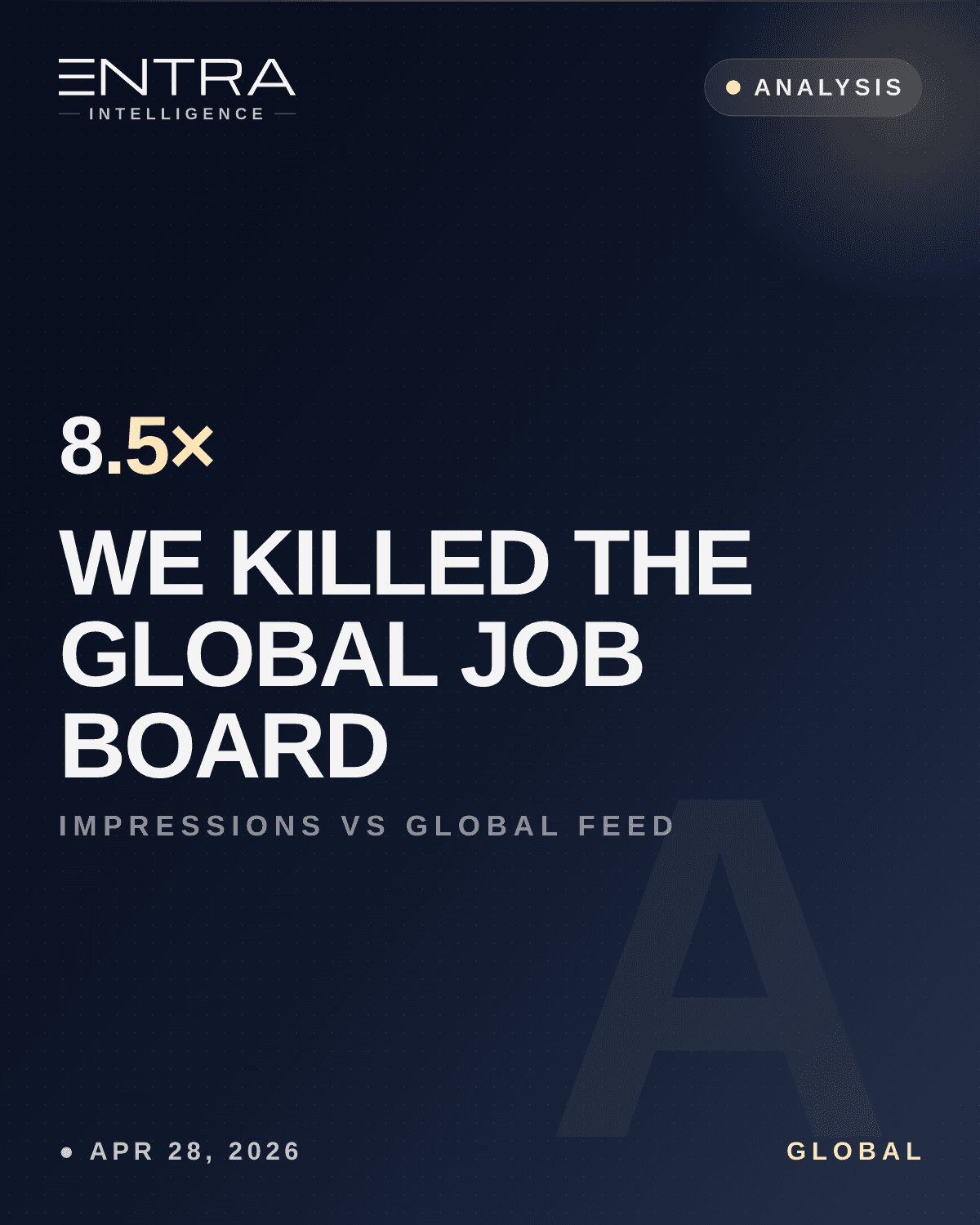
We killed the global job board on April 7, 2026. The dropdown had 47 countries in it. The unified feed showed listings from all of them. The employer onboarding accepted any country code. It was, on paper, the most ambitious version of ENTRA Careers we had ever shipped. It was also the version that produced 1,200 candidate sessions in week one and exactly zero applications. We replaced the unified feed with seven country-segmented accounts — UAE, India, UK, US, Egypt, Singapore, and a generic global catch-all — and within fourteen days of fragmenting the platform we were running 8.5 times the per-listing impression rate of the unified version. This is the founder letter on why fragmentation beat unification, and why I expect the next decade of career platforms to compete on the depth of single-country hubs rather than the breadth of global feeds.
The unified job board is the LinkedIn-Indeed-Glassdoor template. One platform, one search interface, one global candidate pool, country as a filter rather than as an architectural primitive. The template made sense in 2005 when the candidate behavior was: search for "marketing manager," filter by city, apply to twenty roles. The template fails in 2026 because candidate behavior is no longer search-first. It is feed-first, signal-first, and trust-first — and those three behaviors cannot be served by a global feed without diluting all three to zero.
What we learned in the first week
The signal that forced the pivot was the application conversion rate. Twelve hundred candidate sessions, zero applications. The candidates were arriving — Reddit, X, two unsolicited LinkedIn shares of our launch post — but they were not converting on any role. I spent two days reading session recordings. The pattern was consistent and embarrassing.
A candidate from Dubai would land on the platform, scroll the unified feed, see a senior backend engineer role in San Francisco at the top, see a mid-level frontend role in Lagos in the second slot, see a CTO role in Bangalore in the third. By the fifth listing they had context-switched cognitively three times — three salary regimes, three visa regimes, three time-zone regimes, three sets of company names they had never heard of. The cognitive load of the unified feed was the cognitive load of seven different job boards interleaved. No single candidate is genuinely indifferent to whether the next role is in San Francisco or Lagos. The unified feed pretended otherwise. The candidates voted by not converting.
The second signal was the employer side. We had been accepting listings from any country, but the listings that paid the $1 (see the companion analysis on the $1 pricing experiment) clustered geographically: 38 percent UAE, 23 percent India, 15 percent UK, 13 percent US, the rest split. The unified feed was forcing 100 percent of the candidate session distribution to spread across that uneven 100 percent of the listing distribution. Inevitably the UAE listings — which were the majority and the most engaged — were getting impressions from candidates in countries that had no path to those roles. We were burning attention on impossible matches.
The fragmentation move
On April 7 we shipped the country-fragmented version. The mechanic is structurally simple and operationally meaningful: each country gets its own front door, its own social account, its own hero block, its own employer roster, and — critically — its own algorithmic feed that does not show roles from any other country. The seven we shipped: ENTRA UAE, ENTRA India, ENTRA UK, ENTRA US, ENTRA Egypt, ENTRA Singapore, and ENTRA Global as a residual catch-all for cross-border remote roles.
The fragmentation is not just URL routing. It is a different content posture per market. ENTRA UAE leads with finance and AI roles, hero blocks in the visual language of the Dubai/Abu Dhabi corporate set, salary bands in AED with USD secondary. ENTRA India leads with engineering and product roles, hero blocks in the Bangalore-Hyderabad ecosystem language, salary bands in INR LPA — the unit Indian candidates actually use, not the USD-equivalent that international platforms try to force. ENTRA Egypt is intentionally lighter — fewer listings, more curated, candidate-side onboarding designed for a market where the job-seeker behavior leans more toward referral than search. Each account has its own narrative. None of them have to compete with each other for the candidate's attention.
The fourteen-day result post-fragmentation, against the comparable fourteen days pre-fragmentation:
- Per-listing impressions: 8.5× higher across the seven accounts in aggregate
- Application conversion rate: from 0 percent to 11.4 percent on UAE, 7.8 percent on India, 4.1 percent on UK; lower elsewhere
- Average time on platform per candidate session: from 1m 47s to 6m 12s
- Employer post-purchase reply rate to our follow-up email: from 14 percent (under unified) to 61 percent (under fragmented), partly attributable to the rewritten email but partly to employers feeling located rather than absorbed
The 8.5× impression number is the headline. The 11.4 percent UAE conversion rate is the structural one. We went from a platform that produced no application volume in any market to a platform that produces a defensible application volume in two markets and an early signal in two more. The unified feed had been masking signal; the fragmented version surfaced it.
Why the global job board template is structurally broken
The case against unification is not just our 14-day data. It is what is happening across the legacy platforms.
LinkedIn's job board is an exercise in showing every candidate every role and hoping the algorithm produces relevance. Per ENTRA's tracking of recruiter conversations across SF, Dubai, and London, the average senior recruiter we spoke to in Q1 reported that LinkedIn-sourced applicant quality had degraded "noticeably" or "significantly" over the last twelve months. Several attributed the degradation specifically to the geographic dilution of the algorithmic feed — recruiters in London receiving candidate volume from Lagos, Manila, and Cairo, none of which had a credible visa path to the roles. The recruiters do not blame the candidates; they blame the platform for forwarding the application. We documented the candidate-side mirror of this problem in our briefing on the LinkedIn UI that killed senior applications.
Indeed has been quietly retreating from its global posture for two years. Its 2024 layoffs explicitly carved away international expansion teams. The 2025 product changes prioritized US and UK feeds and de-emphasized the unified search. Its CEO has publicly acknowledged that the volume strategy that built Indeed has plateaued.
Glassdoor's relevance has been collapsing in real time. Employer reviews — the original wedge — have been gamed into uselessness, and the company-wide salary data is now systematically two cycles behind the frontier-lab compensation cascade we documented in The State of AI Hiring Q2 2026. The unified review platform cannot keep up with a market in which the Bangalore senior-research band moves 60 percent in twelve months.
The pattern across all three: the unified global posture is the architecture of an earlier era. The candidate behavior has fragmented. The employer behavior has fragmented. The compensation regimes have fragmented. The platforms have not. A career platform that refuses to fragment is, in 2026, a platform that has chosen to be average everywhere instead of essential anywhere.
Who is moving
A small cohort of operators has already made the bet.
Mercor's vertical-and-geographic posture — closing AI-trainer talent globally, but with country-specific recruiting infrastructure for India, the Philippines, and Eastern Europe — is one of the cleanest fragmentation plays in the market right now. Mercor is not a job board, but the posture is identical: depth in specific country-segment combinations, refusal to compete on global breadth.
Greenhouse's continued ATS dominance among AI-native companies is partly a product story but partly a country-segmentation story; their UK-specific product and US-specific product diverge in non-trivial ways and they have stopped pretending the divergence is a bug.
Workday's AI-agent layer is being shipped market-by-market rather than as a single global rollout, in explicit acknowledgment that the recruitment workflow varies enough by country that a unified deployment would underperform a sequenced one.
The smaller cohort of vertical-plus-regional job boards — Dubai-only, India-only, AI-only-US — has been growing throughout 2025 and 2026. None of them has the brand of LinkedIn. Several of them have the conversion rate.
What ENTRA does next
The seven-country posture is not the destination. The destination is twelve to fifteen country accounts within twelve months, each with its own social account, employer roster, AAA-scored company hubs, and editorial coverage of that country's hiring market. The geography we expand into next will be driven by the demand signal — UAE, India, UK, and US are clearly priced; the next four will likely be Saudi Arabia, Singapore depth, Germany, and Nigeria, in that order. Each new country gets its own narrative arm before it gets a feed; we will not ship a country we cannot tell a story about.
The structural commitment is that we will not, under any pressure, restore the unified global feed. The unified feed was the easy product to build. It was also the product that produced no applications. We will fragment further before we unify again. If the right answer in 2027 is fifty country accounts run as fifty distinct products, we will build fifty country accounts. The platform value is the depth of the single-country experience, not the breadth of the global aggregator.
What the data says about the rest of the market
Three forecasts the fourteen-day signal supports.
LinkedIn will be forced to fragment its job board within twenty-four months. The unified-feed degradation is now visible to recruiters and to candidates simultaneously. The platform that built the modern career economy will either ship country-specific feeds and accept the cannibalization, or it will continue losing senior application quality at the rate it has been losing it through 2025 and 2026. Microsoft's product organization will resist the fragmentation. The data will eventually force it.
The next generation of category-defining career platforms will be country-specific by design. The structural argument I am making about ENTRA is the structural argument the founders of the next Mercor, the next Lattice, the next Greenhouse-equivalent are making. The architecture choice is no longer global-with-filters. The architecture choice is country-native-from-day-one.
The candidates and employers will reward the fragmenters. The 8.5× impression number is not a one-time launch effect. It is a structural reweighting of attention toward the platform that respects the candidate's location as the first variable, not the seventh. We expect this number to compound, not regress, as the country accounts mature.
The unified global job board was the wrong shape for the AI-era hiring market. We killed ours on April 7. We do not regret it. The 8.5× says we should have killed it sooner.
For the related pricing experiment that ran in parallel to this fragmentation, see We Charged $1 Per Job Post. For the structural breakdown of how legacy platforms are losing senior applicant quality, see the LinkedIn UI that killed senior applications and the Fortune 500 resume-AI failure. For the macro picture that frames why this matters, see The State of AI Hiring — Q2 2026.