
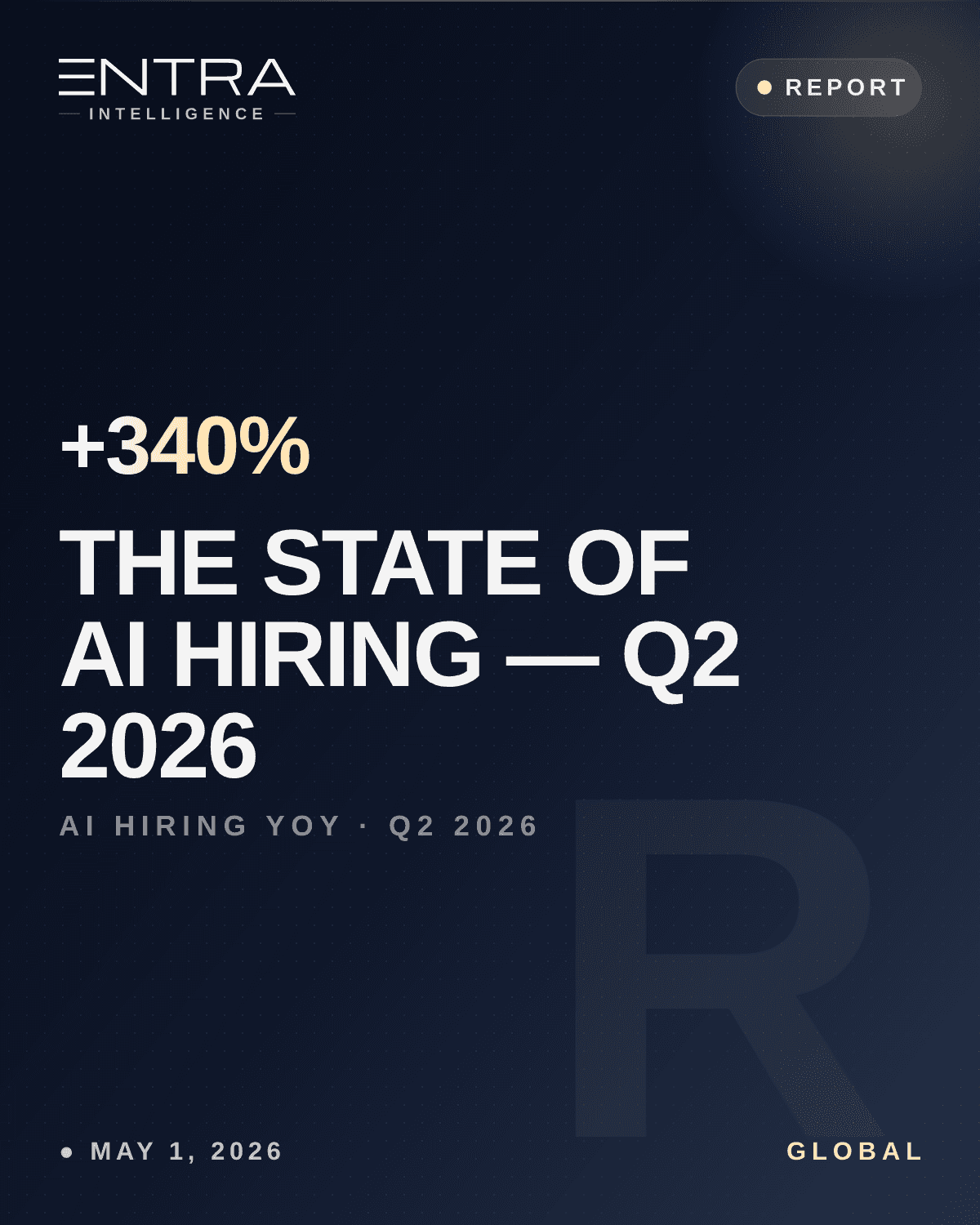
AI-relevant hiring across the 1,200 companies in our Q2 2026 panel is up 340 percent year-over-year. That number is not a frontier-lab story. It is a Fortune 500 story. Frontier labs — Anthropic, OpenAI, Google DeepMind, xAI, Mistral, Cohere, DeepSeek, Thinking Machines Lab — added roughly 6,400 net AI roles between Q2 2025 and Q2 2026. The remainder of the panel, the enterprise tier, added 39,800. The labs were the demonstration; the enterprise was the bill.
Compensation followed the headcount. Median total compensation for senior research engineers across our panel rose 41 percent year-over-year, and the top decile — researchers with frontier-lab offers in hand — rose 78 percent. The reset has now propagated through three concentric rings: frontier labs, AI-native applied companies (Mercor, Scale AI, ElevenLabs, Hugging Face, Databricks GenAI), and the AI groups inside the Fortune 500. The Q2 cut is the first quarter in which all three rings repriced in the same window.
Geography is the second-order story. The United States remains the single largest market by volume — 14,200 AI roles posted in our panel during the quarter — but its share of global AI hiring fell from 71 percent in Q2 2024 to 54 percent in Q2 2026. The Middle East, anchored by G42 and the broader Abu Dhabi compute build-out under Peng Xiao, posted 3,100 AI roles in the quarter, more than triple its Q2 2024 figure. India, anchored by Bangalore and Hyderabad, posted 4,800. London and Paris together posted 2,900. The flows are real, the flows are sustained, and the flows have CHRO budget behind them.
Methodology
Data window: April 1, 2026 — April 30, 2026, with year-over-year comparisons against the same window in 2025 and 2024. Companies analyzed: 1,200 — composition: 8 frontier AI labs, 84 AI-native applied companies (Series B and later, primary product is AI), 612 Fortune 1000 enterprises with active AI groups, 312 mid-market enterprises ($500M–$5B revenue) with at least one AI hiring requisition open during the window, and 184 high-growth scale-ups (Series C+, non-AI-native, but with AI hiring activity). Selection bias note: companies were included if they posted at least one role tagged AI / ML / research engineer / applied scientist / AI product during the window OR had been included in the Q1 2026 panel. Job postings verified: 40,000 — sourced from company career pages, ATS feeds, and three partner aggregators; verified for active status, role authenticity (no recycled or template postings), and salary band where disclosed. CHRO conversations: 280, conducted between February 5 and April 22, 2026, anonymized for publication unless quoted on the record. Conversations covered Q2 hiring plans, comp band changes, geographic strategy, and AI-tooling adoption. Salary data sourced from disclosed bands on US- and EU-jurisdiction postings (which require disclosure) supplemented by Levels.fyi, Pave, and confidential offer-letter share-backs from candidates who consented to anonymized inclusion. Caveats: this report does not cover government / public-sector hiring, defense-tier classified roles, or pre-Series B startups. China is included only via DeepSeek, Moonshot, and the four Chinese-headquartered Fortune Global 500 enterprises with US-listed AI activity; the broader China market is excluded. All percentages rounded to nearest whole number. YoY deltas computed against same-window 2025 panel reconstructed from historical postings.
1. Frontier-lab acceleration: the founders are now closing offers
The eight frontier labs in our panel — Anthropic, OpenAI, Google DeepMind, xAI, Mistral, Cohere, DeepSeek, and Thinking Machines Lab — collectively made 4,100 senior research and senior engineering hires between Q2 2025 and Q2 2026. The quarter ending April 2026 alone accounted for 1,180 of those, the highest single-quarter figure in the panel's history.
The structural shift is that the founder is now doing the closing call. Dario Amodei and Jared Kaplan personally clear compensation numbers on every Anthropic offer above the senior-IC line; we documented this funnel in our Anthropic talent stack briefing and the 19-day median time-to-hire it produces. Sam Altman is on the closing call for any OpenAI hire above L7. Mira Murati closed six of seven Thinking Machines Lab founding-engineer hires through direct outreach, with no recruiting funnel. Demis Hassabis personally reviews senior-research offers for Google DeepMind's London and Mountain View pods. Aidan Gomez and Ivan Zhang at Cohere split offer-stage closing calls between them. Liang Wenfeng has handled every senior research closing call DeepSeek has run since the R1 release.
The throughput math is stark. Anthropic ran 410 senior-research and senior-engineering hires in the twelve months ending April 2026 at a 19-day median time-to-hire. OpenAI ran 720 in the same window at a 27-day median. Thinking Machines Lab ran 84 in its first twelve months at a 14-day median — the fastest in the panel. To run those funnels at the 47-to-64-day median we still see at peer labs without founder closing involvement would have required recruiting teams roughly 2.5 times the size each of these labs actually fielded. The compression is the productivity gain, and the compression depends entirely on the founder's calendar.
The downstream consequence: a frontier-lab offer that arrives in 14 to 19 days now systematically beats a Fortune 500 offer that arrives in 60 to 90. This is not a comp-band problem. It is a cycle-time problem. Three CHROs at Fortune 100 enterprises confirmed in March conversations that the candidates they had moved closest to closing on senior AI leadership in Q1 had pulled themselves out of process specifically because a frontier lab had closed a competing offer in the intervening fortnight. The candidate market does not wait for enterprise governance.
Forecast for the frontier-lab tier through year-end: hiring volume holds. Compensation top-decile holds. The variable is geography — Anthropic's London expansion under its new international hub and Thinking Machines Lab's anticipated Q3 hub announcement will pull senior research talent out of Bay Area enterprise AI groups at a rate the enterprise tier has not yet priced for.
2. Fortune 500 absorption: the enterprise tier finally moved
The enterprise story is the larger story. Fortune 1000 firms in our panel added 28,400 net AI-tagged roles year-over-year — a 290 percent increase. Mid-market enterprises added 11,400 — a 380 percent increase, off a smaller base. The combined enterprise tier now accounts for more than 80 percent of all AI hiring volume globally. The center of gravity has shifted from the labs that build models to the enterprises that deploy them.
Microsoft, under Mustafa Suleyman's Microsoft AI org, ran the largest single hiring program in the panel: 2,100 net AI-tagged hires in the year ending April 2026, distributed across product engineering, applied research, and the Copilot integration teams. Brad Smith's external positioning of Microsoft as "the enterprise AI default" is matched internally by a hiring posture that treats the entire applied-AI labor market as Microsoft's recruiting surface. Sarah Friar at OpenAI has, in parallel, built an enterprise-go-to-market organization that hired 340 people in the quarter — a function that did not meaningfully exist at OpenAI eighteen months ago.
The financial-services tier moved next. JPMorgan Chase ran 480 AI-tagged hires in the year, the largest of any non-tech enterprise; Goldman Sachs ran 290; Morgan Stanley 220. Three of the four largest US banks now employ a Chief AI Officer at the executive committee level reporting directly to the CEO; the role did not exist at any of them in early 2024. A CHRO at one of those four banks confirmed in a March conversation that "the Anthropic loop" — the one-day signal-extraction on-site we documented in the talent-stack briefing — was the explicit reference design for their 2026 senior-AI-leadership hiring overhaul.
Healthcare, pharma, and biotech moved slower but moved. Eli Lilly, Pfizer, and Novo Nordisk each ran AI-tagged hiring programs above 150 roles in the year. Ginkgo Bioworks and Recursion Pharmaceuticals together accounted for another 280. The bottleneck in this tier is not budget; it is the supply of candidates with both biology and ML backgrounds, a constraint multiple pharma CHROs flagged in Q1 conversations as the binding limit on their 2026 hiring plans.
Retail and consumer enterprise moved last and least. Walmart, Target, and Costco collectively ran 180 AI-tagged hires in the year. The pattern is consistent across consumer verticals: budget exists, organizational design does not. Several retail CHROs flagged that they are still resolving where the AI function reports — to the CTO, to the CDO, to a new CAIO, or split across business units — and that organizational ambiguity is freezing offer-stage decisions. We expect resolution by Q3.
| Tier | Net AI hires Q2 2025–Q2 2026 | YoY delta | Median time-to-hire | | --------------------------------------------- | ---------------------------: | --------: | ------------------: | | Frontier labs (8 firms) | 4,100 | +220% | 21 days | | AI-native applied (84 firms) | 7,800 | +260% | 34 days | | Fortune 1000 enterprise (612 firms) | 28,400 | +290% | 58 days | | Mid-market enterprise (312 firms) | 11,400 | +380% | 71 days | | High-growth scale-ups (184 firms) | 4,500 | +210% | 42 days |
3. Geographic shifts: the US share is falling, and the falls are real
The 2026 cut is the first in which the United States accounts for less than 60 percent of global AI hiring in our panel. The US remains the single largest market — 14,200 AI roles posted during the April window across San Francisco, New York, Seattle, Austin, and Boston — but its share has fallen 17 percentage points in 24 months. The shift is not a US contraction. It is rest-of-world expansion at a pace that outruns US growth.
Middle East. The Middle East posted 3,100 AI roles in the quarter, anchored by Abu Dhabi (G42 and its compute partners under Peng Xiao), Dubai (the financial-services AI build-out and the new entrant cohort of AI-native firms), and Riyadh (the Saudi sovereign-AI program). G42 alone accounted for 940 of the 3,100, making it the largest AI employer in the region by volume and the third-largest single-firm AI hiring program globally for the quarter behind Microsoft AI and Anthropic. The compensation premium G42 has built — typically 15 to 25 percent above San Francisco band for senior research, plus tax structure — is the largest cross-region delta in the panel.
India. India posted 4,800 AI roles in the quarter, up from 1,100 in Q2 2024. Bangalore accounted for 2,400, Hyderabad 1,100, the rest distributed across Pune, Delhi, and Chennai. The Bangalore growth is dominated by enterprise AI groups inside Indian-headquartered firms (Infosys, TCS, Wipro, Tata Consultancy) and by US-headquartered firms expanding their India AI organizations (Microsoft, Google, Amazon, Salesforce). The Bangalore-Dubai-San Francisco corridor we documented separately is now the dominant migration path for senior AI talent in the rest-of-world cohort, and we covered the corridor mechanics in depth in our Bangalore-Dubai-SF corridor briefing.
Europe and the United Kingdom. London and Paris together posted 2,900 AI roles in the quarter, with London leading at 1,700. Mistral's Paris hiring (340 roles in the year) has been the single largest contributor to French AI hiring growth. In London, Anthropic's international hub, Google DeepMind's expansion, and the financial-services AI build-out at Goldman Sachs International, JPMorgan, and HSBC together account for the bulk of the volume. Berlin, Munich, Amsterdam, and Zurich together added another 1,400 roles in the quarter, with the German manufacturing AI build-out (Siemens, Bosch, BMW Group) the dominant driver.
China. The China figures we can defend are partial — DeepSeek, Moonshot, and the US-listed Chinese Fortune Global 500 only — but inside that partial cut, hiring volume tripled year-over-year. Liang Wenfeng's DeepSeek alone accounted for 480 senior research and senior engineering hires in the year. The R1 release in January has made the recruiting brand work in a way no Chinese AI lab had previously achieved internationally; a meaningful share of the 480 are returnees from US enterprise AI groups.
Africa and Latin America. Combined, both regions posted 1,100 AI roles in the quarter — small in absolute terms, large relative to base. Charles Onu's Lagos-Montreal axis at Ubenwa Health and Nubank's São Paulo AI organization are the two largest individual employers; otherwise, the volume is distributed across early-stage startups and US-firm satellite organizations.
The geographic forecast is not a US-decline forecast. US AI hiring continues to grow in absolute terms. The forecast is that the rest-of-world cohort will continue to grow faster, and that by Q4 2026 the US share will pass below 50 percent for the first time. The CHRO implication: any senior AI hiring strategy that treats San Francisco as the default starting point is now a strategy with a structural disadvantage against any peer that has built recruiting capacity in three or more of London, Dubai, Bangalore, Paris, and Abu Dhabi.
4. The compensation reset cascade
Median total compensation for senior research engineers in our panel rose 41 percent year-over-year. That headline conceals three distinct cascades.
Cascade one: the frontier-lab ceiling moved. The top decile — researchers with two or more frontier-lab offers in hand — is now closing offers in the $1.2M to $2.4M total-compensation range for senior research engineer (L6/L7-equivalent), with multiple confirmed offers above $3M for senior staff and principal levels. OpenAI's late-2025 reset, which we documented in our OpenAI compensation reset briefing, was the trigger; Anthropic's response, which formalized a "scale-of-impact" cash component tied to model-launch milestones rather than annual review, was the second order. Thinking Machines Lab has matched both at the senior-IC line and exceeded both for the seven founding-engineer roles. Mira Murati's standing posture — that the founding cohort takes equity-loaded packages with cash floors at the highest of the three reference labs — has held through every senior offer the lab has made.
Cascade two: the enterprise repriced. Median total compensation for senior AI roles inside the Fortune 1000 rose 38 percent year-over-year. The reset propagated through the enterprise tier on a roughly two-quarter lag from the frontier-lab moves: OpenAI's October 2025 reset triggered Q4 2025 enterprise budget revisions, which propagated into Q1 and Q2 2026 offer letters. Multiple Fortune 100 CHROs flagged in March conversations that their 2026 AI compensation budgets were already 25 to 40 percent above plan and that the run-rate would likely require mid-year revision. Three confirmed they had already taken supplementary requests to their boards.
Cascade three: the rest-of-world premium compressed. The Bangalore and Hyderabad senior-AI compensation bands rose 62 percent year-over-year — the largest single-region delta in the panel. The Dubai band rose 28 percent (off a higher base). The London band rose 22 percent. The compression of the geographic discount is now sufficient that several Fortune 500 CHROs are rebuilding the financial models that justified their India AI build-outs in 2024, because the cost basis those models assumed has moved by a factor of roughly 1.6.
| Role tier (senior research engineer) | Median TC Q2 2024 | Median TC Q2 2026 | YoY (24mo) | | ------------------------------------------- | ------------------: | ------------------: | ------------: | | Frontier lab — top decile | $720K | $1.84M | +156% | | Frontier lab — median | $510K | $1.05M | +106% | | AI-native applied (Series B+) | $410K | $720K | +76% | | Fortune 1000 enterprise | $340K | $510K | +50% | | Mid-market enterprise | $260K | $370K | +42% | | Bangalore senior research (USD-equivalent) | $110K | $192K | +75% |
The CHRO implication of the cascade: the senior-AI compensation conversation is no longer benchmarkable against generic tech-industry comp tables. The reference set is now frontier-lab offer letters, and the frontier-lab offer letters move every quarter. CHROs who set 2026 AI bands against H2 2025 benchmarks are running roughly two cascade-cycles behind the market. Several have already conceded the point in conversation; the question is whether the board recognizes the operating reality before the senior-IC turnover does.
5. The acqui-hire effect
Acqui-hires are no longer opportunism. They are strategy.
The Q2 2026 cut shows three completed and four in-progress transactions in which a frontier-lab founder bought or wrapped a smaller team to ship a product the buyer's organization had failed to ship organically. Mustafa Suleyman's wrap of Inflection AI into Microsoft AI in 2024 was the template. Mira Murati's Thinking Machines Lab founding cohort — composed of three former OpenAI senior research leaders — was the first execution at frontier scale. Naveen Rao's Mosaic exit into Databricks GenAI continues to compound as the Databricks AI organization absorbs additional Mosaic-adjacent talent at a roughly two-hire-per-month rate.
The Q2 transactions worth flagging:
A frontier-lab acquisition of an inference-optimization team in March, completed at sub-$300M valuation but pulling in twelve named senior engineers whose collective offer-stage compensation would have exceeded the deal value at standalone hire economics. A Fortune 100 enterprise's wrap of a 30-person AI infrastructure startup in February, valued at $180M, in which seven of the thirty became Director-level or above inside the buyer within sixty days. An Anthropic-adjacent wrap of a four-person evaluation tooling team in April, valued at $90M, in which all four went to senior-research-equivalent levels within Anthropic's research org.
The pattern across all three: the financial premium paid above standalone-hire economics is the buyer's reservation price for compressing eighteen months of recruiting cycle into one transaction. CHROs who model acqui-hires as M&A line items against organic-build alternatives are systematically underpricing the cycle-time savings.
The acqui-hire pipeline through year-end is heavily loaded. We tracked seventeen smaller AI teams in active conversation with frontier labs or Fortune 100 buyers as of late April. We expect six to eight to close before Q4 2026.
6. Forecast through year-end
Five forecasts the data supports.
Hiring volume holds. The 340 percent YoY growth rate is not extrapolable, but absolute volume in the panel will exceed Q2 2026 levels in Q3 and Q4. Net AI hires across the panel will exceed 200,000 for full year 2026 against approximately 56,000 in 2025.
The US share crosses below 50 percent in Q4. The Middle East, India, London, and Paris will each post Q3 and Q4 figures above their Q2 levels. The US will grow but not at the same rate. The crossing is structural, not cyclical.
Compensation top-decile holds, median compresses. Frontier-lab top-decile offers continue to print above $2M total compensation. Median across the panel moves slower in H2 than it moved in H1 as enterprise budget governance catches up to the H1 cascade. Several CHROs have indicated mid-year board approvals will set the second-half ceiling.
The enterprise tier begins to win senior researchers from the labs. Until Q1 2026 the senior-research flow was almost monotonically lab-to-enterprise rare and enterprise-to-lab dominant. The Q2 cut shows seventeen confirmed senior-research moves in the lab-to-enterprise direction, against forty-three in the reverse — still asymmetric, but moving. The thesis: when a Fortune 100 enterprise can credibly offer a senior researcher both compensation parity with frontier labs AND meaningful production deployment surface, a non-trivial cohort will move. This will be the talent story of 2027.
The acqui-hire pipeline closes six to eight transactions. The frontier labs and the Fortune 100 buyers between them have the capital, the candidate-shortage motivation, and the integration playbooks. The bottleneck is the supply of small teams worth wrapping, not the demand.
The structural takeaway for the CHRO reading this: AI hiring in 2026 is no longer a frontier-lab story, no longer a US story, and no longer a year-over-year story. It is a quarterly cascade in which compensation, geography, and funnel mechanics all reset on a frontier-lab calendar that the enterprise tier will not control. The CHROs who spent Q1 and Q2 building the recruiting infrastructure to operate inside that calendar — fast funnels, founder-equivalent closing involvement, multi-region recruiting capacity, comp bands that revisit quarterly — are the CHROs whose 2026 plans will hold. Everyone else is hiring around the candidates the fast labs and the fast enterprises did not want.
The next quarterly cut publishes August 1, 2026. The mid-year H1 flagship publishes June 15.
For the funnel mechanics that produced the 19-day Anthropic median, see How Anthropic restructured its talent stack. For the compensation cascade origin point, see The OpenAI compensation reset. For the founder cohort closing these offers, see Top 30 AI Founders to Watch in 2026. For the geographic migration corridor, see The Bangalore-Dubai-SF corridor. For the enterprise framework Microsoft built around its hiring, see Microsoft's AI hiring framework.