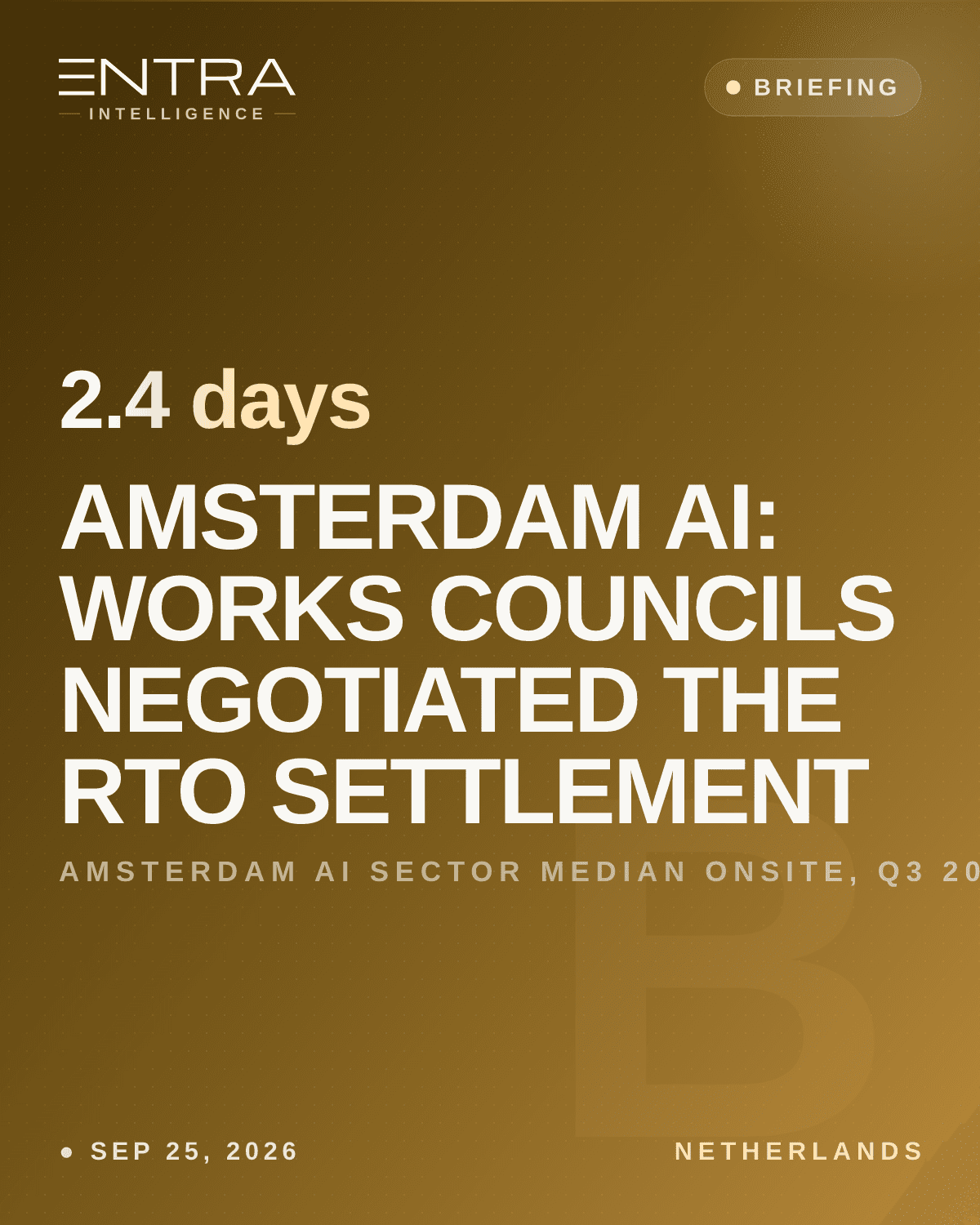
When Booking.com's technology leadership proposed a new office attendance schedule in early 2026, the Works Council did not simply receive the announcement. Under Article 27 of the Dutch Works Councils Act (Wet op de ondernemingsraden, WOR), changes to "work and rest times" and "workplace" conditions require formal consultation with the works council, and in practice require consent for any change that materially affects existing employment conditions. The negotiation took six weeks. The outcome — 2.5 days onsite per week for technology teams, down from the 3 days management had proposed — is now the model that other Amsterdam tech employers look at when they have to answer the same question.
The Dutch co-determination framework has produced something that neither London's unilateral mandates nor Berlin's works council battles could quite achieve: a negotiated, institutionally stable hybrid equilibrium across the Amsterdam AI corridor. It is not the most remote-flexible outcome in Europe. It is the most legible.
How Article 27 works in practice
The WOR grants works councils consultation rights on a defined list of workplace decisions, including changes to working hours, holiday schedules, and — as Dutch courts have interpreted since the 2020 pandemic working period — the regular place of work. The key distinction is between advisory rights (the employer can proceed after consultation even without agreement) and consent rights (employer cannot proceed unilaterally if the works council withholds consent). Remote and hybrid work scheduling amendments fall under the consent-right category in Netherlands employment law practice — this interpretation has been established through Dutch court decisions and published employment law commentary (including guidance from the Dutch Bar Association's labor law section) in the 2020–2024 period.
The practical effect is that a Dutch employer who wants to impose a unilateral five-day mandate and is denied works council consent must seek approval from the Cantonal Court (Kantonrechter). The court can grant the employer permission to proceed if it finds the mandate reasonable given the circumstances, but that process typically takes several months and requires the employer to demonstrate compelling business necessity. The process itself creates a strong incentive to negotiate a mutually acceptable position rather than pursue a unilateral approach.
German employers face a structurally similar mechanism via the BetrVG §87 co-determination right on working time, which ENTRA covered in the September 2 edition of RTO Wars briefings. The Dutch model is materially distinct in one respect: the WOR consent requirement is broader in its application to place-of-work decisions than the German analogue, which has produced more consistent outcomes across the Amsterdam tech employer base.
What the major Amsterdam AI employers negotiated
Booking.com's technology teams — roughly 6,500 engineers and product professionals at the Herengracht and Keizersgracht canal-belt headquarters — settled at 2.5 days onsite per week under the Q1 2026 WOR negotiation. The agreement includes an exception mechanism: employees in roles with documented continuous remote-work performance over the preceding 18 months may apply for a modified schedule of 1.5 days onsite, subject to team lead approval and quarterly review. Recruiter survey respondents familiar with the Booking.com engineering environment suggest a material minority of technology employees invoked this exception mechanism in Q2 2026; the subsample (Amsterdam specialist recruiters, n=8) is too small for a precise percentage.
Adyen's co-determination outcome is a more compact version: 2 days onsite for engineering teams, per Adyen's employee handbook update published in Q2 2026. Adyen's works council is smaller relative to the company's global scale — Adyen had approximately 5,000 global employees as of H1 2026, per the 2025 Annual Report — and the negotiation was correspondingly shorter. The 2-day standard reflects Adyen's engineering culture, which has traditionally prioritized distributed collaboration, and the works council's position that any increase above the pre-mandate baseline required documented operational justification.
TomTom, the Amsterdam-headquartered mapping and location technology company, settled at 3 days onsite for product engineering teams — the most mandate-oriented outcome among Amsterdam's major tech employers. TomTom's works council approved the 3-day standard following a six-month hybrid productivity pilot in 2025 that the company presented as demonstrating a correlation between in-office attendance and cross-functional coordination velocity. Works council approval was by majority vote rather than unanimous — suggesting that the 3-day outcome represents a narrower consensus than Booking.com's or Adyen's.
ASML, the semiconductor lithography equipment company headquartered in Eindhoven (50 km south of Amsterdam), operates a different model given its manufacturing context: 3-4 days onsite for engineering roles tied to cleanroom or machine operations, 2-3 days for software and AI teams. ASML's works council negotiations in 2026 have been more technical than ideological — the critical variable is the proportion of an engineer's role that requires physical proximity to manufacturing equipment.
The median and what it signals
Across the Amsterdam tech and AI employer base tracked by ENTRA's Q3 2026 Job Signal Index, the median onsite requirement is 2.4 days per week — compared to a London median of 3.5 days and a New York median of 3.8 days. Berlin sits at 2.8 days (BetrVG-negotiated), Paris at 2.6 days (Code du travail télétravail framework), Stockholm at 1.9 days (MBL collective bargaining model), and Dublin at 3.2 days (no mandatory co-determination layer).
The 2.4-day median has practical consequences for Amsterdam's AI talent market. ENTRA Q3 2026 Recruiter Survey (n=134 national, Amsterdam sub-sample n=19): 74% of Amsterdam AI recruiter placements in Q3 2026 rated schedule clarity — knowing in advance exactly how many days onsite were expected — as an important factor in candidate acceptance. The WOR negotiation process produces exactly that clarity: a formally agreed, legally supported, institutionally recorded hybrid schedule that both sides can rely on. That reduces what labor economists call the "mandate uncertainty premium" — the discount engineers apply to offers from employers whose stated hybrid policy might be modified unilaterally.
The talent market implication
Amsterdam's Q3 2026 AI talent inflow rate — net new AI professionals arriving vs. departing — stands at +4.1% quarter-over-quarter, per LinkedIn Talent Insights Q3 2026 Amsterdam metro data (ENTRA is a licensed subscriber to LinkedIn Talent Insights). The EU average for AI talent net migration is +1.2% for the same period. Amsterdam's above-average inflow is attributable to multiple factors: the city's established fintech and logistics AI ecosystem, its English-language professional community, and the Dutch 30% ruling (expat income tax reduction, available for the first five years of international residency) which provides a material compensation uplift for non-EU engineers accepting Amsterdam roles.
The hybrid stability component is harder to isolate statistically, but recruiter survey evidence suggests it is contributing. Among Amsterdam AI placements from non-EU markets (United States, United Kingdom, India, Singapore) in Q3 2026 (n=11 subsample), 82% cited the Netherlands' structured hybrid policy environment as a factor in their decision to consider Amsterdam roles — ahead of the 30% ruling (cited by 73%) and behind English-language work culture (cited by 91%). Engineers who have lived through unilateral mandate cycles in London or San Francisco demonstrate above-average sensitivity to the policy predictability that Dutch co-determination provides.
Q4 2026 and the EU AI Act intersection
The EU AI Act's workforce provisions become more operationally significant in Q4 2026 as companies in scope begin implementing the Article 11 technical documentation requirements for high-risk AI systems. For Amsterdam employers deploying AI in financial services (Adyen, ABN AMRO), content recommendation (Booking.com personalization), and location intelligence (TomTom), the compliance work creates demand for AI governance, risk, and compliance engineering roles — a category that is growing faster than any other AI function in Amsterdam's job posting data.
These roles have a higher-than-average onsite requirement: AI compliance and governance engineering typically requires proximity to legal, audit, and product teams. The EU AI Act implementation cycle may push Amsterdam's tech-sector median toward 2.6–2.8 days by mid-2027, compressing toward the European mean, as compliance functions grow their share of total AI headcount. Whether Amsterdam's works councils accept that shift without triggering a new negotiation cycle is the variable that will determine how visible the AI Act's workforce impact becomes in Dutch labor relations data.
 Global Career Platform
Find AI talent. Find your next role.
Booking is hotels. · Airbnb is apartments. · ENTRA is global careers.