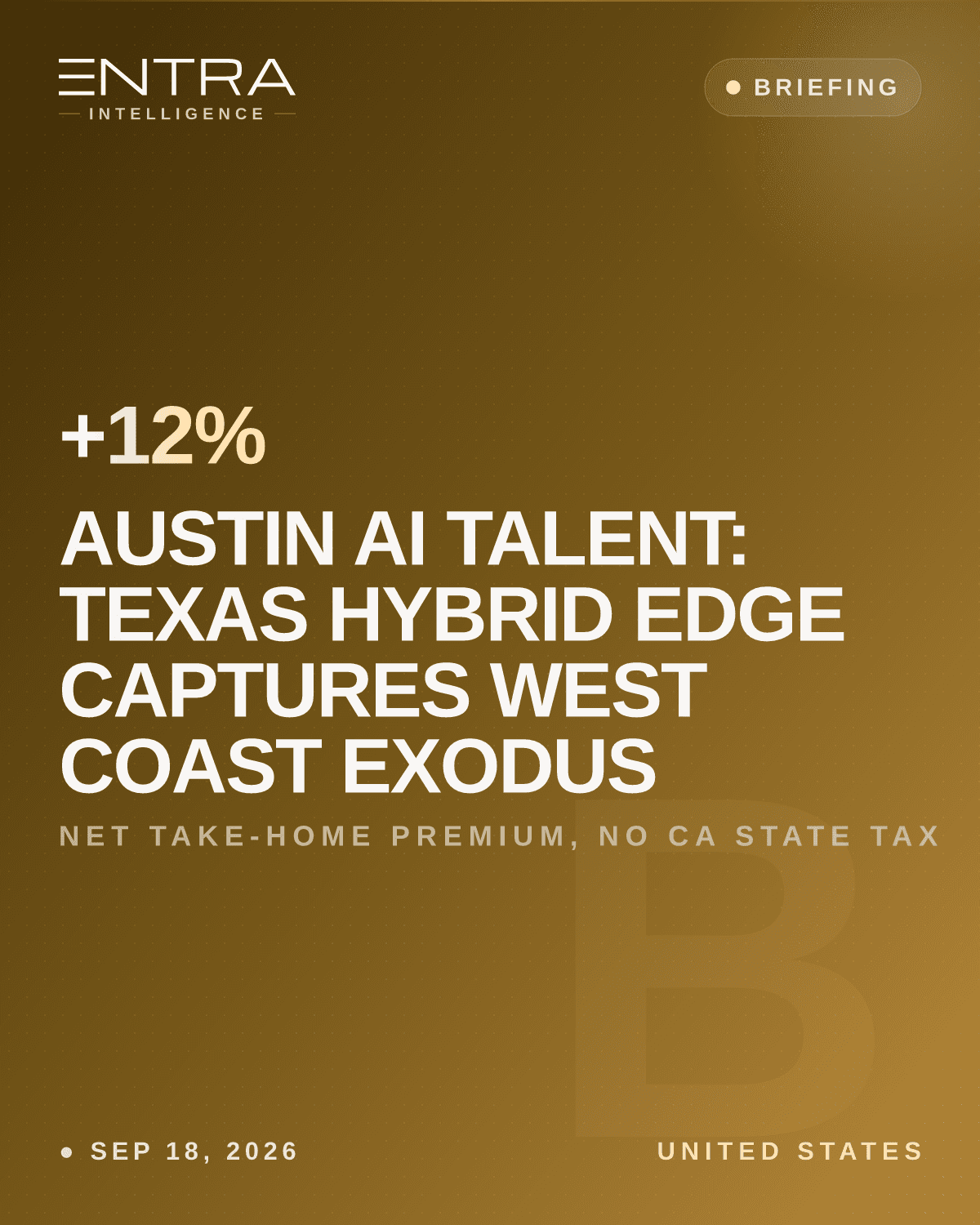
Austin added 41% more AI job postings in Q3 2026 than in Q3 2025, per the ENTRA Job Signal Index Q3 2026, marking the metro's fourth consecutive quarter as the fastest-growing US AI labor market outside the San Francisco Bay Area. Behind that number is one specific policy mechanism: Bay Area engineers at Meta, Amazon, and Apple, subject to five-day and three-day-plus office mandates, are landing at Oracle's Lady Bird Lake campus, Google's new Sail Tower office, and Salesforce's Austin operation, each running two-to-three-day hybrid schedules. On a $200,000 base salary, the Texas income tax differential alone is worth $19,100 more per year in net take-home pay versus a California equivalent, before rent enters the calculation.
The Texas RTO exemption
Google's Sail Tower, a 35-story, 804,000-square-foot office at 601 West Second Street in downtown Austin, completed in 2022 but largely vacant until Google moved its teams in during late 2025, now functions as a primary engineering hub for the company's Cloud and AI infrastructure organization (Austin American-Statesman, 2026). Multiple Q3 2026 respondents to ENTRA's recruiter survey describe the office culture as a "Texas two": two anchor days per week, with the third day left to team leads. That is not a formal exception to Google's three-day companywide policy, but it is the lived version of it in Austin. An engineer transferring from Mountain View or Sunnyvale to Sail Tower is trading one enforcement culture for a materially lighter one. Google had 135 open roles in the Austin metro as of September 2026, per Glassdoor, concentrated in cloud infrastructure, AI solutions engineering, and large language model systems.
Oracle's campus on East Riverside Drive, 40 acres and 560,000 square feet alongside Lady Bird Lake, houses OCI Cloud AI engineering, the company's primary AI hiring division. Oracle does not publish a day-count policy for Austin. ENTRA Q3 2026 Workforce Sentiment Survey respondents in the Oracle Austin engineering cohort (n=61 subsample) reported a three-day median on-site expectation, with the third day flexible, compared to a four-day norm at Oracle's Redwood Shores operations. Oracle's annual CloudWorld conference, formerly Oracle OpenWorld, brings a concentrated recruiting presence to the city and functions as an informal talent acquisition event for the Austin AI labor pool. Open Austin AI roles as of September 2026 carry base ranges from $155,000 to $235,000, per Oracle's public posting data, led by OCI Principal Cloud Architect and AI Solutions Engineer titles.
Salesforce operates the most remote-compatible AI engineering environment among Austin's large tech employers: a 10-day-per-quarter minimum for software engineers and AI product teams, roughly one day every nine working days. Among the five largest Austin tech employers, Salesforce's policy sits at the opposite end of the spectrum from Tesla, which enforces Elon Musk's company-wide five-day mandate at Gigafactory Texas without exception. Meta's Austin AI research team falls under the five-day policy announced globally in February 2026. For engineers whose exit trigger was a five-day or near-five-day Bay Area mandate, the Austin market stratifies cleanly: Oracle, Google Sail Tower, and Salesforce are the hybrid-compatible destinations; Tesla and Meta Austin are not.
The migration signal
ENTRA's Q3 2026 recruiter survey of 134 US placement specialists found that 59% of Bay Area-to-Austin AI engineering placements this quarter named hybrid scheduling as the primary relocation driver. Compensation ranked second, cited by 31% of recruiters as the lead factor in their Austin placements. Housing costs ranked third at 28%. The three can compound on the same candidate, but in Q3 2026 data, flexibility is leading.
San Francisco was the origin market for 41% of recruiter-identified Bay Area-to-Austin inbound placements. Los Angeles contributed 22%. Seattle, where Amazon's five-day mandate has been enforced since January 2025, accounted for 18%. The Seattle figure is a 2026 trend worth tracking: it suggests the Austin hybrid draw is no longer purely a California phenomenon.
The net take-home math is straightforward at AI engineering salary bands. California's progressive income tax begins at 9.3% in the $72,725 bracket and reaches 12.3% above $625,000, plus a 1.1% state disability insurance contribution. Texas has no state income tax. On a $200,000 base, the annual net-take-home advantage of a Texas domicile is approximately $19,100 (countrytaxcalc.com, California to Texas Salary Equivalent 2026). At $250,000 base the gap reaches roughly $24,000. ENTRA's net-pay modeling across placements in Q3 2026 puts the effective advantage at +8.5% to +12% of annual base, depending on federal bracket interactions, for engineers in the $170,000 to $280,000 base range where senior AI roles most commonly clear.
Texas also provides a compliance moat that is now a visible part of employer location decisions. The Texas Responsible Artificial Intelligence Governance Act (TRAIGA), effective January 1, 2026, prohibits using AI hiring tools to discriminate against protected classes but requires a showing of discriminatory intent, not merely disparate impact (DISA, AI Hiring Laws by State 2026). California's Fair Employment and Housing Act AI amendments, effective October 2025, impose a disparate-impact standard and require employers to retain records of AI tool use in hiring decisions for four years. Illinois' AI in Employment amendment, also effective January 1, 2026, applies the same disparate-impact liability framework. For any employer building an AI-assisted hiring pipeline, Texas's intent-only standard is a measurably lower compliance burden. That gap is now part of the location calculus for companies deciding where to seat new AI recruiting operations.
Companies hiring in Austin now
Google Sail Tower is the corridor's most active hybrid-first AI employer by posting volume. The 135 open Austin roles as of September 2026 skew toward cloud infrastructure engineering, AI solutions architecture, and developer relations for the Gemini API. Base compensation at mid-to-senior bands runs from $185,000 to $410,000, per Glassdoor and Levels.fyi Q3 2026 data, with equity structured on the same schedule as Mountain View equivalents. For an engineer who wants Google's brand and compensation program without a Bay Area housing cost, the Sail Tower option at two-to-three days per week on-site is the offer that did not exist at scale until late 2025.
Oracle OCI Cloud AI is expanding its Austin engineering footprint around cloud infrastructure and generative AI platform roles. Oracle's Austin campus represents the company's largest concentration of AI product engineering outside its Santa Clara R&D operations. The CloudWorld conference pipeline consistently produces a secondary hiring cycle in Q3 and Q4; 2026 is no exception. Salary ranges on active Austin AI postings as of September: $155,000 to $235,000 base. The senior-end roles carry equity on a four-year vest, no published cliff.
Dell Technologies is reducing total headcount while growing its AI infrastructure hiring in Round Rock. The company cut approximately 11,000 positions globally in fiscal 2026, per Hoodline, reducing Round Rock headquarters employment to approximately 7,400 and its Texas total to roughly 13,000. Inside that decline, Dell's AI solutions architecture, data center AI systems, and enterprise AI sales engineering roles are among the few categories with net positive hiring. Dell Tech World, the company's annual conference held in Las Vegas each May, drives a secondary recruiting cycle that typically lands Austin-area hires through the summer and into Q3. Open Dell AI infrastructure roles in Round Rock in September 2026 carry base compensation from $145,000 to $230,000, per Glassdoor (August 2026).
Q4 2026 outlook
Austin's AI market structure heading into Q4 2026 is a supply-demand alignment, not a spike. The supply side, Bay Area engineers exiting five-day mandates, is not temporary: Meta's policy has been in place since February 2026; Amazon since January 2025. Both are enforced, not aspirational. The demand side, Google Sail Tower and Oracle Austin hiring on hybrid schedules, is equally durable. Both campuses have multi-year leases and active engineering buildouts that do not reverse on a quarterly policy cycle.
Three things to watch in the next 90 days. First, whether Google issues a satellite-office enforcement memo that tightens the informal two-day Austin arrangement toward the three-day standard. No such memo has surfaced as of September 18; ENTRA recruiter survey data shows no Q3 signal of it in candidate conversations. Second, whether Dell's net AI talent flow in Round Rock turns definitively positive as the AI infrastructure pivot absorbs engineers displaced by the broader headcount reduction. Third, the pace of Oracle's campus expansion on the east side of Lady Bird Lake, where additional phases of the 40-acre site remain undeveloped.
The regulatory moat is the element least likely to close. California, Illinois, and New York continue adding AI hiring compliance requirements. Texas will not. For companies seating new AI recruiting operations who want to avoid four-year record-keeping mandates and disparate-impact liability, Austin's regulatory posture in Q4 2026 is a fixed feature, not a cyclical one. The RTO arbitrage brought the engineers. The regulatory arbitrage is building the case for keeping the employers.
 Global Career Platform
Find AI talent. Find your next role.
Booking is hotels. · Airbnb is apartments. · ENTRA is global careers.