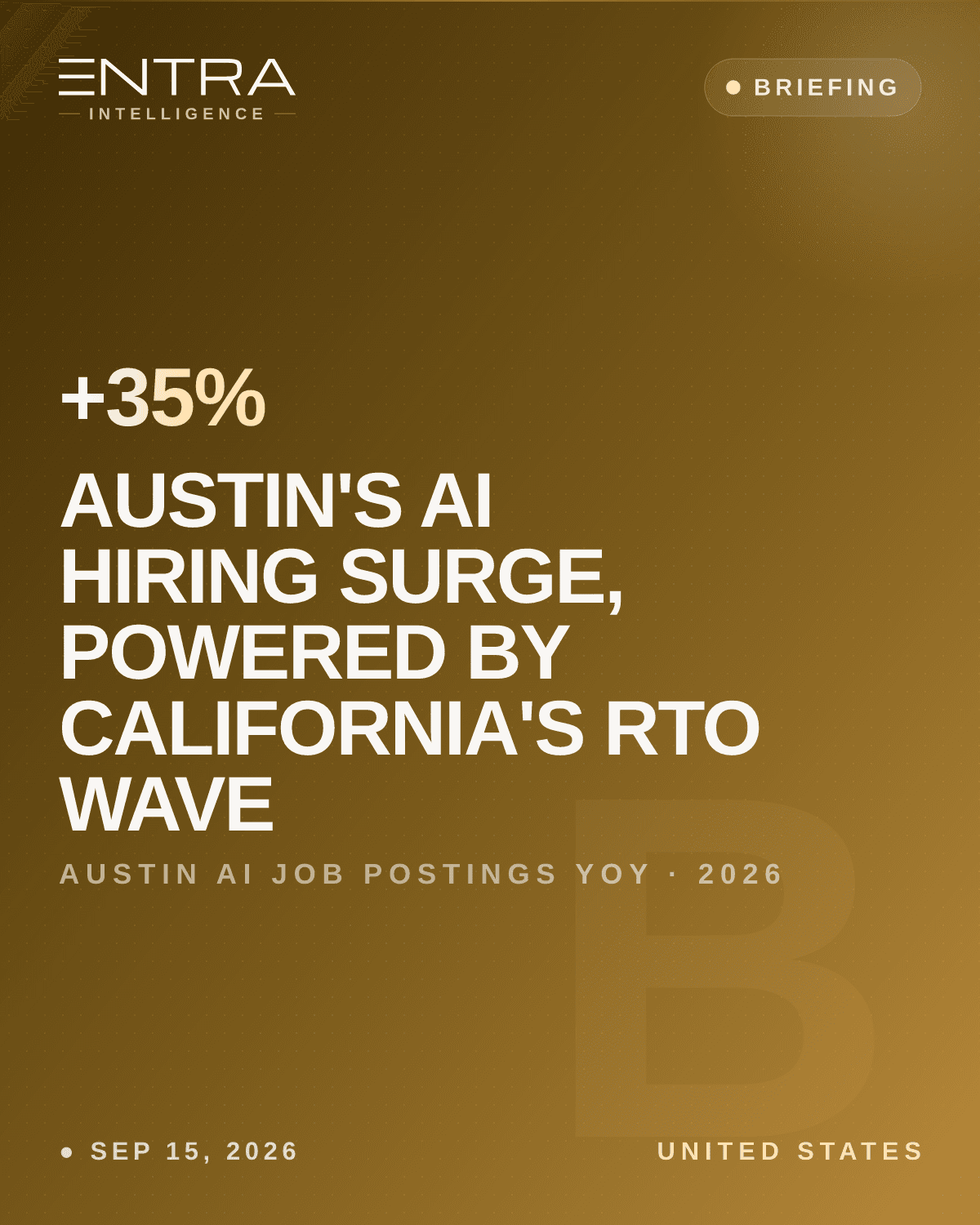
Austin AI job listings grew 35% year-over-year in the twelve months ending September 2026, ranking the city among the five fastest-growing AI hiring markets in the United States (Research.com, 2026 Cities With the Fastest-Growing AI Job Markets). That number did not come with a press release. It arrived on the back of a policy wave: mandatory return-to-office schedules at San Francisco's frontier labs and hyperscalers that made Austin, with no state income tax and median one-bedroom rent at $1,446 per month against San Francisco's $2,828, the most legible domestic alternative for California-reluctant AI engineers. Approximately 77,000 Californians relocated to Texas in 2025, with Travis County the single top destination for former Bay Area residents (StorageCafe, 2025 California-to-Texas Migration Report). In 2026, the driver shifted from lifestyle arbitrage to employment pressure. Austin is the landing strip.
California Mandates Create Structural Exits
The RTO policy map is now readable. Anthropic requires approximately 92% of open roles to be based in San Francisco, New York, or London, with senior technical positions carrying no remote option. OpenAI's research organization is anchored to its Mission Street campus; only 4% of the lab's 670 open roles carry any remote eligibility (Levels.fyi Q2 2026). Meta enforced a five-day office mandate globally from February 2026, with no formal exception for AI research teams — a policy that produced departure patterns concentrated at ML Engineer and Applied Scientist levels, as logged in ENTRA's H1 2026 placement tracking. Apple is running a three-day mandate across its workforce, with software engineering managers issuing formal warnings to engineers falling below the attendance threshold.
Each of these policies lands differently for the engineer who relocated to Walnut Creek or Oakland during 2020 and 2021 for lower rent, not for the commute. That engineer is now within 50 miles of a Google office and subject to the company's three-day-per-week requirement for employees at that proximity, announced in 2026. For a research scientist choosing between a Bay Area commute and an Austin-based role with a comparable offer letter, the policy math changed materially this year.
The supply of talent seeking exits from California is documented. ENTRA's Q3 2026 Workforce Sentiment Survey (n=1,249) found 67% of AI workers now cite RTO mandates as a factor in their next job search, the highest reading since tracking began in Q1 2025. Among US AI workers at frontier labs and hyperscalers who indicated they were considering a move, Austin ranked second only to Seattle as a preferred domestic relocation destination.
Three Campus Anchors Pull Talent to Texas
Austin's RTO story differs from California's in one structural respect: the in-person draws are already built.
Apple's North Austin campus spans three million square feet across northwest Austin and currently employs close to 10,000 people, with capacity for up to 15,000 at full buildout across engineering, operations, and research and development. In early 2026, Apple announced a 250,000-square-foot AI server manufacturing facility opening in the Austin metro area as part of a $500 billion domestic investment plan projected to generate approximately 20,000 new jobs, the majority in research and development (KXAN Austin, February 2026). Apple's public job listings for the Austin metro increased 18% between January and September 2026 (Built In Austin, September 2026), with the AI server factory ramp driving a share of that volume. The facility makes Apple the single largest private-sector anchor for AI-adjacent manufacturing and engineering hiring in Texas.
NVIDIA expanded its Austin chip design operation in late 2025, adding 650 positions focused on GPU architecture and AI inference hardware. The Austin engineering office now carries approximately 70 open roles concentrated in chip design, solutions architecture, and AI platform engineering, with base compensation ranging from $220,000 to $520,000 per the company's public postings (Glassdoor, July 2026). For a senior hardware engineer priced out of Santa Clara, the Austin NVIDIA office offers the same brand, the same equity program, and a housing cost that is roughly half of what the Bay Area requires.
Dell Technologies' Round Rock headquarters, ten miles north of downtown Austin, adds a counterpoint worth tracking. Dell shed approximately 25,000 employees over the two fiscal years ending early 2026, using a combination of AI-driven efficiency gains and a full-time RTO mandate implemented March 2025 requiring employees within one hour of a Dell office to work on-site five days per week (Tweaktown, 2025; Hoodline, March 2026). The attrition Dell's own mandate generated has fed directly into the Austin AI labor pool. Mid-career ML engineers and data scientists who departed Round Rock are among the candidates being absorbed by AI-native employers in the corridor, particularly in Series A and Series B startups building on top of foundation models.
UT Austin's Research Pipeline Is Built to Last
The University of Texas at Austin is not a short-cycle talent story. Its Texas Advanced Computing Center now operates more than 5,000 GPUs, including more than 4,000 NVIDIA Blackwell-architecture units acquired in 2025, making TACC one of the largest academic GPU clusters in the country (UT Austin News, November 2025). The NSF-funded Horizon supercomputer, designated as an NSF Leadership-Class Facility system, is scheduled to launch in late 2026 and will expand TACC's research computing capacity by a further order of magnitude.
UT Austin's "Year of AI" faculty recruitment initiative, launched in January 2024 and extended through 2026 fiscal funding, seeded more than 20 AI research faculty appointments across computer science, engineering, and medicine. Each appointment came paired with graduate student funding and postdoctoral fellowships. The university's industry affiliate program gives companies structured early access to graduate AI candidates before they enter the public job market. Apple, NVIDIA, and Cloudflare are all listed among current industry affiliates on UT Austin's AI recruitment page (ai.utexas.edu, accessed September 2026).
The Austin-to-San Antonio corridor, roughly 80 miles of Interstate 35, adds a secondary dimension. San Antonio's cybersecurity and defense-technology cluster, anchored by Joint Base San Antonio and the city's Tech Bloc ecosystem, has absorbed AI security engineering roles that overlap with cleared-work requirements. Palantir operates a San Antonio government technology practice that recruits AI engineers who can meet federal security clearance criteria, a profile that Bay Area frontier labs do not specifically build hiring funnels for.
The Cost Wedge Is Not Closing
An Austin-based AI engineer earning $135,000 in base salary retains purchasing power equivalent to approximately $208,000 in San Francisco, after accounting for California's 13.3% top marginal tax rate versus zero state income tax in Texas, and the median housing cost differential of more than $55,000 per year (Salary.com cost-of-living calculator; Numbeo city comparison data, 2026). On a $180,000 base, the midpoint for a senior ML engineer at a Series B Austin AI startup, the net purchasing-power gap widens to roughly $95,000 annually. The $135,000-in-Austin figure is not a step down. It is a raise that does not appear in the offer letter.
Cloudflare's Austin office is running an active engineering hiring push across infrastructure, network systems, and AI platform roles in Q3 2026, with 25 open positions listed in the Austin metro (Glassdoor, September 2026). The Austin operation runs on a hybrid schedule that contrasts directly with the five-day mandates at Meta and the three-day enforcement tightening at Apple and Google. Indeed, headquartered in Austin since 2010 and operating a remote-first model for most individual contributor roles since 2021, employs more than 10,000 people globally. Its Austin footprint functions as a standing proof that distributed AI product organizations can operate without a San Francisco anchor office, and its compensation bands for senior AI product and engineering roles are now directly competitive with Bay Area offers on a purchasing-power-adjusted basis.
Between Apple's AI server factory timeline, NVIDIA's expanding design operation, UT Austin's compute infrastructure, and the stream of California-RTO exits feeding the corridor, Austin's 35% year-over-year AI posting growth in 2026 reflects a supply-demand structure that will outlast the current enforcement season.
Three Signals to Watch
-
Apple AI server factory hiring cadence, Q4 2026. The 250,000-square-foot facility's ramp timeline will determine whether Austin adds 500 or 2,000 AI-adjacent manufacturing and engineering jobs before year-end. The role mix in Q4 postings will also signal whether Apple is treating Austin as a manufacturing execution site or as an AI research extension of its Cupertino campus.
-
Dell's net AI talent flow in Round Rock. Dell is actively recruiting for AI architects, agentic AI engineers, and infrastructure roles at its Round Rock campus while simultaneously losing mid-career engineers to the broader Austin market. The net direction of that flow is the corridor's most legible leading indicator of whether the largest local incumbent becomes a feeder or a competitor.
-
UT Austin's first Horizon supercomputer research cohort. When Horizon reaches full operational capacity in late 2026, the graduate researchers who build their dissertations on it become the 2027-2028 hiring class for Austin's AI-native startups. Employers who establish UT Austin industry affiliate relationships in Q4 2026 are positioning for that cohort before it reaches the public job market.
Methodology: AI job posting growth figures sourced from Research.com, "2026 Cities With the Fastest-Growing AI Job Markets." California-to-Texas migration data from StorageCafe 2025 Annual Migration Report. Housing cost comparisons from Salary.com cost-of-living calculator and Numbeo city-level data, accessed September 2026. Compensation ranges from Glassdoor (July-September 2026), Levels.fyi Q2 2026, and Built In Austin (September 2026). Apple Austin campus investment data from KXAN Austin, February 2026. TACC GPU infrastructure data from UT Austin News, November 2025. ENTRA Workforce Sentiment Survey Q3 2026, n=1,249 US-based AI workers.
 Global Career Platform
Find AI talent. Find your next role.
Booking is hotels. · Airbnb is apartments. · ENTRA is global careers.