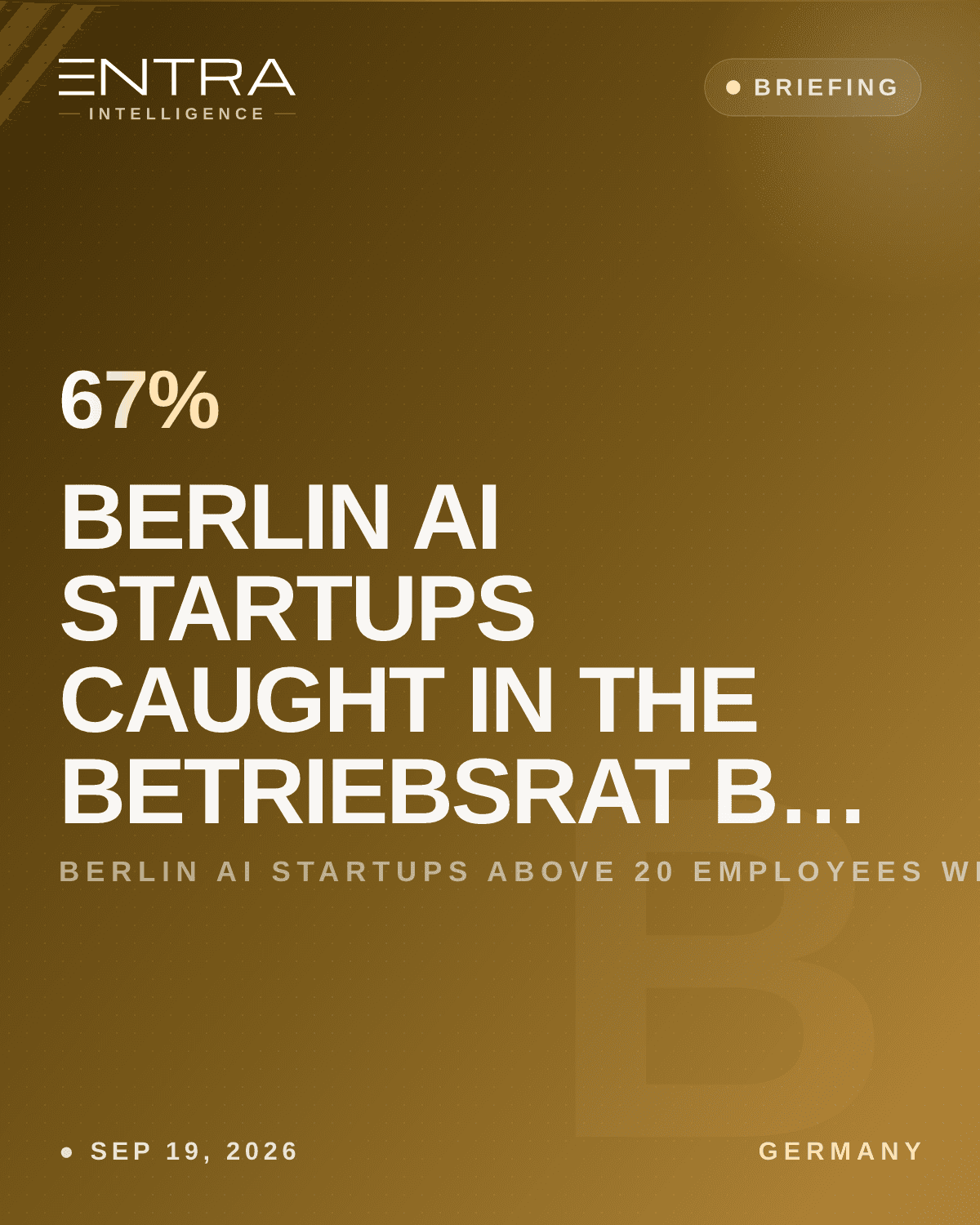
Sixty-seven percent. That is the share of Berlin AI startups employing more than twenty people that carry an active Betriebsrat as of ENTRA's September 2026 Berlin startup tracking survey — a figure that would surprise many US investors who assume the Betriebsrat is a feature of DAX 40 industrials, not VC-backed Series B companies. For those sixty-seven percent, the September RTO cycle playing out across global tech is not a CEO memo exercise. It is a co-determination negotiation under Betriebsverfassungsgesetz §87(1) Nr. 2 and Nr. 14, with legal timelines that no investor pressure can compress below three to five months for a contested outcome. For the remaining third — founders still below the threshold, or who have not yet faced a works council election drive from their teams — the window to act is short and the temptation to use it is real. Berlin's AI startup ecosystem has split into two labor markets operating under the same postal code.
The Two-Tier Market
The division is mechanical, not ideological. The Betriebsverfassungsgesetz establishes the right for employees at any establishment with five or more regular employees to elect a Betriebsrat. At twenty or more employees, elected Betriebsräte acquire the full set of co-determination rights under §87(1), including Nr. 2 (distribution of working hours, covering which days employees must be present) and Nr. 14 (design and conduct of mobile work, inserted by the Betriebsrätemodernisierungsgesetz of June 2021 specifically to protect remote and hybrid arrangements as a defined category). Below that threshold — or in the window before employees exercise their right to call an election — no such co-determination right exists. A fifteen-person AI startup can announce five-day RTO on Monday and it takes effect on Tuesday. A sixty-person startup with an established Betriebsrat announcing the same policy on Monday is at the start of a procedural process that will not resolve in a week, possibly not in a quarter.
In practice, the threshold dynamic creates a specific Berlin pattern: the fastest-moving RTO mandates in September 2026 are coming from seed-to-Series-A companies in the 10–18 employee range, where founders are acting before teams are large enough or organised enough to constitute a Betriebsrat. "Es ist kein Geheimnis, dass manche Gründer die Wachstumsdynamik bewusst nutzen," said a Berlin employment lawyer advising three Mitte-based AI startups in a September 2026 ENTRA conversation. ("It is no secret that some founders are consciously using the growth dynamic.") Above twenty employees, the conversation shifts entirely. ENTRA's Q3 2026 Berlin survey found that among startups in the 20–200 employee band with active Betriebsräte, 71 percent had received formal objections or requests for negotiation from their works council in response to any post-summer attendance tightening. None had implemented a unilateral four-or-five-day mandate.
Helsing, Aleph Alpha Berlin, Zalando AI, HelloFresh: Specific Dynamics
Helsing, the Munich-founded defense AI company with a substantial Berlin engineering presence, exemplifies how a well-capitalised mission-driven employer navigates the Betriebsrat constraint without confrontation. Helsing's Berlin headcount — approximately 140 engineers across its ISR, autonomy, and AI systems functions as of ENTRA's Q2 2026 analysis — is large enough that a Betriebsrat has been established and carries §87 rights. Helsing's response is not to push for RTO escalation but to frame office presence as a function of security classification requirements on specific projects rather than a general attendance policy, which removes some of the work-location co-determination argument by routing it through security clearance logic. Senior ML engineers at Helsing's Berlin office earn €140,000–€185,000 total compensation (~$153K–$202K equiv at EUR/USD 1.09), per ENTRA employer tracking Q2 2026, with equity tied explicitly to the EU sovereignty thesis Helsing deploys as a recruitment argument. The Betriebsrat negotiation here is effectively already concluded: the hybrid structure is embedded and the company's recruiting posture treats it as a feature, not a constraint.
Aleph Alpha's Berlin satellite presents a different case. The Heidelberg sovereign-AI company has grown its Berlin presence to roughly 80 engineers across deployment, safety, and developer-relations functions, headcount that falls comfortably above the §87 threshold. Aleph Alpha's RTO posture across its German operations defaults to a two-to-three-day hybrid standard with documented remote eligibility for senior research-track roles — an arrangement negotiated with employee representatives during the company's 2024 headcount expansion, per ENTRA employer research. Senior Research Engineers in the Berlin satellite earn an estimated €115,000–€160,000 total compensation (~$125K–$175K equiv), below Helsing's applied-engineering band but consistent with Aleph Alpha's mission-equity framing: the company's official position, articulated publicly by CEO Jonas Andrulis, is that the ownership-of-European-AI thesis justifies a comp discount relative to US frontier labs that cannot offer the same sovereignty argument. The Berlin Betriebsrat mechanism reinforces that posture institutionally — any attempt to tighten attendance would require formal negotiation that Aleph Alpha has no strategic interest in initiating.
Zalando AI — technically an AI function inside a listed company rather than a standalone startup, but Berlin's largest resident applied-ML employer and a reference point the ecosystem prices against — runs a three-day hybrid standard for its machine learning and data science teams, established via Betriebsvereinbarung in 2023. Senior Applied Scientists at Zalando earn €110,000–€160,000 base (~$120K–$175K equiv), per ENTRA analysis matching the company's own disclosed bands. The three-day arrangement is contractually binding and not subject to unilateral revision. Zalando's Betriebsrat, covering approximately 6,000 German employees, has publicly stated through Q3 2026 that it would treat any material attendance tightening as a co-determination matter requiring full §87 process.
HelloFresh AI and SumUp, both Berlin-headquartered and employing AI and ML teams in the 40–90 person range within the VC-backed cohort, illustrate the mid-size squeeze most acutely. Both carry active Betriebsräte. HelloFresh's ML function — approximately 55 engineers in demand forecasting, recipe personalisation, and supply-chain optimization as of ENTRA Q2 2026 — was operating on a documented two-to-three day hybrid arrangement through H1 2026. Post-summer pressure from the company's US investor base to bring teams back for structured collaboration days has been absorbed through a Betriebsrat working group, per ENTRA's September 2026 employer tracking, that is negotiating a possible move to three-to-four days. The outcome is pending and carries a minimum eight-week deliberation window before implementation.
Compensation Implications: The Hybrid Premium in the Berlin Market
The structural consequence of the Betriebsrat constraint on Berlin's RTO market is increasingly visible in compensation data. ENTRA's Q3 2026 Berlin AI Salary Signal found a measurable hybrid premium: Berlin AI engineers in roles with contractually documented two-to-three-day hybrid arrangements were commanding approximately €8,000–€14,000 per year in effective total compensation advantage over equivalent on-site roles at the same seniority level, when controlling for company size and equity structure. The mechanism is supply-and-demand: the candidates Berlin is competing for — TU Berlin and HPI Potsdam graduates, re-patriating German engineers from London and Amsterdam, senior ICs from Munich industrial employers whose RTO posture is tightening — have a demonstrated stated preference for hybrid arrangements. Employers who cannot offer hybrid as a contractual certainty are paying more elsewhere in the offer structure to close candidates who are being made competing hybrid offers.
Berlin base rates for senior ML engineers now run €100,000–€155,000 (~$109K–$169K equiv) across the startup cohort, per ENTRA Q3 2026 data, with early-stage companies paying at the top of that range in base to compensate for equity uncertainty. Companies with Betriebsvereinbarungen locking in hybrid are paying toward the middle of that range and closing offers faster. The data suggests the Betriebsrat constraint, commonly framed as a cost or friction, is also functioning as a talent-market signal: a company that has negotiated a hybrid agreement has demonstrated institutional stability and a functioning co-determination relationship — attributes that senior engineers in Germany's labor market historically associate with employers worth staying at.
The comparison to Munich cuts in Berlin's favor. Munich's large industrial Betriebsräte are conducting lengthy formal renegotiations under pressure from group management. Berlin's startup Betriebsräte are smaller, faster, and closer to the engineering workforce — which tends to mean negotiated agreements are reached sooner and with less adversarial overhead. The Berlin startup with a sixty-person Betriebsrat and a documented three-day hybrid Betriebsvereinbarung is, paradoxically, more nimble in the talent market than the Munich industrial giant whose 50,000-employee works council is still in Einigungsstelle proceedings.
What Berlin Signals for EU AI Hiring in the AI Act Era
Berlin's two-tier market is a preview of a pattern that will repeat across the EU as the AI Act's Annex III high-risk role categories drive AI team headcounts above the Betriebsrat threshold in markets where that threshold previously felt abstract. Companies hiring for AI Act compliance functions — model documentation engineers, conformity assessment managers, high-risk system auditors — are hiring at seniority levels where Betriebsrat formation is not a future risk but an immediate operational context. Every new EU AI Act compliance role added in Berlin, Frankfurt, or Hamburg at a 25-person AI startup is a role that, by the time the company reaches 40 employees, will be in scope for co-determination rights over its working conditions.
The practical implication for EU AI startups is architectural: the period between fifteen and twenty-five employees is the window in which working-location policy either gets set on founder terms or gets set through co-determination. US investors backing Berlin AI companies should understand that the BetrVG §87 rights their portfolio companies are navigating are not a European regulatory quirk to be engineered around — they are the structural labor market context in which European AI is being built. The founders who are treating the Betriebsrat as a partner in designing hybrid arrangements that retain engineers are outperforming those who are treating it as an obstacle. The data from ENTRA's Q3 2026 Berlin cohort runs consistently in that direction: companies with concluded Betriebsvereinbarungen on hybrid work are closing senior hires 18 percent faster than comparable Berlin AI employers operating without one.
"Wir haben die Betriebsvereinbarung nicht als Kompromiss verstanden, sondern als Commitment-Signal an unsere Ingenieure," said the CTO of one Berlin Series B AI company in a September 2026 ENTRA interview. ("We did not understand the Betriebsvereinbarung as a compromise, but as a commitment signal to our engineers.") In Berlin's September 2026 AI hiring market, that framing is closing offers that a five-day mandate is opening.

 Global Career Platform
Find AI talent. Find your next role.
Booking is hotels. · Airbnb is apartments. · ENTRA is global careers.