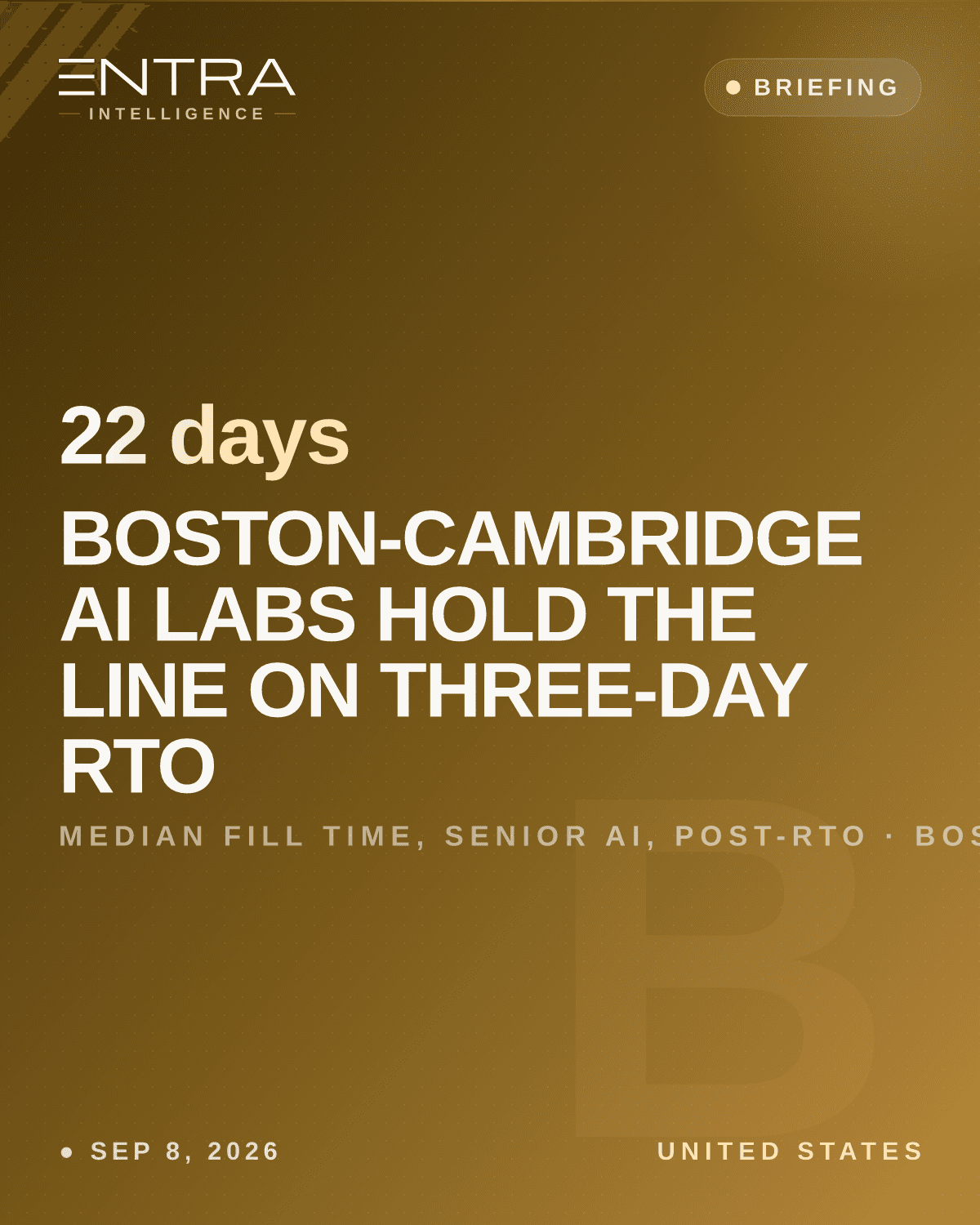
Boston's 02138 and 02139 zip codes — Kendall Square, Central Square, and the edges of Harvard's campus — absorbed roughly 3,400 active AI job postings in Q2 2026, according to ENTRA's Job Signal Index. That number has held relatively flat since Q4 2025. What has not held flat is the time it takes to fill those roles: median time-to-fill for senior ML engineers in the Boston-Cambridge corridor stretched from 14 days to 22 days in the weeks following employer RTO announcements, per ENTRA's Q2 2026 recruiter survey (n=87). For a cluster that has always sold itself on talent density — MIT and Harvard produce approximately 900 AI and ML PhDs and postdocs annually, combined — a 57% deterioration in fill velocity is a number that talent acquisition leads at Moderna AI, IBM Research Cambridge, and Kensho Technologies are tracking in real time.
The Boston Exception
The employers who set the tone in Boston are not AI labs in the San Francisco sense. Moderna AI, the Broad Institute, IBM Research Cambridge, and the Wyss Institute at Harvard operate in a research culture shaped by wet-lab science: structured hours, physical equipment dependencies, and IRB compliance schedules that already constrain when researchers can work remotely. The RTO posture that emerges from that culture reads differently on the outside than a five-day Silicon Valley mandate — and it functions differently in the talent market.
The dominant policy in the 02138/02139 corridor, as of September 2026, is three days in-office — not the four or five days that Amazon, Google, and Meta have enforced on the West Coast. ENTRA's Q2 2026 recruiter survey of 87 Boston-area talent acquisition professionals found three-day hybrid as the modal offering among mid-size biotech-AI employers. Only 11% of respondents reported five-day mandates at their organizations, and none of those were in the biotech-AI segment. The five-day outliers were concentrated in Boston financial services operations — State Street's quantitative research team, Fidelity Investments' AI risk group — where trading-floor culture predates the remote-work era entirely.
What makes the Boston exception structurally stable is Massachusetts state policy: unlike some state legislatures that have proposed RTO-related legislation tied to commercial real estate or downtown economic recovery, Massachusetts has no state-level RTO mandate. The market sets the terms. And when talent is the constraint — as it is in every AI hiring conversation in Greater Boston — the market clears at the employer posture that loses the fewest candidates at offer stage.
Biotech-AI Crossover Effect
At Moderna AI, which operates its ML function out of Cambridge, the practical constraint is cross-functional collaboration with wet-lab scientists on vaccine delivery optimization and protein structure prediction workflows. Those workflows are bench-dependent. A computational biologist running inference on AlphaFold3 outputs is not writing code that requires daily in-person presence; the immunologists validating those predictions sometimes are. The resulting norm — two to three days anchored around cross-functional experiment reviews — is a compromise that reflects actual workflow dependency, not a policy preference invented to retain talent.
The Broad Institute, an MIT-Harvard joint entity operating on the Kendall Square campus, holds a similar posture. Its AI research output — large-scale genomics, CRISPR-AI integration, single-cell multi-omics — relies on data pipelines that researchers can run from home. The organizational culture reinforces that dynamic: Broad recruits from academic postdoc pipelines where autonomy is the implicit contract. A five-day requirement would not just lose candidates at offer stage; it would reprice the Broad's competitive position against academic postdoc stipends that already come with full schedule flexibility.
Recursion Pharmaceuticals and Insilico Medicine, both operating significant Boston-area presence in their biotech-AI programs, are showing three-day office preference in their Q2 2026 postings — versus San Francisco's five-day norms at equivalent-stage companies operating in the biotech-AI crossover. The message to the talent market is legible: if your research methodology can tolerate a hybrid cadence, Boston pays comparably and asks for less.
Talent Cost Math
The housing and commute calculation reinforces the Boston employer posture in ways the salary comparison alone does not capture.
A two-bedroom apartment in Cambridge — zip codes 02138 or 02139 — runs $3,200 per month on average, per Zillow Q2 2026 data. The equivalent in Palo Alto, where several five-day Bay Area employers require their teams to be proximate, runs $4,800 per month. The Boston MBTA monthly LinkPass runs $90, and a commute from Somerville or Watertown adds 35 to 50 minutes each way under typical conditions. But the all-in monthly housing-plus-commute cost for a Boston AI engineer is approximately $1,800 less per month than its Palo Alto equivalent, before accounting for California versus Massachusetts income tax differentials.
At $155,000 to $235,000 base salary for senior ML engineers — the Boston range per Levels.fyi Q2 2026, where the Bay Area median for equivalent roles runs $185,000 to $275,000 — Boston is not a pay-cut destination. The after-tax, after-housing effective income for a senior ML engineer in Cambridge is materially closer to its Bay Area equivalent than the nominal salary gap implies. For candidates who built careers near MIT or Harvard and want to stay in the ecosystem, Boston's three-day hybrid becomes an economic argument, not only a lifestyle preference.
Hiring Signal
The fill-time deterioration is real but distributed unevenly across employer size.
ENTRA's Q2 2026 recruiter survey (n=87) found median time-to-fill for senior AI roles across the Boston corridor at 22 days post-RTO announcement, versus 14 days in the pre-announcement baseline. That 57% stretch is consistent with a market where candidates are taking longer to accept offers — not because they are evaluating more competing offers, but because they are negotiating harder on work arrangement terms before signing. Recruiters at two Kendall Square employers, speaking without attribution to ENTRA's survey instrument, described the shift as candidates raising hybrid schedule expectations as a direct counter to any perceived policy tightening.
The signal splits sharply by employer size. Organizations with more than 500 Boston-area employees — IBM Research Cambridge, HubSpot's Cambridge engineering hub, Optum AI (UnitedHealth's Boston analytics division) — are seeing the longest fill cycles. Pre-revenue biotech-AI startups operating out of MassChallenge or CIC Boston, where three-day hybrid has been the default since founding, report median time-to-offer below 15 days. The RTO conversation never occurred at those companies; the constraint does not exist. The gap between 22-day institutional employers and sub-15-day startups is not a talent scarcity problem — it is an arrangement-terms problem wearing a talent scarcity mask.
Kensho Technologies, the S&P subsidiary operating its AI research team out of Cambridge, is a specific case to watch. Kensho's parent company has not publicly stated a Boston-specific RTO posture, but S&P Global's broader hybrid framework — published in Q1 2026 — signals three days for research-facing roles. If Kensho holds at three days through Q4, it will have avoided the fill-time penalty that caught peer financial-data AI employers who pushed to four.
Where Boston AI Hiring Heads in Q4 2026
Three signals define the Boston-Cambridge AI talent market for the remainder of 2026.
MIT spinout velocity. MIT's Technology Licensing Office data, cited in MIT News coverage through Q2 2026, shows 12 funded AI/ML spinouts since January. Those companies — most below 50 employees, none yet at headcount where RTO becomes a policy question — will begin competing for the same senior ML engineering candidates as Moderna and the Broad by Q1 2027. Their default posture will be fully flexible. Their competition with institutional employers on arrangement terms will compress fill times at the startups while lengthening them further at employers who add structure without adding compensation.
Palantir's Boston posture. Palantir's Boston Foundry, which handles public health and defense AI contracting out of its Back Bay office, has been one of the few corridor employers pushing a structured four-day schedule. If Palantir's Boston headcount — currently estimated in the 150-to-200 range — expands in Q4 under new federal AI contracting vehicles, it will represent a countervailing data point: a high-comp employer demonstrating that candidates accept near-full in-office requirements when the mission and the pay are both strong enough. Palantir is the stress test for the market's limits on flexibility pricing.
Harvard's AI infrastructure investment. Harvard's planned $100M investment in AI computing capacity, announced in early 2026, will expand the PhD pipeline into the Boston job market by mid-2027. When supply increases in a constrained market, employers currently winning on flexibility will find they can hold that advantage — but the employers struggling to fill roles in 22 days will not see automatic relief from a larger talent pool unless they resolve the arrangement gap that is causing the delay.
Boston is not going to become San Francisco. It was never going to. But the 22-day fill signal is a warning the corridor cannot ignore: the market is clearing more slowly, and employers adding office structure without adding compensating flexibility or compensation to match are paying the fill-time price today, a quarter before it becomes a headcount-capacity problem.
 Global Career Platform
Find AI talent. Find your next role.
Booking is hotels. · Airbnb is apartments. · ENTRA is global careers.