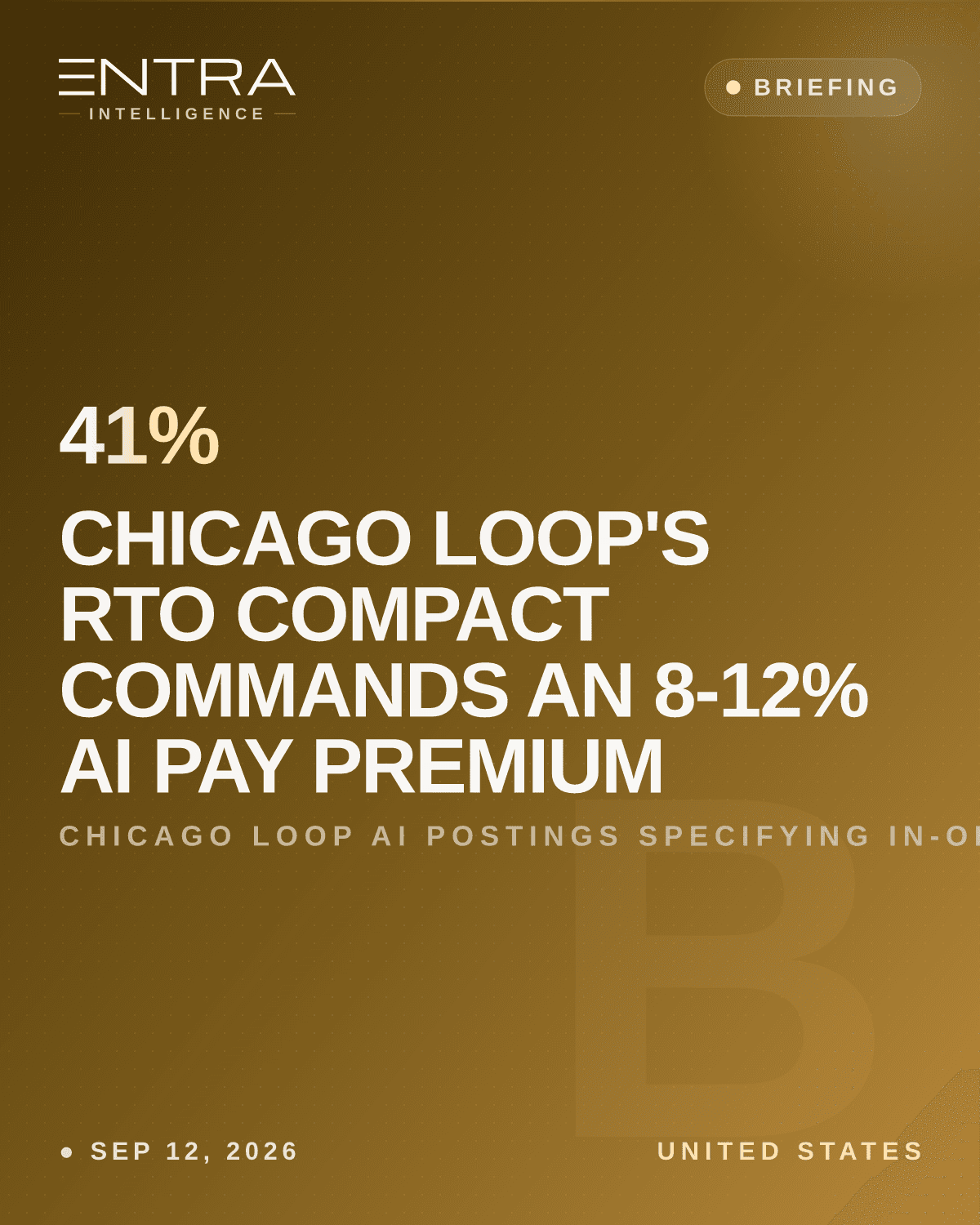
Forty-one percent of Chicago AI job postings now specify in-office attendance — up from 28% in 2025, a 13-percentage-point shift driven in part by an informal coordination effort among Loop employers to synchronize their September return dates around the week of September 8. JPMorgan Chicago, Accenture, Google Chicago, and Salesforce Tower are each enforcing four-to-five-day mandates as of this week. Eight miles northwest, AI companies clustered in the Fulton Market District are running the opposite playbook. The distance between those two labor markets is now measurable in dollars: Loop in-office AI roles command an 8-12% base salary premium over fully remote equivalents for comparable seniority, per ENTRA Job Signal Index Q2-Q3 2026.
The Loop Compact: What Happened on September 8
The "Chicago compact" is not a formal agreement. No document was signed, no joint announcement was issued. What it amounts to, based on public statements and reporting by Crain's Chicago Business and the Chicago Tribune, is that several of the Loop's largest employers aligned on a shared September return calendar — a soft coordination that reduces the competitive disadvantage any single employer would face by pulling employees back to the office first.
JPMorgan's Chicago operations hub at 10 S. Dearborn moved its workforce to a five-day-per-week requirement consistent with CEO Jamie Dimon's company-wide mandate, formalized in early 2025. As of September 2026, Chicago-based JPMorgan AI engineers — primarily in the firm's AI Research Lab and its Payments AI division — operate on full five-day schedules. The Chicago office employs approximately 5,200 people, placing JPMorgan among the Loop's top-five private employers by headcount. Dimon told analysts on JPMorgan's Q2 2026 earnings call that the bank's AI division had grown to "more than 2,000 data scientists and ML engineers globally," with Chicago serving as the second-largest engineering node after New York.
Accenture, whose North American headquarters occupies 500 W. Madison, operates a role-tiered system: client-facing and delivery staff on-site four to five days per week; technology and AI engineering staff at a minimum of three days, with many teams internally aligning to four. Accenture posted 47 AI-related roles in Chicago between June and August 2026, per ENTRA Job Signal Index Q2-Q3 2026 data. Of those 47, 38 — 81% — specified hybrid or on-site requirements with a three-day-or-more floor.
Google's Chicago engineering office at 320 N. Morgan in the West Loop shifted from flexible hybrid to a structured three-plus-days requirement in Q1 2026, consistent with Google's company-wide policy change. The office primarily houses infrastructure and ads engineering; it also includes members of Google DeepMind's Applied team working on enterprise Gemini integrations. Those roles carry the same three-day floor. Google has not published Chicago-specific headcount, but ENTRA Job Signal Index Q2-Q3 2026 tracking of Google's career portal identified 29 Chicago-area AI and ML postings over the same June-August window, all listing on-site or hybrid with three-day minimums.
Salesforce's footprint at 333 W. Wacker — the 57-story tower that bears the company's name — represents its second-largest US office after San Francisco. Salesforce's tiered Chicago policy mirrors its national structure: sales and customer success staff at four-plus days on-site; software engineers and AI product teams at 10 days per quarter. The company's Chicago Einstein AI team is subject to the engineering standard. In practice that is remote-first with quarterly on-site weeks. Among the four largest Loop tech employers, Salesforce AI engineering remains the most flexible by a measurable margin.
The result is a spectrum that runs from five days on-site (JPMorgan) to ten days per quarter (Salesforce AI engineering), with Accenture and Google occupying the middle band at three to four days. That spectrum is what the ENTRA Job Signal Index is reading when it reports 41% of Chicago AI postings now specify in-office: the number captures Loop financial-services and consulting mandates at one end and Google's three-day hybrid at the other. It does not capture Salesforce's AI engineering exception. If it did, the headline figure would be lower.
The Pay Premium and the Fulton Market Counter-Move
The 8-12% salary premium attached to Loop in-office AI roles is the most legible expression of how employers are pricing return-to-office friction. ENTRA Job Signal Index Q2-Q3 2026 data, drawn from 1,847 Chicago-area AI postings tracked between April and August 2026, shows that roles specifying four-plus days on-site at Loop employers averaged $198,000 in base salary for senior AI engineer equivalents. Fully remote Chicago-listed roles at comparable seniority averaged $178,000. The delta is $20,000 — approximately 11% of base — sitting squarely in the 8-12% range.
That premium is not Chicago-specific. The same pattern appears in New York, where Goldman Sachs and Citi carry in-office premiums of 9-14% over remote-equivalent roles per ENTRA Q3 2026 Salary Survey data, and in Boston, where Fidelity and State Street show a 7-10% in-office differential. What makes Chicago notable is the coordinated timing. The simultaneous September 8 return across multiple large employers compresses the market signal into a single week, making the premium visible in the posting data in near-real-time rather than as a lagged quarterly average.
Fulton Market is exploiting exactly that visibility. The district's fastest-growing AI employers — project44, Morningstar's AI research division, Uptake, and Relativity's data-operations team — are operating on remote-first or flexible hybrid schedules that the Loop has structurally moved away from. Project44, the supply-chain visibility platform, lists its ML engineering roles as fully remote as of Q3 2026. Morningstar AI, which launched a standalone research lab in Q1 2026 focused on financial AI models, has no in-office requirement for its ML scientist openings.
Two Chicago-based AI recruiting operators, granted anonymity because they work with clients on both sides of this market, described a measurable shift in candidate interest toward Fulton Market employers since the Loop's September return coordination became public. One placed inbound inquiry volume at Morningstar AI's ML team at approximately 2.5x the Q1 2026 baseline in the three weeks following the compact's effective date. The other said senior AI candidates who had been "warm on JPMorgan roles" were asking to have their profiles surfaced to Fulton Market employers instead.
The recruiting edge shows up in posted role counts, too. Morningstar AI posted 11 AI and ML roles in August 2026, up from four in February — a near-tripling in six months, per ENTRA Job Signal Index Q2-Q3 2026 tracking. Project44 posted nine ML engineering roles in Q3 2026, double its Q1 count. Neither company requires candidates to relocate to Chicago or commit to any minimum on-site days for engineering roles.
What to Watch in Q4 2026
Three fault lines will define whether Chicago's RTO compact holds or begins to crack.
The Northern Trust and Baird question. Two of the Loop's largest financial services employers have not yet published Q4 attendance requirements. Northern Trust, headquartered at 50 S. LaSalle and employing approximately 8,000 people in Chicago, has operated on a flexible hybrid model since 2022. If it announces a four-plus-day mandate consistent with JPMorgan, the in-office share of Chicago AI postings could approach 50% by year-end. If it holds at hybrid, it becomes the default alternative for Loop-area AI talent weighing return requirements.
Whether the pay premium keeps pace with attrition risk. The current 8-12% in-office premium reflects a market that has not yet fully priced its own attrition signal. The Q3 2026 Morningstar AI inbound data point is early and unverified at scale, but the direction is consistent with national patterns: when coordinated RTO pressure becomes visible, candidate interest flows toward the exits. If Loop employers begin losing senior AI engineers to Fulton Market companies at measurable rates, the premium will need to rise further to function as a retention mechanism rather than a recruitment cost.
Salesforce's next policy decision. Salesforce's 10-days-per-quarter AI engineering standard is the key swing variable in this market. CEO Marc Benioff has said publicly, in multiple contexts, that he prefers in-person culture at scale. If Salesforce reverts to a stricter requirement for its Chicago AI team in Q1 2027 — or aligns Chicago engineers to the four-plus-day standard applied to its sales staff — it would pull the highest-volume AI-role poster among the Loop's tech employers toward the JPMorgan end of the spectrum. That shift would structurally move Chicago from a split market to a predominantly in-office one, with material consequences for the city's ability to attract remote-eligible AI talent from outside Illinois.
Chicago's September compact is a market signal, not a mandate. What it tells the broader US AI hiring market is that coordinated RTO pressure can move the compensation floor — but it cannot yet close the flexibility gap that Fulton Market's startups are using to recruit against it.
 Global Career Platform
Find AI talent. Find your next role.
Booking is hotels. · Airbnb is apartments. · ENTRA is global careers.