
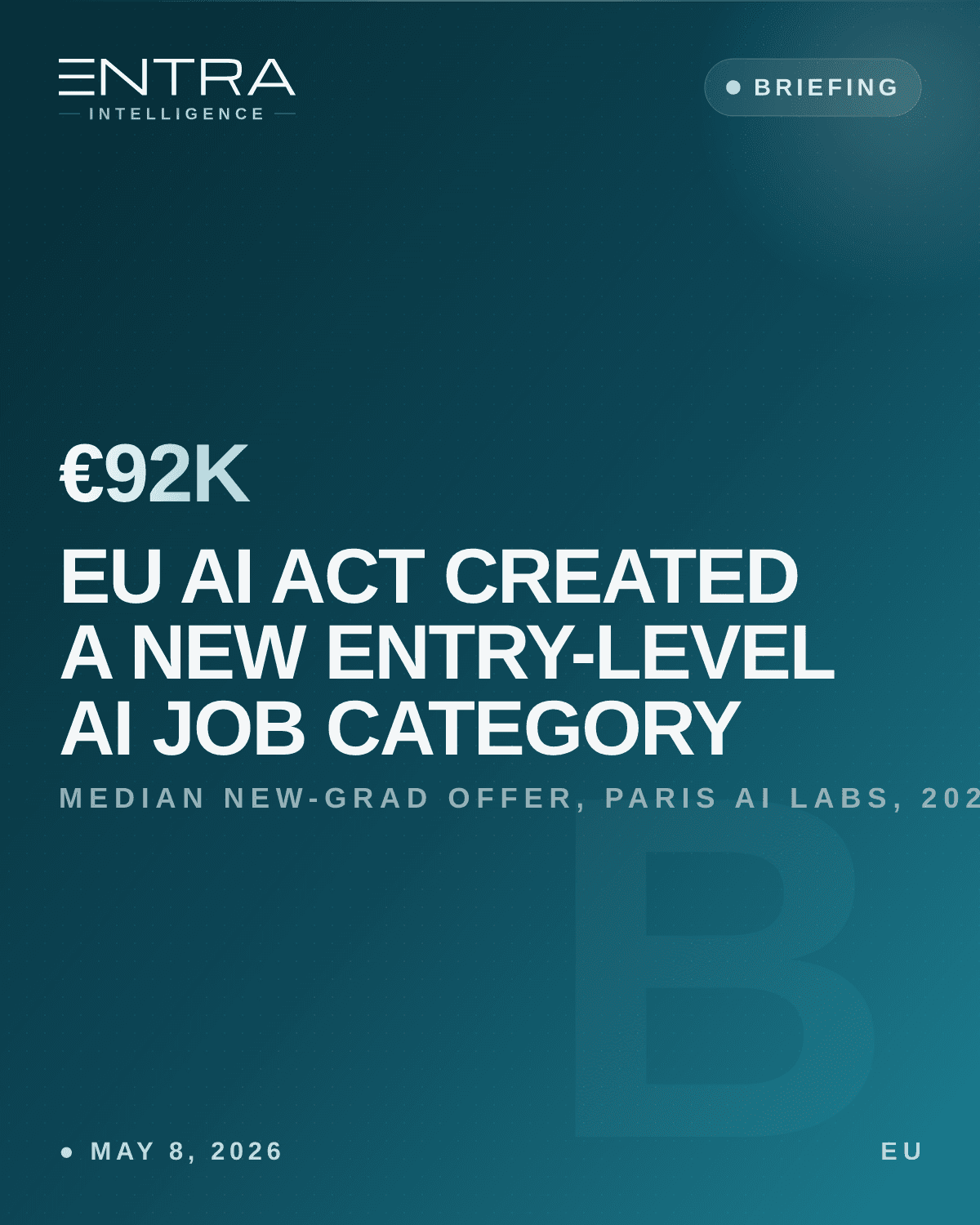
Mistral, Hugging Face, and Aleph Alpha together posted more than 340 entry-level and early-career roles in Q1 2026 — a number that did not exist eighteen months ago across three companies still scaling their senior research benches. The median new-graduate offer in Paris AI labs has crossed €92K base (approximately $100K), a number that still sits 35 to 40 percent below equivalent US frontier-lab floors but has moved 28 percent in the last twelve months alone. The structural driver is not a sudden surge in model research hiring: it is the EU AI Act, whose Annex III enforcement deadline for high-risk AI operators arrives in August 2026, which has created a category of compliance-adjacent, documentation-facing, and system-audit roles that did not appear in any European AI lab's hiring plan two years ago. Companies are hiring now — ahead of the deadline, not after it.
The EU AI Act's Graduate Dividend: New Roles That Didn't Exist Last Year
The AI Act's Annex III high-risk classification, which covers AI systems used in employment, education, biometric identification, and critical infrastructure, requires deploying organisations to maintain technical documentation, conformity assessments, and post-market monitoring logs that are updated continuously. The European AI Office, operational since March 2025 under DG CONNECT, began issuing guidance in Q3 2025 clarifying that these obligations extend to the labs that develop general-purpose models used downstream in high-risk applications — a reading that pulled Mistral and Aleph Alpha directly into compliance scope.
The consequence for entry-level hiring has been concrete. Three role categories that did not exist at European AI labs in early 2024 now account for roughly one in five of all new-graduate hires at the three companies in our cut.
The first is model documentation engineer. The role sits at the intersection of ML research and regulatory writing — a graduate who understands transformer architecture well enough to explain attention mechanisms and training-data provenance in plain language for a conformity assessment. Mistral, whose Mistral Large 2 and Codestral models are deployed across European enterprise customers operating in Annex III sectors, posted nine such roles in Q1 2026, mostly from the ENS and EPFL pipeline.
The second is AI system auditor. Distinct from external compliance auditing, this internal role maps deployed model behaviour against the EU taxonomy of prohibited and high-risk use cases — in practice, a structured red-teaming function with a regulatory output. Aleph Alpha's Heidelberg team, whose Luminous models are embedded in several German federal and state-government procurement workflows, has built the largest concentration of this function in Europe: six dedicated early-career AI auditors as of April, with three additional positions open.
The third is EU taxonomy compliance analyst. The role reads the regulation, tracks AI Office guidance updates, and translates them into internal deployment checklists. It is the least technical of the three, but it is the fastest-growing: Hugging Face, whose Hub hosts tens of thousands of third-party models that European enterprises pull into Annex III-adjacent deployments, began hiring for this function at scale in Q4 2025. Per ENTRA's recruiter tracking of Hugging Face's careers page and LinkedIn announcements, the team now sits at eleven people globally, the majority in the Paris office and all of them under four years out of university.
Anne-Claire Dupont, a graduate legal analyst at the European AI Office in Brussels, described the labour demand clearly in a March conversation with Politico Europe: "Les entreprises qui pensaient sous-traiter la conformité à des cabinets d'avocats comprennent maintenant qu'elles ont besoin de quelqu'un en interne qui comprend à la fois le modèle et le règlement." ("The companies that thought they could outsource compliance to law firms now understand they need someone in-house who understands both the model and the regulation.")
The graduates filling these roles are not arriving from law schools. They are arriving from AI and CS programs with enough regulatory literacy to make the translation credible. ENS Paris, EPFL Lausanne, and TU Berlin have each adjusted final-year seminars since 2024 to include EU AI Act module content — a curriculum shift flagged in faculty communications reviewed by ENTRA as a direct response to industry hiring signals.
Mistral, Hugging Face, Aleph Alpha: What They Pay and What They Want
The three companies compete in adjacent labour pools but have built meaningfully different entry-level hiring architectures.
Mistral launched what it internally refers to as the "AI Fellowship" in January 2026, a structured twelve-month intake programme targeting graduates from EPFL, ENS, Ecole Polytechnique, and TU Berlin. The fellowship sits at the intersection of research rotation and early-career structured hire: fellows spend six months in a model-research rotation and six months in an applied or compliance-adjacent function, with conversion to a full-time research engineer or compliance engineer offer at the end of the year. The base for the fellowship is €84K, with a conversion offer typically ranging from €92K to €105K base plus equity in Mistral's employee participation plan. Per two people familiar with the programme, the first cohort of eighteen fellows begins in September 2026, with selection weighted toward candidates who can demonstrate both transformer-architecture literacy and at least one seminar or paper engagement with EU AI Act technical requirements.
Arthur Mensch told Le Monde in January: "Nous recrutons des gens qui peuvent tenir les deux bouts — le modèle et le règlement — parce que l'Europe nous oblige à le faire, et parce que c'est une compétence que nos concurrents américains n'ont pas à construire." ("We are hiring people who can hold both ends — the model and the regulation — because Europe requires us to do it, and because it is a competency our American competitors do not have to build.")
Hugging Face operates a different structure. Its open-source fellowship, which predates the AI Act and began as a mechanism for funding graduate contributors to the Transformers library and the Hub codebase, has been repurposed since 2025 to serve as the primary pipeline for full-time conversion hiring. Fellows receive a €36K annual stipend plus computing credits; the conversion rate to full-time roles has been approximately 60 percent in the last two cohorts. Full-time entry-level offers at Hugging Face Paris sit between €78K and €95K base, with equity in the company's Series D-era participation plan. The company's distributed-first structure means a meaningful share of fellows and converts are not Paris-based — Amsterdam, Berlin, and Warsaw graduates are represented in recent cohort lists — but the Paris office remains the primary anchor for EU policy-facing roles.
Clément Delangue has positioned the fellowship conversion pipeline as structurally consistent with Hugging Face's open-source identity: the graduates who ship pull requests to the Transformers or PEFT repositories during their fellowship have a public contribution record that makes the conversion offer straightforward to calibrate. "You don't need to guess whether they can build," one senior Hugging Face engineer told us. "You can read the PRs."
Aleph Alpha is the outlier on compensation but arguably the most interesting story on role design. Heidelberg is not Paris; the German mid-city salary premium is lower than the capital premium in France, and Aleph Alpha's base offers for new graduates sit between €72K and €88K. The equity structure, backed by the company's €500M Series B and its sovereign-AI positioning with German and EU government customers, is the retention instrument: employees in the first five years of tenure hold participation rights that vest on a four-year cliff with — per two people familiar with the terms — an acceleration clause tied to federal government contract renewals. What Aleph Alpha offers that Mistral and Hugging Face do not is direct exposure to sovereign-AI procurement: graduates hired into the AI audit and taxonomy compliance function work alongside Bundesministerium der Innern procurement teams, a career signal that has no US equivalent. Jonas Andrulis, Aleph Alpha's CEO, described the proposition in a February interview with Sifted: "Wir bieten keine Silicon-Valley-Gehälter. Wir bieten Eigentümerschaft an der europäischen KI-Infrastruktur, und das ist etwas, das kein amerikanisches Labor kaufen kann." ("We do not offer Silicon Valley salaries. We offer ownership of European AI infrastructure, and that is something no American lab can buy.")
The cross-city compensation picture, across all three companies and role types, looks like this. Paris AI entry-level: €88K–€105K base, €12K–€28K equity grant (four-year vest), approximately $96K–$115K equivalent. Berlin AI entry-level: €72K–€92K base, €10K–€22K equity, approximately $79K–$100K equivalent. Amsterdam AI entry-level (primarily Hugging Face distributed, plus ASML and Adyen AI groups): €82K–€98K base, €8K–€20K equity, approximately $90K–$107K equivalent. Against the US new-graduate floor at a frontier lab — which ENTRA's Q2 2026 data puts at approximately $180K–$220K total comp for a research engineer role — the EUR gap remains real and is accepted as a structural given by all three companies.
Mission vs. Money: Why Some Graduates Still Choose Paris Over Palo Alto
The compensation gap exists and the labs winning graduate talent across it are doing so on a thesis, not a subsidy.
The Brexit effect on UK-to-continent graduate flow is now measurable. Per LinkedIn Talent Insights EU data for Q1 2026, Oxford and Cambridge AI and CS graduates accepting offers outside the UK are, for the first time, more likely to route to Paris than to Dublin or Amsterdam. Dublin had been the post-Brexit default for UK graduates seeking EU market access through a common-law English-speaking jurisdiction. Paris is now competing on research prestige, not just regulatory access: Mistral's fellowship, ENS's proximity, and the Meta FAIR Paris presence have created a research cluster dense enough to generate its own gravity. Three Oxford DPhil candidates in ML and NLP we spoke to in April cited Mistral's open-weight research agenda — specifically the Mistral 8x22B and Codestral architecture decisions — as the primary pull, ahead of either compensation or regulatory interest.
The EU AI Act compliance roles are creating a legitimate entry point for graduates who are technically literate but not yet ready to compete for senior research positions. A new-graduate model documentation engineer at Mistral is doing real work on real deployed models against a regulatory framework that the entire European AI industry has to comply with. The career capital accumulates quickly: after two years in the function, a graduate has a track record that is credible in both research and policy contexts, a combination that does not exist at US labs because US labs have no equivalent compliance obligation.
The August 2026 Annex III enforcement deadline has created a hiring urgency that entry-level candidates can feel. Mistral, Hugging Face, and Aleph Alpha are not hiring for a theoretical future compliance function; they are hiring now, ahead of the deadline, to close documentation gaps that the European AI Office will be able to audit from August 2026 onward. The roles are real, the timelines are tight, and the graduates filling them are not positioned as junior researchers waiting for a chance to contribute — they are the people building the compliance infrastructure that will keep deployed systems legally operational. That is a different psychological contract than the one a new-graduate engineer accepts at a US lab where the compliance obligation is still largely voluntary.
The mission-equity compensation language that Arthur Mensch, Clément Delangue, and Jonas Andrulis all use is not purely rhetorical. The EU AI Act created a structural forcing function: European AI labs must build the compliance infrastructure that US labs may one day need but do not need now. The graduates building that infrastructure are accumulating expertise in a competency the entire global AI industry will eventually require. That is, in the language of the Paris cluster, "ownership of European AI" made literal — and in 2026, it is getting graduates from Oxford and Cambridge to turn down Dublin for Paris.
The EU AI Act did not just create compliance burden. In Paris and Heidelberg, it created a career.
For the broader European startup landscape, see Top 15 European AI Startups 2026. For the global new-graduate compensation context, see The State of AI Hiring Q2 2026. For the open-source ecosystem that anchors Hugging Face's fellowship pipeline, see Hugging Face.