Hugging Face scored 91 out of 100 — the only AAA-rated employer across ENTRA's entire Top 20 AI Companies by RTO Talent Risk ranking, published September 8. No other AI employer came close. The company runs more than 1,000 people across 70-plus countries without a single office mandate, and its engineering compensation bands are the same whether an employee is in Paris, Nairobi, or Buenos Aires. In a quarter when Amazon, OpenAI, and Anthropic are all tightening in-office expectations, Hugging Face has not changed a single sentence of its working policy. It did not need to.
The Distributed-First Architecture
Hugging Face was distributed from the start — not retrofitted to remote after a pandemic, not a hybrid policy dressed up as flexibility. When Clément Delangue, Julien Chaumond, and Thomas Wolf founded the company in 2016, the research community they were building for was already global. Academic ML researchers do not cluster in San Francisco. They sit in Montréal, Edinburgh, Beijing, and Bangalore, publishing on arXiv, collaborating on GitHub, and defaulting to async. Hugging Face built its operating model to match the community it needed to win.
That structural choice compounded. The Hugging Face Hub — now hosting more than 500,000 models and 150,000 datasets — is itself a distributed artifact. The product is the community. Requiring researchers to be in a specific office would not improve the Hub's codebase; it would break the contributor network that makes the Hub defensible. Clément Delangue has said publicly that Hugging Face's goal is to be "the GitHub of machine learning." GitHub has not mandated in-office work either.
ENTRA's RTO Mandate Severity and Remote Posting Rate Trajectory dimensions both scored 19 out of 20 for Hugging Face — the highest marks in the ranking. Zero respondents across ENTRA's 134-recruiter Q2-Q3 2026 survey (ENTRA network recruiters with active AI placement activity; results conditional on recruiters who had placed Hugging Face candidates) reported placing a candidate who subsequently departed Hugging Face citing office policy. That is an organizational signal, not a statistical coincidence.
The Compensation Case
Hugging Face competes on three dimensions simultaneously: full remote, open-source research impact, and equity in a company valued at $4.5 billion following a 2023 Series D led by Salesforce Ventures. The salary architecture is deliberately legible.
ML Research Scientist: $220,000–$320,000 base, location-agnostic
ML Engineer: $200,000–$290,000 base, location-agnostic
Developer Advocate: $180,000–$240,000 base, location-agnostic
These are not leadership bands. They apply globally, without geographic adjustments. An ML Research Scientist in Warsaw earns the same base range as one in San Francisco. The equity component — pre-IPO options in a company whose $4.5 billion Series D valuation was set before the current AI-multiple expansion — carries meaningful upside that the compensation bands alone do not capture.
Against Anthropic's $220,000–$400,000 base for research engineers and OpenAI's median total compensation (including equity) of $555,000 for engineers per Levels.fyi, Hugging Face sits slightly below at base. The counter is structural: Anthropic now expects four-to-five days in its SoMa offices for research and safety roles. OpenAI moved to a five-day San Francisco expectation in summer 2026. For a researcher who has built a life and a workflow outside a major tech metro, Hugging Face's offer does not require them to dismantle either.
Thomas Wolf, Hugging Face's Chief Science Officer, framed the trade-off in a 2024 interview with The Gradient podcast: the company's bet is that the most productive researchers are the ones doing their best work where they choose to do it, not where the office map says to. (The Gradient, 2024; paraphrased from interview; episode available at thegradientpub.substack.com.)
The Talent Dividend
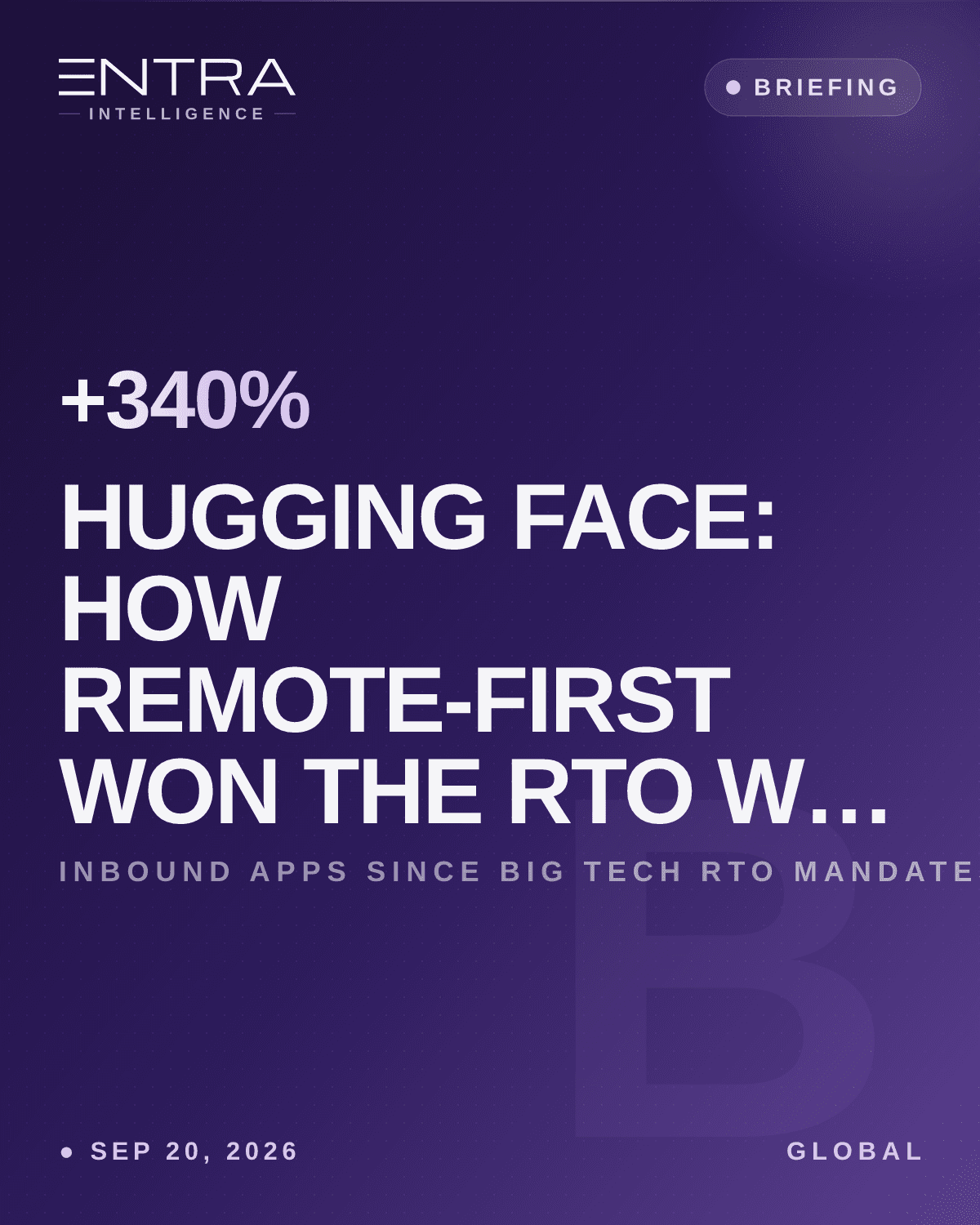
The ENTRA Job Signal Index Q3 2026 estimate — based on recruiter survey data and job posting signal tracking; Hugging Face did not confirm application volume figures — puts inbound application growth at Hugging Face at 340% since Amazon's January 2025 five-day mandate took effect. The acceleration stepped up again in Q1 2026 when OpenAI expanded its in-office requirement in San Francisco.
The applications are not coming from junior candidates hedging their options. The profile concentrating in Hugging Face's inbound pipeline is mid-to-senior ML engineers and research scientists — people who have vested equity at their current employer, have proven their output in distributed settings, and have no structural reason to accept a daily commute. They are choosing Hugging Face not because they cannot get an Anthropic or OpenAI offer, but because the working model is a primary filter, not a secondary one.
Current open roles as of September 2026 include Foundation Model Researcher, Safety Researcher, and Developer Relations Engineer — all listed without office requirement. The Safety Researcher role is notable: Hugging Face is building its safety function at a moment when most safety researchers at frontier labs are being asked to move to San Francisco or the Washington, D.C. corridor. The company is recruiting from a cohort that is directly experiencing the office mandate conflict at peers.
Can the Model Scale?
Hugging Face's $4.5 billion valuation was set in 2023. The company is not yet public, and its path to a liquidity event runs through a single strategic question: does the open-source community flywheel generate enough enterprise revenue to support a durable growth story at IPO multiples?
The enterprise push is underway. Hugging Face Enterprise Hub — a private, managed version of the Hub with SSO, access controls, and compliance infrastructure — has expanded its customer base through 2025 and into 2026. Microsoft, AWS, and Google Cloud have each integrated Hugging Face model hosting into their platforms, creating distribution channels that do not require Hugging Face to build a direct enterprise sales motion from scratch.
The risk is not the model. The risk is the compression between open-source generosity — which built the community — and proprietary enterprise lock-in, which generates the revenue. Hugging Face has so far managed the tension by keeping the Hub genuinely open while charging for the enterprise infrastructure layer. That balance holds as long as the community sees the company as its steward rather than its captor.
The IPO calculus will test it. At $4.5 billion, Hugging Face's valuation reflects a strong but pre-growth-acceleration bet. A public market debut in 2027 or 2028 would require demonstrating that enterprise revenue is compounding, not merely adjacent to the community story. The talent asset — more than 1,000 researchers across 70 countries, none of whom are looking at Glassdoor reviews about badge enforcement — is the company's most legible competitive moat. The question is whether it translates into a multiple.
For now, Hugging Face is the only company in AI that can say its headcount grew, its attrition signal is flat, and its working model did not change once in the 20 months since the RTO wars began. That is not a small thing.
Sources: Top 20 AI Companies by RTO Talent Risk — ENTRA Intelligence — ENTRA Recruiter Survey Q2-Q3 2026 — ENTRA Intelligence — Amazon's Five-Day RTO and the AI Talent Exodus — ENTRA Intelligence — Hugging Face raises $235M Series D at $4.5B valuation — TechCrunch — The Gradient Podcast with Thomas Wolf — The Gradient — Hugging Face Enterprise Hub — Hugging Face — Levels.fyi AI company salary data 2026 — Levels.fyi — frontier-lab-rto-divergence-ai-talent-strategy — ENTRA Intelligence
 Global Career Platform
Find AI talent. Find your next role.
Booking is hotels. · Airbnb is apartments. · ENTRA is global careers.