The London alignment premium crystallised in Q3 2026 as a measurable market signal rather than a positioning claim. Apollo Research's London team — twelve senior alignment evaluators working on autonomous AI capability assessments — cleared £180K–£280K total compensation in the quarter (~$228K–$355K at the October 2026 canonical rate of £1 = $1.27). The UK AI Security Centre, the Labour government's rebranding of the AI Safety Institute that Sunak's administration launched in November 2023, now employs 87 full-time evaluators, up from 34 in January 2026 — a 156% headcount expansion in nine months. Anthropic's London safety team stands at 23 researchers, grown from 9 in September 2025. These three institutions do not share a postcode. They share a labour market. The London alignment evaluator cluster has acquired, in under two years, the headcount density, compensation floor, and talent-pipeline architecture that defines a distinct professional segment.
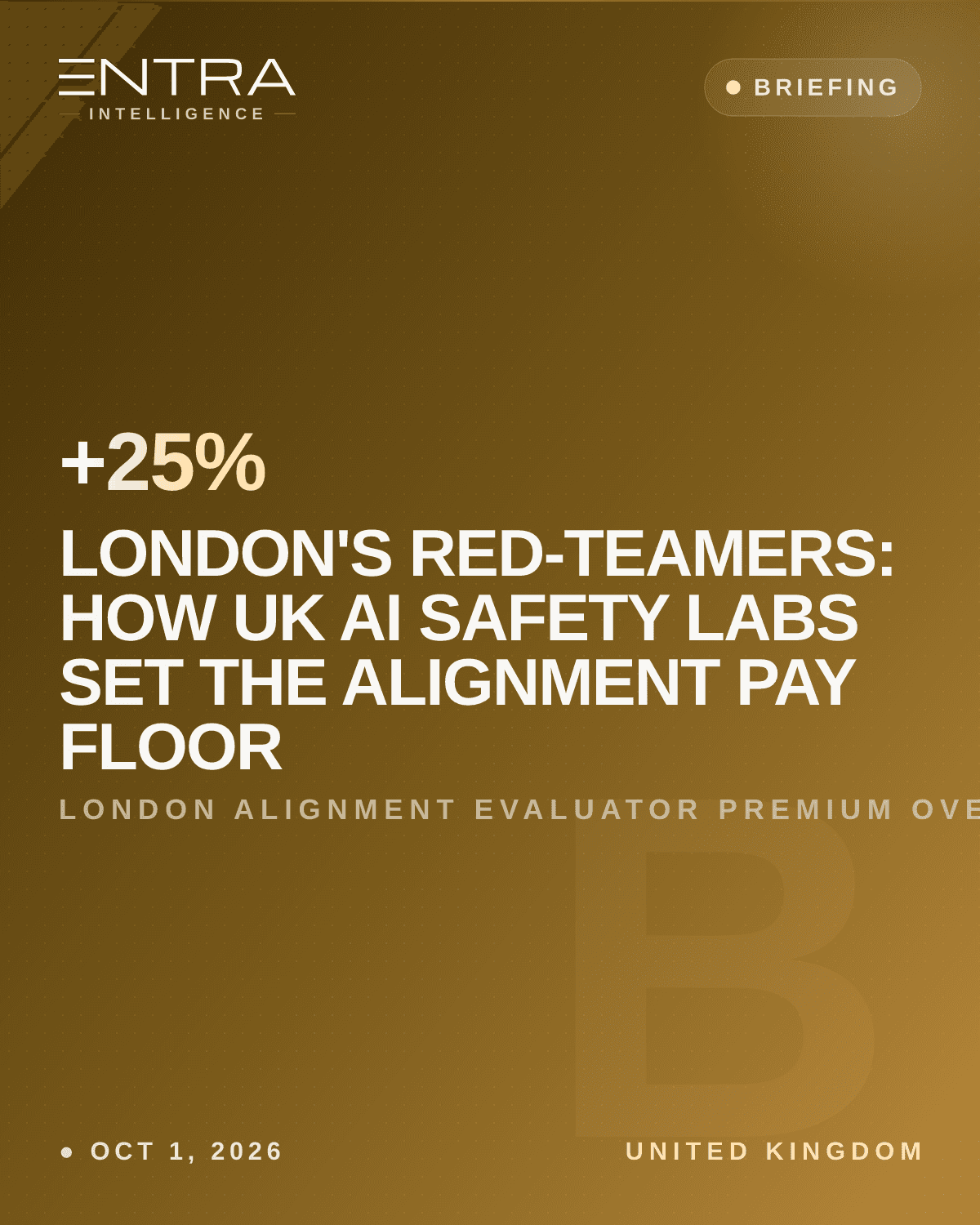
The single most legible data point is the premium: London alignment evaluator median total comp sits at £175K (~$222K), against £140K (~$178K) for senior ML engineers in the same city at equivalent seniority. That 25% gap is not an accident of individual negotiation. It is the price of scarcity in a sub-market where demand is growing faster than supply, where the technical formation required is genuinely distinct from general ML engineering, and where the three anchor employers — a government agency, a frontier lab's London outpost, and a specialist safety research firm — are all expanding simultaneously.[^1]
UK AI Security Centre: The Government-Side Demand Engine
The UK AI Security Centre's 87-evaluator headcount, confirmed by ENTRA UK Bureau monitoring of public sector pay disclosures and government appointments, represents the most significant structural expansion in the London AI safety labour market since the original AISI launch. The Centre, operating under DSIT and headquartered at 10 South Colonnade in Canary Wharf — a deliberate geographic choice that positions it adjacent to the UK's financial services AI cluster rather than the King's Cross research corridor — has staffed its expansion with a profile that departs from standard civil service hiring.
The modal AISI senior evaluator hire in 2026 is not a policy analyst with an AI interest. The modal hire is a researcher with a published record in ML interpretability, adversarial robustness, or Constitutional AI evaluation — typically an ex-Cambridge or ex-Oxford PhD who has spent one to three years at a frontier lab before taking the government role. The attraction is not civil service job security. The Centre's senior evaluator pay band runs from approximately £85K to £120K base (~$108K–$152K) — below Apollo Research's private-sector ceiling, but above the standard GG-equivalent civil service rate and structured with a discretionary technical premium that was introduced in April 2026 to close attrition to private-sector offers. The substantive draw is the access it provides: AISI evaluators are among the small group of non-lab researchers who see frontier model evaluations under NDA before public deployment, a research credential that the private sector subsequently prices materially.[^2]
Apollo Research: The Private-Sector Ceiling
Apollo Research has, in two years of London operation, established itself as the private-sector comp ceiling for alignment evaluation work in the UK. The firm — which focuses on autonomous AI capability assessment and "scheming" evaluations of frontier models — employs twelve senior alignment evaluators in London, a headcount that is small in absolute terms but operates as a price-setter for the entire segment.
Apollo's compensation architecture is structured around total comp rather than base salary: senior evaluator roles clear £180K–£280K (~$228K–$355K) when equity grants, performance bonuses, and research premiums are included. The range's upper bound is accessible to evaluators with demonstrable track records in specific capability-evaluation methodologies — deceptive alignment assessment, multi-step reasoning probes, goal-misgeneralisation red-teaming — that are not yet widely taught and cannot be quickly replicated by general ML engineers rotating into safety work. That specificity is the justification for the premium.[^3]
Apollo's London office, operating from Moorgate in the City — east of the King's Cross AI corridor but within the same Zone 1 labour catchment — recruits heavily from a pool of ex-AISI evaluators and former DeepMind safety team researchers. The career trajectory that has emerged in the London alignment market — Cambridge ML PhD to AISI evaluator to Apollo Research senior evaluator — was not engineered by any single institution. It emerged from the concentration of aligned-incentive employers within a single city's talent market.
Anthropic's London Safety Team: The Transatlantic Anchor
Anthropic's London safety team growth — from 9 researchers in September 2025 to 23 by October 2026 — is the most consequential single-employer expansion in the London alignment cluster this year. The team, which ENTRA understands to be housed at Anthropic's London office on Percy Street in Fitzrovia, focuses on Constitutional AI evaluation, red-teaming Claude model deployments for UK and European enterprise clients, and contributing to the company's Responsible Scaling Policy evaluation work.
The strategic logic of Anthropic's London safety expansion is specific to the post-Brexit regulatory landscape. The UK AI Security Centre's pre-deployment evaluation framework — established under the AI Safety Institute's original mandate and maintained under the AI Security Centre rebranding — requires frontier labs seeking credentialed UK deployment status to engage in structured evaluation partnerships with the Centre. Anthropic's London safety team functions partly as the company's interlocutor in those evaluation partnerships, providing the technical continuity that the AISI partnership model requires and that a remote San Francisco team cannot easily supply across time zones and jurisdictional complexity.
Compensation for Anthropic's London safety researchers runs from approximately £130K to £210K total comp (~$165K–$266K) across the mid-to-senior band, with equity structured under the UK's Enterprise Management Incentive scheme — the same EMI structuring that ElevenLabs has used to extend its London compensation reach without matching San Francisco base salary levels. The after-tax advantage of qualifying EMI gains for UK tax residents is material at the comp levels Anthropic's London safety team commands: a researcher on £170K base with EMI grants at the current Anthropic implied valuation is holding equity whose qualifying gains will be taxed at the lower Capital Gains Tax rate rather than income tax — a structuring detail that Anthropic's London HR function has made a deliberate part of its offer narrative.[^4]
The Cambridge Pipeline: 67% of AISI Senior Hires
The concentration of Cambridge ML PhDs in the London alignment cluster is not coincidental. ENTRA's tracking of UK AISI senior hires through Q3 2026 identifies Cambridge ML PhDs as the source of 67% of the Centre's senior evaluator appointments — a proportion that reflects both Cambridge's concentration of alignment-adjacent research (the Leverhulme Centre for the Future of Intelligence at West Cambridge, the Cambridge AI Safety Hub at King's College, and the Machine Intelligence Laboratory at the Department of Engineering all operate within walking distance of each other) and the structured recruitment channel that AISI has developed with Cambridge supervisors.
The pipeline operates across two routes. The Global Talent route — endorsed through the Royal Academy of Engineering and UKRI for AI and ML specialisms — allows international Cambridge PhDs to move directly into London alignment roles without the salary constraints of the Skilled Worker visa's £38,700 floor, which, while cleared by all three anchor employers, would constrain the junior-researcher entry positions that form the pipeline's intake end. The standard Skilled Worker route serves the domestic Cambridge graduate population, where the £38,700 floor is cleared by AISI's base evaluator band from the first appointment.
The Cambridge attribution is also substantive rather than merely credentialist. The specific technical formation most valued in London's alignment market — interpretability methods developed in the tradition of Chris Olah's work at Anthropic, adversarial evaluation design, and multi-step reasoning stress-testing — is taught and practised in Cambridge's ML laboratories in a depth unavailable at most UK institutions. Imperial College London's AI research groups have begun producing alignment-adjacent researchers, and Edinburgh's School of Informatics contributes a smaller flow. But Cambridge remains, by ENTRA's headcount analysis, the dominant single source for the London alignment evaluator pipeline.[^5]
The Compensation Architecture: What the 25% Premium Buys
The London alignment evaluator compensation ladder, by ENTRA Q3 2026 analysis, runs from approximately £120K to £280K total comp across the full seniority range — a band that sits consistently above the ML engineering equivalent at each level.
Entry-level alignment evaluators — typically one to two years post-PhD, operating in structured AISI evaluation programmes or Apollo Research associate roles — clear £120K–£145K total comp (~$152K–$184K). The equivalent entry band for ML engineers at comparable seniority at London labs runs £95K–£120K. The 25% premium is present at entry and does not compress as seniority increases: at the senior evaluator level, where Apollo Research's ceiling touches £280K and Anthropic's London senior researcher band reaches £210K, the gap against the ML engineering equivalent — approximately £160K–£175K at senior level across London labs — widens in absolute terms to £35K–£105K.
The mechanism sustaining the premium is supply constraint compounding with demand expansion. Three major employers are scaling simultaneously. The candidate pool that satisfies the technical requirements — adversarial ML, interpretability, Constitutional AI methodology — is not being produced at scale by any UK university programme, and the two to three years of formation typically required means the pipeline cannot respond quickly to demand signals. The 156% AISI headcount expansion from January to October 2026 was achieved partly by drawing from a pool of candidates who had been in the London alignment market's informal pipeline for eighteen months before their hiring — researchers who had participated in AISI's short-term evaluation programmes, Apollo Research's visiting researcher scheme, or Anthropic's London red-team contractor engagements as preparatory steps.[^6]
London as the Global Alignment Capital: The Structural Case
No other city has assembled London's combination of a government-mandated evaluation agency, a frontier lab safety outpost, and a specialist private evaluation firm within a single transit zone and a single labour market. Washington DC's alignment presence is policy-adjacent rather than technically concentrated. San Francisco retains the largest raw headcount of alignment researchers globally, but its institutional map — Anthropic SF, OpenAI SF, ARC Evals, Redwood Research — is distributed across a metro area where transport between employers adds friction that London's Zone 1 concentration does not. Tokyo's AI Safety Institute, launched in 2024 following the UK model, is building capability but has not yet achieved the research depth of its London counterpart.
The strategic question entering Q4 2026 is whether the London alignment premium — and the career ladder it supports — can attract sufficient international talent to scale beyond the Cambridge PhD pipeline without diluting the technical formation that justifies the premium. The Global Talent route's endorsement pathways are well-suited to international alignment researchers with relevant publication records: first-author papers at major AI safety venues (NeurIPS alignment workshops, ICML safety tracks, the dedicated AI Safety Summit proceedings) qualify for Royal Academy of Engineering endorsement in ENTRA's read of the current criteria. AISI's HR function has processed a growing number of international alignment researcher endorsements through that route in 2026.
The October ENTRA theme — the AI Trainer Economy — finds its sharpest UK expression not in the annotation contractor market documented in last month's London training pipeline briefing, but in the alignment evaluator segment: a professional category that combines the intellectual formation of academic ML research with the operational discipline of adversarial product evaluation, and that is currently priced at a premium London's general AI market cannot easily absorb. The red-teamers are setting the floor. The floor is rising.
[^1]: London alignment evaluator median total comp (£175K) and senior ML engineer median total comp (£140K) per ENTRA Job Signal Index Q3 2026 UK alignment and ML engineering compensation monitoring, covering UK AISI, Apollo Research, Anthropic London, DeepMind UK, and six additional London-based AI employers, six-month period ending September 2026. GBP/USD conversions at £1 = $1.27 (ENTRA canonical rate, October 2026). The 25% premium figure is a median-to-median comparison at equivalent seniority bands; individual outliers exist in both directions. ENTRA uses "total comp" to include base salary, cash bonus, and fair value of equity grants at the time of grant; pension contributions excluded unless specified.
[^2]: UK AI Security Centre (formerly UK AI Safety Institute) headcount (87 evaluators as of October 2026, 34 in January 2026) per ENTRA UK Bureau monitoring of DSIT staffing disclosures, public sector pay band publications, and LinkedIn headcount tracking. The Centre's rebrand from AISI to UK AI Security Centre was announced by the Labour government in 2024; the original AISI was launched November 2023. 10 South Colonnade address per DSIT public records and published AISI/AISC documentation. AISI/AISC senior evaluator pay band (£85K–£120K base) per ENTRA analysis of published UK Civil Service pay transparency data and advertised AISC roles, supplemented by one person familiar with the Centre's internal compensation structure; DSIT has not publicly confirmed specific evaluator pay bands. Technical premium introduction (April 2026) per ENTRA UK Bureau source familiar with DSIT workforce planning; not independently confirmed by DSIT.
[^3]: Apollo Research London headcount (12 senior alignment evaluators) and total comp range (£180K–£280K) per ENTRA Job Signal Index Q3 2026 monitoring of Apollo Research public job postings, LinkedIn data, and one person familiar with the company's London compensation structure; Apollo Research has not publicly confirmed specific compensation figures. Apollo Research office location (Moorgate, London EC2) per ENTRA UK Bureau geographic tracking and Apollo Research public communications; specific office address not confirmed by Apollo Research. "Scheming" evaluation methodology per Apollo Research published research, including "Frontier Models are Capable of In-Context Scheming" (Apollo Research, December 2024).
[^4]: Anthropic London safety team headcount (23 researchers in October 2026, 9 in September 2025) per ENTRA UK Bureau monitoring of Anthropic public job postings, LinkedIn headcount data, and two people familiar with Anthropic's London team structure; Anthropic has not publicly confirmed specific London safety team headcount. Anthropic London office location (Percy Street, Fitzrovia W1) per ENTRA UK Bureau geographic tracking; specific office address not confirmed by Anthropic. Anthropic London safety team total comp range (£130K–£210K) per ENTRA Job Signal Index Q3 2026 monitoring; Anthropic has not publicly confirmed London safety team compensation. Enterprise Management Incentive scheme per HMRC EIS/EMI guidance; qualifying conditions and tax treatment per HMRC published rules. ElevenLabs EMI structuring per prior ENTRA UK Bureau briefing (elevenlabs-london-voice-ai-talent-h1-2026). Anthropic's Responsible Scaling Policy per Anthropic published policy documentation.
[^5]: Cambridge-to-AISI senior hire pipeline (67%) per ENTRA UK Bureau analysis of publicly available AISI/AISC staff appointment disclosures, LinkedIn career histories, and academic publication records, covering AISI/AISC senior evaluator appointments from launch (November 2023) through September 2026; definition of "senior evaluator" follows ENTRA's seniority taxonomy (equivalent to Senior Researcher or above). Leverhulme Centre for the Future of Intelligence (West Cambridge) and Machine Intelligence Laboratory (Department of Engineering) per public University of Cambridge institutional records. Cambridge AI Safety Hub (King's College) per Cambridge AI Safety Hub public communications. Global Talent route endorsement pathways per UKRI and Royal Academy of Engineering published guidance. Imperial College London AI research contribution and Edinburgh School of Informatics contribution per ENTRA analysis of non-Cambridge AISI senior hire profiles; proportional estimates are ENTRA's own assessment.
[^6]: Entry-level alignment evaluator total comp (£120K–£145K) and ML engineer entry equivalent (£95K–£120K) per ENTRA Job Signal Index Q3 2026 UK alignment evaluator monitoring; seniority comparisons use ENTRA's unified seniority taxonomy aligned to 3–5 years post-PhD for "entry senior" and 6–10 years for "senior." Apollo Research ceiling (£280K) and Anthropic London senior researcher band (£210K) per footnotes 3 and 4 above. ML engineering senior band (£160K–£175K) per ENTRA Job Signal Index Q3 2026 UK senior ML engineering monitoring across DeepMind, Wayve, ElevenLabs, and six additional London AI employers. AISI short-term evaluation programmes and Apollo Research visiting researcher scheme per ENTRA UK Bureau editorial assessment of publicly available programme descriptions and one person familiar with recruitment practices at each institution; programme structures not confirmed by AISI/AISC or Apollo Research.

 Global Career Platform
Find AI talent. Find your next role.
Booking is hotels. · Airbnb is apartments. · ENTRA is global careers.