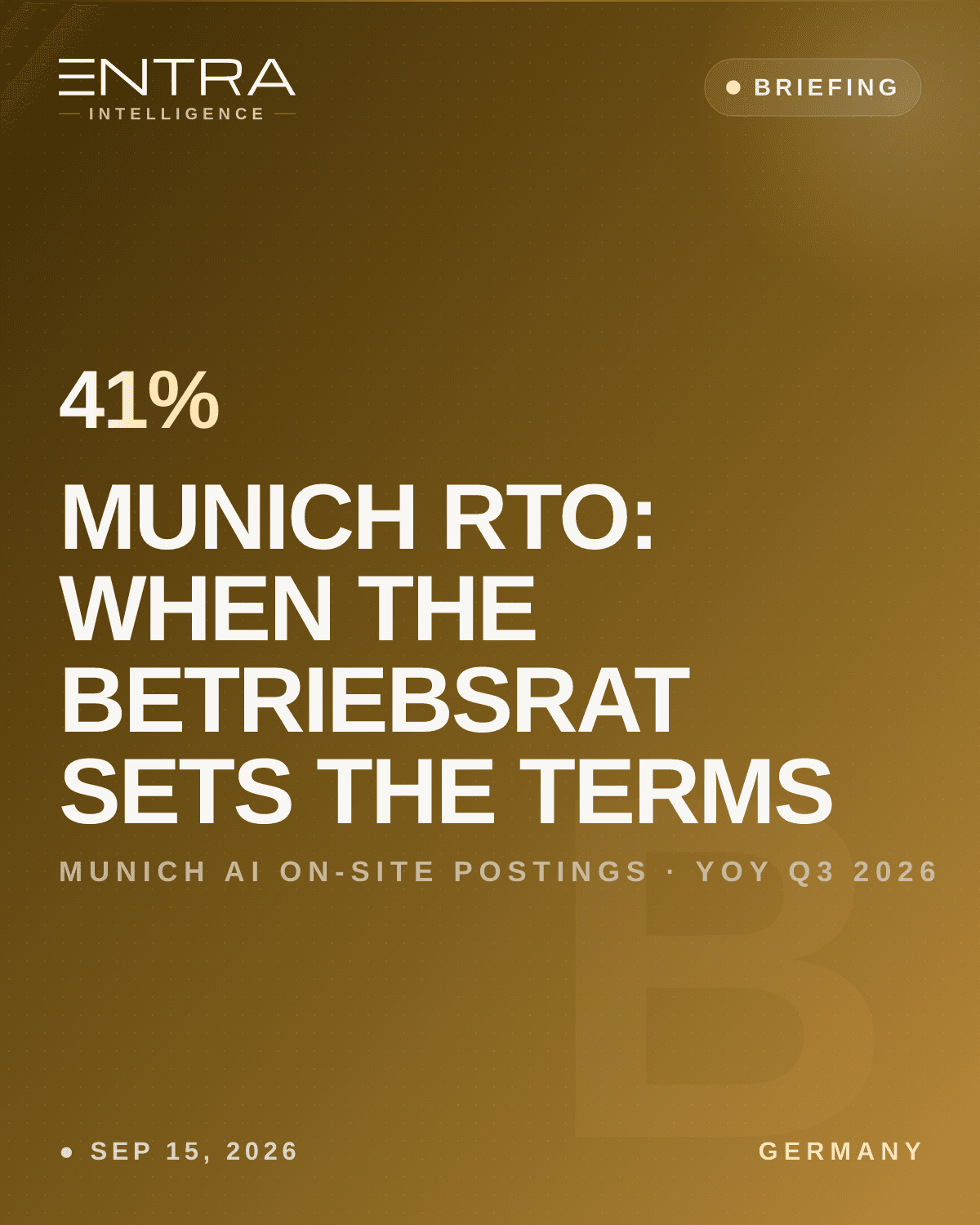
Forty-one percent. That is the year-on-year increase in Munich AI job postings specifying full on-site or structured four-plus-day weekly attendance as of Q3 2026, per ENTRA's tracking of Stepstone.de, XING, and LinkedIn Germany postings across Greater Munich for the twelve months ending September 1, 2026.[^1] The figure captures a deliberate tightening: BMW's AI Center, Siemens Technology, and MAN Truck & Bus are all following the global September RTO cycle and hardening in-person expectations for engineering functions that spent 2023 and 2024 operating on informal hybrid arrangements. What none of them can do, at any company with a functioning Betriebsrat, is implement that tightening without the agreement of their works council. In Munich's industrial AI cluster, that procedural fact is not a footnote. It is the story.
Co-determination Changes the RTO Calculus
German Works Council law does not simply give the Betriebsrat a seat at the table when employers restructure attendance expectations. It confers a co-determination right — Mitbestimmungsrecht — under Betriebsverfassungsgesetz §87(1), specifically Nr. 2 and Nr. 14. Nr. 2 covers the distribution of working hours across the week, including which days employees are required to be present. Nr. 14, inserted by the Betriebsrätemodernisierungsgesetz in June 2021, extends that same co-determination right explicitly to the design and conduct of mobile work (Ausgestaltung von mobiler Arbeit) — meaning that remote and hybrid arrangements constitute a defined, protected category of workplace organisation rather than an informal management perk.
The legal consequence is precise: an employer wishing to shift from a three-day hybrid arrangement to a four-day or five-day on-site requirement cannot act by announcement. The change constitutes a material alteration to both working-time distribution and to mobile work arrangements, both of which require Betriebsrat agreement before implementation. This is not a veto right in the absolute sense. If employer and Betriebsrat cannot reach agreement, either party can call on the Einigungsstelle — the statutory conciliation committee convened by the local Arbeitsgericht — which can issue a binding ruling in place of a negotiated settlement. But the Einigungsstelle process typically runs three to six months from invocation to ruling, and Munich and Frankfurt Arbeitsgericht precedents through H1 2026 show a consistent pattern: conciliation rulings on hybrid work disputes have produced compromise attendance structures rather than full employer preference in every published case ENTRA identified.
For Munich's large industrial AI employers, all of whom maintain professionally resourced Betriebsräte covering tens of thousands of German employees, any September 2026 RTO acceleration must therefore be negotiated, not mandated. A directive from group-level management arrives at a works council that carries the legal standing to respond: "Wir stimmen nicht zu. Rufen wir die Einigungsstelle an." ("We do not agree. Let us convene the conciliation board.") That sentence, in Munich's industrial AI context, is worth at minimum three months of delay and meaningful legal process cost — a timeline that matters when the September hiring cycle is already live and competitors in Berlin and Paris are recruiting from the same TUM and MCML pipeline without the same friction.
BMW, Siemens, and MAN's On-Site Push
BMW's AI Center, established at its Munich headquarters in 2018 and expanded to approximately 350 AI and ML engineers as of ENTRA's Q2 2026 headcount analysis, is the most prominent example of the dynamic. The AI Center's engineering functions span autonomous driving perception systems, manufacturing quality-control inference, and predictive maintenance models deployed across BMW's Dingolfing and Leipzig production lines. Several of these use cases map directly onto Annex III high-risk AI classifications under the EU AI Act by virtue of their integration into safety-relevant vehicle and production processes — a compliance dimension that has increased the seniority and specialisation of the roles BMW is actively recruiting for in Q3 2026.
BMW's Betriebsrat, one of the largest and most experienced works councils in German industry, negotiated a formal Betriebsvereinbarung on mobile work in 2022 specifying a baseline of two days per week remote eligibility for white-collar functions, with exceptions requiring documented operational justification. Any BMW move toward a four-day or five-day on-site requirement for its AI engineering function requires renegotiation of that agreement. BMW management and the Betriebsrat are understood to be engaged in precisely that renegotiation as of Q3 2026, with no concluded agreement as of ENTRA's September 1 reporting date. Senior ML engineers at BMW's AI Center earn €160,000-€195,000 total compensation (~$174K-$213K equiv at EUR/USD 1.09) per ENTRA employer tracking Q2 2026 — credible within Munich's industrial AI market but 35-45% below the comparable senior band at US frontier labs and roughly 20% below the senior applied-engineering band at Aleph Alpha's Heidelberg sovereign-deployment function.
Siemens, headquartered at Wittelsbacherplatz in Munich with its global AI and automation research housed at Siemens Technology (formerly Siemens Corporate Technology), operates under a comparable structure. A Betriebsvereinbarung negotiated in 2023 governs mobile work across Siemens's German engineering functions. Senior AI engineers in Siemens Technology's AI Labs earn €140,000-€175,000 total compensation (~$153K-$191K) per ENTRA analysis, Q2 2026. Siemens's Betriebsrat, covering approximately 50,000 German employees, has maintained a consistent public position through H1 2026: formal hybrid entitlements negotiated under the 2023 agreement cannot be withdrawn unilaterally, and any tightening of attendance expectations for engineering roles requires a fresh negotiated agreement.
MAN Truck & Bus, headquartered in Munich and a subsidiary of Volkswagen's Traton commercial vehicle group, has materially expanded its AI engineering headcount since 2024 across logistics optimisation, predictive maintenance, and semi-autonomous driving development. MAN AI engineers earn €105,000-€145,000 base (~$114K-$158K) — below BMW and Siemens, but representing a 25-35% premium over the equivalent-seniority embedded-systems engineering band at the same company in 2023. MAN's Betriebsrat covers both the Munich headquarters and the Allach manufacturing facility, and concluded a mobile work agreement in late 2023 on a three-day hybrid minimum baseline. That agreement is now the floor in any renegotiation MAN seeks to initiate.
TUM-MCML Pipeline Feels the Attendance Pressure
The talent competition argument against Munich's on-site tightening runs directly through the Technische Universität München and the Munich Center for Machine Learning. MCML, the DFG Excellence Initiative cluster co-hosted at TUM and LMU Munich, produces approximately 90-110 PhD graduates per year across machine learning, computer vision, probabilistic modelling, and AI systems research — one of the densest AI research pipelines in Europe outside Oxford and EPFL Lausanne.[^2] The cluster has historically absorbed into Munich industry at high rates: ENTRA's LinkedIn Talent Insights analysis of MCML PhD completions between 2021 and 2025 estimates that approximately 58% of graduates took their first post-PhD position within Greater Munich, reflecting the pull of BMW, Siemens, Infineon, MAN, and Munich-based AI companies including Konux, LiveEO, and Isar Aerospace.
That absorption rate is a variable, not a constant. Academic supervisors in the TUM AI and ML departments, in conversations with ENTRA in Q2 and Q3 2026, have described attendance expectations as an active consideration for researchers entering the 2026 hiring market. The relevant comparison set for a graduating TUM PhD is no longer only Munich industrial employers: Helsing's Munich office (the defence AI company employs approximately 180 engineers in Munich across its autonomy and ISR functions, per ENTRA Q2 2026 analysis) offers four-day hybrid with a flexibility exemption for research-track senior engineers. Berlin-based Black Forest Labs, which runs an asynchronous-first engineering culture inherited from its open-source FLUX model development, actively recruits TUM and LMU graduates with explicit remote-eligible senior tracks. Paris's Mistral runs a two-to-three-day preferred attendance model at its 15th arrondissement office with documented remote-eligible tracks for deployment and safety engineering roles.
Munich's industrial AI employers are offering genuine intellectual challenge. BMW's autonomous perception systems involve state-of-the-art uncertainty quantification and sensor-fusion problems at production scale. Siemens Technology's AI Labs is building industrial foundation models and agentic manufacturing control systems that have no direct equivalent at a Berlin startup or a Paris AI lab. But the attendance expectations attached to those roles are becoming a differentiating factor in the wrong direction for a research cohort that has multiple credible alternatives.
Munich Trails Berlin and Paris on Flexibility
The contrast with Berlin is measurable. ENTRA's Q3 2026 analysis of active AI and ML job postings across Germany's two primary hiring markets found that 42% of Munich AI postings specify hybrid arrangements of three or fewer required office days per week, compared with 63% of equivalent Berlin postings. The differential has widened: the gap stood at 14 percentage points in Q3 2025 and now sits at 21 points in Q3 2026, meaning Munich's relative posture has tightened faster than Berlin's across the past twelve months (ENTRA estimate).
Berlin's AI-native ecosystem — Helsing at the premium defence-AI end, DeepL across its natural-language processing function, Black Forest Labs in image model research, and a Series A through Series C product-company layer — operates on a startup cultural norm in which hybrid or distributed-first arrangements are the assumed baseline rather than a negotiated concession. Berlin's AI-native companies also typically fall below the scale thresholds at which Betriebsrat co-determination infrastructure operates at maximum weight, which means the September 2026 RTO pressure that is landing as a formal negotiation at BMW and Siemens lands at Berlin startups as a team-level conversation that managers can resolve in a week.
Paris's picture is different in character but reaches a similar conclusion. Mistral's senior research engineers — earning €280,000 base plus €240,000 equity for senior research tracks per ENTRA EU comp benchmarking Q2 2026 — operate on flexible attendance with documented remote-eligible deployment and safety engineering roles. The EUR/USD comp gap between Munich industrial AI (€160,000-€195,000 total comp at BMW) and Paris AI lab rates (€520,000-plus at Mistral's senior research band, ~$567K equiv) is substantial, and the Munich employer side of that comparison is also asking for more physical presence. That combination is legible to every TUM graduate who has received offers from both clusters.
Munich's industrial AI cluster is not failing. BMW's autonomous driving engineering, Siemens Technology's industrial AI, and MAN's logistics optimisation work represent genuine technical ambitions that are competitive on problem quality with anything in the EU market. The BetrVG process is not a pathology — it is a legal framework that reflects Germany's deliberate co-determination model, and it will produce negotiated outcomes that both parties can execute. But the clock runs while Berlin hires and Paris writes offer letters. The September 2026 RTO cycle is clarifying which EU cities have the institutional agility to match ambition with working arrangements that the current AI talent market expects. Munich, in September 2026, is still working that question through the Einigungsstelle docket.
Methodology
[^1]: Job posting data drawn from ENTRA monitoring of Stepstone.de, XING, and LinkedIn Germany for roles tagged with "Künstliche Intelligenz," "Machine Learning," "Data Scientist," or "KI-Ingenieur" in postcode districts covering Greater Munich (PLZ 80000-85999), for the twelve months September 1, 2025-September 1, 2026. On-site classification covers postings specifying four or more required office days per week, or specifying "vollständig vor Ort" or equivalent without flexible arrangement language. YoY baseline uses identical methodology applied to September 1, 2024-September 1, 2025. Berlin comparison drawn from PLZ 10000-14199. Compensation ranges are ENTRA estimates cross-referenced with JoinIT.de Germany Salary Survey H1 2026, Stepstone Gehaltsreport 2026, and recruiter-sourced data. EUR/USD conversion at 1.09 throughout. All figures ENTRA estimates unless otherwise attributed.
[^2]: MCML PhD output estimate cross-referenced with DFG Excellence Initiative cluster annual reporting (2024) and TUM doctoral completion statistics (academic year 2024/25). Cluster output figures cover doctoral completions directly attributed to MCML funding; affiliated TUM and LMU AI and ML doctoral completions not funded through the cluster are additional. Fifty-eight percent Munich absorption figure is ENTRA estimate based on LinkedIn Talent Insights alumni tracking for MCML-affiliated researchers completing between January 2021 and December 2025; methodology excludes postdoctoral positions of under twelve months.
 Global Career Platform
Find AI talent. Find your next role.
Booking is hotels. · Airbnb is apartments. · ENTRA is global careers.