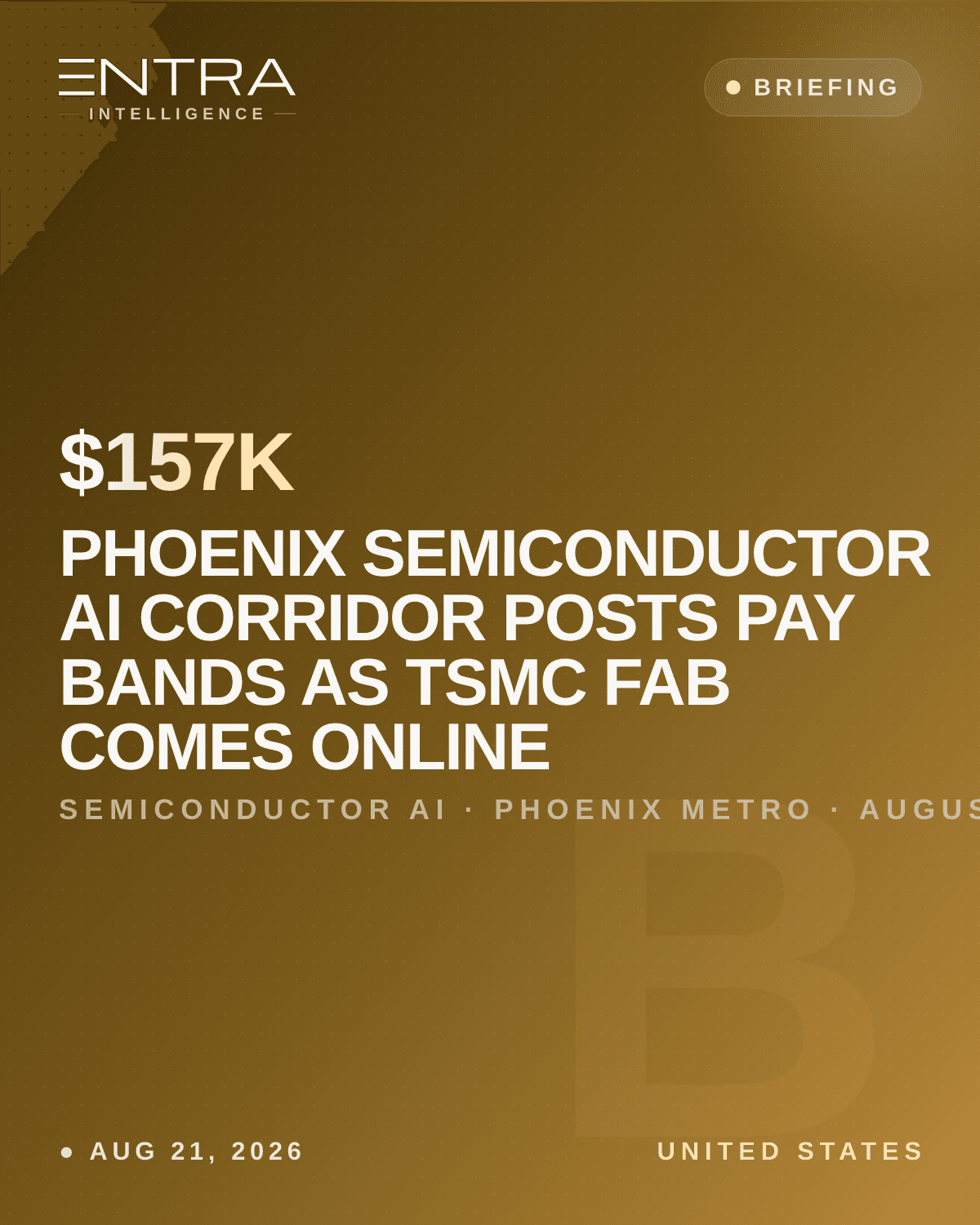
Fifty-eight percent of active AI and ML job postings in the Phoenix metro carried salary bands as of Q2 2026, per the ENTRA Job Signal Index, which tracked approximately 1,200 open roles across Arizona's largest semiconductor, autonomous vehicle, and technology employers. Arizona has no statewide salary disclosure statute. The number reaches 58 percent anyway, because the companies anchoring the market -- TSMC, Intel, and Waymo -- are publicly traded, California-registered, or both, and they have brought their compliance postures with them. The median senior ML engineer base in the Phoenix metro in that period was $157,000, with a full range of $130,000 to $185,000 across roles in semiconductor manufacturing AI, autonomous vehicle operations, and applied research.
TSMC's Fab and the Disclosure Effect
TSMC Arizona's Phase 2 investment, announced in April 2026, commits $3.2 billion to a second fab on the Mesa campus northeast of Phoenix, extending the company's total Arizona buildout toward three facilities and a target of 4nm node production by Q1 2027. The direct engineering hires feeding that ramp -- process integration engineers, yield ramp specialists, and AI-enabled fabrication tooling roles adjacent to the fab floor -- carry posted bands of $135,000 to $190,000, per ENTRA's Q2 2026 monitoring of TSMC's Arizona career portal.
That disclosure posture is not civic generosity. TSMC is listed on the NYSE and operates a global HR compliance framework that treats investor-facing salary consistency and legal disclosure hygiene as overlapping concerns. The result is a publicly readable compensation dataset that candidates and competing employers across the Phoenix metro use as a market reference. The 58 percent metro-wide disclosure rate in ENTRA's Q2 2026 data traces back disproportionately to the TSMC anchor: of postings classified as AI or semiconductor engineering roles from principal employers in the Phoenix-Mesa-Chandler MSA, band disclosure approached 80 percent; among subcontractor and facilities management postings in the same geography, it fell below 25 percent.
That gap is the defining pay data problem of the Phoenix semiconductor corridor. A facilities systems specialist posting from a vendor operating within two miles of the TSMC fab campus in Q2 2026 was as likely to see no compensation data as to see a range. An engineer at TSMC itself saw a posted band before the first recruiter call. Arizona law requires neither. The fab's publicly traded parent does the disclosure work the state does not.
Arizona has no salary disclosure statute. A review of the Arizona State Legislature's bill tracking system as of August 2026 confirms no enacted or pending bill requiring salary ranges in job postings for the current legislative session cycle. Eighteen states plus the District of Columbia have enacted mandatory disclosure requirements, per the ENTRA Pay Transparency Audit Q2 2026. Arizona is not among them.
Waymo's Chandler-Tempe ML Density Cluster
Waymo's Phoenix metro operation logged 30,000-plus rides per week as of Q2 2026, per Waymo press releases covering the commercial Waymo One fleet running in Chandler and Tempe. That operational density is, for labor market purposes, a machine learning data generation engine. Every ride cycle produces sensor fusion sequences, object classification events, and edge-case annotation requirements that translate directly into ML engineering headcount at the local operations level.
The density of ML roles in the Phoenix metro arrived 18 months earlier than ENTRA's secondary-market forecasting model projected for a metro of Phoenix's population scale. The standard pattern in autonomous vehicle deployment has been a 24-to-30-month lag between commercial service launch and secondary-hub ML team consolidation. Waymo's Chandler footprint has compressed that timeline. The facility now runs localized data annotation pipelines, fleet systems optimization roles, and model monitoring functions that constitute a discrete ML cluster rather than a satellite extension of Mountain View.
Waymo's Q2 2026 Phoenix postings carried bands as standard practice, consistent with the company's national posting posture driven by California SB 1162 obligations through its Alphabet parent registration. ML operations engineer roles in Chandler posted bands of $140,000 to $175,000 in ENTRA's Q2 monitoring. That range sits below the TSMC senior band ceiling but reaches the same candidate population: engineers with applied ML experience choosing between Phoenix's lower cost base and Bay Area offers carrying California's 9.3 percent marginal income tax rate above $72,725.
Intel Chandler: Arc Chips and the AI Accelerator Build-Out
Intel's Chandler campus employs more than 12,000 people across fab operations and advanced packaging, and as of Q2 2026, an AI accelerator team aligned to the Arc chip series and the NEX platform products group. The AI accelerator team is posting roles focused on on-device inference optimization, neural processing unit workload modeling, and software toolchain development bridging Intel's hardware architecture to AI framework compatibility layers.
Intel's compensation posture for these roles tracks closely with TSMC's band structure. Senior AI chip engineers in Chandler posted $145,000 to $195,000 base salary in Q2 2026, per ENTRA Job Signal Index monitoring, with equity structured as four-year RSU vesting. The geographic proximity -- Intel and TSMC operating within 15 miles of each other in the East Valley -- and the compositional overlap in chip architecture and process optimization skill sets create a competitive compensation environment where the two anchor employers are effectively bidding against each other for the same senior engineers.
NXP Semiconductors maintains Arizona operations contributing to the automotive chip supply chain running through the same corridor. NXP's Phoenix-area engineering roles posted without bands in ENTRA's Q2 monitoring, consistent with a Dutch-headquartered HR posture more aligned with European disclosure norms than US state-by-state compliance decisions. NVIDIA's supply chain presence -- as a forecast customer of TSMC Arizona's N4 node production -- is adding downstream demand pressure that is driving process engineering role volume upward heading into the 2027 production window.
ASU Pipeline: 420 Graduates Into a Market That Needs More
Arizona State University's AI Research Institute graduates approximately 420 CS and AI students annually, per ENTRA bureau estimates based on published Ira A. Fulton Schools of Engineering enrollment data. That is the primary local pipeline feeding into a market whose two largest employers are collectively planning several hundred additional senior engineering hires through 2026 and 2027. Supply is running below demand at the senior level.
Graduates entering the Phoenix semiconductor AI corridor in 2026 are landing entry-level base salaries of $100,000 to $130,000, per ENTRA's Q2 2026 recruiter placement survey data across the metro. The step to senior-level bands -- $130,000 to $185,000 -- reflects three to five years of fab-relevant or ML-relevant experience that ASU graduates do not carry at graduation. The AI Research Institute is building applied research partnerships with Intel and TSMC that channel students toward fabrication-adjacent ML roles: materials characterization, process simulation, and yield prediction modeling. The cohort-to-industry-placement lag on those partnerships is three to five years. The fab ramp is happening now.
Three Signals to Watch Through Q1 2027
Three signals to track through 2026 and into 2027.
The Arizona disclosure gap will widen before any legislative response closes it. As TSMC's Phase 2 construction workforce expands and the subcontractor economy around the fab scales, the gap between the metro-wide 58 percent disclosure rate and the below-25 percent subcontractor rate will produce a two-tier labor market: one legible to candidates, one opaque, separated by employer tier rather than role category or compensation level.
California's SB 1162 is already functioning as a de facto disclosure floor for Phoenix. Any company with a single California-eligible remote candidate for a Phoenix-posted role triggers SB 1162 disclosure on that listing. Waymo's Alphabet parent registration activates this obligation across its national postings. As more California-headquartered companies establish Phoenix operations drawn by TSMC's supply chain gravity and Waymo's AV infrastructure, the SB 1162 overhang will push Phoenix's disclosure rate upward without the Arizona legislature acting.
Watch the TSMC Phase 2 production ramp in Q1 2027. The second wave of direct engineering hires -- yield optimization, AI-enabled fab tooling, process integration at the 4nm node -- will arrive as a discrete posting cluster. If those roles carry the same $135,000-to-$190,000 band architecture as Phase 1 direct hires, the metro-wide disclosure rate holds above 55 percent. If subcontractor volume outpaces direct hiring in the ramp period, the rate could drift below that threshold for the first time since TSMC Arizona went active.
Arizona does not need a disclosure law for the Phoenix corridor to function as a transparent market for the top tier of its engineering workforce. It needs one for everyone else.
[1] Phoenix metro AI and ML posting data -- 58% disclosure rate, $130K-$185K senior ML engineer base range, $157K median senior ML engineer base -- sourced from ENTRA Job Signal Index Q2 2026, monitoring approximately 1,200 active postings in the Phoenix-Mesa-Chandler MSA. Roles were classified as AI or ML where job function or title contained AI, ML, machine learning, deep learning, LLM, computer vision, or NLP as primary descriptors.
[2] TSMC Arizona Phase 2 investment ($3.2B announced April 2026) and 4nm node production target (Q1 2027) sourced from TSMC company announcements and Reuters coverage, April 2026.
[3] Waymo Phoenix ridership (30,000-plus rides per week, Q2 2026) sourced from Waymo press releases.
[4] Intel Chandler employee count (12,000-plus) sourced from Intel Corporation company disclosures and Arizona Commerce Authority employer data, 2026.
[5] ASU AI Research Institute graduate output (~420 annually) is an ENTRA bureau estimate based on published enrollment data from Arizona State University's Ira A. Fulton Schools of Engineering; the institution was not contacted for comment. Arizona salary disclosure status confirmed via Arizona State Legislature bill tracking system as of August 2026; 18-state count sourced from ENTRA Pay Transparency Audit Q2 2026.
 Global Career Platform
Find AI talent. Find your next role.
Booking is hotels. · Airbnb is apartments. · ENTRA is global careers.