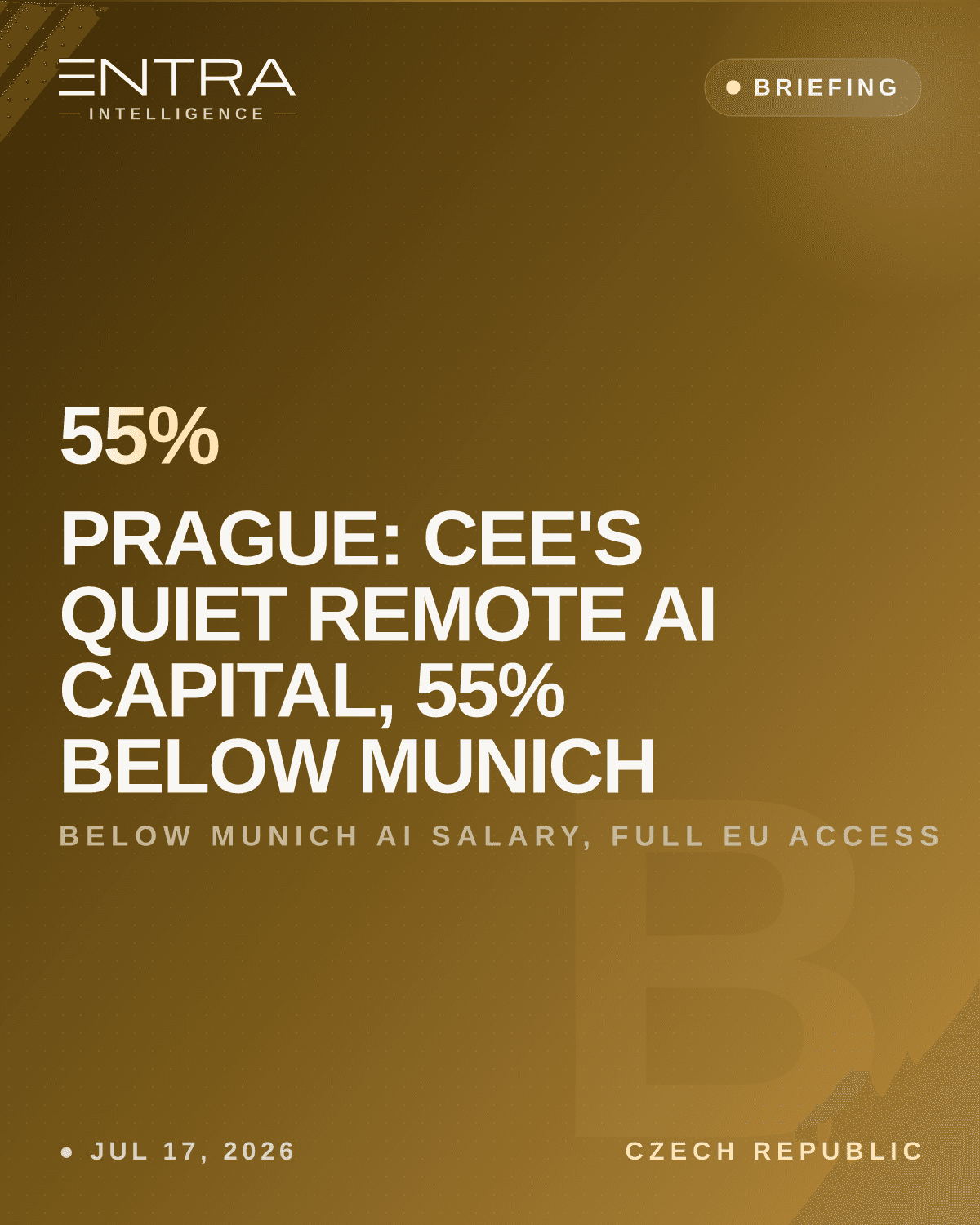
Prague's senior ML engineers earn CZK 115,000–170,000 per month gross (approximately €4,580–€6,772 per month, or €55,000–€81,000 annually) against a Munich band of €95,000–€150,000 for equivalent roles, per ENTRA's EU AI Salary Index H1 2026 and JoinIT DE Q2 2026 salary benchmarks. The gross differential runs 45–55 percent. After adjusting for Czech cost of living, which Numbeo's Q2 2026 composite places 44 percent below Munich, the effective purchasing-power gap compresses to approximately 10–18 percent at the senior-IC band. For employers building remote AI teams inside the EU perimeter, that is the Prague thesis in two numbers: a team-cost advantage that holds on gross, and a cost-of-living buffer that makes Prague-based engineers genuinely competitive on household economics with Munich and Berlin peers.
The Czech Republic has been an EU member since 2004, operates inside Schengen, and carries AA– sovereign ratings from both S&P and Fitch as of mid-2026. Its broadband infrastructure averages 131 Mbps fixed download speed per DESI 2025 data, above the EU-27 average of 117 Mbps, presenting no technical constraint on distributed AI engineering. Czech Technical University (ČVUT) has been graduating engineers since 1707. Oracle, Microsoft, and SAP each built development and support centres in Prague before the distributed-work era made those decisions look prescient. What has shifted in H1 2026 is the rate at which distributed-native employers (Berlin AI startups, Dutch fintech scale-ups, Belgian enterprise software companies) are directly contracting Prague engineers on remote agreements without requiring Czech-office affiliation. The CEE arbitrage has been legible on paper for years. In 2026, it is being realised at hiring velocity.
The University Pipeline
Czech Technical University in Prague (ČVUT, founded 1707) is Central Europe's oldest technical institution and one of its two most productive AI engineering sources. Its Faculty of Electrical Engineering (FEL) and Faculty of Information Technology (FIT) graduate approximately 1,700–2,100 engineers annually across computer science, electrical engineering, and information technology tracks. ČVUT's Czech Institute of Informatics, Robotics and Cybernetics (CIIRC) operates the university's principal AI and robotics research function, housing more than 250 researchers as of mid-2026 per CIIRC's published institutional data. CIIRC's machine learning, computer vision, and autonomous systems groups publish consistently at NeurIPS, ICLR, and CVPR, and the Institute's industry PhD programme places approximately 30 candidates per year directly into applied AI roles at Czech and European employers. Active industry co-investigators at CIIRC include Toyota Research Institute Europe, Siemens, and CERN: a research partnership profile that positions ČVUT's output well above the Central European average for direct frontier-lab legibility.
Charles University (Univerzita Karlova, founded 1348), the oldest university in Central Europe, contributes through its Faculty of Mathematics and Physics (MFF), which graduates approximately 700–900 CS and applied mathematics students annually. MFF's Computer Science Institute maintains active research groups in natural language processing, machine learning theory, and computer vision, with a particular concentration in multilingual NLP (Czech-German and Czech-English parallel corpus work) that is directly relevant to the open-source multilingual fine-tuning wave accelerating across European AI in 2026.
Combined, ČVUT and Charles University produce approximately 2,400–3,000 CS and engineering graduates per year with AI-adjacent qualifications, per ENTRA's analysis of published institutional enrolment and graduation data (2024–25 academic year). The two institutions together constitute one of the deepest per-capita CS graduate pipelines in Central Europe, ahead of every Slovak, Hungarian, or Austrian technical university by graduate volume.
The Employer Landscape
Prague's established tech employer base is institutionally dense in ways that distinguish it from other CEE cities. Oracle's Global Cloud Support Organization (GCSO) employs approximately 1,500 engineers and technical staff in Prague, per ENTRA's LinkedIn headcount analysis, including a growing cloud infrastructure and ML engineering function as Oracle Cloud Infrastructure (OCI) expands its EU data residency commitments under GDPR Article 28 processor terms. Microsoft's Czech development centre has been operating in Prague since the mid-1990s; its H1 2026 headcount additions concentrated in Azure AI and Copilot engineering tracks, consistent with Microsoft's announced global AI engineering expansion programme. SAP's Czech operations contribute to Joule AI and Business AI stack development across the Walldorf-to-Prague engineering corridor.
JetBrains, whose development tooling serves more than 12 million developers globally, was co-founded in Prague in 2000 and retains a substantive engineering presence in the city. Its JetBrains AI and AI Assistant products, built on fine-tuned open models including Mellum (the company's code completion model released in H1 2026), are developed partly from the Prague engineering team. The Prague JetBrains function sits at the intersection of developer tooling and LLM inference optimisation, making it one of the few Prague employers whose AI engineering output is directly legible to the open-source model fine-tuning ecosystem.
Productboard, the Czech-founded product management platform that reached unicorn valuation at $1.7B in its 2021 Series D (backed by Tiger Global and Dragoneer), maintains its principal engineering and AI development functions in Prague. The company's AI roadmap for H2 2026, centred on AI-assisted product discovery and automated feedback synthesis, is generating active Prague hiring for ML and applied science roles. Kiwi.com, headquartered in Brno with a Prague engineering presence, operates one of the Czech Republic's most production-hardened AI systems: itinerary optimization models and disruption management intelligence processing high search volume across 600+ airline partners.
The pattern that defines H1 2026 specifically is inbound remote contracting. German, Dutch, and Belgian AI-native employers are establishing Czech employer-of-record arrangements or Czech s.r.o. entity structures (both accessible within five business days for new registrants) to hire Prague engineers directly on EU-law contracts without requiring physical office establishment. That low-friction remote-onboarding path is what distinguishes the Czech legal environment from, for example, Poland's or Hungary's comparable engineering pools, where employment law complexity adds 6–8 weeks to remote-hire setup.
The Cost Math
The three-city comparison that anchors most senior-IC negotiations targeting CEE remote talent in H2 2026:
| Market | Senior AI Eng Gross/yr | Est. Net | 2BR Central Rent | Net Purchasing Power vs Prague | |---|---|---|---|---| | Prague (CZ) | €55K–€81K | €41K–€60K | €900–€1,400/mo | Baseline | | Munich (DE) | €95K–€150K | €56K–€89K | €2,300–€3,500/mo | +5–15% | | Berlin (DE) | €80K–€125K | €46K–€73K | €1,800–€2,700/mo | Roughly parity | | Amsterdam (NL) | €80K–€130K | €56K–€91K* | €1,900–€2,900/mo | +8–18% |
*Amsterdam figure assumes 30 Percent Ruling eligibility; without it, Dutch net runs 6–9 points lower.
(CZK/EUR at €1 = CZK 25.1, Q2 2026. EUR/USD at ~$1.092, Q2 2026. Czech net reflects 15% flat income tax plus approximately 11% employee-side health and social contributions; effective take-home approximately 74% of gross for typical senior engineer. German net reflects progressive marginal rates reaching 42% above €66K plus solidarity surcharge and social contributions. Net figures illustrative; not tax advice. Prague rent: Vinohrady, Žižkov, Smíchov districts, mid-2026. Munich/Berlin/Amsterdam: comparable central districts.)
The Munich comparison is the one that drives negotiation. At a Prague gross of €70,000 and Munich gross of €120,000, the net differential is approximately €52K versus €70K, a gap of €18K per year. Prague central housing at €1,200 per month against Munich's €2,800 per month reduces the housing spend differential by approximately €19K per year. The math resolves to purchasing-power parity or better at Prague gross bands above €65K when housing is included. Remote employers who build that arithmetic into their compensation model, rather than anchoring to Munich gross without cost-of-living adjustment, are the ones closing Prague senior engineers in H2 2026.
EU AI Act and the Czech Compliance Environment
The Czech Republic is fully subject to the EU AI Act (Regulation (EU) 2024/1689) as an EU member state. The national supervisory authority for GDPR purposes is the Office for Personal Data Protection (Úřad pro ochranu osobních údajů, ÚOOÚ), which has been designated as the competent authority for AI Act national implementation coordination. Article 50 transparency obligations, requiring disclosure when users interact with AI-generated content or AI systems capable of manipulating or deceiving, became effective August 2, 2026, and apply to any product with Czech or EU users regardless of the engineering team's location. The Annex III high-risk AI system compliance deadline, requiring technical documentation under Article 11, risk management under Article 9, and conformity assessment before placing high-risk AI systems on the EU market, is December 2, 2027.
For employers building Prague remote teams in AI compliance, governance, or responsible AI roles, the Czech regulatory credential carries the same EU-perimeter standing as an equivalent Berlin or Amsterdam hire. ENTRA's monitoring of Prague-area employer career portals through June 30, 2026, identified 34 active roles with explicit AI Act, AI governance, or responsible AI labelling, up from approximately 8 in H1 2025, a 325 percent increase tracking the broader EU compliance engineering wave. Czech employers building AI systems in Annex III categories (automated decision-making in employment, biometric classification, critical infrastructure management) are beginning compliance engineering hires 17 months ahead of the December 2027 deadline, consistent with the documentation lead time Article 11 technical dossier requirements imply.
H2 2026 Outlook
Three structural dynamics shape Prague's position through the end of 2026.
The EU Blue Card (Modrá karta EU) is Prague's primary onramp for non-EU AI talent. The Czech Republic's 2026 income threshold for EU Blue Card qualification is approximately 1.5 times the national average gross monthly salary: CZK 72,000 per month (~€2,870, ~€34,440 annually), per Czech Ministry of Interior published 2026 guidance. Every senior AI engineering role in the Prague market clears that threshold by design. Processing time at the Czech Ministry of Interior for standard applications runs 30–60 days from complete submission. For Ukrainian engineers, the largest non-EU AI-adjacent engineering community in Czech Republic at an estimated 8,000–12,000 IT workers as of mid-2026 per Czech Statistical Office immigration data, the Czech temporary protection status already permits employment without a separate work permit, creating a direct labour market integration pathway that no other CEE capital replicates at that volume.
Mistral's open-weight releases (Mistral 7B, Mixtral 8x22B, and the H1 2026 Mistral Small 3.1 update) are accelerating fine-tuning work at Prague employers without frontier-model compute budgets. ČVUT's CIIRC and Charles University's MFF NLP groups are active contributors to the Czech-language fine-tuning ecosystem building atop Llama 3 and Mistral base models. For employers who need Czech-German or Czech-Slovak multilingual AI capabilities, a direct product requirement for any Central European enterprise software company, Prague has the deepest native-language training data expertise in the CEE corridor. That is not a niche advantage. German-speaking Central Europe represents the EU's largest enterprise software market by revenue, and Czech-language models serve a directly adjacent user base.
The ČVUT-industry PhD pipeline is the long-run indicator. Approximately 30 industry-PhD placements per year from CIIRC, with an expanding cohort of EU AI startup co-investigators added in 2025 and 2026, means Prague's research-engineering output is self-replenishing in a way that hired-in distributed pools in Bratislava or Budapest are not. The convergence of that pipeline, a 15% flat income tax rate that simplifies compensation modelling for remote employers, and an EU Blue Card that processes in 30–60 days for qualified candidates is building the conditions for Prague's remote AI hiring volume to accelerate materially into 2027.
Není to jen o ceně. Je to o tom, co dostanete za tu cenu. It is not only about the price. It is about what you receive for that price. What Prague delivers is not an arbitrage that narrows when the frontier-lab competition intensifies: a CS graduate pipeline compounding for 300 years, a cost structure that closes the real-income gap with Munich, and an EU compliance credential with no discount. It deepens.
All salary figures represent ENTRA EU AI Salary Index H1 2026 estimates, cross-referenced against JoinIT DE Q2 2026 salary benchmarks, Welcome to the Jungle CZ salary data, and Glassdoor Czech Republic ML engineer data; individual offers will vary. CZK/EUR conversion at €1 = CZK 25.1 (Q2 2026 prevailing mid-market rate). EUR/USD at ~$1.092 (Q2 2026). ČVUT CS/engineering graduate output (~1,700–2,100 annually from FEL and FIT) and Charles University MFF graduate output (~700–900 annually) are ENTRA estimates based on published institutional enrolment and graduation data for the 2024–25 academic year; figures are approximations and have not been confirmed by ČVUT or Charles University. CIIRC headcount (~250 researchers, mid-2026) sourced from CIIRC published institutional data; CIIRC industry PhD placement (~30/year) from ENTRA analysis of CIIRC programme documentation. JetBrains developer count (12 million+) from JetBrains published product metrics. JetBrains founding date (2000, Prague) from publicly available company history. Productboard Series D valuation ($1.7B, 2021) from publicly reported funding round. Oracle GCSO Prague headcount (~1,500) is an ENTRA estimate from LinkedIn headcount analysis as of Q2 2026; Oracle has not confirmed this figure. Czech compliance-adjacent AI role count (34 roles H1 2026; approximately 8 H1 2025) sourced from ENTRA monitoring of Prague-area employer career portals and LinkedIn Czech Republic through June 30, 2026. Czech broadband speed (131 Mbps average fixed download, DESI 2025) and EU-27 average (117 Mbps) sourced from European Commission Digital Economy and Society Index 2025. Prague 2BR rent ranges (€900–€1,400/month, Vinohrady, Žižkov, Smíchov) reflect ENTRA analysis of Bezrealitky.cz and Sreality.cz listings, mid-2026; individual market outcomes vary. EU Blue Card Czech income threshold (CZK 72,000/month, approximately 1.5× national average) sourced from Czech Ministry of Interior published 2026 guidance; figure subject to annual revision; individual eligibility will depend on specific employer and role documentation. Ukrainian IT worker population in Czech Republic (8,000–12,000, mid-2026) is an ENTRA directional estimate based on Czech Statistical Office immigration data and ČSSD analyst reports; not an official statistic. Czech income tax flat rate (15%) and social/health contribution estimate (~11% employee side) reflect Czech income tax law 586/1992 Sb. and applicable 2026 rates; effective take-home figures are illustrative estimates and not tax advice; individual outcomes depend on personal circumstances, applicable treaties, and contribution structure. German effective tax rate references reflect progressive income tax schedule as applicable to the stated gross ranges; illustrative only; not tax advice. EU AI Act enforcement dates: Article 50 transparency obligations effective August 2, 2026; Annex III high-risk system full compliance deadline December 2, 2027 per Regulation (EU) 2024/1689 and applicable transitional provisions. All ENTRA estimates are internal analysis and have not been confirmed by named companies or institutions.
 Global Career Platform
Find AI talent. Find your next role.
Booking is hotels. · Airbnb is apartments. · ENTRA is global careers.