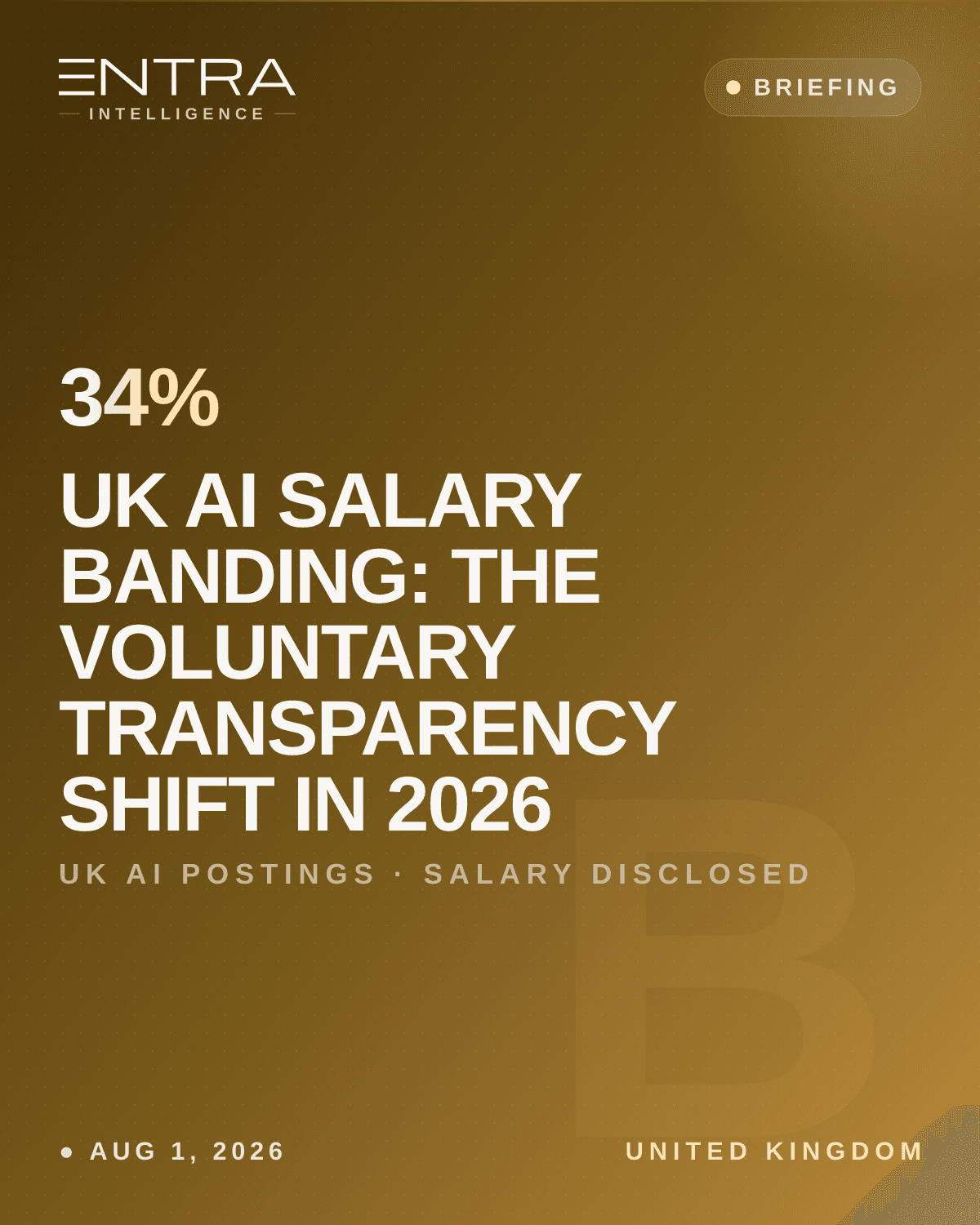
A third of UK AI job postings now include a salary range. No law required it. The ENTRA LinkedIn Job Signal Index, tracking more than 4,200 UK AI postings in Q2 2026, found that 34% disclosed a salary band — up from 22% in Q1 2025, a twelve-point rise in eighteen months without a single legislative intervention. The shift is driven by two asymmetric forces: EU Pay Transparency Directive Article 5 spillover onto the UK operations of multinationals, and a generation of US-trained engineers conditioned by Colorado, New York, and California disclosure laws to expect a number before agreeing to a first call. The result is a UK AI hiring market in which voluntary transparency has moved from competitive differentiator to near-default for employers serious about the senior IC pipeline. The gap between what employers will publish and what the full picture shows has become the real information asymmetry.
The UK's Transparency Patchwork
No UK statute requires salary disclosure in a job posting. The nearest analogue is gender pay gap (GPG) reporting, mandated by the Equality Act 2010 (Gender Pay Gap Information) Regulations 2017 for employers with 250 or more staff. GPG reporting requires disclosure of aggregate pay gap metrics, published annually by April 5, but contains no provision on band transparency for individual roles. The two frameworks are routinely conflated in employer communications; they measure different things entirely.
The distinction matters analytically. GPG data tells you the difference between the median man and median woman at a given employer. It tells you nothing about absolute pay levels, band widths, or whether a candidate presenting at a given level can expect a number before the third interview stage.
GPG filings from the UK's largest AI employers in 2025 are publicly available via the government's mandatory portal. DeepMind UK's 2025 report shows a median hourly pay gap of 18.3%, which the disclosure narrative attributes in part to the structural gender imbalance at senior-researcher level. ARM UK filed a 2025 gap of 14.2% — marginally below the Office for National Statistics tech-sector median of 15.7% for the same reporting period. Stability AI, which had fewer than 250 UK-based employees through most of 2025, is not required to file GPG data and has not published a voluntary report.
These are real disclosures. They are also not pay transparency. A candidate reading DeepMind's 18.3% gap knows that the organisation has an internal equity challenge at seniority level. They do not know whether the Research Engineer role they are interviewing for pays £105K or £145K at hire.
Who Is Publishing and What the Numbers Show
Against this disclosure patchwork, the voluntary band publishers are making a specific competitive argument: we will tell you the number before you invest time in the process.
Wayve — Alex Kendall's autonomous vehicle foundation-model company, which closed its Series C at $1.05B led by SoftBank in May 2024 and is now valued by ENTRA at approximately $8.6B on secondary market evidence from H1 2026 — began publishing salary bands on London job postings in Q1 2026. Its published Senior ML Engineer band is £120K–£175K base (~$152K–$221K), with EMI equity options structured against the current valuation sitting on top. The band width of £55K across a single grade is not imprecision; it signals the variance Wayve will carry depending on depth within the level. The floor clears the Skilled Worker visa general salary threshold of £38,700 with room to spare, and the ceiling exceeds what most UK-listed fintech employers are paying for equivalent applied ML tenure.
ElevenLabs' London office, operating out of Shoreditch as part of Mati Staniszewski's voice AI organisation at an $11B Series D valuation reached in February 2026, published a Staff AI Engineer band of £130K–£200K base (~$165K–$253K) on postings in Q2 2026. The £200K ceiling is a direct statement to senior engineers evaluating London against New York: this is not a discounted market. ElevenLabs competes for the same voice-model research and multilingual synthesis engineering profiles as Speechmatics and Synthesia across the King's Cross AI corridor, and publishing the band is part of the acquisition argument.
ENTRA's Salary Survey Q2 2026, drawing on 620 responses from UK-based AI professionals, locates the broader market. Senior ML Engineer (L5 equivalent) total compensation: £130K–£185K, median £155K (~$196K). Staff Research Scientist: £160K–£280K, with the top of that range concentrated in the King's Cross lab corridor at DeepMind and in the pre-IPO equity-heavy structures at ElevenLabs and Wayve. The UK median base salary across all AI roles in the survey sits at £95K — well above the Skilled Worker visa general floor but substantially below the US nominal median of approximately $200K. Adjusted for purchasing power parity, that US figure compresses to roughly £105K equivalent, narrowing the real gap to approximately nine percent at median. The headline arbitrage narrative on UK-versus-SF compensation overstates the shortfall.
ARM Cambridge — NASDAQ-listed, SoftBank-majority-owned, with the UK AI and ML engineering bench concentrated at its Fulbourn Road campus — does not publish role-level salary bands in UK postings as a matter of company policy. Candidate-submitted Glassdoor data runs £85K–£145K for senior ML hardware engineers in Cambridge, but that is not employer-confirmed data. ARM's restraint on band disclosure is the policy outlier among the companies in this analysis: its 2025 GPG filing is public but its posted compensation architecture is opaque.
EU Pressure on UK Multinationals
Post-Brexit, UK employers carry no obligation under EU Directive 2023/970/EU, the Pay Transparency Directive, which Member States were required to transpose into national law by 7 June 2026. Article 5 of that Directive specifically requires employers to publish salary range information in job vacancy notices. The Directive applies to EU-jurisdiction postings, not to postings in Great Britain.
But UK multinationals hiring across both geographies face an operational reality that is reshaping UK posting practice without any legislative compulsion.
DeepMind's parent, Alphabet, publishes salary ranges on EU postings to comply with the Directive. The same Alphabet HR infrastructure and job-posting system serves the King's Cross campus. Maintaining a separate, non-transparent UK posting architecture distinct from the EU-compliant Alphabet system requires deliberate engineering of a two-track disclosure policy. That friction is, in practice, not being absorbed: DeepMind's UK postings now frequently include salary ranges as a consequence of posting-system defaults and the cost of exception-management, not because UK law demands it.
Microsoft Research Cambridge — the ex-Cambridge ML research arm operating in collaboration with the Turing Institute — publishes ranges on UK postings as a direct consequence of Microsoft's global job-posting standards, originally adopted to comply with US state disclosure laws and now applied across all geographies. The effect is a Global Talent visa-eligible role at Microsoft Research Cambridge carrying a visible band without any UK regulatory driver.
The pattern is consistent: when a multinational's posting infrastructure is EU- or US-compliant by default, the UK operation inherits transparency that the UK legislative framework never required. Article 5 of the EU Directive is producing a de facto spillover into the UK AI hiring market through the operational preferences of the organisations that dominate the King's Cross corridor.
What 2027 Looks Like
The Labour government's Employment Rights Act 2025, which received Royal Assent in June 2025, extends mandatory GPG reporting but does not introduce salary band disclosure requirements for job postings. An Article 5-equivalent provision — requiring employers to publish an initial pay range in vacancy notices — has not appeared in secondary legislation consultation as of Q2 2026, and no parliamentary debate on the point has reached committee stage.
The voluntary market may pre-empt the question. ENTRA's Job Signal Index, at a current trajectory from 22% in Q1 2025 to 34% in Q2 2026, projects 45% voluntary disclosure in UK AI postings by Q2 2027 under a linear trend assumption. If the trajectory follows the US pattern — where voluntary disclosure preceded mandatory disclosure by two to three years before becoming effectively ubiquitous — the UK AI segment may reach majority disclosure before any consultation concludes. Labour's anticipated pay transparency consultation, expected in H2 2026 based on the government's Good Work Plan commitments, will find a market that has already moved significantly on its own terms.
For senior engineers evaluating UK AI roles in H2 2026, the operating condition is this: if you are interviewing with Wayve, ElevenLabs, or any multinational operating Directive-compliant EU postings, expect a number. If you are interviewing with an ARM-scale UK-listed organisation that has made no equivalent commitment, the band is still a negotiation variable — and you should ask before the second round, not the third.
ENTRA LinkedIn Job Signal Index: Q1 2025 and Q2 2026 figures from proprietary analysis of UK AI job postings tagged to ML, AI research, and data science functions across LinkedIn, Indeed, and employer career pages. ENTRA Salary Survey Q2 2026: 620 UK respondents, fielded May–June 2026; figures represent ENTRA estimates and are not confirmed by any named employer. Gender pay gap figures sourced from UK Government Gender Pay Gap Service mandatory filings; DeepMind UK and ARM UK 2025 reports publicly available at gender-pay-gap.service.gov.uk. Wayve valuation estimate per ENTRA secondary market analysis, H1 2026; not confirmed by Wayve. ElevenLabs Series D valuation per public announcement, February 2026. Skilled Worker visa general salary threshold per Home Office immigration salary list, effective April 2024. EU Pay Transparency Directive 2023/970/EU transposition deadline 7 June 2026 per official EU Journal. Employment Rights Act 2025 Royal Assent date June 2025 per UK Parliament records.
For Wayve's London hiring architecture, see Cambridge-Wayve-ARM: The Remote AI Cluster Analysis. For ElevenLabs' full UK bench profile, see Cambridge vs DeepMind: How ElevenLabs Is Building Its London Research Bench. For ARM Cambridge's mid-year AI hiring picture, see ARM Holdings Cambridge: AI Talent H1 2026.

 Global Career Platform
Find AI talent. Find your next role.
Booking is hotels. · Airbnb is apartments. · ENTRA is global careers.