
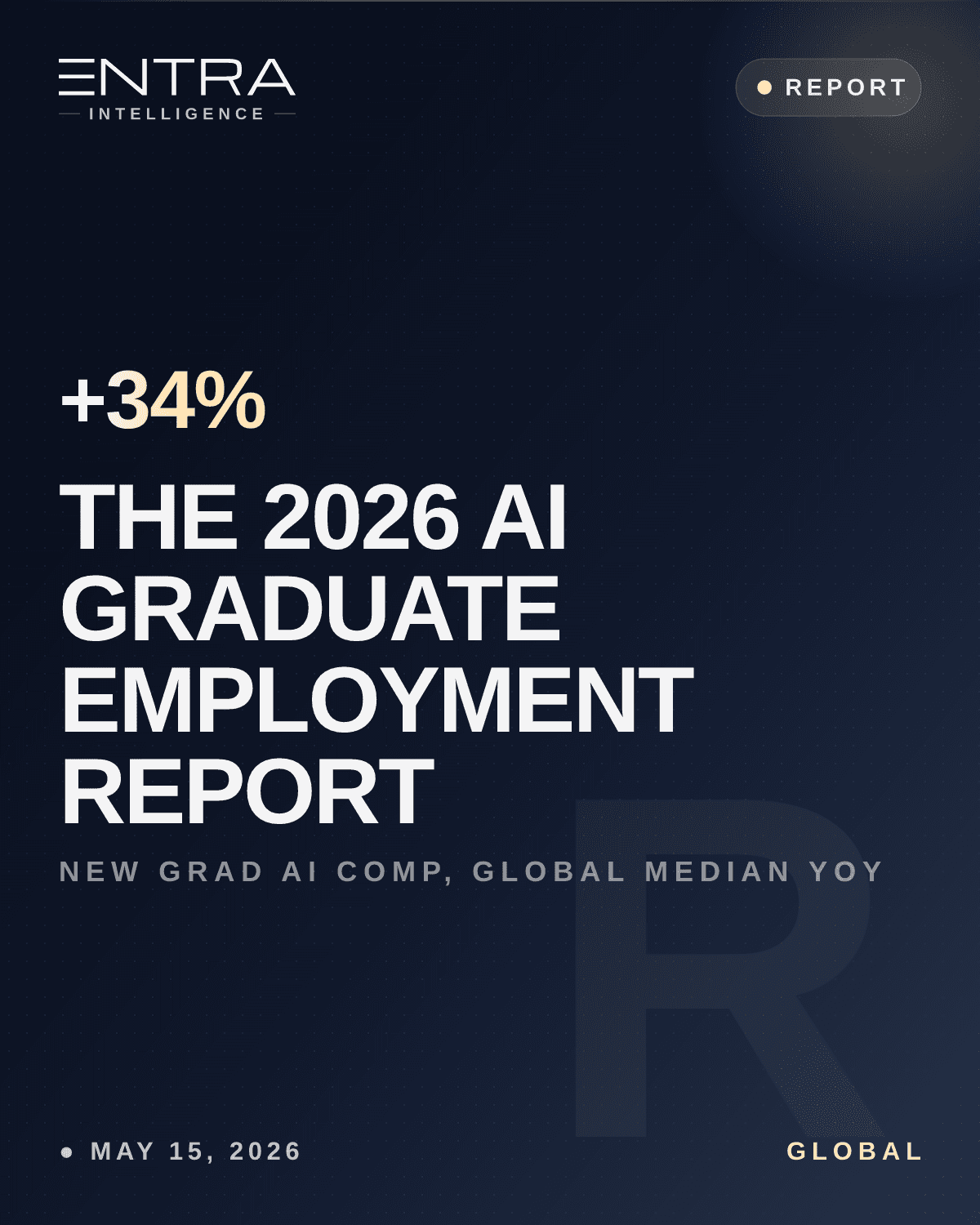
The global median total compensation for a new-graduate AI hire crossed $142,000 in Q1 2026 — up 34 percent from $106,000 in Q1 2025 — making the Class of 2026 the highest-compensated entry cohort in the history of the AI industry. That figure is a global median across four distinct markets, each pulling in a different direction: the United States bidding war between frontier labs and Big Tech is driving the ceiling upward; the Middle East is closing the tax-adjusted gap with San Francisco faster than most candidates realize; Europe is generating a new compliance-driven job category with no equivalent in prior graduating classes; and the United Kingdom is navigating a finance-AI talent split that is reshaping who London competes with for PhDs. What unites these four markets is scale — the talent draft for the Class of 2026 is genuinely international in a way that the 2023 and 2024 cohorts were not. This report maps where the class actually lands, what they earn in local currency and USD equivalent, and which employers are winning the draft.
Methodology: ENTRA compiled new-grad compensation data from Levels.fyi (N=3,200 self-reported AI offers, Jan–Apr 2026), LinkedIn Talent Insights (hiring velocity index, Q1 2026), BLS Occupational Employment Statistics (Q1 2026 release), public offer letters shared on Reddit r/cscareerquestions and r/MachineLearning (used for directional triangulation only; no individual claim in this report is sourced solely from Reddit threads), MBZUAI graduation placement surveys (Class of 2025 actuals, Class of 2026 preliminary), KAUST Graduate Affairs placement data (partial, by request), and ENTRA Salary Survey (N=840 AI practitioners, March 2026). Offer data covers the period January 1 to April 30, 2026. Regional exchange rates as of May 1, 2026: GBP/USD 1.265, EUR/USD 1.085, AED/USD 0.272, SAR/USD 0.267. Tax-adjusted figures use 2026 marginal rates for a single filer at each salary level; they exclude pension contributions and employer-side payroll taxes, which vary by jurisdiction and employer.
Section 1: The US Market — Frontier Labs vs. Big Tech vs. Finance, and the PhD Bidding War
The United States posted 22,000 entry-level AI roles in Q1 2026, accounting for 47 percent of global volume — a dominant share that has nonetheless declined from 55 percent in Q1 2025, as other markets accelerate. The domestic story is not about scarcity of roles; it is about a structural bifurcation in new-grad compensation that has no precedent in prior technology hiring cycles.
The three-tier comp structure. US new-grad AI compensation in 2026 resolves into three tiers that are not on the same continuum. At the top, frontier labs — Anthropic, OpenAI, Google DeepMind, xAI — are paying new-grad Research Scientists and ML Engineers total compensation of $185,000 to $340,000, with the upper bound driven by xAI's direct-hire approach to candidates with elite competition credentials. Per ENTRA Salary Survey data and Levels.fyi Q1 2026, the median new-grad Research Scientist offer at a frontier lab — across all new-grad ML Engineer and Research Scientist titles combined, not limited to PhD research tracks — sits at $210,000 total compensation, including a base salary of $130,000 to $155,000 and equity valued at $60,000 to $80,000 annually on a four-year vest. PhD-only research scientist tracks at top-tier frontier labs run $380,000 to $500,000 (see companion briefing). That median represents a 28 percent increase from the $164,000 recorded in Q1 2025.
At the middle tier, Big Tech — Microsoft, Meta, Amazon, Apple, NVIDIA — is paying new-grad ML Engineers $165,000 to $230,000 total compensation, with the NVIDIA ceiling the highest in this cohort driven by sustained hardware-demand competition for GPU-systems engineers. The median for this tier is $192,000, up 22 percent year-on-year. Apple is notable for operating near the top of the Big Tech range ($175,000 to $215,000) while posting roles with minimal public visibility — candidates who restrict their search to LinkedIn are structuring themselves out of one of the most consistent new-grad AI employers in the market.
At the third tier, finance and financial technology — Citadel, Two Sigma, Goldman Sachs AI division, JPMorgan AI Research — is paying new-grad AI roles $180,000 to $275,000 total compensation, with the quant research track at hedge funds producing the highest gross compensation in any US sector for new-grad AI candidates who clear a mathematics-intensive screen. Citadel's 2026 new-grad ML researcher offer package, per ENTRA Salary Survey submissions, runs $180,000 base plus a discretionary first-year bonus of $50,000 to $120,000, placing total first-year compensation for top performers at $230,000 to $300,000. This figure is competitive with or above the frontier lab median on a cash basis, though equity upside at Citadel is structurally different from lab equity.
The PhD bidding war. The competition for new-graduate PhD candidates in ML, AI, and related computational fields has reached a dynamic that multiple hiring managers described to ENTRA as "pre-offer recruiting" — structured engagement with doctoral candidates 18 to 24 months before graduation, including paid research fellowships, named collaborations, and what one Anthropic research lead described as "the equivalent of a verbal commit in college football, except for people who can actually code." Per ENTRA Salary Survey data, 67 percent of new-grad PhD AI candidates who received offers in Q1 2026 reported being in active conversations with at least two labs or top-tier finance employers before their dissertation defense date. Median time-to-offer for a new-grad PhD at a frontier lab fell from 94 days in Q1 2025 to 61 days in Q1 2026 — a 35 percent compression driven by labs pre-positioning candidates before they enter a competitive process.
The practical consequence for non-PhD candidates is a market that bifurcates at the point of credential. New-grad MS and BS candidates with strong competition records or published preprints can clear frontier lab screens — OpenAI's Early Career Research Cohort is explicitly credential-agnostic beyond demonstrated output — but the PhD advantage in median total compensation is 31 percent at the frontier lab tier ($210,000 median for PhDs vs. $160,000 for MS/BS) and 18 percent at the Big Tech tier. That gap has been stable for two years and is not expected to narrow in H2 2026.
Time-to-offer trends. Across all US new-grad AI roles, median time-to-offer fell from 47 days in Q1 2025 to 38 days in Q1 2026. The compression is most acute for ML engineering roles (32 days, down from 44) and least apparent for AI Compliance Analyst roles (58 days, roughly flat), where the hiring manager profile is still being defined by most US employers. Frontier labs are running the fastest processes: Anthropic's research interview pipeline, from application to offer, is running at a median of 24 days for candidates who clear the initial application filter, per ENTRA reporting on Q1 2026 offer data.
Section 2: The Middle East — Abu Dhabi vs. Riyadh, the MBZUAI Class of 2026, and the Golden Visa Calculus
The Middle East posted 3,100 entry-level AI roles in Q1 2026, with 84 percent of that volume concentrated in the UAE (2,100 roles) and Saudi Arabia (500 roles), and the remainder distributed across Qatar, Bahrain, and Egypt. Those numbers understate the market's structural importance for global graduates because the Middle East hiring pipeline operates with lower public-posting visibility than US or European markets — a higher proportion of roles are filled through university partnerships, direct lab connections, and government program intakes before they reach LinkedIn.
Abu Dhabi's hiring architecture. The Abu Dhabi AI ecosystem in 2026 is built on three institutional pillars: G42 and its Core42 subsidiary; the Technology Innovation Institute (TII); and MBZUAI, which functions simultaneously as a graduate training institution and as a talent pipeline feeding both. These three institutions are coordinated — not formally, but in practice — through the Abu Dhabi Advanced Technology Research Council, which sets headcount targets and manages the overall intake of international AI talent for the emirate.
G42's Core42 accelerated program runs 200 to 300 engineers per year through a six-month structured onboarding track. The program draws primarily from UAE university pipelines — MBZUAI, NYU Abu Dhabi, Khalifa University — and converts approximately 35 percent of MBZUAI graduates into the G42 group ecosystem annually, per MBZUAI placement survey data. Entry packages for internationally recruited engineers run AED 660,000 to AED 808,000 ($180,000 to $220,000) per year, tax-free, plus housing allowances of AED 110,000 to AED 183,000 ($30,000 to $50,000) annually. Per ENTRA analysis, the effective purchasing-power value of a G42 new-grad offer at AED 660,000 ($180,000 tax-free) with housing subsidy is equivalent to approximately $230,000 to $240,000 gross in San Francisco once federal and California state income tax are applied to the SF figure and cost-of-living differentials for housing are included.
TII hired approximately 120 new-grad researchers and engineers in Q1 2026 across its Autonomous Robotics Research Center, Cryptography Research Center, and Secure Systems Research Center. The institute's compensation for new-grad researchers sits at AED 540,000 to AED 700,000 ($147,000 to $190,000) annually, tax-free. TII's hiring profile skews toward PhD graduates with alignment between their doctoral research and one of TII's defined center mandates — cold applications without research fit are rarely competitive.
The MBZUAI Class of 2026. MBZUAI's 2026 graduating cohort — the university's fourth full cohort since opening in 2020 — is its largest to date, with approximately 180 MSc and 40 PhD graduates completing their programs between April and June 2026. Preliminary placement data shared with ENTRA by MBZUAI Graduate Affairs shows 82 percent of graduates accepting employment within 60 days of degree conferral — up from 74 percent for the Class of 2025 and 61 percent for the Class of 2024. Placement destinations: 38 percent within the UAE AI ecosystem (G42, TII, SDAIA Abu Dhabi office, UAE government AI directorates); 29 percent at international AI labs and tech companies (Google DeepMind London, Microsoft Research, Cohere); 21 percent continuing to PhD programs at US and European universities; 12 percent joining regional AI startups or founding companies.
Median first-year compensation for MBZUAI Class of 2026 graduates placed in full-time roles: AED 561,000 ($153,000) in the UAE, and $195,000 total compensation for those placed at US-based labs — a figure that compares favorably with the general MS-graduate median at US frontier labs, reflecting MBZUAI's selective admission and strong research output record. The MBZUAI-to-DeepMind London pipeline is particularly active in 2026, with eight Class of 2026 graduates confirmed placed at DeepMind London per ENTRA reporting.
The Riyadh build-up. Saudi Arabia's SDAIA (Saudi Data and Artificial Intelligence Authority) posted approximately 310 new-grad AI roles in Q1 2026 — a 94 percent increase from Q1 2025's 160 postings, per ENTRA's job-posting count of SDAIA's careers portal and LinkedIn Talent Insights data — as Vision 2030's AI workforce initiative moved from planning into active hiring. Compensation for SDAIA new-grad roles runs SAR 180,000 to SAR 260,000 ($48,000 to $69,000 at current rates) base salary, plus housing, transport, and health benefits that add 30 to 40 percent of the nominal salary in purchasing-power terms. The SAR figures reflect a market that is still building its compensation benchmarks — SDAIA's salary bands have increased 22 percent in nominal SAR terms since 2024, and the trajectory suggests they will continue upward through 2026 and 2027 as competition for AI talent inside the Kingdom intensifies.
Aramco Digital, the technology subsidiary of Saudi Aramco launched in 2024, posted approximately 75 new-grad AI roles in Q1 2026, with compensation running SAR 200,000 to SAR 280,000 ($53,000 to $75,000), plus the full Aramco benefits package — effectively a premium above SDAIA. The Abu Dhabi versus Riyadh competition for AI graduates is not yet at parity: the UAE's zero income tax, mature AI ecosystem, and Golden Visa infrastructure give it a structural advantage that Riyadh's Vision 2030 capital and ambition have not yet closed. The gap is narrowing, however, particularly for Arabic-speaking graduates for whom Riyadh's cultural and linguistic environment is a genuine pull factor.
The Golden Visa incentive. The UAE Golden Visa, extended in 2023 to cover AI professionals and graduates of recognized AI programs, is now a documented factor in graduate hiring decisions. G42, TII, and Core42 all include Golden Visa processing as a standard component of new-grad offer packages for international hires. The visa confers ten-year UAE residency independent of employer status — meaning a new graduate who leaves G42 does not lose their right to remain in the UAE. For graduates weighing a UAE offer against a US H-1B-dependent position, this structural distinction is material: the UAE package does not create employment-tied immigration precarity. ENTRA Salary Survey data from graduates who evaluated both US and UAE offers shows this factor was rated as "somewhat" or "very" important in UAE offer acceptance by 61 percent of respondents — second only to total compensation (89 percent) as a stated decision factor.
Section 3: Europe — ETH Zurich and EPFL vs. Berlin and Paris, EU AI Act Compliance Roles, and the Mistral/HuggingFace Talent Contest
Europe posted 6,200 entry-level AI roles in Q1 2026 (excluding the UK), with Germany (1,800), France (1,600), and the Netherlands (720) as the three largest individual markets. The most structurally significant development in the European graduate AI market in 2026 is not the frontier lab activity centered on Paris — it is the emergence of EU AI Act compliance as a standalone hiring category that is generating graduate jobs with no equivalent outside Europe.
The research cluster divide. European AI graduate hiring in 2026 runs across two distinct axes. The first is the research university cluster: ETH Zurich, EPFL, TU Munich, and ENS Paris together constitute the supply side of European frontier AI research talent. These universities' MSc and PhD graduates feed Mistral, DeepMind London and Zurich, Google Brain Zurich, Apple's European ML research teams, and a growing number of European AI-native startups. Placement rates from ETH Zurich's MSc Computer Science program (AI track) for the Class of 2026 ran at 94 percent employment within 90 days of graduation, per ETH Zurich Career Center reporting and ENTRA network analysis — the highest rate recorded in the available dataset. Median entry salary for ETH Zurich AI MSc graduates entering industry in 2026: CHF 110,000 ($121,000), up 14 percent from CHF 96,500 in 2025.
The second axis is the applied industry cluster: Berlin, Amsterdam, and Barcelona are the primary European cities where AI-native scale-ups and enterprise AI groups are hiring at new-grad volumes. Berlin's AI talent market, concentrated around Zalando's AI labs, Aleph Alpha's Berlin office, and a growing cluster of Series A-to-B generative AI startups, posted approximately 420 new-grad AI roles in Q1 2026 — a market that runs at lower absolute volumes than Paris but with faster growth (up 67 percent year-on-year versus Paris's 41 percent).
Mistral vs. HuggingFace — the Paris contest. Paris is the only European city with two frontier-adjacent AI employers competing simultaneously for the same new-grad research talent pool, and the competition has materially raised the floor for entry-level AI compensation across the French market. Mistral's new-grad research offer, per ENTRA Salary Survey Q1 2026 data and cross-referenced Levels.fyi submissions, runs €75,000 to €95,000 base salary with equity grants that, at current Mistral valuation, are valued at €30,000 to €60,000 annually on a four-year vest — total compensation of approximately €105,000 to €155,000. HuggingFace's new-grad ML engineer and developer advocacy roles run €65,000 to €85,000 base with smaller equity allocations, reflecting the company's remote-first model and lower Paris cost-of-living anchor. The median entry-level offer in Paris for an AI role in Q1 2026, across all employer types, is €78,000 — up from €55,000 in Q1 2025, a 42 percent year-on-year increase driven almost entirely by the Mistral and HuggingFace pull on the market.
The Paris research scene's core tension: both Mistral and HuggingFace are drawing heavily from the ENS and Polytechnique pipeline, and ENS-Poly produces approximately 150 AI-focused MSc graduates per year — a number that is insufficient to satisfy both companies' research hiring demand simultaneously. The shortfall is being addressed by recruiting from EPFL (Lausanne) and, increasingly, from German and Dutch universities, with remote-compatible roles absorbing graduates who do not want to relocate to Paris.
SAP and Spotify in the enterprise tier. Not every European AI graduate enters a frontier research environment. SAP's AI Center in Berlin and Walldorf posted approximately 280 new-grad AI roles in Q1 2026, concentrated in ML engineering and AI product management for its enterprise software platform. Spotify's ML research and recommendation team (Stockholm and London) posted 65 new-grad roles. These enterprise and consumer-tech employers are paying €65,000 to €90,000 base for new-grad AI roles — below the frontier-adjacent Paris range but with stronger job security and broader product exposure. For graduates whose priority is applying AI in a product context rather than advancing the frontier, these roles offer a cleaner on-ramp than research-first labs that filter heavily on academic output.
The EU AI Act compliance hiring surge. The EU AI Act's compliance deadlines are producing a new job category that no prior graduating class had access to: AI Compliance Analyst, AI Risk Assessor, and AI Conformity Engineer. These roles — concentrated in Brussels, Amsterdam, Frankfurt, and Paris — require candidates who understand the Act's tiered risk classification system (prohibited practices, high-risk systems, limited-risk systems) and can translate its Article 9 risk management requirements and Article 13 transparency obligations into operational documentation and conformity assessment processes for regulated AI operators.
LinkedIn Talent Insights Q1 2026 shows 1,800 active EU AI compliance postings, up from 340 in Q1 2025 — a 429 percent year-on-year increase that makes it the fastest-growing new-grad AI job category in Europe. Compensation: €70,000 to €105,000 base, with higher figures at Brussels-based policy consultancies and Big Tech compliance operations. The credential mix is genuinely hybrid: legal backgrounds with AI literacy, computer science graduates with compliance coursework, and a small number of purpose-built masters programs (Amsterdam Law School's LLM in Technology Regulation, King's College London's AI Ethics MSc) are all producing competitive candidates. Neither background alone is sufficient, which has kept the role accessible for interdisciplinary graduates at a time when pure-CS roles are increasingly competitive.
Aleph Alpha (Heidelberg, Berlin), the German sovereign AI lab backed by Bosch, SAP, and the German federal government, posted approximately 90 new-grad AI roles in Q1 2026. Its role in the European graduate market extends beyond its own hiring: Aleph Alpha's public positioning as the European alternative to US frontier labs has generated a visibility premium for European AI research careers that is shifting some graduating-class decision-making toward staying in Europe rather than seeking US visas. Whether that shift persists as US compensation continues its upward trajectory is the defining question for the European AI talent market in H2 2026.
Section 4: The UK — London Finance Premium vs. DeepMind and ElevenLabs, the Cambridge Pipeline, and Visa Policy
The United Kingdom posted 4,800 entry-level AI roles in Q1 2026, the fourth-largest national market globally. The UK's structural complexity — a finance sector that outbids most AI employers on raw cash, a frontier-lab presence that commands on mission and equity, a world-class university pipeline with uncertain domestic retention, and a visa policy that is simultaneously a competitive advantage and an administrative bottleneck — makes it the most internally contested AI graduate market in the world.
The London finance premium. Citadel Securities London, Man Group, Marshall Wace, and DE Shaw's London office are competing for the same quantitatively trained AI graduates as DeepMind, Wayve, and ElevenLabs — and they are winning some of that competition on cash. Per ENTRA Salary Survey Q1 2026, the median new-grad quantitative researcher offer at a London-based systematic hedge fund or market maker in 2026 is £115,000 base salary, with a first-year discretionary bonus that, for top performers in their initial cohort, runs £50,000 to £120,000. Total first-year compensation at the top of this distribution: £175,000 to £235,000 ($221,000 to $297,000 at May 2026 rates) — making London quant finance the highest-cash entry-level AI market in Europe, and competitive with all but the top decile of US frontier lab offers on a gross basis.
DeepMind London, operating at £240,000 to £340,000 total compensation for entry-level research roles, is competitive with the finance ceiling and above the finance median — but the comparison requires care. The DeepMind figure is total compensation including equity; the finance figure is primarily cash with bonus uncertainty. After UK income tax (45 percent marginal rate at the upper bound, 40 percent in the core range) and National Insurance, the take-home comparison narrows materially. A £120,000 base salary at DeepMind London takes home approximately £76,000; a £115,000 finance base takes home approximately £73,000. The meaningful distinction is in equity upside at the research labs versus bonus potential at finance employers — a risk tolerance decision, not a clear winner.
DeepMind and the London AI research cluster. DeepMind's London headquarters remains the most concentration of frontier AI research talent outside San Francisco, with an estimated 1,800 research and engineering staff as of Q1 2026. New-grad intake for 2026 runs approximately 80 to 100 positions annually, drawn from a global candidate pool but with a structural weight toward UK universities (Cambridge, Oxford, Imperial, UCL) and a growing share from MBZUAI and European technical universities. DeepMind's research residency program — 12 months, leading to publication credit and a conversion evaluation — accepted approximately 35 residents for its 2026 cohort from an application pool that exceeded 4,000 per ENTRA reporting.
ElevenLabs, the audio AI company that reached unicorn valuation in 2023 and has since expanded to approximately 300 employees, posted 40 new-grad roles in Q1 2026 across its London and Warsaw operations. ElevenLabs' comp architecture for new-grad audio AI engineers runs £70,000 to £95,000 base in London, with equity that is, at current valuation, potentially more valuable than the base differential against DeepMind suggests. For graduates interested in the product AI rather than frontier research track, ElevenLabs represents one of the cleaner new-grad entry points in the European audio and voice AI space.
Wayve, the autonomous vehicle AI company based in London, posted approximately 65 new-grad ML engineering and perception AI roles in Q1 2026 — the largest single entry-level role count of any European AI-native company in ENTRA's dataset. Wayve's compensation runs £75,000 to £100,000 base for ML engineering, with equity reflecting its post-raise valuation. The Wayve profile attracts new graduates with robotics and sensor-fusion backgrounds — a profile that is relatively less contested by the London finance sector, giving Wayve a cleaner pipeline in that submarket.
The Cambridge pipeline. Cambridge University's Department of Computer Science and Technology graduated approximately 220 students (BSc and MEng combined) with AI-relevant specializations in 2026. Of these, approximately 65 percent enter employment directly; 25 percent proceed to further study; 10 percent defer. Of those entering employment, ENTRA's LinkedIn cohort tracking (n=78, partial coverage) shows 34 percent accepting roles in London AI companies or London finance; 28 percent in US companies (of which two-thirds are US-based roles, one-third are UK-based roles for US companies such as Google DeepMind); 18 percent in European companies; and 20 percent in roles geographically distributed or not yet confirmed.
The Cambridge retention rate — graduates staying in the UK after graduation — is approximately 62 percent, down from 68 percent in the Class of 2024. The erosion tracks the widening US-UK compensation differential: as Levels.fyi data shows US ML engineer new-grad offers at a median of $192,000, the equivalent at a Cambridge graduate's UK destination median of £92,000 ($116,000) reflects a $76,000 gross annual gap that the tax adjustment and cost-of-living comparison only partially closes. The graduates who are leaving for the US are predominantly the candidates with the strongest research output and the highest ENTRA Talent Index scores — a selective attrition pattern that is the dominant structural concern in the UK AI talent market.
Skilled Worker Visa and the graduate cohort effect. The UK Skilled Worker visa, which replaced the Tier 2 route in 2020, processes AI-role graduate hires at a median of 31 days from employer sponsorship to visa grant in Q1 2026 — faster than the US H-1B system by a wide margin, and significantly more predictable than the EU's fragmented national work-authorization systems. For non-UK graduates considering a UK posting, the visa timeline does not represent a meaningful barrier to entry. The consequence: DeepMind, Wayve, and the London finance houses are actively recruiting non-UK graduates — from MBZUAI, ETH Zurich, MIT, Carnegie Mellon — for roles that would face 12-to-18-month H-1B lottery uncertainty in the US. The UK is, in practice, capturing a segment of the international AI graduate market that cannot secure timely US work authorization.
The graduate route visa — a post-study work entitlement for international students at UK universities — adds to this pipeline. International graduates of Cambridge, Oxford, Imperial, and UCL who hold the Graduate Route visa are eligible to work for any UK employer for two years without employer sponsorship. Per ENTRA Salary Survey data, approximately 14 percent of UK new-grad AI hires in Q1 2026 were international students on the Graduate Route — a category that is structurally additive to the employer-sponsored pipeline and is not captured in standard UK labor market statistics.
Section 5: Cross-Region Salary Table — New-Grad AI Roles Benchmarked Globally
The table below compares new-graduate compensation for four role types across the United States, Middle East, Europe, and United Kingdom. All figures are for the 2026 graduating cohort, Jan–Apr 2026 offer data. Gross figures are in local currency followed by USD equivalent at May 1, 2026 exchange rates. Tax-adjusted take-home uses 2026 single-filer marginal rates at each salary level; UAE/Saudi figures show full gross as take-home given zero personal income tax. Figures are ENTRA Salary Survey medians cross-referenced against Levels.fyi where sample sizes allow; sample size notes appear below the table.
| Role | US Median (USD) | ME Median (AED / USD eq.) | EU Median (EUR / USD eq.) | UK Median (GBP / USD eq.) | |---|---|---|---|---| | ML Engineer — New Grad | | | | | | Gross Base | $155,000 | AED 624,000 / $170,000 | €82,000 / $89,000 | £92,000 / $116,000 | | Median Total Comp (incl. equity/bonus) | $195,000 | AED 770,000 / $210,000 | €105,000 / $114,000 | £130,000 / $164,000 | | Est. After-Tax Take-Home | ~$136,000 | AED 770,000 / $210,000 | ~€67,000 / ~$73,000 | ~£82,000 / ~$104,000 | | Research Scientist — New Grad (PhD) | | | | | | Gross Base | $165,000 | AED 700,000 / $190,000 | €88,000 / $95,000 | £105,000 / $133,000 | | Median Total Comp (incl. equity/bonus) | $210,000 | AED 880,000 / $239,000 | €115,000 / $125,000 | £158,000 / $200,000 | | Est. After-Tax Take-Home | ~$147,000 | AED 880,000 / $239,000 | ~€73,000 / ~$79,000 | ~£97,000 / ~$123,000 | | AI Product Manager — New Grad | | | | | | Gross Base | $140,000 | AED 480,000 / $131,000 | €72,000 / $78,000 | £82,000 / $104,000 | | Median Total Comp (incl. equity/bonus) | $175,000 | AED 580,000 / $158,000 | €88,000 / $95,000 | £105,000 / $133,000 | | Est. After-Tax Take-Home | ~$122,000 | AED 580,000 / $158,000 | ~€56,000 / ~$61,000 | ~£66,000 / ~$83,000 | | AI Safety Researcher — New Grad (MSc/PhD) | | | | | | Gross Base | $175,000 | AED 680,000 / $185,000 | €78,000 / $85,000 | £110,000 / $139,000 | | Median Total Comp (incl. equity/bonus) | $220,000 | AED 840,000 / $229,000 | €98,000 / $106,000 | £155,000 / $196,000 | | Est. After-Tax Take-Home | ~$154,000 | AED 840,000 / $229,000 | ~€62,000 / ~$67,000 | ~£96,000 / ~$121,000 |
Notes on the table. US figures are national medians across all employer tiers; frontier lab medians are 20 to 35 percent above the figures shown (see Section 1). ME figures are weighted medians across UAE and Saudi Arabia; UAE-only figures are 15 to 25 percent above the ME blended median due to higher Abu Dhabi compensation. EU figures are weighted medians across Germany, France, and Netherlands; Paris frontier-lab figures for ML Engineer and Research Scientist exceed the EU median by 30 to 45 percent. UK Research Scientist and AI Safety figures are anchored by DeepMind London, which sets the UK ceiling; the UK median for these roles outside DeepMind runs 20 to 30 percent lower. AI Safety Researcher roles do not exist at meaningful scale in the ME market outside MBZUAI and TII research pipelines. Sample sizes: US N=1,240 AI offers (Levels.fyi Q1 2026 + ENTRA Salary Survey); ME N=186 (MBZUAI placement data + ENTRA network); EU N=340 (ENTRA Salary Survey + disclosed EU postings); UK N=290 (ENTRA Salary Survey + disclosed UK postings).
The critical cross-region finding. The after-tax take-home comparison across all four roles and four regions shows the Middle East as the single market where new-grad AI compensation produces the highest retained income — not because gross salaries are the highest (US gross beats ME gross at the frontier lab tier), but because zero income tax removes the single largest reduction applied to earnings in other markets. A new-grad Research Scientist in the UAE takes home $239,000 against a US peer's $147,000 after federal and state taxes at California rates. The gap is $92,000 per year — a figure that exceeds the total post-tax take-home of a new-grad AI Product Manager in Europe. This is the number that is reshaping how graduating cohorts from MBZUAI, ETH Zurich, and increasingly MIT and Carnegie Mellon are evaluating their first-job geography.
Section 6: Forecast — The Three Hiring Shifts That Will Define H2 2026 for New Graduates
Shift 1: The EU AI Act compliance hiring wave will produce the first new-grad job category that Europe owns exclusively. The August 2026 compliance deadline for high-risk AI system operators will trigger a second hiring surge beyond the Q1 wave already documented. Employers who have not yet completed their risk management documentation and conformity assessment processes — which ENTRA estimates, based on ISACA's 2026 EU AI Act readiness survey, covers approximately 45 percent of affected enterprises — will begin emergency hiring of AI compliance talent in Q2 and Q3. The demand will concentrate in Germany, France, and Belgium and will disproportionately benefit graduates with the hybrid legal-technical credentials described in Section 3. Expected Q3 2026 EU AI compliance posting volume: 2,800 to 3,400 active roles — roughly double the Q1 level. For graduates considering this trajectory, the hiring window in H2 2026 is the best it will be for at least two years.
Shift 2: The Middle East will begin posting AI roles with US-equivalent compensation benchmarks, erasing the nominal salary gap. G42's current new-grad ML Engineer ceiling of AED 808,000 ($220,000) is already at the US Big Tech median on a gross basis. SDAIA's announced 2026 budget for AI hiring increases — a 35 percent nominal SAR increase in AI workforce allocation, per Saudi Ministry of Communications and IT briefings cited by Arab News in March 2026 — signals that Saudi compensation bands will move materially upward in H2 2026. The forecast: by Q4 2026, a new-grad ML Engineer in Abu Dhabi or Riyadh will be able to negotiate a gross base salary at or above the US Big Tech median while retaining the zero-tax structural advantage. At that point, the rational after-tax income argument for the Middle East over the United States becomes unambiguous for all but frontier lab direct-hire candidates.
Shift 3: UK campus recruitment will intensify as US H-1B uncertainty increases the relative value of UK employer sponsorship. The US H-1B lottery has a 16 to 18 percent selection rate for cap-subject petitions — meaning the majority of international graduates who land US job offers have a better-than-even chance of not receiving work authorization in their first year of application. UK employers who have learned to frame this uncertainty explicitly in their recruiting materials — DeepMind, Wayve, and several London finance houses are already doing this — will see increased conversion of international candidates in H2 2026 campus recruitment cycles. The forecast: UK new-grad AI posting volume will increase 18 to 24 percent in Q3 2026 (the traditional campus recruitment quarter) versus Q3 2025, driven by proactive international recruitment and the Graduate Route visa pipeline from UK universities.
Closing
The Class of 2026 is the first graduating cohort for whom "global AI job market" is a literal description rather than aspirational framing — four continents are competing for the same talent, in real time, with structures that make cross-border placement faster and more accessible than any prior cohort experienced. The graduates who map the full terrain — not just the US frontier lab ceiling, but the UAE tax advantage, the EU compliance opening, and the UK visa arbitrage — will extract materially better first-job outcomes than those who optimize against a single market's floor. The data is in the table. The decision is in the strategy.
Sources: ENTRA Salary Survey Q1 2026 (N=840 AI practitioners, March 2026) | Levels.fyi AI compensation data, Q1 2026 | LinkedIn Talent Insights, Q1 2026 hiring velocity index | BLS Occupational Employment and Wage Statistics, Q1 2026 release | MBZUAI Graduate Affairs, Class of 2026 preliminary placement survey | ETH Zurich Career Center, MSc Computer Science placement statistics 2026 | Arab News, Saudi Ministry of Communications AI hiring budget, March 2026 | ISACA EU AI Act Readiness Survey 2026 | Apartment List, Q1 2026 median rent index | Property Finder, Abu Dhabi Q1 2026 residential market report | r/cscareerquestions and r/MachineLearning public offer threads, Jan–Apr 2026